
We undergo regular health check-ups at the hospital to prevent fatal diseases, even before we feel any physical abnormalities. Just as polyps are detected and removed before cancer metastasizes, proactively identifying precursor symptoms, whether tangible or intangible, is key to prevention.
Then what about the ‘buildings’ and ‘industrial factories’ where we breathe and work every day? Unfortunately, current building safety remains at the level of ‘reactive response,’ akin to rushing to the emergency room only after the symptoms of cancer have spread throughout the body and pain (collapse, electrical shorts, and leaks) has occurred.
The existing fire and disaster prevention systems, which sound an alarm when a fire breaks out, are already too late. True safety must begin with detecting and treating the subtle ‘arrhythmias’ in the electrical and power equipment, the nervous system of a building, before a catastrophe like a fire strikes. It is time to introduce a ‘building health check-up’ system that diagnoses and prescribes solutions for buildings using Artificial Intelligence (AI).
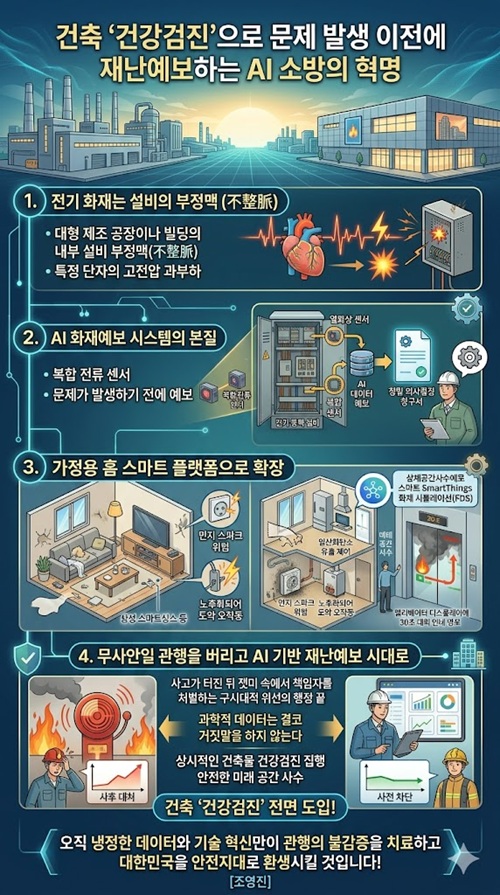
1. Electrical Fires are the Price of Neglecting Equipment Arrhythmias
The interior of large manufacturing plants or commercial buildings is like a giant organism. The flow of high-voltage lines from the power company, through transformers to low-voltage cabinets, and then distributed to power equipment like freezers or large rotating machinery, precisely matches the flow of blood through a human heart and blood vessels.
During recent pilot tests of an AI fire early warning system at the sites of leading domestic manufacturing and food plants, we witnessed a shocking reality.
Even advanced factories belonging to large corporations, equipped with established, well-known global monitoring systems, were completely unaware that ‘negative power factor’ due to abnormal frequency fluctuations or ‘overload at specific terminals’ were constantly occurring within their critical electrical cabinets.
The phenomenon where current and frequency are not equally delivered to the three-phase power supply, creating a dissonance, is analogous to an ‘arrhythmia’ in humans, where the heart beats irregularly. What happens if this critical condition, which would cause immediate and complete defects in a semiconductor factory, is neglected?
Machines may malfunction for unknown reasons, paralyzing production lines, or the temperature at connection points may rise sharply (extreme danger if the difference between the three phases exceeds 10°C), leading to a major fire where a line breaks and explodes at any moment. The underlying issues in electrical, communication, and fire safety equipment, which we have overlooked, are inducing heart attacks in buildings.
2. The Essence of an AI Fire Early Warning System is Prediction Before Problems Occur
When we commonly hear the term ‘fire prediction,’ we imagine an urgent system that triggers a warning at the last moment when smoke or flames appear. However, the true power of prediction by an intelligent disaster prevention AI lies in ‘diagnosing and prescribing solutions through long-term data accumulation’.
AI embeds thermal imaging sensors and composite current sensors within cabinets, autonomously learning in real-time the temperature patterns of terminals, and the minute imbalances in voltage and current, which are invisible to the human eye. Then, before a fire situation arises that would require firefighters to be dispatched, it delivers a precise decision-request document to management and building owners stating, "The component in this part is currently overloaded and is on the verge of failure; it must be replaced immediately."
By proactively detecting signs of failure and replacing components in advance, we achieve overwhelming safety by fundamentally preventing the causes of fire, and gain financial benefits through cost reduction by efficiently managing equipment. This prevents assets from becoming 'worthless' due to momentary carelessness.
This entire process, from diagnosis to prescription for large buildings, power plants, and military security facilities, is not merely about installing sensors but is an innovative asset safety management model that maintains the value of buildings through an early warning system.
3. Expansion from Industrial Plants to Home Smart Platforms
This innovative AI-based ‘building diagnosis and early warning’ technology has no reason to be confined to specialized buildings and plant equipment. It is evolving into an area that prevents unseen fires in the apartments and various residential spaces where we live.
Currently, fire inspections in apartments are merely a formality, with residents manually filling out checklists to confirm the operation of wired detectors. The dangers lurking behind TV cabinets with dust-laden outlets posing a risk of sparks, or boiler control systems that malfunction due to aging, are not known to anyone in advance before a problem occurs.
The ‘home AI safety service,’ currently being pursued through integration with major smart home platforms (e.g., Samsung SmartThings), will bring a paradigm shift in residential culture. It will usher in an era of smart homes where users of smart home platforms are shown their daily electricity usage trends in an engaging way, with fused safety information including the underlying risks of outlet overheating or carbon monoxide (CO) leaks, provided at around 10,000 won per month.
The ‘home AI safety service’ can predict the spread path of smoke and gas through fire simulation (FDS) and educate residents with precise evacuation instructions before colorless, odorless, and deadly carbon monoxide rises. If a 30-second evacuation route video is continuously broadcast on elevator displays, it can dramatically reduce deaths by suffocation even in a panic-inducing fire situation.
4. Moving Beyond Complacency to an Era of AI-Based Disaster Forecasting
Scientific data never lies. We must end the outdated and hypocritical administration that punishes those responsible and strengthens regulations in the ashes after an accident has occurred.
Only when building managers open their eyes to immediate safety data and conduct continuous building health check-ups through AI can industrial factories and residential spaces across South Korea be transformed into safe zones.
We must fully adopt technological innovation that predicts fires in advance and treats building problems. This is the only solution to address the complacency within the public sector, which is mired in routine practices, and to secure the future spaces where our children will live.

◆ Youngjin Cho
CEO of Rose AI

 Iranian Foreign Ministry: "Continuing Message Exchanges with the U.S. and Activities of Mediating Countries"
Esmaeil Baghaei, Spokesperson for the Iranian Ministry of Foreign Affairs [Xinhua, Yonhap News file photo]Esmaeil Baghaei, spokesperson for the Iranian Ministry of Foreign Affairs, stated on the 26th
Iranian Foreign Ministry: "Continuing Message Exchanges with the U.S. and Activities of Mediating Countries"
Esmaeil Baghaei, Spokesperson for the Iranian Ministry of Foreign Affairs [Xinhua, Yonhap News file photo]Esmaeil Baghaei, spokesperson for the Iranian Ministry of Foreign Affairs, stated on the 26th
 President Yoon: "Do You Think You Are Safe from the Special Counsel?"... Final Statement Video Released
President Yoon Suk Yeol rebuking the special prosecutor on the 24th. [Court video / @birds_justice X account subtitle GIF] A video of President Yoon Suk Yeol's closing statement at his trial rega
President Yoon: "Do You Think You Are Safe from the Special Counsel?"... Final Statement Video Released
President Yoon Suk Yeol rebuking the special prosecutor on the 24th. [Court video / @birds_justice X account subtitle GIF] A video of President Yoon Suk Yeol's closing statement at his trial rega
 President Yoon, regarding the first-instance ruling on the Public Official Election Act: “An excessive political verdict that distorts the facts… We will appeal immediately.”
The first-instance sentencing hearing for President Yoon Suk Yeol regarding violations of the Public Official Election Act is being broadcast live at Seoul Station on the 27th. [Photo=Yonhap News]Pres
President Yoon, regarding the first-instance ruling on the Public Official Election Act: “An excessive political verdict that distorts the facts… We will appeal immediately.”
The first-instance sentencing hearing for President Yoon Suk Yeol regarding violations of the Public Official Election Act is being broadcast live at Seoul Station on the 27th. [Photo=Yonhap News]Pres
 WSJ: "SK Hynix ADR Premium Is a Sign of AI Trading Overheat"
Advertisement for SK Hynix ADR listing in New York's Times Square [Reuters=Yonhap News file photo]The Wall Street Journal (WSJ) has pointed out that the price of SK Hynix’s American Depositary Recei
WSJ: "SK Hynix ADR Premium Is a Sign of AI Trading Overheat"
Advertisement for SK Hynix ADR listing in New York's Times Square [Reuters=Yonhap News file photo]The Wall Street Journal (WSJ) has pointed out that the price of SK Hynix’s American Depositary Recei
 'Godfather of Japanese Mystery Novels' Keigo Higashino Passes Away After Battle with Cancer at 68
Famous Japanese mystery novelist Keigo Higashino [AFP=Yonhap News]It has been belatedly reported that Keigo Higashino, the "godfather of Japanese mystery novels" and author of bestsellers such as "The
'Godfather of Japanese Mystery Novels' Keigo Higashino Passes Away After Battle with Cancer at 68
Famous Japanese mystery novelist Keigo Higashino [AFP=Yonhap News]It has been belatedly reported that Keigo Higashino, the "godfather of Japanese mystery novels" and author of bestsellers such as "The
 [Park Pil-kyu Security Column] To the Ignorant Trying to Clothe a Beast in Sheep's Clothing
Rep. Kim Byung-joo of the Democratic Party of Korea [Photo=Yonhap News]“The Air Force Academy doesn't teach you how to fly a plane!” “The Army, Navy, and Air Force academies are exactly the
[Park Pil-kyu Security Column] To the Ignorant Trying to Clothe a Beast in Sheep's Clothing
Rep. Kim Byung-joo of the Democratic Party of Korea [Photo=Yonhap News]“The Air Force Academy doesn't teach you how to fly a plane!” “The Army, Navy, and Air Force academies are exactly the
 [Issue Diagnosis] Two Effects of the Election Petition Review
 [Photo] Evidence of Election Fraud Flooding U.S. Media… Trump Had 2.7 Million Votes Stolen
 [Video] U.S. Semiquincentennial Air Show... 'Art in the Sky' streaks across New York
 [Editorial Cartoon] A Draconian Law That Undermines Freedom of Expression

 List
List










