 The scene of an explosion accident at the Hanwha Aerospace Daejeon plant in Oesung-dong, Yuseong-gu, Daejeon, on the morning of the 1st. Smoke is rising from the factory. [Photo = Yonhap News]
On June 1, 2026, a major fire accompanied by an explosion occurred at the Hanwha Aerospace plant in Yuseong-gu, Daejeon, resulting in a tragedy that claimed five lives and injured two.
The precision processing room, a critical security facility that produces propulsion systems for missiles and rockets, was engulfed in flames in an instant. This is the third fatal explosion accident at this plant, following incidents in 2018 and 2019. The cradle of the defense industry, supposedly at the forefront of technology, is repeatedly becoming a "death trap" for on-site workers.
Explosion accidents and special fires at defense facilities are on a different level than fires in ordinary buildings. This is because the very materials involved contain their own oxygen, exhibiting "self-combustion" properties that water cannot extinguish, and due to the high security barrier, external safety inspections are not effectively implemented.
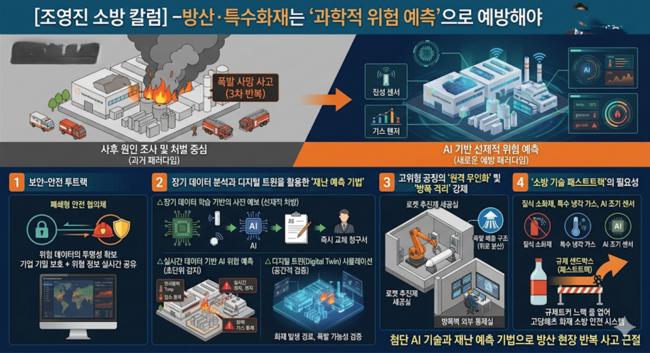
To break this cruel cycle where citizens' lives are put at risk in places that produce weapons for national security, we must completely shift the accident prevention paradigm from post-incident investigation and punishment to "AI-based proactive risk prediction."
1. Ensuring Transparency of Risk Data through a 'Security-Safety Two-Track' Approach
Historically, defense facilities, due to their status as critical national security installations, have had extremely limited access to internal processes and material information, resulting in fire department inspections being merely superficial. Security has effectively created an extraterritorial zone for safety.
To address this, a "Security-Safety Two-Track Information Sharing System" must be introduced. While strictly protecting corporate secrets, a "closed safety consultative body" should be institutionalized to share in real-time with fire authorities the types and quantities of hazardous materials handled and the risk levels of each process. Only when data is shared can accurate risk prediction and tailored entry strategies for accident response be developed.
2. 'Disaster Prediction Techniques' Utilizing Long-Term Data Analysis and Digital Twins
Considering the unique nature of defense and chemical materials, initial firefighting after ignition is virtually impossible. Therefore, the mandatory implementation of "scientific prediction techniques" to prevent accidents at their source is urgently needed.
∆Pre-emptive Forecasts Based on Long-Term Data Learning (Proactive Prescription)
While we often imagine fire and disaster prediction systems that issue warnings at the last moment, the true power of intelligent AI forecasting lies in "diagnosis and prescription through long-term data accumulation" when there are signs of an impending explosion, before any sparks fly. By embedding composite current and thermal imaging sensors within power control cabinets and workplaces, AI can autonomously learn about invisible temperature changes at terminals and minute power imbalances.
This enables the delivery of "immediate replacement requests" for parts nearing failure to management before a fire occurs, thus preventing the root causes of fires and explosions. It is an innovative asset safety management model that prevents corporate assets from becoming "zero" due to momentary lapses in vigilance.
∆Real-Time Data-Based AI Risk Prediction (Second-by-Second Detection)
Sensors collecting data on temperature, pressure, micro-gas leak concentrations, and vibration must be densely deployed within high-risk workplaces, and AI must analyze this data in real-time. A system that detects and warns of explosion signs imperceptible to human senses on a second-by-second basis must be in constant operation.
∆Digital Twin Simulation (Spatial Verification)
Large-scale plants with fire and explosion risks must be mandated to adopt digital twin technology, which replicates the actual plant environment in a virtual space. By continuously simulating fire progression paths and the potential for explosions of special materials in a virtual environment, hidden vulnerabilities at the site can be proactively identified and addressed.
3. Mandating 'Remote Unmanned Operations' and 'Explosion-Proof Isolation' for High-Risk Processes
Processes involving extremely hazardous materials, such as the cleaning and processing of rocket propellants that caused this tragedy, must completely separate humans from danger. Human involvement must be fundamentally prohibited, and these operations must be fully replaced by AI robots and remote-controlled automated systems.
Legal standards should be enforced to ensure that workers only perform monitoring from control rooms outside thick explosion-proof walls. The interior of the work areas must be mandated to have an isolated ecosystem with an "explosion relief structure" that disperses explosive pressure upwards in the event of an accident.
4. The Need for a 'Firefighting Technology Fast Track'
To respond to fires involving new chemical and defense materials that cannot be extinguished with water, a regulatory sandbox (fast track) must be implemented to rapidly introduce innovative disaster prevention technologies, such as smothering agents, special cooling gases, and AI early warning sensors, to the field. The bottleneck of verified advanced equipment being unable to enter defense sites due to conservative fire inspection and certification systems must be decisively broken.
Post-incident pronouncements of "thorough investigation" can no longer be an alternative. The only way to prevent recurring malicious accidents in industrial settings is to proactively control incidents by combining advanced AI technology and disaster prediction techniques with firefighting safety systems.

◆ Cho Young-jin
CEO, Rose AI

 Iranian Foreign Ministry: "Continuing Message Exchanges with the U.S. and Activities of Mediating Countries"
Esmaeil Baghaei, Spokesperson for the Iranian Ministry of Foreign Affairs [Xinhua, Yonhap News file photo]Esmaeil Baghaei, spokesperson for the Iranian Ministry of Foreign Affairs, stated on the 26th
Iranian Foreign Ministry: "Continuing Message Exchanges with the U.S. and Activities of Mediating Countries"
Esmaeil Baghaei, Spokesperson for the Iranian Ministry of Foreign Affairs [Xinhua, Yonhap News file photo]Esmaeil Baghaei, spokesperson for the Iranian Ministry of Foreign Affairs, stated on the 26th
 President Yoon: "Do You Think You Are Safe from the Special Counsel?"... Final Statement Video Released
President Yoon Suk Yeol rebuking the special prosecutor on the 24th. [Court video / @birds_justice X account subtitle GIF] A video of President Yoon Suk Yeol's closing statement at his trial rega
President Yoon: "Do You Think You Are Safe from the Special Counsel?"... Final Statement Video Released
President Yoon Suk Yeol rebuking the special prosecutor on the 24th. [Court video / @birds_justice X account subtitle GIF] A video of President Yoon Suk Yeol's closing statement at his trial rega
 President Yoon, regarding the first-instance ruling on the Public Official Election Act: “An excessive political verdict that distorts the facts… We will appeal immediately.”
The first-instance sentencing hearing for President Yoon Suk Yeol regarding violations of the Public Official Election Act is being broadcast live at Seoul Station on the 27th. [Photo=Yonhap News]Pres
President Yoon, regarding the first-instance ruling on the Public Official Election Act: “An excessive political verdict that distorts the facts… We will appeal immediately.”
The first-instance sentencing hearing for President Yoon Suk Yeol regarding violations of the Public Official Election Act is being broadcast live at Seoul Station on the 27th. [Photo=Yonhap News]Pres
 WSJ: "SK Hynix ADR Premium Is a Sign of AI Trading Overheat"
Advertisement for SK Hynix ADR listing in New York's Times Square [Reuters=Yonhap News file photo]The Wall Street Journal (WSJ) has pointed out that the price of SK Hynix’s American Depositary Recei
WSJ: "SK Hynix ADR Premium Is a Sign of AI Trading Overheat"
Advertisement for SK Hynix ADR listing in New York's Times Square [Reuters=Yonhap News file photo]The Wall Street Journal (WSJ) has pointed out that the price of SK Hynix’s American Depositary Recei
 'Godfather of Japanese Mystery Novels' Keigo Higashino Passes Away After Battle with Cancer at 68
Famous Japanese mystery novelist Keigo Higashino [AFP=Yonhap News]It has been belatedly reported that Keigo Higashino, the "godfather of Japanese mystery novels" and author of bestsellers such as "The
'Godfather of Japanese Mystery Novels' Keigo Higashino Passes Away After Battle with Cancer at 68
Famous Japanese mystery novelist Keigo Higashino [AFP=Yonhap News]It has been belatedly reported that Keigo Higashino, the "godfather of Japanese mystery novels" and author of bestsellers such as "The
 [Park Pil-kyu Security Column] To the Ignorant Trying to Clothe a Beast in Sheep's Clothing
Rep. Kim Byung-joo of the Democratic Party of Korea [Photo=Yonhap News]“The Air Force Academy doesn't teach you how to fly a plane!” “The Army, Navy, and Air Force academies are exactly the
[Park Pil-kyu Security Column] To the Ignorant Trying to Clothe a Beast in Sheep's Clothing
Rep. Kim Byung-joo of the Democratic Party of Korea [Photo=Yonhap News]“The Air Force Academy doesn't teach you how to fly a plane!” “The Army, Navy, and Air Force academies are exactly the
 [Issue Diagnosis] Two Effects of the Election Petition Review
 [Photo] Evidence of Election Fraud Flooding U.S. Media… Trump Had 2.7 Million Votes Stolen
 [Video] U.S. Semiquincentennial Air Show... 'Art in the Sky' streaks across New York
 [Editorial Cartoon] A Draconian Law That Undermines Freedom of Expression

 List
List










