 Ho Chi Minh (left), born in 1890, and Yo Un-hyung, born in 1886.
Ho Chi Minh. Real name: Nguyen Sinh Cung. Born on May 19, 1890, in Nghe An, French Indochina, he passed away on September 2, 1969, in Hanoi. Today, he is remembered as a symbol of Vietnamese independence.
Yo Un-hyung. Born on May 25, 1886, in Yangpyeong, Gyeonggi Province. Assassinated on July 19, 1947, at the Hyewa-dong Rotary in Seoul. He is widely known for promoting a coalition movement between the left and right immediately after liberation.
Ho Chi Minh: A Communist Revolutionary, Yo Un-hyung: A Naive Nationalist
Today, Korean society often remembers these two men as "national leaders," "independence activists," and "anti-imperialist figures." However, historical research should not remain solely within the realm of sentimentality or moral image. What is crucial is not only what they resisted but also what they sought to build. It is at this point that Ho Chi Minh and Yo Un-hyung must be re-examined.
Shanghai, in particular, is a key space. Many Koreans remember Shanghai romantically, understanding it only as the city where the Provisional Government existed and exiled independence activists operated. However, Shanghai in the 1920s and 1930s was a far more complex and dangerous political space.
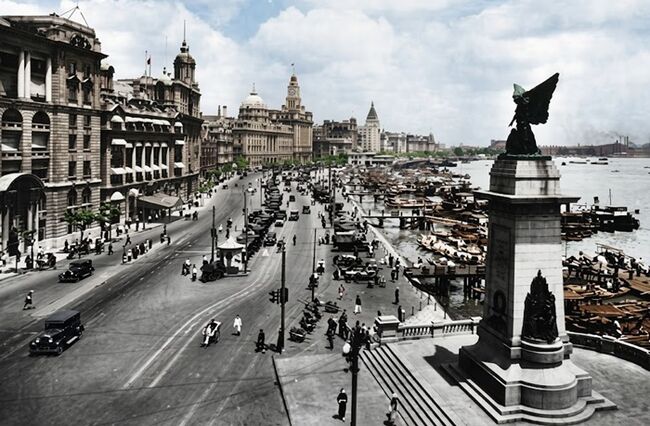 Shanghai in the 1920s. In the late 19th and early 20th centuries, Shanghai, China, saw the establishment of the International Settlement, a jointly governed area by foreign powers.
It was not only simple nationalists who were present there. Comintern organizations, Chinese communist forces, international revolutionaries, and Soviet revolutionary networks were all active. Following the Russian Revolution, the Comintern sought to leverage colonial national movements as part of a global revolution, and Shanghai was one of its connecting hubs.
In other words, Shanghai was not merely a place of exile but a port of revolution. Ho Chi Minh was a figure who grew within that international revolutionary network. He joined the French Communist Party in 1920 and subsequently moved between Moscow and Guangzhou, operating as a Comintern activist. Relevant research and international materials show that he was strongly influenced by Leninist revolutionary strategy.
He was not simply an "Vietnamese independence activist." He was a communist revolutionary. For Ho Chi Minh, independence was both the ultimate goal and a pathway to establishing revolutionary power. While he rejected French colonial rule, he did not aim to establish a liberal democratic system thereafter. The state he built was a one-party communist system.
Arriving in Guangzhou at the end of 1924, Ho Chi Minh worked with Comintern organizations and founded the Vietnamese Revolutionary Youth League in 1925. This would later become the core foundation of the Indochinese communist movement.
During this very period, Korean independence movements were also operating within the Shanghai and Guangzhou axis. Yo Un-hyung was also present in that space. Materials from the Mongyang Memorial Hall and various studies explain that Yo Un-hyung had interactions not only with Chinese revolutionary figures but also with Ho Chi Minh.
Yo Un-hyung: Standing Between Liberal Democracy and Communism
Today, some narratives romanticize this as "international solidarity among Asian revolutionaries." However, the actual political reality was far more perilous. At that time, Shanghai was not solely a space for anti-Japanese nationalism. International communism, radical revolutionary movements, and anti-imperialist networks were intertwined. The phrase "national liberation" often concealed the objective of building revolutionary power.
The problem is that Yo Un-hyung was too closely associated with such spaces. Of course, Yo Un-hyung was not an overt communist like Park Heon-yeong. However, he ultimately failed to clearly sever ties with the inherent dangers of leftist revolutionary forces immediately before and after liberation.
Today, Korean society often remembers Yo Un-hyung as a "reasonable moderate" or a "politician of unity." However, the coalition between the left and right at that time was entirely different from the concept of moderate cooperation within a democratic system today.
The left at that time was a radical political force linked to the Soviet revolutionary line. Liberal democracy and revolutionary communism were not mere differences of opinion. They were a clash over the very system of the state.
In such a situation, Yo Un-hyung believed that he could unite the left and right under the banner of the nation. However, reality did not unfold that way.
He organized the Committee for the Preparation of Korean Independence, which subsequently became linked to the declaration of the Provisional People's Republic of Korea. However, the Provisional People's Republic of Korea was not a liberal democratic government established through free elections and constitutional procedures. It had a much stronger character as a revolutionary political organization.
Today, Korean society has granted excessive absolution in the face of the term "anti-Japanese." Many are remembered as democrats simply for resisting Japanese rule. However, anti-Japanese sentiment and liberalism are not synonymous. Independence movements and democracy do not automatically go hand in hand.
The history of the 20th century has already proven this. The Russian Revolution promised freedom but led to one-party dictatorship. The Chinese Revolution also prioritized revolutionary power over individual freedom. Vietnam was no different. Ho Chi Minh overthrew colonial rule, but what he established thereafter was not a liberal democratic state but a communist party-centered system.
However, Korean society has long failed to adequately criticize these issues under the name of "nation." The romanticization of the Shanghai revolutionary network is particularly dangerous. Shanghai at that time was not simply a space for independence movements. It was a space where radical politics spread, with international revolutionary forces and nationalist forces intermingling. Korean, Chinese, and Vietnamese activists influenced each other within it. Ho Chi Minh was a prime example of success within that current. Yo Un-hyung was a figure who did not sufficiently guard against the dangers of that space.
Ultimately, history should not be read through emotions. Simply looking at who opposed Japan is only half the story. We must also consider what kind of state they sought to build. We must dispassionately assess whether they dreamed of a state centered on freedom or aimed for a system that prioritized revolutionary power.
By that standard, Ho Chi Minh can no longer be merely a national hero. He was an international communist revolutionary. The same applies to Yo Un-hyung. In the chaos of liberation, he spoke of national unity but failed to draw a clear line between liberal democracy and revolutionary communism. That political ambiguity carried the inherent risk of opening the door to revolutionary forces.
What is needed today is not romantic nostalgia. It is a dispassionate reading of political history. We must move beyond the naive historical perspective that "anything anti-Japanese is good." Only then can we truly see the reality of 20th-century East Asian revolutions and the political essence of the figures who operated within them.
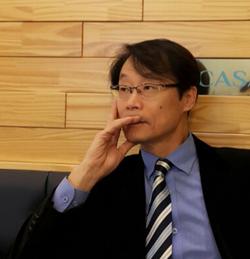
◆ Songsan (송산)
Poet and researcher of history and philosophy. Former director of the Syngman Rhee Academy. Currently serves as a senior researcher at the Korean Modern and Contemporary History Research Association and as the representative of the philosophy forum Lykeion. He has published four poetry collections, co-translated "Heroes of Khukhoji," and authored the humanities books "Joseon, Which Became Myth," "Humanities on Tatami," and "A Liberal's Reading of Gramsci." Songsan is a pen name.

 Iranian Foreign Ministry: "Continuing Message Exchanges with the U.S. and Activities of Mediating Countries"
Esmaeil Baghaei, Spokesperson for the Iranian Ministry of Foreign Affairs [Xinhua, Yonhap News file photo]Esmaeil Baghaei, spokesperson for the Iranian Ministry of Foreign Affairs, stated on the 26th
Iranian Foreign Ministry: "Continuing Message Exchanges with the U.S. and Activities of Mediating Countries"
Esmaeil Baghaei, Spokesperson for the Iranian Ministry of Foreign Affairs [Xinhua, Yonhap News file photo]Esmaeil Baghaei, spokesperson for the Iranian Ministry of Foreign Affairs, stated on the 26th
 President Yoon: "Do You Think You Are Safe from the Special Counsel?"... Final Statement Video Released
President Yoon Suk Yeol rebuking the special prosecutor on the 24th. [Court video / @birds_justice X account subtitle GIF] A video of President Yoon Suk Yeol's closing statement at his trial rega
President Yoon: "Do You Think You Are Safe from the Special Counsel?"... Final Statement Video Released
President Yoon Suk Yeol rebuking the special prosecutor on the 24th. [Court video / @birds_justice X account subtitle GIF] A video of President Yoon Suk Yeol's closing statement at his trial rega
 President Yoon, regarding the first-instance ruling on the Public Official Election Act: “An excessive political verdict that distorts the facts… We will appeal immediately.”
The first-instance sentencing hearing for President Yoon Suk Yeol regarding violations of the Public Official Election Act is being broadcast live at Seoul Station on the 27th. [Photo=Yonhap News]Pres
President Yoon, regarding the first-instance ruling on the Public Official Election Act: “An excessive political verdict that distorts the facts… We will appeal immediately.”
The first-instance sentencing hearing for President Yoon Suk Yeol regarding violations of the Public Official Election Act is being broadcast live at Seoul Station on the 27th. [Photo=Yonhap News]Pres
 WSJ: "SK Hynix ADR Premium Is a Sign of AI Trading Overheat"
Advertisement for SK Hynix ADR listing in New York's Times Square [Reuters=Yonhap News file photo]The Wall Street Journal (WSJ) has pointed out that the price of SK Hynix’s American Depositary Recei
WSJ: "SK Hynix ADR Premium Is a Sign of AI Trading Overheat"
Advertisement for SK Hynix ADR listing in New York's Times Square [Reuters=Yonhap News file photo]The Wall Street Journal (WSJ) has pointed out that the price of SK Hynix’s American Depositary Recei
 'Godfather of Japanese Mystery Novels' Keigo Higashino Passes Away After Battle with Cancer at 68
Famous Japanese mystery novelist Keigo Higashino [AFP=Yonhap News]It has been belatedly reported that Keigo Higashino, the "godfather of Japanese mystery novels" and author of bestsellers such as "The
'Godfather of Japanese Mystery Novels' Keigo Higashino Passes Away After Battle with Cancer at 68
Famous Japanese mystery novelist Keigo Higashino [AFP=Yonhap News]It has been belatedly reported that Keigo Higashino, the "godfather of Japanese mystery novels" and author of bestsellers such as "The
 [Park Pil-kyu Security Column] To the Ignorant Trying to Clothe a Beast in Sheep's Clothing
Rep. Kim Byung-joo of the Democratic Party of Korea [Photo=Yonhap News]“The Air Force Academy doesn't teach you how to fly a plane!” “The Army, Navy, and Air Force academies are exactly the
[Park Pil-kyu Security Column] To the Ignorant Trying to Clothe a Beast in Sheep's Clothing
Rep. Kim Byung-joo of the Democratic Party of Korea [Photo=Yonhap News]“The Air Force Academy doesn't teach you how to fly a plane!” “The Army, Navy, and Air Force academies are exactly the
 [Issue Diagnosis] Two Effects of the Election Petition Review
 [Photo] Evidence of Election Fraud Flooding U.S. Media… Trump Had 2.7 Million Votes Stolen
 [Video] U.S. Semiquincentennial Air Show... 'Art in the Sky' streaks across New York
 [Editorial Cartoon] A Draconian Law That Undermines Freedom of Expression

 List
List









