The South Korean flag and the U.S. flag. The South Korean and U.S. flags flying at the Korean War Veterans Memorial in Imjingak, Paju, Gyeonggi Province. Yonhap News
It has been reported by U.S. media that the U.S. administration considered demanding that South Korea increase its defense spending to 3.8% of its gross domestic product (GDP) during the U.S.-Korea trade negotiations concluded late last month.
Furthermore, it was reported that a request for the South Korean government to publicly express its support for the "strategic flexibility" of U.S. Forces Korea (USFK)—which implies broadening the role and operational scope of U.S. troops in Korea to counter China—was also among the issues the U.S. had considered proposing.
The Washington Post (WP) reported this on the 9th (local time), citing internal U.S. government documents it had obtained. The article highlighted instances in which the Trump administration attempted to leverage tariffs to extract diplomatic, security, and political concessions from other nations.
According to the "initial draft of the U.S.-Korea agreement" reported by the WP, the U.S. wanted South Korea to increase its defense spending—which was 2.6% of its GDP as of last year—to 3.8%, and to increase its share of defense cost-sharing (the amount South Korea pays for the stationing of USFK troops).
The draft also included a requirement that South Korea "issue a political statement supporting the flexibility of the U.S. military posture in Korea (also known as strategic flexibility) to better deter China while continuing to deter North Korea."
These points were raised by various U.S. government departments as items to demand from South Korea ahead of the U.S.-Korea trade negotiations.
It has not been immediately confirmed whether the U.S. actually made these demands during the course of the tariff negotiations. Security issues were not included in the announcements made by both countries regarding the trade agreement late last month, and the South Korean government previously stated that issues such as defense cost-sharing were not discussed during the process of reaching the trade deal.
However, if the contents of this report are true, the position of the Trump administration has been made somewhat clear, regardless of whether these demands were already formally presented to South Korea.
In other words, one can infer that it is the position of the U.S. government to seek a near 50% increase in South Korea's defense spending and to obtain the South Korean government's public consent to the "strategic flexibility" of U.S. Forces Korea.
Consequently, there is speculation that U.S. demands regarding an increase in South Korea's defense spending and support for strategic flexibility may be concretized during the upcoming U.S.-Korea summit, which could be held in Washington D.C. as early as this month.
Yonhap News
What do you think of this article?

 Trump pressures for rate cut again ahead of FOMC... "Should be the lowest in the world"
U.S. President Donald Trump. [Photo = The White House] U.S. President Donald Trump once again pressured the Federal Reserve, the U.S. central bank, to lower interest rates on the 27th (local time
Trump pressures for rate cut again ahead of FOMC... "Should be the lowest in the world"
U.S. President Donald Trump. [Photo = The White House] U.S. President Donald Trump once again pressured the Federal Reserve, the U.S. central bank, to lower interest rates on the 27th (local time
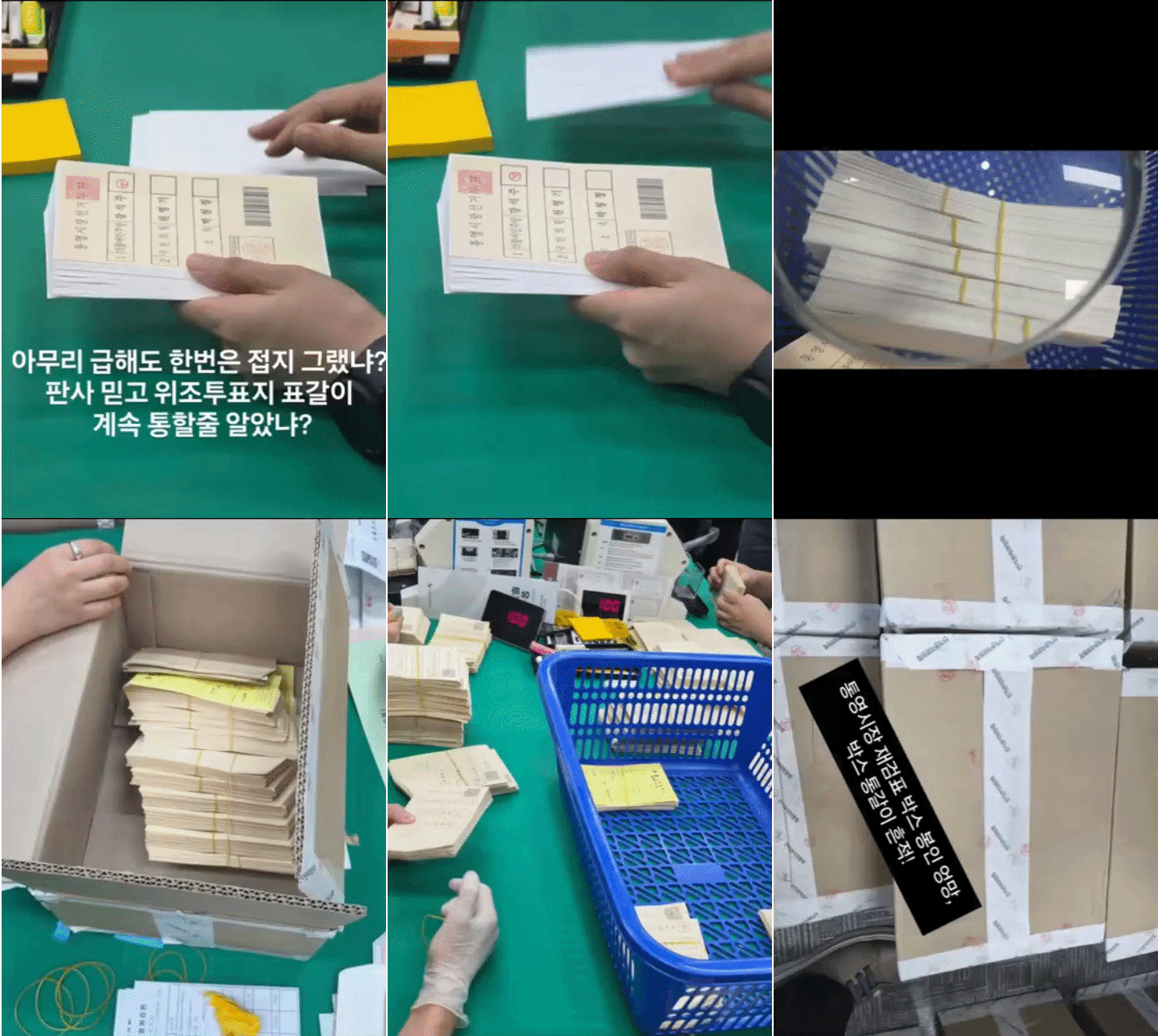 “Ignoring crisp ballots and damaged seals”… Tongyeong mayoral recount concludes with ‘no change in outcome,’ leaving suspicions and public outrage behind
Suspected counterfeit ballots discovered in Tongyeong [GIF from social media of Representative Hwang Kyo-ahn / Attorney Park Joo-hyun]During a recount of the Tongyeong mayoral election in South Gyeong
“Ignoring crisp ballots and damaged seals”… Tongyeong mayoral recount concludes with ‘no change in outcome,’ leaving suspicions and public outrage behind
Suspected counterfeit ballots discovered in Tongyeong [GIF from social media of Representative Hwang Kyo-ahn / Attorney Park Joo-hyun]During a recount of the Tongyeong mayoral election in South Gyeong
 President Yoon, regarding the first-instance ruling on the Public Official Election Act: “An excessive political verdict that distorts the facts… We will appeal immediately.”
The first-instance sentencing hearing for President Yoon Suk Yeol regarding violations of the Public Official Election Act is being broadcast live at Seoul Station on the 27th. [Photo=Yonhap News]Pres
President Yoon, regarding the first-instance ruling on the Public Official Election Act: “An excessive political verdict that distorts the facts… We will appeal immediately.”
The first-instance sentencing hearing for President Yoon Suk Yeol regarding violations of the Public Official Election Act is being broadcast live at Seoul Station on the 27th. [Photo=Yonhap News]Pres
 WSJ: "SK Hynix ADR Premium Is a Sign of AI Trading Overheat"
Advertisement for SK Hynix ADR listing in New York's Times Square [Reuters=Yonhap News file photo]The Wall Street Journal (WSJ) has pointed out that the price of SK Hynix’s American Depositary Recei
WSJ: "SK Hynix ADR Premium Is a Sign of AI Trading Overheat"
Advertisement for SK Hynix ADR listing in New York's Times Square [Reuters=Yonhap News file photo]The Wall Street Journal (WSJ) has pointed out that the price of SK Hynix’s American Depositary Recei
 'Godfather of Japanese Mystery Novels' Keigo Higashino Passes Away After Battle with Cancer at 68
Famous Japanese mystery novelist Keigo Higashino [AFP=Yonhap News]It has been belatedly reported that Keigo Higashino, the "godfather of Japanese mystery novels" and author of bestsellers such as "The
'Godfather of Japanese Mystery Novels' Keigo Higashino Passes Away After Battle with Cancer at 68
Famous Japanese mystery novelist Keigo Higashino [AFP=Yonhap News]It has been belatedly reported that Keigo Higashino, the "godfather of Japanese mystery novels" and author of bestsellers such as "The
 [Park Pil-kyu Security Column] To the Ignorant Trying to Clothe a Beast in Sheep's Clothing
Rep. Kim Byung-joo of the Democratic Party of Korea [Photo=Yonhap News]“The Air Force Academy doesn't teach you how to fly a plane!” “The Army, Navy, and Air Force academies are exactly the
[Park Pil-kyu Security Column] To the Ignorant Trying to Clothe a Beast in Sheep's Clothing
Rep. Kim Byung-joo of the Democratic Party of Korea [Photo=Yonhap News]“The Air Force Academy doesn't teach you how to fly a plane!” “The Army, Navy, and Air Force academies are exactly the
 [Issue Diagnosis] Two Effects of the Election Petition Review
 [Photo] Evidence of Election Fraud Flooding U.S. Media… Trump Had 2.7 Million Votes Stolen
 [Video] U.S. Semiquincentennial Air Show... 'Art in the Sky' streaks across New York
 [Editorial Cartoon] A Draconian Law That Undermines Freedom of Expression

 List
List