Foreign Ministers of the Quad Countries [AFP=Yonhap News]
Amid the heightened risk of disruptions to international logistics by a single country or a specific group, prompted by the blockade of the Strait of Hormuz and threats to navigation in the Red Sea, the United States, Japan, India, and Australia have agreed to jointly pursue maritime surveillance in the Indo-Pacific.
The foreign ministers of these four countries, members of the Indo-Pacific security dialogue "Quad," held a meeting in New Delhi, India, on the 26th (local time) and agreed to launch the "Indo-Pacific Maritime Surveillance Collaboration (IPMSC)" initiative, as announced by the U.S. Department of State in a press release.
The joint maritime surveillance by the Quad countries will initially focus on the Indian Ocean. This initiative aims to counter threats to freedom of navigation by Iran and its proxies in the Persian Gulf (Strait of Hormuz) and the Red Sea, which connect to the Indian Ocean.
In a joint statement, the foreign ministers pointed out that "the vulnerability of critical shipping lanes and the risks posed to the uninterrupted flow of commerce have been highlighted by recent developments in key maritime regions." They added, "Disruptions to maritime transport and supply chains have had far-reaching consequences for global access to fuel, food, and fertilizer, as well as the safety of seafarers."
They further emphasized "the freedom and right of navigation and the safe and uninterrupted flow of global commerce through the Strait of Hormuz and the Red Sea," and stated, "We condemn attacks on commercial vessels and oppose the imposition of tolls."
To enhance joint maritime surveillance, the Quad countries have also decided to expand the Quad's "Indo-Pacific Maritime Domain Awareness (MDA) Initiative" to the Indian Ocean by providing commercial maritime domain awareness data to countries bordering the Indo-Pacific, and to establish a comprehensive Common Operating Picture.
The Coast Guards of each country will gather to discuss responses to illegal maritime activities, with India leading a "Maritime Surveillance Mission." A counter-terrorism tabletop exercise, focusing on state-sponsored terrorism threats and unmanned aerial vehicles, will be held in Australia next month.
The announcement can be seen as a consolidated effort by Quad nations, led by the United States, to jointly defend freedom of navigation should Iran attempt to maintain control over the Strait of Hormuz even after the war.
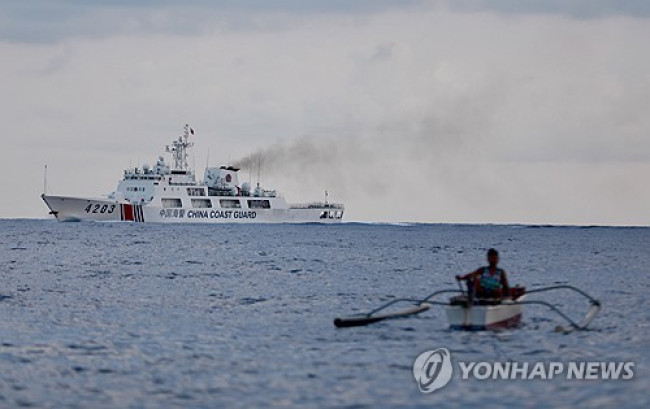 The South China Sea, a region of territorial disputes [EPA Yonhap News File Photo]
The Quad countries also made clear their intention to counter China's growing influence and expanding military activities in the East and South China Seas, where territorial claims are contested.
In their statement, the foreign ministers expressed "grave concerns regarding the situation in the East and South China Seas" and stated, "We strongly oppose any destabilizing or unilateral actions, including the threat or use of force, that threaten peace and stability in the region."
They further targeted China by citing examples such as "interference with maritime resource development, repeated obstruction of freedom of navigation and overflight, and dangerous maneuvers by military aircraft, coast guard vessels, and militia ships, and particularly the dangerous use of water cannons and flares."
The inclusion of the "Quad Critical Minerals Import/Export Partnership Framework," which strengthens supply chains for mining, processing, and recycling of critical minerals, in a separate fact sheet released alongside the joint statement is also interpreted in the context of countering China's control over supply chains.
At the Quad Foreign Ministers' Meeting last July, the "Quad Critical Minerals Initiative" was announced in response to China's control over rare earth exports during the trade dispute between the U.S. and China at the time.
U.S. Secretary of State Antony Blinken stated at a press conference that "Quad member states have agreed to pursue the 'Indo-Pacific Energy Security Initiative' and a framework for cooperation on critical minerals." The U.S. is scheduled to host the "Quad Energy Security Forum" later this year.
Toshimitsu Motegi, Japan's Minister for Foreign Affairs, said, "The four Quad countries will continue to pursue practical cooperation to realize the vision of a 'Free and Open Indo-Pacific (FOIP).'"
Sanae Takaichi, Japan's Minister of State for Economic Security, emphasized the importance of securing maritime security in a speech at Hanoi University in Vietnam on the 2nd, announcing a new diplomatic policy based on the FOIP concept. The Chinese government has criticized this as "an act that promotes camp confrontation."
In their statement, the foreign ministers "reaffirmed our commitment to the complete denuclearization of North Korea" and condemned "North Korea's illicit ballistic missile and weapons of mass destruction development."
They also expressed "deep concern regarding North Korea's malicious cyber activities and the activities of its IT workers, which are used to fund North Korea's illicit programs for weapons of mass destruction and ballistic missiles."
The meeting was attended by Secretary Blinken, Minister Motegi, Australian Minister for Foreign Affairs Penny Wong, and Indian Minister of External Affairs S. Jaishankar.
The Quad is a security dialogue launched in 2004 to counter China's growing influence in the Indo-Pacific region. Initially, it was a ministerial-level meeting, but U.S. President Joe Biden elevated it to a summit-level meeting in 2021.
The Quad summit, scheduled to be held in India at the end of last year, was canceled due to conflicts between the U.S. and India over trade issues at the time.

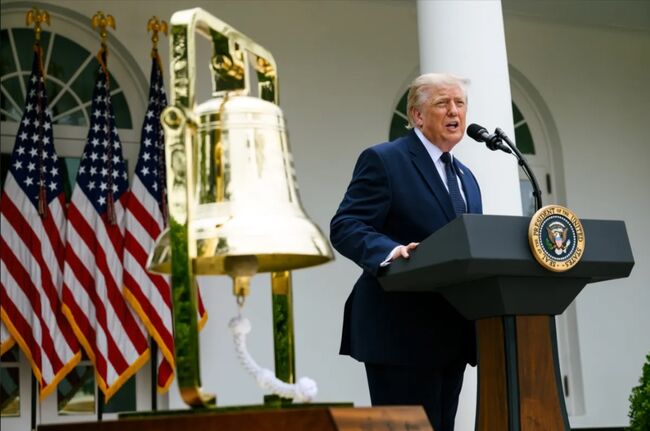 Trump pressures for rate cut again ahead of FOMC... "Should be the lowest in the world"
U.S. President Donald Trump. [Photo = The White House] U.S. President Donald Trump once again pressured the Federal Reserve, the U.S. central bank, to lower interest rates on the 27th (local time
Trump pressures for rate cut again ahead of FOMC... "Should be the lowest in the world"
U.S. President Donald Trump. [Photo = The White House] U.S. President Donald Trump once again pressured the Federal Reserve, the U.S. central bank, to lower interest rates on the 27th (local time
 “Ignoring crisp ballots and damaged seals”… Tongyeong mayoral recount concludes with ‘no change in outcome,’ leaving suspicions and public outrage behind
Suspected counterfeit ballots discovered in Tongyeong [GIF from social media of Representative Hwang Kyo-ahn / Attorney Park Joo-hyun]During a recount of the Tongyeong mayoral election in South Gyeong
“Ignoring crisp ballots and damaged seals”… Tongyeong mayoral recount concludes with ‘no change in outcome,’ leaving suspicions and public outrage behind
Suspected counterfeit ballots discovered in Tongyeong [GIF from social media of Representative Hwang Kyo-ahn / Attorney Park Joo-hyun]During a recount of the Tongyeong mayoral election in South Gyeong
 President Yoon, regarding the first-instance ruling on the Public Official Election Act: “An excessive political verdict that distorts the facts… We will appeal immediately.”
The first-instance sentencing hearing for President Yoon Suk Yeol regarding violations of the Public Official Election Act is being broadcast live at Seoul Station on the 27th. [Photo=Yonhap News]Pres
President Yoon, regarding the first-instance ruling on the Public Official Election Act: “An excessive political verdict that distorts the facts… We will appeal immediately.”
The first-instance sentencing hearing for President Yoon Suk Yeol regarding violations of the Public Official Election Act is being broadcast live at Seoul Station on the 27th. [Photo=Yonhap News]Pres
 WSJ: "SK Hynix ADR Premium Is a Sign of AI Trading Overheat"
Advertisement for SK Hynix ADR listing in New York's Times Square [Reuters=Yonhap News file photo]The Wall Street Journal (WSJ) has pointed out that the price of SK Hynix’s American Depositary Recei
WSJ: "SK Hynix ADR Premium Is a Sign of AI Trading Overheat"
Advertisement for SK Hynix ADR listing in New York's Times Square [Reuters=Yonhap News file photo]The Wall Street Journal (WSJ) has pointed out that the price of SK Hynix’s American Depositary Recei
 'Godfather of Japanese Mystery Novels' Keigo Higashino Passes Away After Battle with Cancer at 68
Famous Japanese mystery novelist Keigo Higashino [AFP=Yonhap News]It has been belatedly reported that Keigo Higashino, the "godfather of Japanese mystery novels" and author of bestsellers such as "The
'Godfather of Japanese Mystery Novels' Keigo Higashino Passes Away After Battle with Cancer at 68
Famous Japanese mystery novelist Keigo Higashino [AFP=Yonhap News]It has been belatedly reported that Keigo Higashino, the "godfather of Japanese mystery novels" and author of bestsellers such as "The
 [Park Pil-kyu Security Column] To the Ignorant Trying to Clothe a Beast in Sheep's Clothing
Rep. Kim Byung-joo of the Democratic Party of Korea [Photo=Yonhap News]“The Air Force Academy doesn't teach you how to fly a plane!” “The Army, Navy, and Air Force academies are exactly the
[Park Pil-kyu Security Column] To the Ignorant Trying to Clothe a Beast in Sheep's Clothing
Rep. Kim Byung-joo of the Democratic Party of Korea [Photo=Yonhap News]“The Air Force Academy doesn't teach you how to fly a plane!” “The Army, Navy, and Air Force academies are exactly the
 [Issue Diagnosis] Two Effects of the Election Petition Review
 [Photo] Evidence of Election Fraud Flooding U.S. Media… Trump Had 2.7 Million Votes Stolen
 [Video] U.S. Semiquincentennial Air Show... 'Art in the Sky' streaks across New York
 [Editorial Cartoon] A Draconian Law That Undermines Freedom of Expression

 List
List