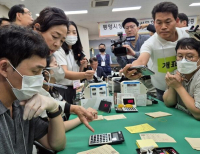
Samsung Electronics and SK Hynix showing strength, won stabilization, and foreign capital flows converging to raise expectations for a re-evaluation of the Korean stock market. The photo shows the dealing room at Hana Bank in Jung-gu, Seoul. [Photo=Yonhap News]
This week's fund flow theme is "Resumption of Korean Asset Re-evaluation Expectations."
It wasn't just emerging markets as a whole that rose. Korea reacted more significantly.
EWY (iShares MSCI South Korea ETF), a Korean exchange-traded fund (ETF), showed significant movement during the week, exhibiting a stronger trend than EEM (iShares MSCI Emerging Markets ETF), an emerging market ETF.
This difference is important. It could signal that global investors are not simply buying emerging markets, but are beginning to reprice Korea separately.
This week's Capital Rotation Radar asks one question:
Are foreign funds returning to the Korean market?
Judging by price movements alone, favorable signals have emerged. The KOSPI 200 futures saw a significant jump during the week, and the USD/KRW exchange rate declined from the 1511 won range to 1493 won.
The fact that the strength of Korean ETFs, the rebound in overnight futures, and the strengthening of the won have moved in the same direction is a crucial clue in interpreting foreign capital flows.
The Korean stock market's upside momentum is limited when the exchange rate is weak and foreign buying is sluggish. Conversely, when the won stabilizes and foreign demand picks up, rapid index gains, primarily driven by large-cap stocks, can occur.
Three structural factors were confirmed in the market this week:
First, the strength of Korean ETFs is linked to the re-evaluation of semiconductors.
Micron Technology's surge was not just a single-stock issue in the US. The spread of AI servers, High Bandwidth Memory (HBM), data center investments, and long-term memory demand outlook are all gaining prominence, increasing expectations for Korean semiconductor large-cap stocks.
In the Korean stock market, semiconductors are not just an industry sector; they are the heart of the index. When foreigners buy into Korea, Samsung Electronics and SK Hynix are ultimately what they look at first.
Second, the strengthening of the won increased the credibility of fund inflows.
For foreign investors, the exchange rate is as important as stock price appreciation. Even if stock prices rise, if the won weakens, the dollar-denominated return decreases.
This week's decline in the USD/KRW exchange rate has worked to enhance the dollar-based attractiveness of Korean assets. In particular, with falling oil prices and stabilizing US interest rates, upward pressure on the won could intensify.
Third, the National Pension Service's increased allocation to domestic equities has provided an indirect stabilizing factor for foreign demand.
When the National Pension Service, the largest long-term investor in Korea, raises its target allocation for domestic equities, the market does not view this as a mere numerical adjustment.
While there were significant concerns about mechanical selling due to exceeding the domestic equity allocation, the increase in the target allocation is interpreted as easing that pressure. From a foreign investor's perspective, a reduction in the downside pressure on the Korean market is a significant change.
The National Pension Fund Investment Management Committee raised the target allocation for domestic equities from the previous 14.9% to 20.8% this year.
Concurrently, it decided to temporarily expand the permissible range for Strategic Asset Allocation (SAA) for domestic equities. However, the specific range was not disclosed, citing reasons such as financial market stability and fairness in fund management operations. Therefore, it is more accurate to view this as a "possibility of easing selling pressure" rather than "elimination of selling pressure."
However, the fund flow has not been fully confirmed.
The surge in Korean ETFs reflects expectations ahead of time, and actual sustained net buying by foreigners in the domestic spot market requires separate confirmation.
Furthermore, during periods of rapid short-term gains, volatility can increase as leveraged products and profit-taking orders move in tandem.
This week's Capital Rotation Radar conclusion is as follows:
The Korean market has entered a phase of separate re-evaluation expectations driven by a combination of semiconductors, the won, and policy-driven supply and demand, rather than simply rising as part of the broader emerging market trend.
Next week's key points to watch are threefold:
First, we need to confirm how much net buying foreigners will actually conduct in KOSPI large-cap stocks.
Second, we need to observe whether the USD/KRW exchange rate stabilizes in the 1490 won range.
Third, we need to check if the strength of Korean ETFs translates into supply and demand in the domestic spot market.
※This article is for reference analysis to aid in understanding the content and is not investment advice. Actual market conditions and stock prices may vary depending on foreign capital flows, exchange rates, index levels, and policy variables.

 Bill Pulte to Restructure ‘Deep State’… Announces 4th Round of Layoffs at the Office of the Director of National Intelligence
Acting Director of National Intelligence Bill Pulte announced Sunday that he has carried out a fourth "deliberate and measured" reduction in personnel since taking office on June 19, as part of the Tr
Bill Pulte to Restructure ‘Deep State’… Announces 4th Round of Layoffs at the Office of the Director of National Intelligence
Acting Director of National Intelligence Bill Pulte announced Sunday that he has carried out a fourth "deliberate and measured" reduction in personnel since taking office on June 19, as part of the Tr
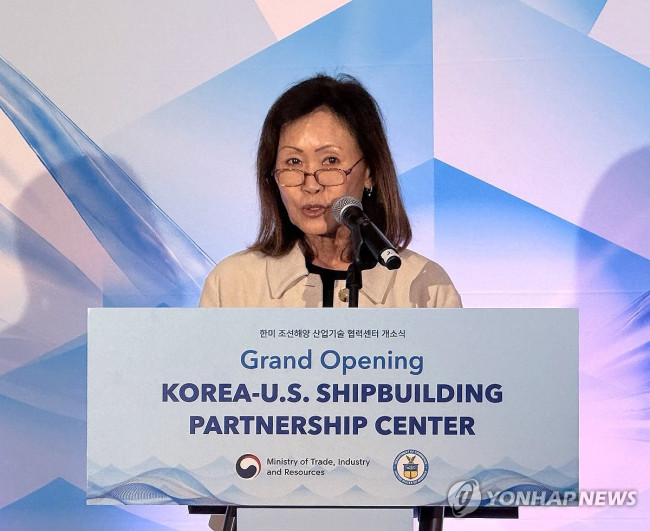 First U.S. Ambassador of Trump's Second Term to Arrive This Week… Will It Provide Momentum to Resolve Pending Issues?
U.S. Ambassador to South Korea Michelle Steel speaks at the opening ceremony of the Korea-U.S. Shipbuilding Cooperation Center held at the Mayflower Hotel in Washington, D.C., on the 23rd (local time)
First U.S. Ambassador of Trump's Second Term to Arrive This Week… Will It Provide Momentum to Resolve Pending Issues?
U.S. Ambassador to South Korea Michelle Steel speaks at the opening ceremony of the Korea-U.S. Shipbuilding Cooperation Center held at the Mayflower Hotel in Washington, D.C., on the 23rd (local time)
 President Yoon, regarding the first-instance ruling on the Public Official Election Act: “An excessive political verdict that distorts the facts… We will appeal immediately.”
The first-instance sentencing hearing for President Yoon Suk Yeol regarding violations of the Public Official Election Act is being broadcast live at Seoul Station on the 27th. [Photo=Yonhap News]Pres
President Yoon, regarding the first-instance ruling on the Public Official Election Act: “An excessive political verdict that distorts the facts… We will appeal immediately.”
The first-instance sentencing hearing for President Yoon Suk Yeol regarding violations of the Public Official Election Act is being broadcast live at Seoul Station on the 27th. [Photo=Yonhap News]Pres
 91% of Net Influx of MZ Generation Goes to Seoul Metropolitan Area… Population Migration Also Shows 'K-shaped Polarization' by Industry
[Provided by Leaders Index]Over the past four years, the MZ generation population has become increasingly concentrated in the Seoul metropolitan area and the Chungcheong region. While cities cen
91% of Net Influx of MZ Generation Goes to Seoul Metropolitan Area… Population Migration Also Shows 'K-shaped Polarization' by Industry
[Provided by Leaders Index]Over the past four years, the MZ generation population has become increasingly concentrated in the Seoul metropolitan area and the Chungcheong region. While cities cen
 'Godfather of Japanese Mystery Novels' Keigo Higashino Passes Away After Battle with Cancer at 68
Famous Japanese mystery novelist Keigo Higashino [AFP=Yonhap News]It has been belatedly reported that Keigo Higashino, the "godfather of Japanese mystery novels" and author of bestsellers such as "The
'Godfather of Japanese Mystery Novels' Keigo Higashino Passes Away After Battle with Cancer at 68
Famous Japanese mystery novelist Keigo Higashino [AFP=Yonhap News]It has been belatedly reported that Keigo Higashino, the "godfather of Japanese mystery novels" and author of bestsellers such as "The
 [Park Pil-kyu Security Column] To the Ignorant Trying to Clothe a Beast in Sheep's Clothing
Rep. Kim Byung-joo of the Democratic Party of Korea [Photo=Yonhap News]“The Air Force Academy doesn't teach you how to fly a plane!” “The Army, Navy, and Air Force academies are exactly the
[Park Pil-kyu Security Column] To the Ignorant Trying to Clothe a Beast in Sheep's Clothing
Rep. Kim Byung-joo of the Democratic Party of Korea [Photo=Yonhap News]“The Air Force Academy doesn't teach you how to fly a plane!” “The Army, Navy, and Air Force academies are exactly the
 [Issue Diagnosis] Two Effects of the Election Petition Review
 [Photo] Evidence of Election Fraud Flooding U.S. Media… Trump Had 2.7 Million Votes Stolen
 [Video] U.S. Semiquincentennial Air Show... 'Art in the Sky' streaks across New York
 [Editorial Cartoon] A Draconian Law That Undermines Freedom of Expression

 List
List