Chinese manufacturing economy [Photo courtesy of Reuters/Yonhap News. Reproduction and database prohibited]
China's manufacturing sector expansion has virtually stalled in May. Persistent domestic demand weakness, coupled with rising raw material and energy costs due to Middle East instability, has hampered the overall manufacturing industry.
According to data from the National Bureau of Statistics of China on the 31st, the Purchasing Managers' Index (PMI) for the manufacturing sector in May stood at 50.0. This represents a 0.3-point decrease from April and aligns with the market forecast of 50.0 compiled by Reuters.
A PMI above 50 indicates economic expansion, while a reading below 50 signifies contraction.
This index remained below the benchmark for eight consecutive months from April to November last year. It rebounded to 50.1 in December, but contracted again to 49.3 in January and 49.0 in February of this year. Subsequently, it showed positive momentum with readings of 50.4 and 50.3 in March and April, respectively.
Looking at the sub-indices for the May PMI, the production index fell by 0.3 points from the previous month to 51.2, but it was the only one of the five major indices that constitute the manufacturing PMI to remain in expansion territory.
The new orders index dropped by 0.7 points to 49.9, indicating continued weakness in demand. The raw material inventory index also declined by 0.7 points to 48.6. The employment index and the suppliers' delivery time index recorded 48.6 and 49.2, respectively, down 0.2 points and 0.3 points from the previous month.
By enterprise type, the large enterprise PMI in May rose by 0.9 points from the previous month to 51.1, showing a relatively robust trend.
In contrast, the PMI for medium and small enterprises fell by 1.9 points and 1.6 points, respectively, to 48.6 and 48.5, remaining below the benchmark.
On the same day, the National Bureau of Statistics announced that the non-manufacturing PMI increased by 0.7 points from the previous month to 50.1.
By industry, the construction industry recorded 48.8, and the service industry stood at 50.3, up 0.8 points and 0.7 points respectively from the previous month.
Among service industries, railway transport, telecommunications, broadcasting, television, and insurance showed relatively brisk activity, exceeding 55.0. However, air transport and real estate showed sluggish performance, falling below the benchmark.
The composite PMI, which combines manufacturing and non-manufacturing sectors, rose by 0.4 points from the previous month to 50.5.
Regarding last month's indicators, Wang Qing, chief macroeconomist at Golden Credit Rating, explained to Chinese economic media Jiemian News that "the impact of weak domestic demand and soaring international oil prices was significant."
Xu Tianchen, senior economist at The Economist Intelligence Unit, also analyzed that "while the Iran conflict has not had a substantial impact on China's energy security, the oil supply shortage and rising oil prices will affect some industries, such as the chemical industry."
Experts assess that with the simultaneous slowdown in manufacturing and rebound in non-manufacturing sectors, the Chinese economy is generally maintaining a moderate growth trend. However, they conclude that the recovery of domestic demand is the key variable that will determine the future economic trajectory. (Yonhap News)

 Bill Pulte to Restructure ‘Deep State’… Announces 4th Round of Layoffs at the Office of the Director of National Intelligence
Acting Director of National Intelligence Bill Pulte announced Sunday that he has carried out a fourth "deliberate and measured" reduction in personnel since taking office on June 19, as part of the Tr
Bill Pulte to Restructure ‘Deep State’… Announces 4th Round of Layoffs at the Office of the Director of National Intelligence
Acting Director of National Intelligence Bill Pulte announced Sunday that he has carried out a fourth "deliberate and measured" reduction in personnel since taking office on June 19, as part of the Tr
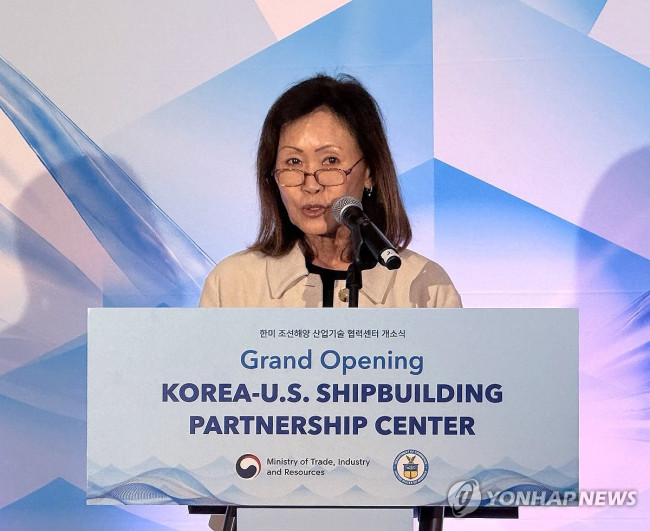 First U.S. Ambassador of Trump's Second Term to Arrive This Week… Will It Provide Momentum to Resolve Pending Issues?
U.S. Ambassador to South Korea Michelle Steel speaks at the opening ceremony of the Korea-U.S. Shipbuilding Cooperation Center held at the Mayflower Hotel in Washington, D.C., on the 23rd (local time)
First U.S. Ambassador of Trump's Second Term to Arrive This Week… Will It Provide Momentum to Resolve Pending Issues?
U.S. Ambassador to South Korea Michelle Steel speaks at the opening ceremony of the Korea-U.S. Shipbuilding Cooperation Center held at the Mayflower Hotel in Washington, D.C., on the 23rd (local time)
 President Yoon, regarding the first-instance ruling on the Public Official Election Act: “An excessive political verdict that distorts the facts… We will appeal immediately.”
The first-instance sentencing hearing for President Yoon Suk Yeol regarding violations of the Public Official Election Act is being broadcast live at Seoul Station on the 27th. [Photo=Yonhap News]Pres
President Yoon, regarding the first-instance ruling on the Public Official Election Act: “An excessive political verdict that distorts the facts… We will appeal immediately.”
The first-instance sentencing hearing for President Yoon Suk Yeol regarding violations of the Public Official Election Act is being broadcast live at Seoul Station on the 27th. [Photo=Yonhap News]Pres
 91% of Net Influx of MZ Generation Goes to Seoul Metropolitan Area… Population Migration Also Shows 'K-shaped Polarization' by Industry
[Provided by Leaders Index]Over the past four years, the MZ generation population has become increasingly concentrated in the Seoul metropolitan area and the Chungcheong region. While cities cen
91% of Net Influx of MZ Generation Goes to Seoul Metropolitan Area… Population Migration Also Shows 'K-shaped Polarization' by Industry
[Provided by Leaders Index]Over the past four years, the MZ generation population has become increasingly concentrated in the Seoul metropolitan area and the Chungcheong region. While cities cen
 'Godfather of Japanese Mystery Novels' Keigo Higashino Passes Away After Battle with Cancer at 68
Famous Japanese mystery novelist Keigo Higashino [AFP=Yonhap News]It has been belatedly reported that Keigo Higashino, the "godfather of Japanese mystery novels" and author of bestsellers such as "The
'Godfather of Japanese Mystery Novels' Keigo Higashino Passes Away After Battle with Cancer at 68
Famous Japanese mystery novelist Keigo Higashino [AFP=Yonhap News]It has been belatedly reported that Keigo Higashino, the "godfather of Japanese mystery novels" and author of bestsellers such as "The
 [Park Pil-kyu Security Column] To the Ignorant Trying to Clothe a Beast in Sheep's Clothing
Rep. Kim Byung-joo of the Democratic Party of Korea [Photo=Yonhap News]“The Air Force Academy doesn't teach you how to fly a plane!” “The Army, Navy, and Air Force academies are exactly the
[Park Pil-kyu Security Column] To the Ignorant Trying to Clothe a Beast in Sheep's Clothing
Rep. Kim Byung-joo of the Democratic Party of Korea [Photo=Yonhap News]“The Air Force Academy doesn't teach you how to fly a plane!” “The Army, Navy, and Air Force academies are exactly the
 [Issue Diagnosis] Two Effects of the Election Petition Review
 [Photo] Evidence of Election Fraud Flooding U.S. Media… Trump Had 2.7 Million Votes Stolen
 [Video] U.S. Semiquincentennial Air Show... 'Art in the Sky' streaks across New York
 [Editorial Cartoon] A Draconian Law That Undermines Freedom of Expression

 List
List