Voters cast their ballots at a preemptive voting station set up at the Sinjil 4-dong Community Center in Yeongdeungpo-gu, Seoul, on May 30, the second day of preemptive voting for the 6·3 local elections. [Yonhap News]
The Election Crime Watchdog of the Liberty and Innovation Party filed a complaint against the chairpersons of election management committees at various levels and election officials on charges of violating Article 157, Paragraph 2, and Article 158, Paragraph 3 of the Public Official Election Act in mid-May. This fact was notified to the election management committees at each level through Munseo24.
Additionally, regarding the upcoming June 3, 2026 local elections, the party conveyed to the provincial and municipal/county/district election management committees that some procedures the National Election Commission intends to operate may violate the Public Official Election Act.
In response, the National Election Commission sent an explanatory statement asserting that the procedures in question fall under legitimate election management duties. However, upon reviewing the content, numerous questions and contradictions were found in terms of legal interpretation and system operation. This article aims to summarize the claims of the National Election Commission and the Election Crime Watchdog's opinions to serve as a reference for public judgment.
1. The Issue of Batch Production, Collection, and Distribution of (Preemptive) Voting Management Officer Stamps
(1) Claims of the National Election Commission
The National Election Commission explains that since election management committees have the authority to manage and supervise (preemptive) voting management officers, it is also possible to produce and distribute election supplies such as stamps in the process of supporting election office operations. Furthermore, it claims that the purpose of a (preemptive) voting management officer affixing their personal seal (private stamp) under the Public Official Election Act is to verify whether ballots were issued by an authorized person, and that the entity producing the stamp or the production process are not essential matters.
Accordingly, the National Election Commission's position is that they operate by batch-producing stamps for those who wish them, collecting them for inspection, and then redistributing them before election day.
(2) Opinion of the Election Crime Watchdog
We believe that the intention behind the Public Official Election Act requiring the 'private seal' or 'personal stamp' of a (preemptive) voting management officer is to clarify responsibility in the ballot issuance process and to establish a safeguard to prevent fraudulent activities. Therefore, the production, storage, and management of stamps can be seen not merely as a matter of administrative convenience but as elements directly linked to the credibility of the election.
In particular, the method where election management bodies directly produce and distribute stamps, or collect and store personal stamps before redistributing them, is not a procedure explicitly stipulated in the law. Therefore, it is necessary to review whether such operating methods truly align with the intentions foreseen by the law.
While the National Election Commission cites efficiency and convenience as reasons, transparency and verifiability should take precedence over convenience in election procedures. In the past, there have been instances where stamps were registered just before the start of voting in some regions, and some opinions suggest that this method could minimize unnecessary controversy.
Ultimately, what matters is not to assume the National Election Commission's good intentions, but whether the system itself is designed to prevent any suspicion from arising.
2. The Issue of (Preemptive) Voting Staff Affixing the (Preemptive) Voting Management Officer's Signature (Printed)
(1) Claims of the National Election Commission
The National Election Commission explains that according to Article 146-2, Paragraph 4 of the Public Official Election Act and related rules, (preemptive) voting management officers can give necessary instructions and supervision to (preemptive) voting staff.
Therefore, it claims that it is legitimate election office management and execution for a preemptive voting management officer to instruct preemptive voting staff to carry out ballot issuance and delivery, or to affix and deliver the voting management officer's stamp.
(2) Opinion of the Election Crime Watchdog
Article 157, Paragraph 2 of the Public Official Election Act stipulates, "When delivering ballots to electors, the voting management officer shall do so after affixing their private seal." Furthermore, Article 158, Paragraph 3 of the Public Official Election Act states, "The preemptive voting management officer shall print the ballots, affix their own stamp, and then deliver them."
A natural interpretation of the legal text is that the person affixing the private seal is the voting management officer or the preemptive voting management officer themselves.
However, the National Election Commission, citing its management and supervision authority, permits stamping by voting staff. The Election Crime Watchdog questions whether the authority to manage and supervise extends to the power to change the subject of the act as stipulated by law.
In particular, considering the law explicitly specifies 'private seal' or 'own stamp', more stringent legal review is deemed necessary regarding whether this task can be delegated to a third party.
3. The Issue of Division Facilities and Separate Ballot Issuance for Within-District and Outside-District Voters
(1) Claims of the National Election Commission
The National Election Commission explains that it operates by dividing within-district and outside-district areas to prevent the commingling of ballots and return envelopes because the voting procedures for within-district and outside-district electors differ.
It also claims that in cases where multiple elections are held simultaneously, such as the nationwide simultaneous local elections, ballots can be issued in two stages (first and second) in accordance with the Public Official Election Act and related rules, and therefore, ballot issuance stations, polling booths, and ballot boxes are installed separately to accommodate this.
(2) Opinion of the Election Crime Watchdog
The Public Official Election Act allows for the details of voting procedures and methods in cases of simultaneous multiple elections to be determined by the rules of the National Election Commission.
However, subordinate regulations and operational guidelines must always be applied within the scope of higher laws.
The Election Crime Watchdog is not questioning the method of issuing ballots in two stages itself, but argues that the private seal affixing procedure required by Article 157, Paragraph 2 and Article 158, Paragraph 3 of the Public Official Election Act must be faithfully observed even in such operational processes.
Election management procedures are not solely for efficiency but also serve the purpose of preventing the use of counterfeit ballots and procedural defects. Therefore, the position of the Election Crime Watchdog is that no matter the operational method, the core procedures stipulated by law must not be compromised.
4. The Issue of Signature and Interleaving Before Attaching Special Seals
(1) Claims of the National Election Commission
The National Election Commission explains that it operates by first affixing the seal to the ballot box and then signing, because if the special seal is attached first, the signature may be damaged or difficult to read due to surface irregularities. It further claims that since the special seal is rendered unusable if removed by displaying an 'OPEN VOID' mark, the integrity of the seal is maintained regardless of whether it is interleaved.
(2) Opinion of the Election Crime Watchdog
The original purpose of interleaving (interleaving stamps) is to prove that two or more documents or objects have been maintained in a continuous state.
Therefore, the reason for interleaving during the ballot box sealing process is to secure the integrity of the seal and the ballot box, and to block the possibility of subsequent replacement or alteration.
For this, interleaving that connects the seal and the ballot box together can be an important verification tool.
Despite this, the National Election Commission argues that the integrity of the seal is maintained simply by the fact that it cannot be reused.
However, would not the integrity of the seal be completely nullified if someone removed the existing seal, signed, and then attached a new seal?
Furthermore, while the National Election Commission explains that signing after attaching the seal first may lead to signature damage or difficulty in reading due to surface irregularities, this reason alone is not sufficient to prove the necessity of pre-signing. This is because if the signature quality is poor, it is also possible to replace the seal and re-seal.
The Election Crime Watchdog believes that the tamper-evident feature of special seals alone is insufficient and that additional verification measures are needed to confirm that the seal and ballot box have been maintained in the same state.
For elections, public trust in the procedures, not just the results, is important. Therefore, sealing procedures must possess a level of verifiability and transparency that the public can understand, in addition to technical security.
Based on the explanations from the National Election Commission, the commission claims that these procedures are legal operations based on current laws and regulations.
However, the core issue raised by the Election Crime Watchdog is not simply the existence of authority. It is more important whether the system is designed and operated to ensure public trust in election procedures, and whether it is managed in a way that minimizes room for fraud or misunderstanding.
Elections are the foundation of democracy, and public trust in election results is paramount. Therefore, election management bodies must ensure transparency and strictness at a level that the public can understand, beyond mere legal permissibility.
Especially given the various controversies and suspicions surrounding election management procedures recently, the National Election Commission has a responsibility to adequately explain to the public not only that the procedures are "legal" but also why they are necessary and how they fundamentally prevent potential fraud.
We hope that the 6·3 local elections will be conducted as fair and transparent elections, leaving no room for suspicion. We also urge the National Election Commission to prioritize restoring public trust and to undertake more rigorous and cautious election management.
Oh Sung-hoon, Doctor, Liberty and Innovation Party Election Crime Watchdog

 Trump pressures for rate cut again ahead of FOMC... "Should be the lowest in the world"
U.S. President Donald Trump. [Photo = The White House] U.S. President Donald Trump once again pressured the Federal Reserve, the U.S. central bank, to lower interest rates on the 27th (local time
Trump pressures for rate cut again ahead of FOMC... "Should be the lowest in the world"
U.S. President Donald Trump. [Photo = The White House] U.S. President Donald Trump once again pressured the Federal Reserve, the U.S. central bank, to lower interest rates on the 27th (local time
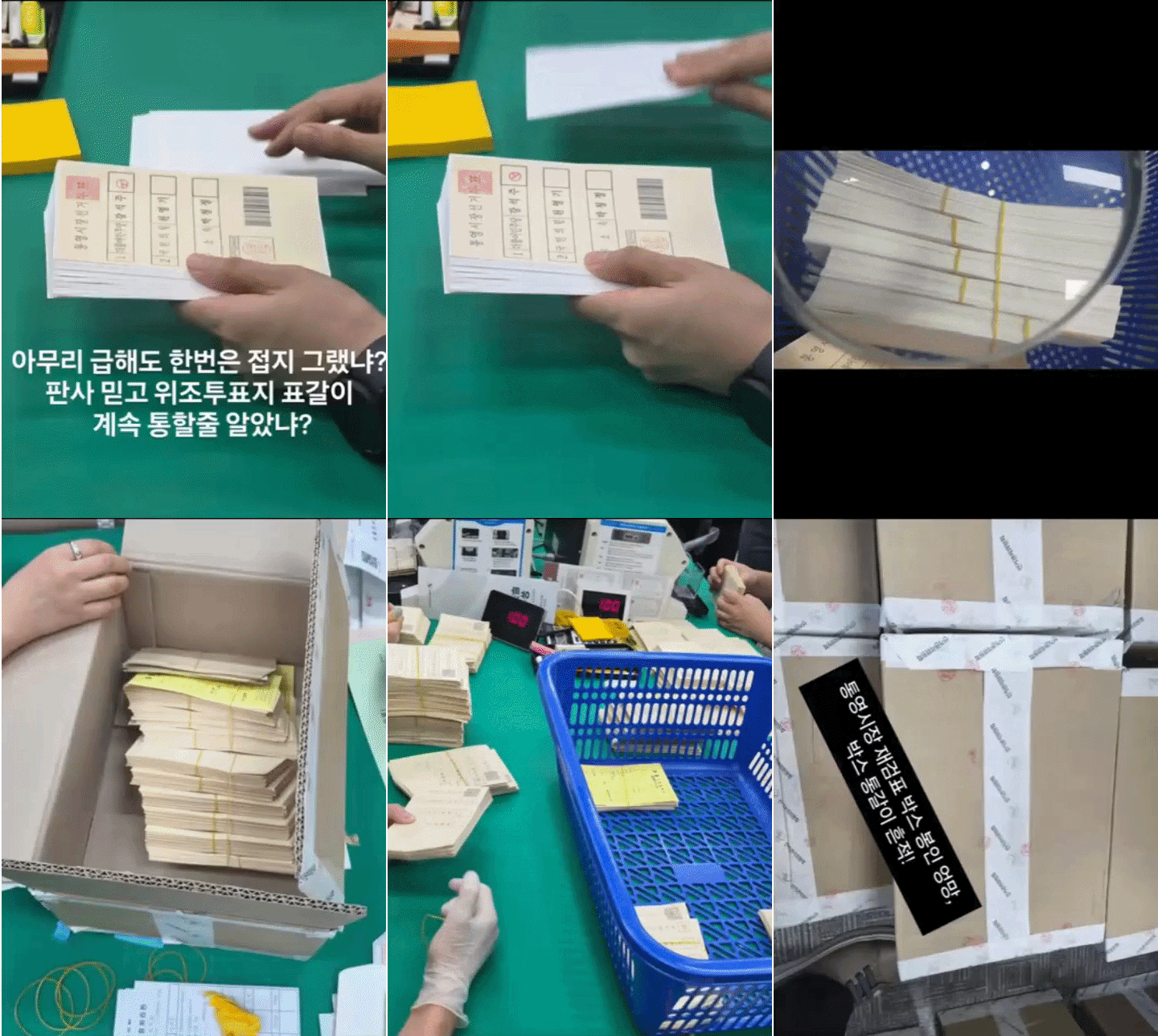 “Ignoring crisp ballots and damaged seals”… Tongyeong mayoral recount concludes with ‘no change in outcome,’ leaving suspicions and public outrage behind
Suspected counterfeit ballots discovered in Tongyeong [GIF from social media of Representative Hwang Kyo-ahn / Attorney Park Joo-hyun]During a recount of the Tongyeong mayoral election in South Gyeong
“Ignoring crisp ballots and damaged seals”… Tongyeong mayoral recount concludes with ‘no change in outcome,’ leaving suspicions and public outrage behind
Suspected counterfeit ballots discovered in Tongyeong [GIF from social media of Representative Hwang Kyo-ahn / Attorney Park Joo-hyun]During a recount of the Tongyeong mayoral election in South Gyeong
 President Yoon, regarding the first-instance ruling on the Public Official Election Act: “An excessive political verdict that distorts the facts… We will appeal immediately.”
The first-instance sentencing hearing for President Yoon Suk Yeol regarding violations of the Public Official Election Act is being broadcast live at Seoul Station on the 27th. [Photo=Yonhap News]Pres
President Yoon, regarding the first-instance ruling on the Public Official Election Act: “An excessive political verdict that distorts the facts… We will appeal immediately.”
The first-instance sentencing hearing for President Yoon Suk Yeol regarding violations of the Public Official Election Act is being broadcast live at Seoul Station on the 27th. [Photo=Yonhap News]Pres
 WSJ: "SK Hynix ADR Premium Is a Sign of AI Trading Overheat"
Advertisement for SK Hynix ADR listing in New York's Times Square [Reuters=Yonhap News file photo]The Wall Street Journal (WSJ) has pointed out that the price of SK Hynix’s American Depositary Recei
WSJ: "SK Hynix ADR Premium Is a Sign of AI Trading Overheat"
Advertisement for SK Hynix ADR listing in New York's Times Square [Reuters=Yonhap News file photo]The Wall Street Journal (WSJ) has pointed out that the price of SK Hynix’s American Depositary Recei
 'Godfather of Japanese Mystery Novels' Keigo Higashino Passes Away After Battle with Cancer at 68
Famous Japanese mystery novelist Keigo Higashino [AFP=Yonhap News]It has been belatedly reported that Keigo Higashino, the "godfather of Japanese mystery novels" and author of bestsellers such as "The
'Godfather of Japanese Mystery Novels' Keigo Higashino Passes Away After Battle with Cancer at 68
Famous Japanese mystery novelist Keigo Higashino [AFP=Yonhap News]It has been belatedly reported that Keigo Higashino, the "godfather of Japanese mystery novels" and author of bestsellers such as "The
 [Park Pil-kyu Security Column] To the Ignorant Trying to Clothe a Beast in Sheep's Clothing
Rep. Kim Byung-joo of the Democratic Party of Korea [Photo=Yonhap News]“The Air Force Academy doesn't teach you how to fly a plane!” “The Army, Navy, and Air Force academies are exactly the
[Park Pil-kyu Security Column] To the Ignorant Trying to Clothe a Beast in Sheep's Clothing
Rep. Kim Byung-joo of the Democratic Party of Korea [Photo=Yonhap News]“The Air Force Academy doesn't teach you how to fly a plane!” “The Army, Navy, and Air Force academies are exactly the
 [Issue Diagnosis] Two Effects of the Election Petition Review
 [Photo] Evidence of Election Fraud Flooding U.S. Media… Trump Had 2.7 Million Votes Stolen
 [Video] U.S. Semiquincentennial Air Show... 'Art in the Sky' streaks across New York
 [Editorial Cartoon] A Draconian Law That Undermines Freedom of Expression

 List
List