 Noh Tae-ak, Chairman of the National Election Commission, apologizes to the public on the 5th at the National Election Commission in Gwacheon, Gyeonggi Province, regarding the ballot paper shortage incident. [Photo=Yonhap News]
The most important issue to scrutinize in media reports surrounding the ballot paper shortage incident in the June 3 local elections is the status of the Election Commission.
The Election Commission is not a third party explaining the situation from the outside. It is the party responsible for managing the system of printing, distributing, storing, and additionally sending ballot papers.
Therefore, the media should not use the statements of an institution that could be subject to investigation or inquiry if the incident escalates as the starting point of fact.
The Election Commission is a Responsible Party, Not an Explainer
Reporting the Election Commission's claims is not inherently problematic. The public needs to be informed about the stance taken by the election management body.
However, this is, at best, the self-declaration of the responsible agency. Until independently verified, the Election Commission's words are claims, not facts.
The media's role does not end with conveying these claims. It begins with verifying whether these claims align with actual records.
The National Election Commission claimed that it sent additional ballot papers to 67 polling stations nationwide during the main vote of the June 3 local elections, and that additional ballot papers were actually used in 50 of these, with voting temporarily suspended and then resumed in 22 polling stations due to a ballot paper shortage.
It also claimed that in recent elections, as early voting rates have increased, there has been a tendency for many ballot papers to be left over for the main vote, and that there were internal opinions suggesting the need for reduced printing due to the burden of collection, storage, and disposal.
However, these numbers and explanations of the cause are merely the Election Commission's initial claims.
Until it is confirmed how many were actually printed, how many were allocated to which polling stations, where the reserve copies were stored, and who ordered the additional delivery and through what procedure, these cannot be considered established facts.
In particular, if the figures are prefaced by the Election Commission itself as "what we have understood so far," the media should handle them with even greater caution.
'Revealed' and 'Claimed' Are Different
At this point, the reporting attitude of the old media becomes problematic.
Some reports used verbs such as "revealed," "explained," "conveyed," or "was confirmed" for the Election Commission's statements, rather than "claimed." This can be seen as common expressions when relaying official announcements.
However, in this case, it is different. The Election Commission is not a neutral observer but a party responsible for the incident. Attaching verbs denoting fact to the self-declaration of a party leads readers to accept it as a verified outcome.
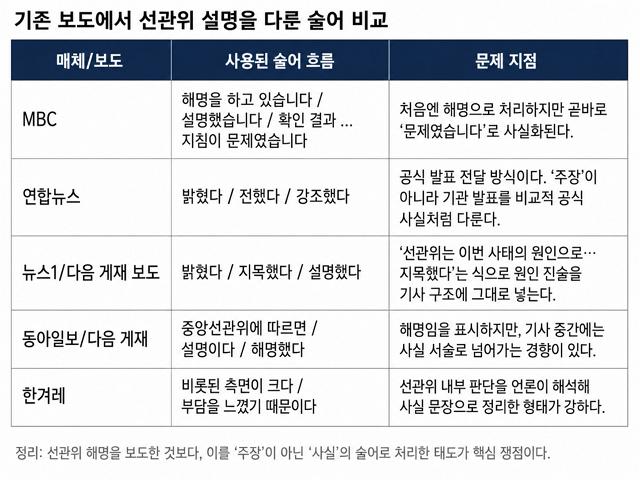
"The Election Commission claimed" and "The Election Commission revealed" are not the same. The former creates distance.
The latter gives the impression of an official fact. Furthermore, the expression "was confirmed" gives the impression that the media independently verified the facts.
However, if the report is based on the Election Commission's own internal investigation results, it is not a confirmation but the Election Commission's self-assessment. A single verb in a news sentence can alter the nature of the incident.
MBC, while reporting the National Election Commission's initial internal investigation results, framed it as: "It was confirmed that ballot papers were insufficient at 50 polling stations nationwide."
This phrasing can give readers the impression that the Election Commission's announcement is a confirmed fact. However, as the actual basis is the Election Commission's internal investigation, this should be treated as content that the Election Commission itself stated it had identified, rather than the result of independent verification.
Yonhap News, focusing on the Election Commission's briefing, also reported figures of 67 polling stations where additional ballots were sent, 50 polling stations with actual shortages, and 22 polling stations where voting was temporarily suspended. The reports themselves are necessary in that they convey official announcements.
However, the reasons provided by the Election Commission, such as "increase in early voting rates," "burden of remaining ballot papers," "necessity of reduced printing," and "variation by polling station," should remain as the Election Commission's claims, not as established causes.
Causes Must Be Verified by Records, Not Announcements
The essence of this incident is not simply the shortage of ballot papers. Ballot papers are a physical condition for citizens to exercise their right to vote.
If voters arriving at a polling station had to wait or were unable to vote due to a shortage of ballot papers, this can escalate beyond administrative error to an infringement of the right to participate in elections.
In such matters, reporting the words of the responsible agency as fact is no different from entrusting the fish to a cat and then writing down the cat's words verbatim in the ledger.
The question the media should have asked first was not "What did the Election Commission explain as the cause?" but "What records verify the Election Commission's claims?"
The number of voters at each polling station, the number of early voters, the expected number for the main vote, the actual allocated quantity, the location of reserve copies, the time of additional delivery, the person responsible for transport, confirmation of receipt, and whether observers were present should be disclosed. Unless these documents are cross-referenced, "50% printing directive," "variation by polling station," and "increase in early voting rates" are all merely the Election Commission's claims, not causes.
The right to vote is not a right guaranteed by an overall average. Voters must be able to vote at their designated polling station within the stipulated time.
What is Needed is Verification of Claims, Not Organization of Claims
The fact that Noh Tae-ak, Chairman of the National Election Commission, offered his resignation, and that the Election Commission announced it would form a fact-finding committee composed of external experts, means that the cause of this incident has not yet been determined.
In a situation where the cause has not been determined, it is a reversal of order for the media to treat the words of the responsible agency as factual.
In the flow of reporting this incident, the media was quick to convey the Election Commission's claims but was stingy with the question marks that should precede those claims.
Reporting announcements from responsible agencies and accepting those announcements as fact are entirely different matters.
The media's role does not end with organizing announcements. Verifying whether the announcements are true, demanding missing records, and identifying contradictions are the basic functions of the media.
The Election Commission's claims are subjects of reporting. However, they should not be the premise of fact.
What is needed now is not an article that neatly organizes the Election Commission's claims, but an article that verifies them.
The investigation into the cause of the ballot paper shortage incident should begin not with the Election Commission's press release, but with the disclosure of records related to printing, distribution, storage, and transportation, as well as observer logs.

 Iranian Foreign Ministry: "Continuing Message Exchanges with the U.S. and Activities of Mediating Countries"
Esmaeil Baghaei, Spokesperson for the Iranian Ministry of Foreign Affairs [Xinhua, Yonhap News file photo]Esmaeil Baghaei, spokesperson for the Iranian Ministry of Foreign Affairs, stated on the 26th
Iranian Foreign Ministry: "Continuing Message Exchanges with the U.S. and Activities of Mediating Countries"
Esmaeil Baghaei, Spokesperson for the Iranian Ministry of Foreign Affairs [Xinhua, Yonhap News file photo]Esmaeil Baghaei, spokesperson for the Iranian Ministry of Foreign Affairs, stated on the 26th
 President Yoon: "Do You Think You Are Safe from the Special Counsel?"... Final Statement Video Released
President Yoon Suk Yeol rebuking the special prosecutor on the 24th. [Court video / @birds_justice X account subtitle GIF] A video of President Yoon Suk Yeol's closing statement at his trial rega
President Yoon: "Do You Think You Are Safe from the Special Counsel?"... Final Statement Video Released
President Yoon Suk Yeol rebuking the special prosecutor on the 24th. [Court video / @birds_justice X account subtitle GIF] A video of President Yoon Suk Yeol's closing statement at his trial rega
 President Yoon, regarding the first-instance ruling on the Public Official Election Act: “An excessive political verdict that distorts the facts… We will appeal immediately.”
The first-instance sentencing hearing for President Yoon Suk Yeol regarding violations of the Public Official Election Act is being broadcast live at Seoul Station on the 27th. [Photo=Yonhap News]Pres
President Yoon, regarding the first-instance ruling on the Public Official Election Act: “An excessive political verdict that distorts the facts… We will appeal immediately.”
The first-instance sentencing hearing for President Yoon Suk Yeol regarding violations of the Public Official Election Act is being broadcast live at Seoul Station on the 27th. [Photo=Yonhap News]Pres
 WSJ: "SK Hynix ADR Premium Is a Sign of AI Trading Overheat"
Advertisement for SK Hynix ADR listing in New York's Times Square [Reuters=Yonhap News file photo]The Wall Street Journal (WSJ) has pointed out that the price of SK Hynix’s American Depositary Recei
WSJ: "SK Hynix ADR Premium Is a Sign of AI Trading Overheat"
Advertisement for SK Hynix ADR listing in New York's Times Square [Reuters=Yonhap News file photo]The Wall Street Journal (WSJ) has pointed out that the price of SK Hynix’s American Depositary Recei
 'Godfather of Japanese Mystery Novels' Keigo Higashino Passes Away After Battle with Cancer at 68
Famous Japanese mystery novelist Keigo Higashino [AFP=Yonhap News]It has been belatedly reported that Keigo Higashino, the "godfather of Japanese mystery novels" and author of bestsellers such as "The
'Godfather of Japanese Mystery Novels' Keigo Higashino Passes Away After Battle with Cancer at 68
Famous Japanese mystery novelist Keigo Higashino [AFP=Yonhap News]It has been belatedly reported that Keigo Higashino, the "godfather of Japanese mystery novels" and author of bestsellers such as "The
 [Park Pil-kyu Security Column] To the Ignorant Trying to Clothe a Beast in Sheep's Clothing
Rep. Kim Byung-joo of the Democratic Party of Korea [Photo=Yonhap News]“The Air Force Academy doesn't teach you how to fly a plane!” “The Army, Navy, and Air Force academies are exactly the
[Park Pil-kyu Security Column] To the Ignorant Trying to Clothe a Beast in Sheep's Clothing
Rep. Kim Byung-joo of the Democratic Party of Korea [Photo=Yonhap News]“The Air Force Academy doesn't teach you how to fly a plane!” “The Army, Navy, and Air Force academies are exactly the
 [Issue Diagnosis] Two Effects of the Election Petition Review
 [Photo] Evidence of Election Fraud Flooding U.S. Media… Trump Had 2.7 Million Votes Stolen
 [Video] U.S. Semiquincentennial Air Show... 'Art in the Sky' streaks across New York
 [Editorial Cartoon] A Draconian Law That Undermines Freedom of Expression

 List
List









