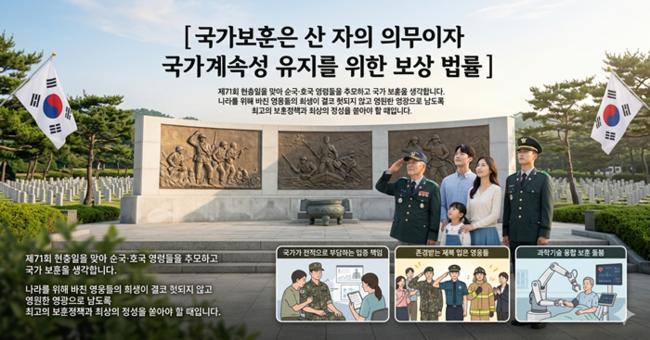
 Cemetery at Seoul National Cemetery ⒸHanmi Ilbo
Each year, as Memorial Day approaches, there is a subject that tugs at our heartstrings.
We must remember the blood, sacrifice, and dedication of the fallen soldiers of the Korean War who charged forward without a moment to think of their families back home, their sole focus being the nation's safety amidst the onslaught of artillery; the patriotic martyrs who gave their one and only lives unconditionally; and the 55 heroes of the Second Battle of Yeonpyeong, the sinking of the Cheonan, and the shelling of Yeonpyeong, who defended the West Sea.
There is a self-evident truth we must remember: defending the nation is not a mere theory or slogan; it is proven only through 'dedication' and 'action' where one gives their entire being. Therefore, it is the duty of those living today to fully care for and honor the spirits of those who died for their country, those who defended it, and those who protected our freedom. We must consider veteran support as essential for the nation's existence.
Developed nations define veteran support as "the core of national identity and continuity of security." The United States has a Department of Veterans Affairs, stating that "caring for heroes is a sacred duty of the nation," and implements robust veteran policies. The "G.I. Bill," a welfare policy introduced by the United States after World War II to provide extraordinary support for the medical care, education, and housing of returning soldiers, transformed returning servicemen into a highly educated middle class, becoming a "driving force for national development" that propelled the US to become the world's strongest nation.
The United Kingdom, through the "Soldier's Oath," ensures the government and society are responsible for their sacrifices until the end, while Australia treats veteran support not as welfare but as an "investment in future security." Like them, we too must redefine veteran support from a mere benevolent compensation to an institutional responsibility for the nation's perpetuity.
On Memorial Day, we should not merely offer prayers for the departed and pay respects. Instead, we must examine the structural contradictions in South Korea's veteran support policies and transition to a future-oriented paradigm.
First, the 'burden of proof must be entirely borne by the state' in the veteran assessment system.
Currently, our veteran assessment system often requires individuals recognized for their contributions and their families to prove the causal relationship between their injuries or illnesses and their service themselves. This is not a show of respect for their dedication, but rather an administratively convenient approach that inflicts further emotional distress.
For injuries and illnesses sustained while performing duties in uniform, the state must proactively provide evidence and protection. There is an urgent need for legislative and institutional improvements that decisively shift the burden of proof from the veteran to the state. Only when there is trust that the state will be responsible until the end can our youth confidently answer the nation's call.
Second, we must foster a 'social atmosphere' where heroes in uniform are respected.
True veteran support does not end with simply handing over a few pieces of monetary compensation. A cultural foundation must be established where heroes in uniform, such as soldiers, police officers, and firefighters, receive overwhelming respect and just treatment throughout society.
We must build a robust system, across both public and private sectors, where those who have contributed to national defense receive preferential treatment socially and institutionally. We must elevate the standards to prevent politicians and pseudo-scholars who disparage or alienate those who have sacrificed on the front lines of security and public safety from gaining a foothold in our society.
The pain of the past, when the memorial service for the heroes of the Battle of Yeonpyeong was ignored, and the malicious conspiracy theories and denigration by some pseudo-scholars towards the sailors of the Cheonan must not be repeated. Now, just as the United States has nurtured veterans into the middle class and treated them as heroes in daily life through the "G.I. Bill," we too must elevate the standards of national compensation and social respect so that the sacrifices of those in uniform are not marginalized.
Third, we must evolve into a 'national veteran care system' that integrates advanced science and technology.
We must actively adopt AI and advanced science and technology into our defense and security systems to protect the lives of our service members. This is because minimizing the sacrifices of heroes in uniform on the battlefield and in disaster areas is the starting point of veteran support.
Furthermore, for wounded veterans and their families who have already made sacrifices, we must provide world-class scientific and technological welfare services, such as robotic prosthetics and AI-based chronic disease monitoring. Just as your love for the country was the highest spiritual science that physically protected the Republic of Korea, the nation's veteran support, compensation, and reward must also be the most scientific and optimal.
Veteran support is a memory of the past and a solemn promise of the future. It is time for the government and all citizens to pour the best veteran support policies and utmost sincerity into ensuring that the sacrifices of our heroes, offered for the nation, are never in vain and remain an eternal glory.
To the patriotic spirits and national defense heroes resting in the embrace of free Korea! Please lay down your heavy burdens and rest in eternal peace. On the 71st Memorial Day, we commemorate the fallen and patriotic heroes and reflect on national veteran support.
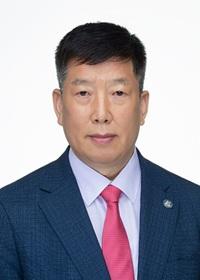
◆ Park Pil-kyu
Editor, Hanmi Ilbo
Korea Military Academy, Class of '82 (40th)

 Iranian Foreign Ministry: "Continuing Message Exchanges with the U.S. and Activities of Mediating Countries"
Esmaeil Baghaei, Spokesperson for the Iranian Ministry of Foreign Affairs [Xinhua, Yonhap News file photo]Esmaeil Baghaei, spokesperson for the Iranian Ministry of Foreign Affairs, stated on the 26th
Iranian Foreign Ministry: "Continuing Message Exchanges with the U.S. and Activities of Mediating Countries"
Esmaeil Baghaei, Spokesperson for the Iranian Ministry of Foreign Affairs [Xinhua, Yonhap News file photo]Esmaeil Baghaei, spokesperson for the Iranian Ministry of Foreign Affairs, stated on the 26th
 President Yoon: "Do You Think You Are Safe from the Special Counsel?"... Final Statement Video Released
President Yoon Suk Yeol rebuking the special prosecutor on the 24th. [Court video / @birds_justice X account subtitle GIF] A video of President Yoon Suk Yeol's closing statement at his trial rega
President Yoon: "Do You Think You Are Safe from the Special Counsel?"... Final Statement Video Released
President Yoon Suk Yeol rebuking the special prosecutor on the 24th. [Court video / @birds_justice X account subtitle GIF] A video of President Yoon Suk Yeol's closing statement at his trial rega
 President Yoon, regarding the first-instance ruling on the Public Official Election Act: “An excessive political verdict that distorts the facts… We will appeal immediately.”
The first-instance sentencing hearing for President Yoon Suk Yeol regarding violations of the Public Official Election Act is being broadcast live at Seoul Station on the 27th. [Photo=Yonhap News]Pres
President Yoon, regarding the first-instance ruling on the Public Official Election Act: “An excessive political verdict that distorts the facts… We will appeal immediately.”
The first-instance sentencing hearing for President Yoon Suk Yeol regarding violations of the Public Official Election Act is being broadcast live at Seoul Station on the 27th. [Photo=Yonhap News]Pres
 WSJ: "SK Hynix ADR Premium Is a Sign of AI Trading Overheat"
Advertisement for SK Hynix ADR listing in New York's Times Square [Reuters=Yonhap News file photo]The Wall Street Journal (WSJ) has pointed out that the price of SK Hynix’s American Depositary Recei
WSJ: "SK Hynix ADR Premium Is a Sign of AI Trading Overheat"
Advertisement for SK Hynix ADR listing in New York's Times Square [Reuters=Yonhap News file photo]The Wall Street Journal (WSJ) has pointed out that the price of SK Hynix’s American Depositary Recei
 'Godfather of Japanese Mystery Novels' Keigo Higashino Passes Away After Battle with Cancer at 68
Famous Japanese mystery novelist Keigo Higashino [AFP=Yonhap News]It has been belatedly reported that Keigo Higashino, the "godfather of Japanese mystery novels" and author of bestsellers such as "The
'Godfather of Japanese Mystery Novels' Keigo Higashino Passes Away After Battle with Cancer at 68
Famous Japanese mystery novelist Keigo Higashino [AFP=Yonhap News]It has been belatedly reported that Keigo Higashino, the "godfather of Japanese mystery novels" and author of bestsellers such as "The
 [Park Pil-kyu Security Column] To the Ignorant Trying to Clothe a Beast in Sheep's Clothing
Rep. Kim Byung-joo of the Democratic Party of Korea [Photo=Yonhap News]“The Air Force Academy doesn't teach you how to fly a plane!” “The Army, Navy, and Air Force academies are exactly the
[Park Pil-kyu Security Column] To the Ignorant Trying to Clothe a Beast in Sheep's Clothing
Rep. Kim Byung-joo of the Democratic Party of Korea [Photo=Yonhap News]“The Air Force Academy doesn't teach you how to fly a plane!” “The Army, Navy, and Air Force academies are exactly the
 [Issue Diagnosis] Two Effects of the Election Petition Review
 [Photo] Evidence of Election Fraud Flooding U.S. Media… Trump Had 2.7 Million Votes Stolen
 [Video] U.S. Semiquincentennial Air Show... 'Art in the Sky' streaks across New York
 [Editorial Cartoon] A Draconian Law That Undermines Freedom of Expression

 List
List









