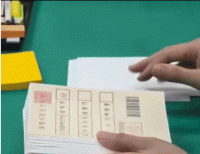
Dealers are working at the dealing room of Hana Bank headquarters in Seoul on the 8th, when the KOSPI circuit breaker was triggered amid a sharp decline. [Yonhap News]
The KOSPI plunged sharply, falling by up to 8% during trading on the 8th, and breaking the 8,000-point mark due to concerns over interest rate hikes and the impact of a shock in US semiconductor stocks.
As of 9:35 AM on the day, the KOSPI stood at 7,653.12, down 507.47 points (6.22%) from the previous trading day.
The index opened at 8,048.09, down 112.50 points (1.38%) from the previous day, then widened its decline and fell below the 8,000-point level, reaching a low of 7,442.73 (-8.80%) at one point.
This represents a 16.68% drop from the KOSPI's all-time intraday high of 8,933.62 recorded on the 2nd.
The KOSDAQ also experienced a sharp decline of over 5% on the day, falling approximately 30% from its peak.
A decline of more than 10% from the peak is considered a technical correction.
A circuit breaker was triggered in the KOSPI market shortly after opening at 9:03:42 AM due to the sharp decline.
This measure, which halts trading on the Korea Exchange for 20 minutes, was implemented because the KOSPI remained 8% below its previous day's closing price for one minute. This is the first time the circuit breaker has been activated since March 9th.
However, the sharp decline continued afterward, leading to the activation of a temporary halt on program sell orders (sell-side car).
The KOSPI's fall below the 8,000-point level marks the first time since it surpassed 8,000 points intraday on the 15th of last month, just 24 days (14 trading days) later.
Foreign investors are net sellers of 351.6 billion won in the stock market. This marks the 21st consecutive day of net selling by foreign investors.
In contrast, individual and institutional investors are net buyers of 207 billion won and 142 billion won, respectively.
In the Seoul foreign exchange market, the won-dollar exchange rate opened at 1,555.2 won per dollar, up 16.1 won from the previous trading day.
This opening rate for the exchange rate is the highest since March 6, 2009 (1,590 won), during the global financial crisis.
The KOSPI is falling sharply due to the rapid decline in stock prices, particularly in technology stocks, in the US market, and the renewed escalation of tensions in the Middle East.
In the previous trading session on the New York stock market, the Dow Jones Industrial Average and the S&P 500 index fell by 1.35% and 2.65% respectively, while the Nasdaq Composite index saw a significant drop of 4.18%.
Notably, there was a sell-off primarily in technology stocks, including Nvidia (-6.20%), Micron Technology (-13.25%), and ADM (-10.86%), causing the Philadelphia Semiconductor Index to plummet by 10.26%.
Investor sentiment has abruptly cooled due to the prospect that strong US employment data could lead the Federal Reserve (Fed) to raise interest rates within the year.
Consequently, the yields on US 10-year and 30-year Treasury bonds surpassed the psychological resistance levels of 4.5% and 5.0% respectively.
Additionally, the retreat of hopes for a de-escalation of tensions following clashes near the Strait of Hormuz over the weekend has also acted as a negative factor for the domestic stock market.
International oil prices have rebounded again due to the renewed escalation of tensions in the Middle East.
Seo Sang-young, a researcher at Mirae Asset Securities, stated, "This week's financial markets are expected to be one where discussions surrounding US inflation data, bond yields, and the sustainability of AI investments will take place concurrently."
Han Ji-young, a researcher at Kiwoom Securities, also commented, "The early part of this week could be challenging due to the lingering impact of the US semiconductor stock plunge last Friday, and the mid-week period will be affected by US May CPI (Consumer Price Index), Oracle's earnings, the SpaceX IPO, and the simultaneous expiration of futures and options contracts."
In this unfavorable market environment, major stocks including the 'KOSPI bellwether' Samsung Electronics [005930] (-5.62%) and SK Hynix [000660] (-4.11%), as well as other top market capitalization stocks, are declining.
Furthermore, most top stocks such as SK Square [402340] (-5.33%), Hyundai Motor [005380] (-7.00%), Samsung Electro-Mechanics [009150] (-3.76%), and LG Energy Solution [373220] (-2.66%) are showing losses (indicated by red indicators).
By sector, only telecommunications (2.05%) is rising, while most others, including securities (-6.95%), construction (-6.40%), and metals (-5.60%), are declining.
At the same time, the KOSDAQ index stood at 945.67, down 56.77 points (5.66%) from the previous trading day.
The index opened at 959.61, down 42.83 points (4.27%) from the previous day, falling below the 1,000-point mark.
Due to the sharp decline in the index, a sell-side car was activated in the KOSDAQ market around 9:06 AM.
Foreign investors and institutions are net buyers of 9.9 billion won and 54.7 billion won respectively, while individual investors are net sellers of 34.7 billion won.
Among top market capitalization stocks, most, including Alteogen [196170] (-8.42%), Ecopro BM [247540] (-7.63%), Ecopro [086520] (-8.86%), and Rainbow Robotics [277810] (-5.39%), are experiencing stock price declines.

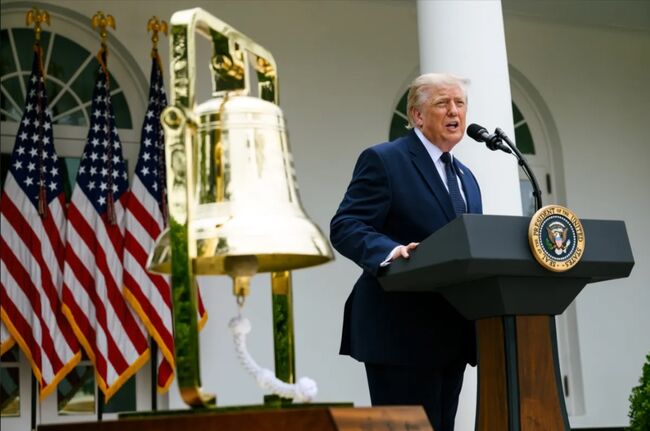 Trump pressures for rate cut again ahead of FOMC... "Should be the lowest in the world"
U.S. President Donald Trump. [Photo = The White House] U.S. President Donald Trump once again pressured the Federal Reserve, the U.S. central bank, to lower interest rates on the 27th (local time
Trump pressures for rate cut again ahead of FOMC... "Should be the lowest in the world"
U.S. President Donald Trump. [Photo = The White House] U.S. President Donald Trump once again pressured the Federal Reserve, the U.S. central bank, to lower interest rates on the 27th (local time
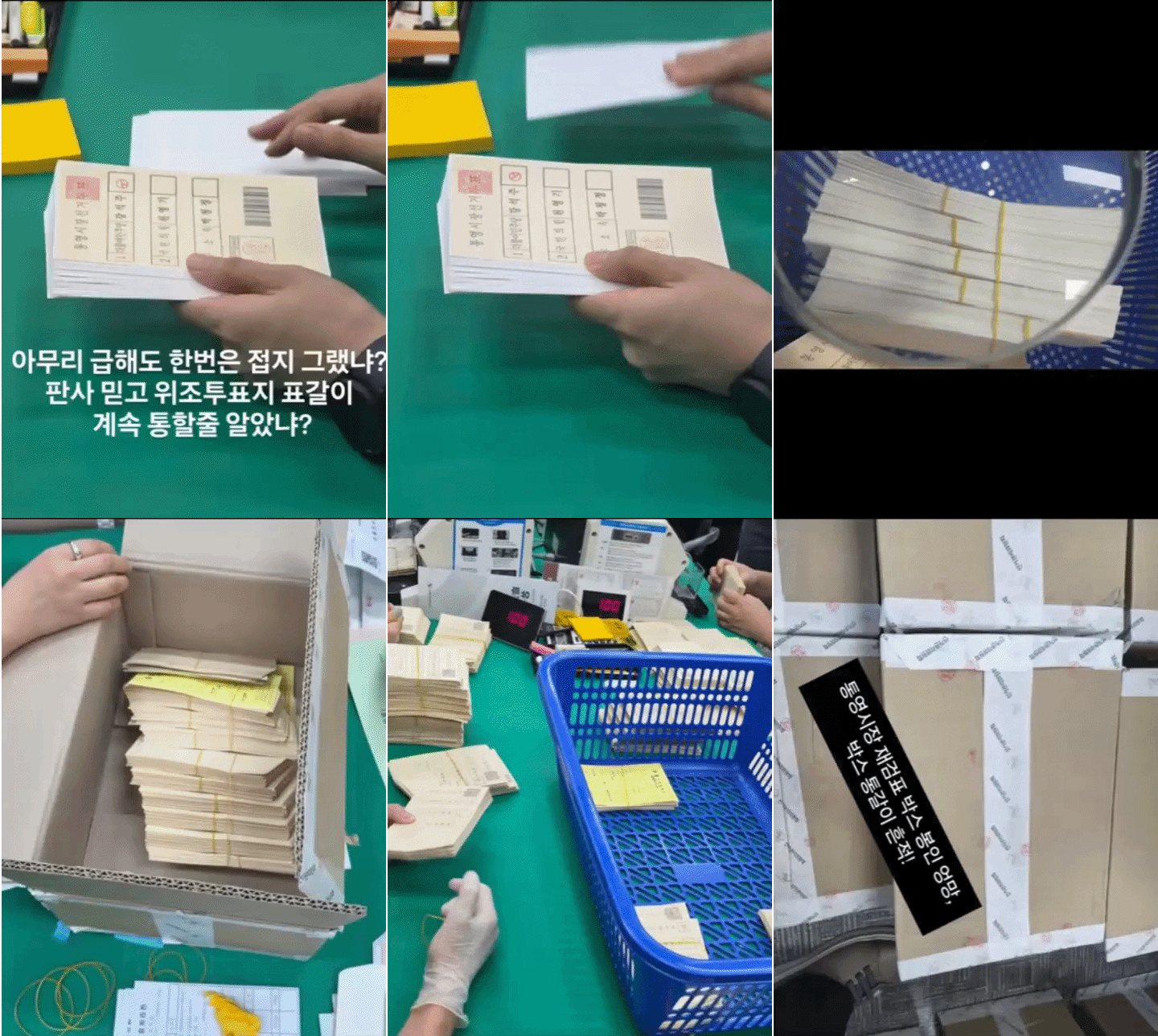 “Ignoring crisp ballots and damaged seals”… Tongyeong mayoral recount concludes with ‘no change in outcome,’ leaving suspicions and public outrage behind
Suspected counterfeit ballots discovered in Tongyeong [GIF from social media of Representative Hwang Kyo-ahn / Attorney Park Joo-hyun]During a recount of the Tongyeong mayoral election in South Gyeong
“Ignoring crisp ballots and damaged seals”… Tongyeong mayoral recount concludes with ‘no change in outcome,’ leaving suspicions and public outrage behind
Suspected counterfeit ballots discovered in Tongyeong [GIF from social media of Representative Hwang Kyo-ahn / Attorney Park Joo-hyun]During a recount of the Tongyeong mayoral election in South Gyeong
 President Yoon, regarding the first-instance ruling on the Public Official Election Act: “An excessive political verdict that distorts the facts… We will appeal immediately.”
The first-instance sentencing hearing for President Yoon Suk Yeol regarding violations of the Public Official Election Act is being broadcast live at Seoul Station on the 27th. [Photo=Yonhap News]Pres
President Yoon, regarding the first-instance ruling on the Public Official Election Act: “An excessive political verdict that distorts the facts… We will appeal immediately.”
The first-instance sentencing hearing for President Yoon Suk Yeol regarding violations of the Public Official Election Act is being broadcast live at Seoul Station on the 27th. [Photo=Yonhap News]Pres
 WSJ: "SK Hynix ADR Premium Is a Sign of AI Trading Overheat"
Advertisement for SK Hynix ADR listing in New York's Times Square [Reuters=Yonhap News file photo]The Wall Street Journal (WSJ) has pointed out that the price of SK Hynix’s American Depositary Recei
WSJ: "SK Hynix ADR Premium Is a Sign of AI Trading Overheat"
Advertisement for SK Hynix ADR listing in New York's Times Square [Reuters=Yonhap News file photo]The Wall Street Journal (WSJ) has pointed out that the price of SK Hynix’s American Depositary Recei
 'Godfather of Japanese Mystery Novels' Keigo Higashino Passes Away After Battle with Cancer at 68
Famous Japanese mystery novelist Keigo Higashino [AFP=Yonhap News]It has been belatedly reported that Keigo Higashino, the "godfather of Japanese mystery novels" and author of bestsellers such as "The
'Godfather of Japanese Mystery Novels' Keigo Higashino Passes Away After Battle with Cancer at 68
Famous Japanese mystery novelist Keigo Higashino [AFP=Yonhap News]It has been belatedly reported that Keigo Higashino, the "godfather of Japanese mystery novels" and author of bestsellers such as "The
 [Park Pil-kyu Security Column] To the Ignorant Trying to Clothe a Beast in Sheep's Clothing
Rep. Kim Byung-joo of the Democratic Party of Korea [Photo=Yonhap News]“The Air Force Academy doesn't teach you how to fly a plane!” “The Army, Navy, and Air Force academies are exactly the
[Park Pil-kyu Security Column] To the Ignorant Trying to Clothe a Beast in Sheep's Clothing
Rep. Kim Byung-joo of the Democratic Party of Korea [Photo=Yonhap News]“The Air Force Academy doesn't teach you how to fly a plane!” “The Army, Navy, and Air Force academies are exactly the
 [Issue Diagnosis] Two Effects of the Election Petition Review
 [Photo] Evidence of Election Fraud Flooding U.S. Media… Trump Had 2.7 Million Votes Stolen
 [Video] U.S. Semiquincentennial Air Show... 'Art in the Sky' streaks across New York
 [Editorial Cartoon] A Draconian Law That Undermines Freedom of Expression

 List
List