Senate Republicans, who have struggled to advance President Donald Trump’s signature "SAVE America Act" aimed at election integrity, have found new momentum.
Previously, Senate Republicans attempted twice to include the SAVE America Act in a marathon voting session to pass a $70 billion immigration enforcement bill for ICE and CBP, but failed. If successful, they would have used the budget reconciliation process to bypass the Democratic filibuster and pass the bill with a simple majority.
The reason for the failure was that several Republican senators voted against it, joining Democratic senators. Four Republican senators, Susan Collins (Maine), Lisa Murkowski (Alaska), Mitch McConnell (Kentucky), and Thom Tillis (North Carolina), voted against the bill.
The amendment they opposed was submitted by Senator Lindsey Graham (South Carolina) and sought to add several policies to the SAVE America Act, including a ban on transgender men participating in women's sports.
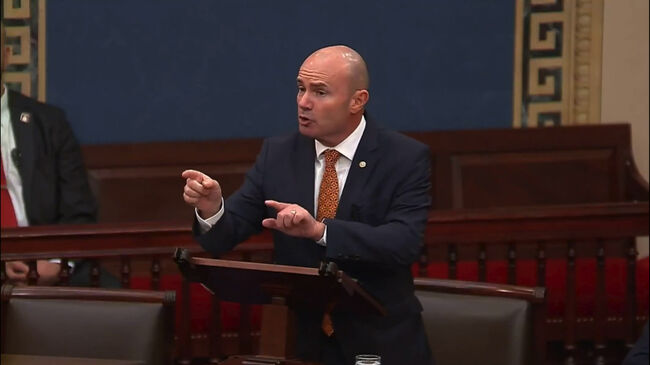
However, an amendment submitted by Senator Mike Lee (Utah) unexpectedly garnered the support of Senator Collins, achieving 50 votes in favor. This means that Vice President JD Vance could cast the 51st vote to pass the SAVE America Act.
"This means that had it not been for the zombie filibuster, the SAVE America Act, which passed the House, would have gone to the White House to be signed by President Trump," Lee said.
Conservatives, including Senator Lee, have been pressuring Senate Majority Leader John Thune (R-S.D.) to filibuster to exhaust the Democrats and pass the bill with a simple majority.
Senator Lee stated that he would give Democrats an opportunity to support the SAVE America Act and dismissed Democratic criticism of the bill as "paranoid delusion."
However, Thune is reportedly not rushing to process the bill, fearing that Republicans will not unite to block the numerous amendments that Democrats could introduce.
Republicans could also abolish the filibuster rule altogether. However, there is considerable debate among Republican senators about this approach, as it could become a significant obstacle for Republicans if Democrats gain majority status in the Senate.
In 1917, the "Cloture" rule, which allows for the termination of unlimited debate, was first introduced, requiring a two-thirds vote of present senators. In 1975, this requirement was significantly reduced to 60 votes, or three-fifths.
In 2013, under Democratic leadership, the threshold for blocking the filibuster on nominations for high-level cabinet positions and federal lower court judges was lowered from 60 votes to a simple majority, effectively neutralizing it. In 2017, under Republican leadership, the scope was expanded to include nominations for federal Supreme Court justices, making it impossible to block Supreme Court appointments through filibuster.
According to Fox News, Thune said, "As you know, this is not a new requirement. And generally in Congress, rulings are like a double-edged sword. We can't help but win some and lose some, but it was the same when the Democrats were the majority."
By Sung Ku Hong, Chief Reporter, NNP USA / Special Correspondent NNP info@newsandpost.com

 Iranian Foreign Ministry: "Continuing Message Exchanges with the U.S. and Activities of Mediating Countries"
Esmaeil Baghaei, Spokesperson for the Iranian Ministry of Foreign Affairs [Xinhua, Yonhap News file photo]Esmaeil Baghaei, spokesperson for the Iranian Ministry of Foreign Affairs, stated on the 26th
Iranian Foreign Ministry: "Continuing Message Exchanges with the U.S. and Activities of Mediating Countries"
Esmaeil Baghaei, Spokesperson for the Iranian Ministry of Foreign Affairs [Xinhua, Yonhap News file photo]Esmaeil Baghaei, spokesperson for the Iranian Ministry of Foreign Affairs, stated on the 26th
 President Yoon: "Do You Think You Are Safe from the Special Counsel?"... Final Statement Video Released
President Yoon Suk Yeol rebuking the special prosecutor on the 24th. [Court video / @birds_justice X account subtitle GIF] A video of President Yoon Suk Yeol's closing statement at his trial rega
President Yoon: "Do You Think You Are Safe from the Special Counsel?"... Final Statement Video Released
President Yoon Suk Yeol rebuking the special prosecutor on the 24th. [Court video / @birds_justice X account subtitle GIF] A video of President Yoon Suk Yeol's closing statement at his trial rega
 President Yoon, regarding the first-instance ruling on the Public Official Election Act: “An excessive political verdict that distorts the facts… We will appeal immediately.”
The first-instance sentencing hearing for President Yoon Suk Yeol regarding violations of the Public Official Election Act is being broadcast live at Seoul Station on the 27th. [Photo=Yonhap News]Pres
President Yoon, regarding the first-instance ruling on the Public Official Election Act: “An excessive political verdict that distorts the facts… We will appeal immediately.”
The first-instance sentencing hearing for President Yoon Suk Yeol regarding violations of the Public Official Election Act is being broadcast live at Seoul Station on the 27th. [Photo=Yonhap News]Pres
 WSJ: "SK Hynix ADR Premium Is a Sign of AI Trading Overheat"
Advertisement for SK Hynix ADR listing in New York's Times Square [Reuters=Yonhap News file photo]The Wall Street Journal (WSJ) has pointed out that the price of SK Hynix’s American Depositary Recei
WSJ: "SK Hynix ADR Premium Is a Sign of AI Trading Overheat"
Advertisement for SK Hynix ADR listing in New York's Times Square [Reuters=Yonhap News file photo]The Wall Street Journal (WSJ) has pointed out that the price of SK Hynix’s American Depositary Recei
 'Godfather of Japanese Mystery Novels' Keigo Higashino Passes Away After Battle with Cancer at 68
Famous Japanese mystery novelist Keigo Higashino [AFP=Yonhap News]It has been belatedly reported that Keigo Higashino, the "godfather of Japanese mystery novels" and author of bestsellers such as "The
'Godfather of Japanese Mystery Novels' Keigo Higashino Passes Away After Battle with Cancer at 68
Famous Japanese mystery novelist Keigo Higashino [AFP=Yonhap News]It has been belatedly reported that Keigo Higashino, the "godfather of Japanese mystery novels" and author of bestsellers such as "The
 [Park Pil-kyu Security Column] To the Ignorant Trying to Clothe a Beast in Sheep's Clothing
Rep. Kim Byung-joo of the Democratic Party of Korea [Photo=Yonhap News]“The Air Force Academy doesn't teach you how to fly a plane!” “The Army, Navy, and Air Force academies are exactly the
[Park Pil-kyu Security Column] To the Ignorant Trying to Clothe a Beast in Sheep's Clothing
Rep. Kim Byung-joo of the Democratic Party of Korea [Photo=Yonhap News]“The Air Force Academy doesn't teach you how to fly a plane!” “The Army, Navy, and Air Force academies are exactly the
 [Issue Diagnosis] Two Effects of the Election Petition Review
 [Photo] Evidence of Election Fraud Flooding U.S. Media… Trump Had 2.7 Million Votes Stolen
 [Video] U.S. Semiquincentennial Air Show... 'Art in the Sky' streaks across New York
 [Editorial Cartoon] A Draconian Law That Undermines Freedom of Expression

 List
List