 The Tumen River, which separates Tumen City (left) in China from Namyang Workers' District in Onsong County, North Korea. [Photo=Yonhap News]
President Xi Jinping's visit to Pyongyang from June 8-9 was not merely a goodwill visit or a celebration of diplomatic relations. It revealed a sophisticated strategy to reaffirm influence on the Korean Peninsula and establish a new strategic order amidst the grand geopolitical landscape of US-China strategic competition, North Korea-Russia military cooperation, and the shifting balance of power in Northeast Asia.
1. Hidden Intentions of the Pyongyang Visit and Ambitions for Maritime Expansion
Particularly noteworthy is the de facto disappearance of "denuclearization" from the summit agenda and the emphasis placed on "safeguarding sovereignty, security, and development interests." This starkly illustrates China's evolving stance: it is now realistically tolerating North Korea's nuclear weapons and intends to leverage them as strategic assets to counter the United States in the current US-China confrontation.
Ultimately, this visit can be assessed as a declaration of a "highly calculated strategic symbiosis" where North Korea is granted normalization of border trade and the resumption of air and rail services for regime security and economic/security breathing room, while China aims to seize the initiative in Korean Peninsula affairs and pressure the United States.
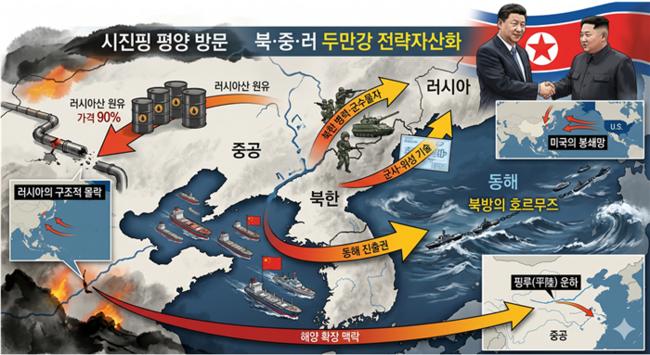
More importantly, beyond political and military alignment, the visit is deeply imbued with China's long-held ambition to establish a bridgehead on the Tumen River for its "advance into the East Sea."
It is crucial to note that China's strategy to secure maritime access through the lower reaches of the Tumen River, as part of its development of the Northeast Three Provinces and its logistics network in the East Sea, was a core agenda item discussed beneath the surface of the North Korea-China talks.
We must analyze and prepare for the triangular contest among North Korea, which controls the Tumen River; China, which seeks access to the Tumen River; and Russia, which stands to benefit from allowing navigation through the Tumen River estuary, from the perspective of our national survival.
2. Russia's Structural Collapse and China's Expansion into the East Sea
Behind the shift in communist bloc hegemony lies the tragic plight of Russia, which has become China's "energy transporter" and effectively a northern vassal state due to the prolonged Ukraine war. With its oil refining facilities devastated by Ukrainian drone attacks, Russia faces the risk of "oil field collapse" where crude oil solidifies underground, and its access to the European market has been cut off.
China is exploiting this critical weakness, slashing the price of Russian crude oil to about 90% of market value. Russia is caught in a vicious cycle, bleeding its resources but struggling to even cover war costs.
Ultimately, the last card thrown by Putin, facing a survival crisis, is the "geopolitical collateral" that has been protected for generations and China's long-cherished "right to access the East Sea." Historically, China has strived to regain navigation rights through the Tumen River estuary since losing them in the 1860 Treaty of Beijing, while Russia has rigorously blocked it for its own security.
However, cornered by the war, Russia has finally unlocked the security gate it had maintained for over 160 years. In a joint statement in May 2024, Russia officially stated that it "will hold constructive dialogue regarding Chinese vessels' navigation through the Tumen River estuary and their access to the East Sea." In essence, for a few dollars and to continue the war, it has entirely ceded the gateway to East Sea hegemony to China.
3. China's Absorption of North Korea and the US Response to Blockades
As Russia's defensive wall crumbles, China is moving to bring North Korea firmly under its strategic control.
As North Korea sought to reduce its reliance on China by receiving military and satellite technology from Russia in exchange for providing troops and military supplies, China sent a warning signal: "While you can get closer to Russia, you cannot deviate from China's role as your strategic patron."
China is now unlatching the doors to cash, food, and technological aid, which it had previously withheld while observing the US, in an effort to firmly secure North Korea as a buffer zone. Simultaneously, this is a direct challenge to the US's Indo-Pacific containment strategy. From China's perspective, North Korea is a powerful shield that diverts pressure from US-South Korea security cooperation.
If tensions on the Korean Peninsula escalate, a significant portion of US military power will be tied down by North Korean provocations, making it difficult for the US to focus on Taiwan and the South China Sea. The explicit mention of cooperation in diplomacy, law enforcement, and military matters during this meeting is a strategic demonstration to the US, signaling a potential move towards a security community.
4. China's Strategic Expansion into the Tumen River and East Sea, and Its Linkage with the Pinglu Canal
This geopolitical pressure from China is closely intertwined with its domestic economic survival strategy. To revitalize the economies of its chronically stagnant Northeast Three Provinces (Jilin, Liaoning, Heilongjiang), China has long yearned to utilize the Rason-Sonbong Special Economic Zone and secure a waterway through the lower Tumen River.
This aligns perfectly with China's broader maritime expansion, evidenced by the construction of the "Pinglu Canal," which connects its southwestern inland regions with Southeast Asia, involving astronomical capital investment. Just as it expanded its logistics hegemony in the south through the canal, China calculates it can secure the "Hunchun-Rason-Sonbong" logistics network in the north to ship its own cargo directly into the East Sea.
Once this route is opened, logistics efficiency between China and Russia's Far East will be maximized. Ultimately, in exchange for supporting the North Korean regime, China will simultaneously seize maritime control in the northern Korean Peninsula and practical economic territory.
5. The "Strait of Hormuz of the North" Crisis and Our Response
In conclusion, Xi Jinping's visit to Pyongyang has reaffirmed North Korea's status as a key strategic asset in the US-China competition. Most concerning is the fact that as China's acquisition of waterway access in the lower Tumen River and its push into the East Sea materialize, not only our West Sea but also our East Sea will be exposed to China's maritime influence.
If Chinese maritime forces, disguised as civilian vessels, and energy logistics flood into the East Sea, it would create an unprecedented security disaster, with the geopolitical crisis of the Strait of Hormuz in the Middle East spilling over into our East Sea. The East Sea would transform into the "Strait of Hormuz of the North," dominated by the maritime hegemony of North Korea, China, and Russia.
As Russia's temporary decline and China's expansion converge on the Tumen River, which is constitutionally part of our territory, the Republic of Korea must solidify its alliance with the United States and meticulously re-examine its maritime security capabilities without any gaps. In this era of immense geopolitical upheaval, the historical golden time afforded to us is not long.
◆ Park Pil-gyu
Editorial board member of the Hankyoreh
Korea Military Academy, Class of 40

 Iranian Foreign Ministry: "Continuing Message Exchanges with the U.S. and Activities of Mediating Countries"
Esmaeil Baghaei, Spokesperson for the Iranian Ministry of Foreign Affairs [Xinhua, Yonhap News file photo]Esmaeil Baghaei, spokesperson for the Iranian Ministry of Foreign Affairs, stated on the 26th
Iranian Foreign Ministry: "Continuing Message Exchanges with the U.S. and Activities of Mediating Countries"
Esmaeil Baghaei, Spokesperson for the Iranian Ministry of Foreign Affairs [Xinhua, Yonhap News file photo]Esmaeil Baghaei, spokesperson for the Iranian Ministry of Foreign Affairs, stated on the 26th
 President Yoon: "Do You Think You Are Safe from the Special Counsel?"... Final Statement Video Released
President Yoon Suk Yeol rebuking the special prosecutor on the 24th. [Court video / @birds_justice X account subtitle GIF] A video of President Yoon Suk Yeol's closing statement at his trial rega
President Yoon: "Do You Think You Are Safe from the Special Counsel?"... Final Statement Video Released
President Yoon Suk Yeol rebuking the special prosecutor on the 24th. [Court video / @birds_justice X account subtitle GIF] A video of President Yoon Suk Yeol's closing statement at his trial rega
 President Yoon, regarding the first-instance ruling on the Public Official Election Act: “An excessive political verdict that distorts the facts… We will appeal immediately.”
The first-instance sentencing hearing for President Yoon Suk Yeol regarding violations of the Public Official Election Act is being broadcast live at Seoul Station on the 27th. [Photo=Yonhap News]Pres
President Yoon, regarding the first-instance ruling on the Public Official Election Act: “An excessive political verdict that distorts the facts… We will appeal immediately.”
The first-instance sentencing hearing for President Yoon Suk Yeol regarding violations of the Public Official Election Act is being broadcast live at Seoul Station on the 27th. [Photo=Yonhap News]Pres
 WSJ: "SK Hynix ADR Premium Is a Sign of AI Trading Overheat"
Advertisement for SK Hynix ADR listing in New York's Times Square [Reuters=Yonhap News file photo]The Wall Street Journal (WSJ) has pointed out that the price of SK Hynix’s American Depositary Recei
WSJ: "SK Hynix ADR Premium Is a Sign of AI Trading Overheat"
Advertisement for SK Hynix ADR listing in New York's Times Square [Reuters=Yonhap News file photo]The Wall Street Journal (WSJ) has pointed out that the price of SK Hynix’s American Depositary Recei
 'Godfather of Japanese Mystery Novels' Keigo Higashino Passes Away After Battle with Cancer at 68
Famous Japanese mystery novelist Keigo Higashino [AFP=Yonhap News]It has been belatedly reported that Keigo Higashino, the "godfather of Japanese mystery novels" and author of bestsellers such as "The
'Godfather of Japanese Mystery Novels' Keigo Higashino Passes Away After Battle with Cancer at 68
Famous Japanese mystery novelist Keigo Higashino [AFP=Yonhap News]It has been belatedly reported that Keigo Higashino, the "godfather of Japanese mystery novels" and author of bestsellers such as "The
 [Park Pil-kyu Security Column] To the Ignorant Trying to Clothe a Beast in Sheep's Clothing
Rep. Kim Byung-joo of the Democratic Party of Korea [Photo=Yonhap News]“The Air Force Academy doesn't teach you how to fly a plane!” “The Army, Navy, and Air Force academies are exactly the
[Park Pil-kyu Security Column] To the Ignorant Trying to Clothe a Beast in Sheep's Clothing
Rep. Kim Byung-joo of the Democratic Party of Korea [Photo=Yonhap News]“The Air Force Academy doesn't teach you how to fly a plane!” “The Army, Navy, and Air Force academies are exactly the
 [Issue Diagnosis] Two Effects of the Election Petition Review
 [Photo] Evidence of Election Fraud Flooding U.S. Media… Trump Had 2.7 Million Votes Stolen
 [Video] U.S. Semiquincentennial Air Show... 'Art in the Sky' streaks across New York
 [Editorial Cartoon] A Draconian Law That Undermines Freedom of Expression

 List
List









