Apartment complex in Seoul (Seoul=Yonhap News) Reporter Lee Jae-hee = The appearance of an apartment complex viewed from Namsan in Seoul on the 1st. [Yonhap News]
Amid deepening wealth inequality due to rising real estate prices, the Bank of Korea has analyzed that the position of young people without homes is shrinking as income inequality also grows due to so-called "K-shaped growth" skewed towards some information technology (IT) sectors.
In a report titled "BOK Issues Note: The Reality and Impact of Household Polarization in Our Economy," released on the 11th, the BOK diagnosed that the Korean economy is currently facing a situation of "complex polarization," characterized by a combination of widening wealth gaps and the re-expansion of income gaps.
The report pointed out that while wealth polarization between households and generations has become structurally entrenched due to the surge in real estate prices, signs of widening income inequality, which had been on a downward trend, are now emerging due to growth disparities between industries.
The income Gini coefficient, which indicates the degree of income inequality, had been on a downward trend since 2021 but rebounded in 2024 after a three-year decline.
In particular, income inequality between industries is worsening as wages are significantly increasing in the IT sector, with companies like Samsung Electronics and SK Hynix deciding to pay large performance bonuses, while wage growth in other sectors remains limited.
Lee Jae-ho, a deputy director at the BOK's Economic Research Department who authored the report, explained, "In the past, wage gaps were mainly seen based on employment status, such as permanent versus non-permanent employees. However, the current characteristic of income polarization is the prominent gap between industries."
The spread of artificial intelligence (AI) technology is also likely to widen income gaps by replacing jobs held by low-income individuals and young people with less experience.
According to a survey conducted by the BOK, a higher proportion of respondents with lower income levels and younger age groups indicated that their jobs are likely to be replaced by AI.
Looking at the number of employed individuals by age group since the release of generative AI, employment for young people has rapidly decreased, while employment for those in their 50s has actually increased.
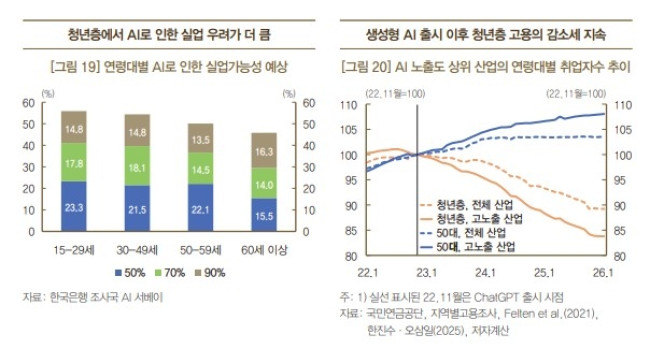 Concerns about youth unemployment due to AI [Provided by the Bank of Korea]
The BOK assessed that the economic standing of those without homes and young people is significantly declining as the wealth polarization, solidified by rising real estate prices, is compounded by widening income gaps due to the spread of AI.
According to the report, the proportion of young people aged 20-30 among households in the bottom 20% (1st quintile) for both net assets and income nearly doubled from 7.9% in 2020 to 15.2% in 2025.
During this period, only the proportion of those in their 20s and 30s increased among all age groups.
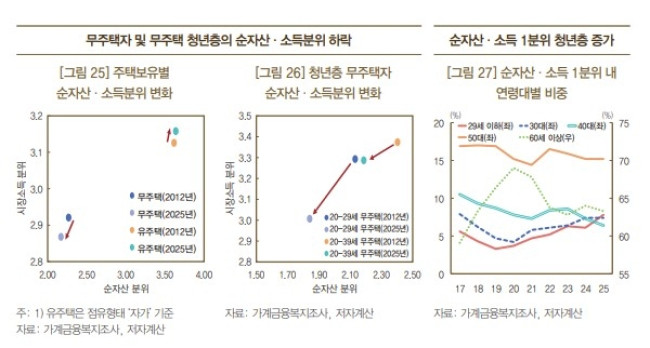 Decline in net assets and income quintiles for homeowners and young homeowners [Provided by the Bank of Korea]
The BOK pointed out that as wealth and income polarization widen, the overall productivity of the economy declines, posing a risk of hindering our economic growth.
According to the report, a 1%p increase in the wealth share of the top 10% leads to a 0.16% decrease in total factor productivity two years later.
Furthermore, it added that the reduction in the economic activity capacity of low-income and young households, which have a relatively high propensity to consume, risks lowering domestic demand vitality for the entire economy.
To address these complex polarization issues, the BOK proposed improving household asset structures centered on real estate and guiding household funds towards productive sectors to promote efficient resource allocation.
Additionally, it suggested redesigning the redistribution system to ensure that the benefits of technological advancements spread throughout the economy and strengthening vocational training support for job transitions and retraining for workers in occupations with a high risk of technological displacement.
The BOK also proposed revitalizing the domestic ecosystem, including the materials, components, and equipment industries, for key industries such as semiconductors, to ensure that the performance of the IT sector spreads throughout the economy. It also recommended increasing investment in non-IT core industries such as shipbuilding, defense, and nuclear power.

 Trump pressures for rate cut again ahead of FOMC... "Should be the lowest in the world"
U.S. President Donald Trump. [Photo = The White House] U.S. President Donald Trump once again pressured the Federal Reserve, the U.S. central bank, to lower interest rates on the 27th (local time
Trump pressures for rate cut again ahead of FOMC... "Should be the lowest in the world"
U.S. President Donald Trump. [Photo = The White House] U.S. President Donald Trump once again pressured the Federal Reserve, the U.S. central bank, to lower interest rates on the 27th (local time
 “Ignoring crisp ballots and damaged seals”… Tongyeong mayoral recount concludes with ‘no change in outcome,’ leaving suspicions and public outrage behind
Suspected counterfeit ballots discovered in Tongyeong [GIF from social media of Representative Hwang Kyo-ahn / Attorney Park Joo-hyun]During a recount of the Tongyeong mayoral election in South Gyeong
“Ignoring crisp ballots and damaged seals”… Tongyeong mayoral recount concludes with ‘no change in outcome,’ leaving suspicions and public outrage behind
Suspected counterfeit ballots discovered in Tongyeong [GIF from social media of Representative Hwang Kyo-ahn / Attorney Park Joo-hyun]During a recount of the Tongyeong mayoral election in South Gyeong
 President Yoon, regarding the first-instance ruling on the Public Official Election Act: “An excessive political verdict that distorts the facts… We will appeal immediately.”
The first-instance sentencing hearing for President Yoon Suk Yeol regarding violations of the Public Official Election Act is being broadcast live at Seoul Station on the 27th. [Photo=Yonhap News]Pres
President Yoon, regarding the first-instance ruling on the Public Official Election Act: “An excessive political verdict that distorts the facts… We will appeal immediately.”
The first-instance sentencing hearing for President Yoon Suk Yeol regarding violations of the Public Official Election Act is being broadcast live at Seoul Station on the 27th. [Photo=Yonhap News]Pres
 WSJ: "SK Hynix ADR Premium Is a Sign of AI Trading Overheat"
Advertisement for SK Hynix ADR listing in New York's Times Square [Reuters=Yonhap News file photo]The Wall Street Journal (WSJ) has pointed out that the price of SK Hynix’s American Depositary Recei
WSJ: "SK Hynix ADR Premium Is a Sign of AI Trading Overheat"
Advertisement for SK Hynix ADR listing in New York's Times Square [Reuters=Yonhap News file photo]The Wall Street Journal (WSJ) has pointed out that the price of SK Hynix’s American Depositary Recei
 'Godfather of Japanese Mystery Novels' Keigo Higashino Passes Away After Battle with Cancer at 68
Famous Japanese mystery novelist Keigo Higashino [AFP=Yonhap News]It has been belatedly reported that Keigo Higashino, the "godfather of Japanese mystery novels" and author of bestsellers such as "The
'Godfather of Japanese Mystery Novels' Keigo Higashino Passes Away After Battle with Cancer at 68
Famous Japanese mystery novelist Keigo Higashino [AFP=Yonhap News]It has been belatedly reported that Keigo Higashino, the "godfather of Japanese mystery novels" and author of bestsellers such as "The
 [Park Pil-kyu Security Column] To the Ignorant Trying to Clothe a Beast in Sheep's Clothing
Rep. Kim Byung-joo of the Democratic Party of Korea [Photo=Yonhap News]“The Air Force Academy doesn't teach you how to fly a plane!” “The Army, Navy, and Air Force academies are exactly the
[Park Pil-kyu Security Column] To the Ignorant Trying to Clothe a Beast in Sheep's Clothing
Rep. Kim Byung-joo of the Democratic Party of Korea [Photo=Yonhap News]“The Air Force Academy doesn't teach you how to fly a plane!” “The Army, Navy, and Air Force academies are exactly the
 [Issue Diagnosis] Two Effects of the Election Petition Review
 [Photo] Evidence of Election Fraud Flooding U.S. Media… Trump Had 2.7 Million Votes Stolen
 [Video] U.S. Semiquincentennial Air Show... 'Art in the Sky' streaks across New York
 [Editorial Cartoon] A Draconian Law That Undermines Freedom of Expression

 List
List