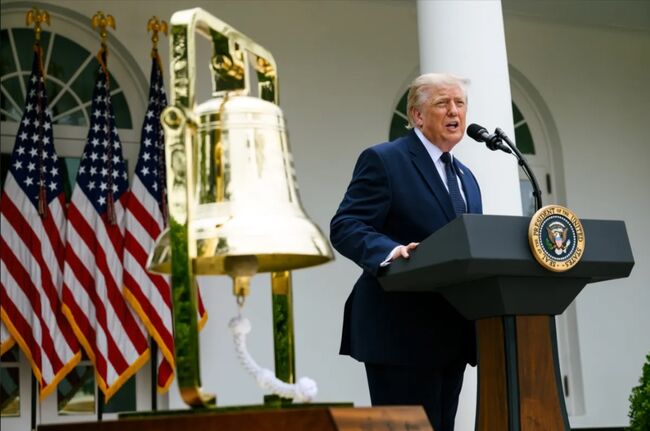
 This illustrates the paradox where strong employment and economic growth increase the likelihood of interest rate hikes, which in turn leads to downward pressure on stock prices. It shows the current market structure where good economic indicators are not necessarily a boon for the stock market. ]Image=Hanmi Ilbo]
Why Good Employment Became Bad News for Stock Prices
The biggest paradox of the market this week was that good economic indicators drove down stock prices.
The number of non-farm payroll employees in the U.S. in May increased by 172,000, significantly exceeding the market expectation of 88,000. Stronger-than-expected employment indicates a robust U.S. economy and sustained consumer spending power. Generally, this is positive news for corporate revenue and earnings.
However, the stock market reacted to interest rates before economic growth.
Strong employment can lead to increased wages and consumption, potentially driving up inflation again. This reduces the Federal Reserve's need to lower interest rates and could even lead to further rate hikes depending on the situation. Good employment, therefore, signifies prolonged high interest rates, turning it into bad news for the stock market.
An interest rate hike is fundamentally bad news for the stock market as a whole.
As interest rates rise, companies' borrowing costs increase. The cost of funds needed for investment, factory expansion, and mergers and acquisitions goes up. Simultaneously, the discount rate applied to calculate the present value of future earnings also rises.
Stocks that heavily reflect future growth expectations rather than current earnings, such as those in AI, semiconductors, internet, and biotech, are particularly affected. Even if a company's growth outlook remains the same, higher interest rates will lead to a lower fair stock price.
The sharp decline and rebound in semiconductor stocks this week should be understood within this framework.
When U.S. employment data came out strong, the market repriced the possibility of interest rate hikes within the year. U.S. 10-year and 2-year Treasury yields rose, and semiconductor and AI-related stocks plummeted. Subsequently, as inflation data came in lower than expected and tensions in the Middle East eased, Treasury yields fell, leading to a rebound in semiconductor stocks.
This was not because AI semiconductor demand disappeared and then reappeared within a single day. It was because investors' willingness to pay for the same future earnings changed as interest rates fluctuated.
Of course, interest rate hikes are not equally bad for all sectors.
Banks can see their net interest margins widen if lending rates rise faster than deposit rates. Insurance companies can also increase their investment yields by investing in bonds with higher interest rates. If interest rate hikes are accompanied by economic prosperity, industrial and some cyclical stocks may perform relatively well.
However, if interest rates rise excessively, the interest burden on households and businesses increases, leading to a slowdown in consumption and investment. Delinquencies and bad loans also rise. The initial benefits seen in financial stocks are unlikely to be sustained long-term.
It is also important to consider why interest rates are rising.
When interest rates rise due to strong growth and employment, corporate earnings can somewhat cushion stock price declines. Conversely, when interest rates are tightened to curb rising oil prices and inflation, economic slowdown and valuation decline occur simultaneously. This is a much more significant negative for the stock market.
The most dangerous combination in the current market is rising oil prices, rising U.S. interest rates, a strengthening dollar, and a weakening won. If this combination occurs, foreign capital will flow out of the Korean market, putting pressure on both Samsung Electronics and SK Hynix.
Samsung Electronics will be hit by interest rate shocks through foreign investor flows, while SK Hynix will face a double blow from foreign investor flows and AI valuation adjustments.
The conclusion of Money Insight this week is that earnings alone are not the sole determinant of the semiconductor bull market.
Even with strong AI demand and memory prices, stock prices can be volatile if U.S. Treasury yields continue to rise.
Conversely, if U.S. interest rates stabilize and the won strengthens, semiconductor earnings and AI demand can once again become the central variables driving stock prices.
Next Week's Checkpoints
We need to monitor how strongly the Federal Reserve signals potential interest rate hikes, the direction of U.S. 10-year Treasury yields after the FOMC meeting, and whether oil price stabilization translates into actual inflation and interest rate reductions.
The direction of semiconductor stocks next week is likely to be determined first in the U.S. Treasury market, rather than in the semiconductor plants themselves.

 Trump pressures for rate cut again ahead of FOMC... "Should be the lowest in the world"
U.S. President Donald Trump. [Photo = The White House] U.S. President Donald Trump once again pressured the Federal Reserve, the U.S. central bank, to lower interest rates on the 27th (local time
Trump pressures for rate cut again ahead of FOMC... "Should be the lowest in the world"
U.S. President Donald Trump. [Photo = The White House] U.S. President Donald Trump once again pressured the Federal Reserve, the U.S. central bank, to lower interest rates on the 27th (local time
 “Ignoring crisp ballots and damaged seals”… Tongyeong mayoral recount concludes with ‘no change in outcome,’ leaving suspicions and public outrage behind
Suspected counterfeit ballots discovered in Tongyeong [GIF from social media of Representative Hwang Kyo-ahn / Attorney Park Joo-hyun]During a recount of the Tongyeong mayoral election in South Gyeong
“Ignoring crisp ballots and damaged seals”… Tongyeong mayoral recount concludes with ‘no change in outcome,’ leaving suspicions and public outrage behind
Suspected counterfeit ballots discovered in Tongyeong [GIF from social media of Representative Hwang Kyo-ahn / Attorney Park Joo-hyun]During a recount of the Tongyeong mayoral election in South Gyeong
 President Yoon, regarding the first-instance ruling on the Public Official Election Act: “An excessive political verdict that distorts the facts… We will appeal immediately.”
The first-instance sentencing hearing for President Yoon Suk Yeol regarding violations of the Public Official Election Act is being broadcast live at Seoul Station on the 27th. [Photo=Yonhap News]Pres
President Yoon, regarding the first-instance ruling on the Public Official Election Act: “An excessive political verdict that distorts the facts… We will appeal immediately.”
The first-instance sentencing hearing for President Yoon Suk Yeol regarding violations of the Public Official Election Act is being broadcast live at Seoul Station on the 27th. [Photo=Yonhap News]Pres
 WSJ: "SK Hynix ADR Premium Is a Sign of AI Trading Overheat"
Advertisement for SK Hynix ADR listing in New York's Times Square [Reuters=Yonhap News file photo]The Wall Street Journal (WSJ) has pointed out that the price of SK Hynix’s American Depositary Recei
WSJ: "SK Hynix ADR Premium Is a Sign of AI Trading Overheat"
Advertisement for SK Hynix ADR listing in New York's Times Square [Reuters=Yonhap News file photo]The Wall Street Journal (WSJ) has pointed out that the price of SK Hynix’s American Depositary Recei
 'Godfather of Japanese Mystery Novels' Keigo Higashino Passes Away After Battle with Cancer at 68
Famous Japanese mystery novelist Keigo Higashino [AFP=Yonhap News]It has been belatedly reported that Keigo Higashino, the "godfather of Japanese mystery novels" and author of bestsellers such as "The
'Godfather of Japanese Mystery Novels' Keigo Higashino Passes Away After Battle with Cancer at 68
Famous Japanese mystery novelist Keigo Higashino [AFP=Yonhap News]It has been belatedly reported that Keigo Higashino, the "godfather of Japanese mystery novels" and author of bestsellers such as "The
 [Park Pil-kyu Security Column] To the Ignorant Trying to Clothe a Beast in Sheep's Clothing
Rep. Kim Byung-joo of the Democratic Party of Korea [Photo=Yonhap News]“The Air Force Academy doesn't teach you how to fly a plane!” “The Army, Navy, and Air Force academies are exactly the
[Park Pil-kyu Security Column] To the Ignorant Trying to Clothe a Beast in Sheep's Clothing
Rep. Kim Byung-joo of the Democratic Party of Korea [Photo=Yonhap News]“The Air Force Academy doesn't teach you how to fly a plane!” “The Army, Navy, and Air Force academies are exactly the
 [Issue Diagnosis] Two Effects of the Election Petition Review
 [Photo] Evidence of Election Fraud Flooding U.S. Media… Trump Had 2.7 Million Votes Stolen
 [Video] U.S. Semiquincentennial Air Show... 'Art in the Sky' streaks across New York
 [Editorial Cartoon] A Draconian Law That Undermines Freedom of Expression

 List
List









