더불어민주당 남인순·이수진 의원이 발의한 ‘모자보건법 개정안’은 먹는 낙태약 도입과 건강보험 적용, 그리고 법령상 용어를 ‘인공임신중절’에서 ‘인공임신중지’로 변경하는 내용을 담고 있습니다. 여성계와 좌파 진영은 이를 ‘여성 건강권’과 ‘자기결정권’의 진전이라 주장하지만, 기독교계와 보수단체는 태아의 생명권을 침해하는 극단적 조치로 반대하고 있습니다. 특히 용어 변경은 단순한 표현 차이가 아닌, 1960년대 이후 급진 페미니즘이 주도해 온 언어·사상 전환 흐름과 맞물려 있어 사회·문화적 논쟁이 확산되고 있습니다. 본 기고문은 이 ‘임신중지’ 용어 변화의 역사와 사상적 배경을 짚고, 법안이 지닌 생명윤리적 결여를 비판적으로 분석합니다. <편집자 주>
 On the 4th, at the National Assembly Communication Center, the National Federation for Fetal and Women's Protection, comprising 69 civic groups, held a press conference at the National Assembly's Press Hall to oppose the amendment to the Maternal and Child Health Act proposed by Assembly members Nam In-soon and Lee Su-jin.
The "Abortion" related bill, specifically the <Amendment to the Maternal and Child Health Act>, proposed by Democratic Party Assembly members Nam In-soon and Lee Su-jin in July, has become a political issue due to opposition from conservative groups, including the Christian community. They have formed the <National Federation for Fetal and Women's Protection> comprising 69 organizations to counter this. The core of the bill proposed by the two assembly members includes the introduction of the abortion pill, which is not yet approved domestically. Assembly member Nam In-soon added the explanation, "Introduction of safe medication for pregnancy termination for women," when proposing the bill.
The bill contains four main points: △ Unlimited abortion for full-term fetuses △ Introduction of the abortion pill △ Application of National Health Insurance for induced abortion procedures and abortion medication △ Change in terminology from "induced abortion" to "pregnancy termination." As is well-known, the Constitutional Court ruled in 2019 that the crime of abortion under the Penal Act was unconstitutional. The Constitutional Court cited "excessive infringement of the pregnant woman's right to self-determination" and ordered the National Assembly to enact alternative legislation by the end of December 2020, stating that fetuses after 22 weeks of gestation have a possibility of independent survival. However, the National Assembly has failed to enact alternative legislation for six years. Pro-choice advocates interpret this as a de facto decriminalization, as the abortion crime has been invalidated.
In this context, Assembly members Nam In-soon and Lee Su-jin have proposed a radical <Amendment to the Maternal and Child Health Act>. Women's groups advocating for the abolition of the abortion crime have been actively campaigning for the introduction of abortion medication for years. This author intends to examine the background and context of changing the term "abortion" to "pregnancy termination" through this column.
The leftist feminist movement, which advocates for abortion rights, has, from some point onwards, defined the term "abortion" as discriminatory towards women and argued that it should be replaced with "pregnancy termination" or "interruption of pregnancy." Now, "pregnancy termination" has become the socially accepted term instead of "abortion." They argued that the meaning of "abortion," which is "to drop the fetus," carries a negative connotation that unfairly blames only the woman. During the peak of the feminist movement in Korea in 2017, activists campaigning for the abolition of the abortion crime simultaneously pushed for the use of "pregnancy termination," emphasizing that respecting women's sexual self-determination as autonomous beings is the path to a gender-equal society.
For instance, one of the slogans of the <Joint Action for the Abolition of the Abortion Crime for All>, formed in 2017, was "The state must guarantee pregnancy termination as a health right." Since then, they have strongly advocated for the legalization of the abortion pill. In the <Discussion on Resolving the Legislative Void for Induced Pregnancy Termination> hosted by Democratic Party Assembly member Nam In-soon at the National Assembly on August 6th, the title also used the term "pregnancy termination" instead of "abortion."
The term "pregnancy termination" gained further traction during the tenure of the late former Seoul Mayor Park Won-soon. Mayor Park, who was also a feminist, launched the <Seoul City Gender Equality Language Dictionary> starting in 2018, based on citizen proposals, with the aim of "a single word, a single action creates a gender-equal Seoul" during a time when the feminist movement was rapidly growing. The <Seoul City Gender Equality Language Dictionary>, which ran from 2018 to 2020 in Seasons 1-3, included the change from "abortion" to "pregnancy termination." During this period, efforts were focused on improving many traditionally familiar terms into legal and administrative language, such as single parents → unmarried couples, strollers → infant carriers, low birth rate → low birth rate, career-broken women → employment-interrupted women, and uterus → uterine cavity.
Tracing the history of this new wave of linguistic change, it began as part of the radical feminist movement intertwined with the New Left movement that emerged in the late 1960s. Betty Friedan, who ignited the American radical feminist movement, advocated for the right to abortion and made it a major agenda item for the women's movement. Simone de Beauvoir, considered a pioneer of radical feminism and author of "The Second Sex," also greatly influenced feminists by stating in her book, "Motherhood should not be prioritized. Abortion is not something to regret."
The war for the right to abortion began with the rise of American radical feminism. Feminists created new vocabulary or redefined terms, citing gender discrimination, prejudice, and violations of equality embedded in existing language. Language is a tool of thought, and by dominating language, it determines the scope of justice and the limits of thought in this era.
Since the 1980s, the trend of "Political Correctness (PC)," a leftist term, became popular. Under the banner of eliminating discrimination and prejudice from a political perspective, it exerted control over language, thought, and media. Women, races, and sexual minorities were called socially vulnerable groups, and discriminatory language towards them resulted in labeling individuals as sexists, misogynists, or racists. The shackles of language resulted in controlling thought, infringing on freedom of expression, and silencing free debate.
The expansion of concepts, such as labeling existing terms as hateful or sexist, influenced the enactment of the "Discrimination Prohibition Act." Today, the discourse is dominated by the left and feminists. They claim that calling abortion "abortion" and the uterus "uterus" is not in line with gender equality, and therefore, new language created by feminists must be used. This signifies the dominant position of feminist discourse.
The <Amendment to the Maternal and Child Health Act> proposed by Assembly members Nam In-soon and Lee Su-jin is a bill that changes all references to "induced abortion" to "induced pregnancy termination." As mentioned earlier, the justification presented by this bill is women's health rights and self-determination based on women's judgment and decisions. However, it lacks the bioethics of sacrificing the fetus for the sake of the pregnant woman's right to self-determination. Furthermore, if extreme methods like allowing the abortion pill are considered a solution, it must first be recognized that this infringes upon the fetus's right to life. In addition, the proposal to apply health insurance to abortion procedures or the introduction of the abortion pill means that taxpayers' money will be used to end a fetus's life.
Finally, let us recall Article 3 of the Universal Declaration of Human Rights: "Everyone has the right to life, liberty, and security of person." Let us firmly remember that the right to life of the fetus is naturally included in the term "everyone."
Oh Sera-bi (Author, Co-representative of the Korea Alternative Solidarity, Director of Women & Family)
※ The opinions of external contributors may differ from the editorial direction of this publication.

 Trump pressures for rate cut again ahead of FOMC... "Should be the lowest in the world"
U.S. President Donald Trump. [Photo = The White House] U.S. President Donald Trump once again pressured the Federal Reserve, the U.S. central bank, to lower interest rates on the 27th (local time
Trump pressures for rate cut again ahead of FOMC... "Should be the lowest in the world"
U.S. President Donald Trump. [Photo = The White House] U.S. President Donald Trump once again pressured the Federal Reserve, the U.S. central bank, to lower interest rates on the 27th (local time
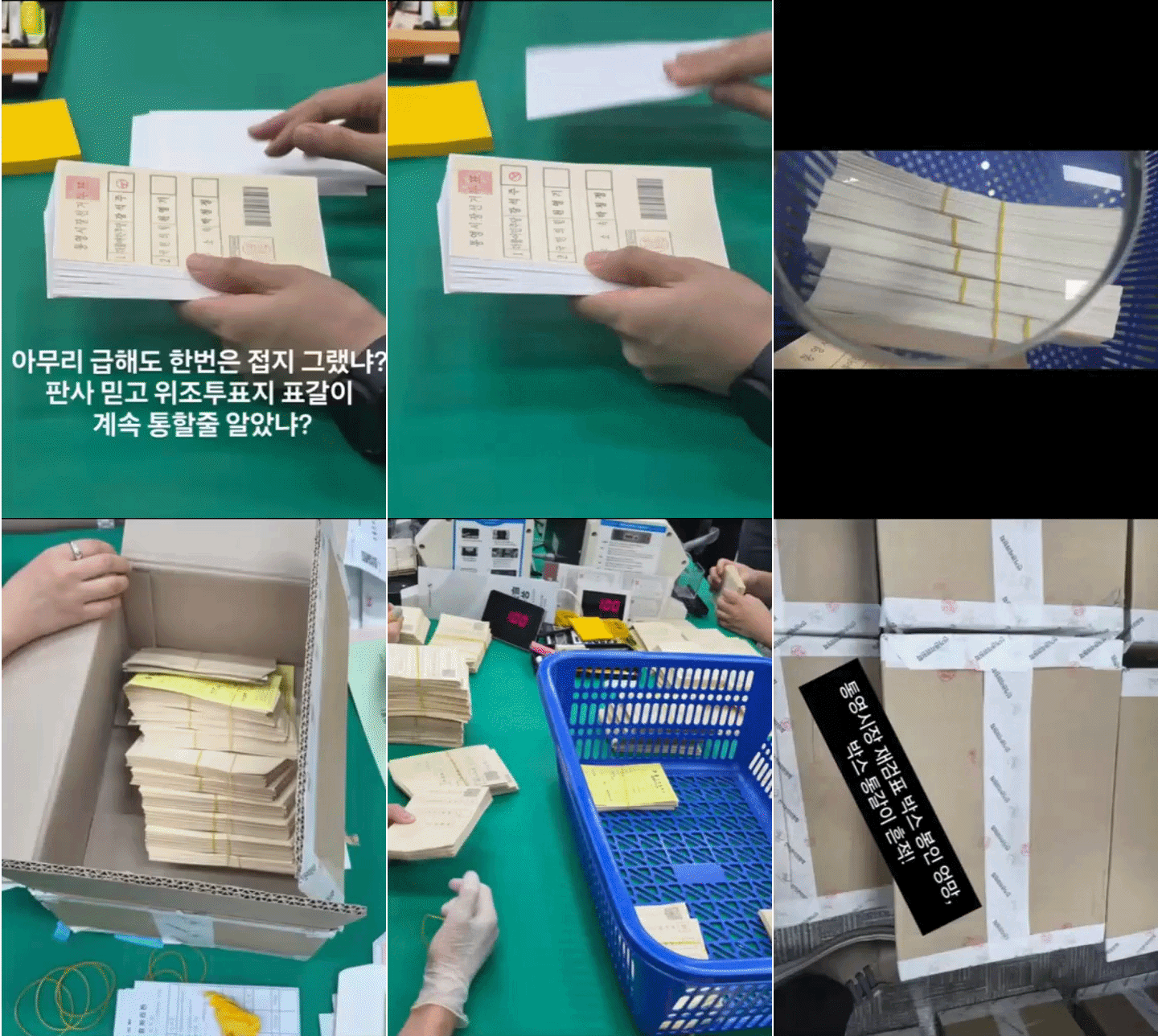 “Ignoring crisp ballots and damaged seals”… Tongyeong mayoral recount concludes with ‘no change in outcome,’ leaving suspicions and public outrage behind
Suspected counterfeit ballots discovered in Tongyeong [GIF from social media of Representative Hwang Kyo-ahn / Attorney Park Joo-hyun]During a recount of the Tongyeong mayoral election in South Gyeong
“Ignoring crisp ballots and damaged seals”… Tongyeong mayoral recount concludes with ‘no change in outcome,’ leaving suspicions and public outrage behind
Suspected counterfeit ballots discovered in Tongyeong [GIF from social media of Representative Hwang Kyo-ahn / Attorney Park Joo-hyun]During a recount of the Tongyeong mayoral election in South Gyeong
 President Yoon, regarding the first-instance ruling on the Public Official Election Act: “An excessive political verdict that distorts the facts… We will appeal immediately.”
The first-instance sentencing hearing for President Yoon Suk Yeol regarding violations of the Public Official Election Act is being broadcast live at Seoul Station on the 27th. [Photo=Yonhap News]Pres
President Yoon, regarding the first-instance ruling on the Public Official Election Act: “An excessive political verdict that distorts the facts… We will appeal immediately.”
The first-instance sentencing hearing for President Yoon Suk Yeol regarding violations of the Public Official Election Act is being broadcast live at Seoul Station on the 27th. [Photo=Yonhap News]Pres
 WSJ: "SK Hynix ADR Premium Is a Sign of AI Trading Overheat"
Advertisement for SK Hynix ADR listing in New York's Times Square [Reuters=Yonhap News file photo]The Wall Street Journal (WSJ) has pointed out that the price of SK Hynix’s American Depositary Recei
WSJ: "SK Hynix ADR Premium Is a Sign of AI Trading Overheat"
Advertisement for SK Hynix ADR listing in New York's Times Square [Reuters=Yonhap News file photo]The Wall Street Journal (WSJ) has pointed out that the price of SK Hynix’s American Depositary Recei
 'Godfather of Japanese Mystery Novels' Keigo Higashino Passes Away After Battle with Cancer at 68
Famous Japanese mystery novelist Keigo Higashino [AFP=Yonhap News]It has been belatedly reported that Keigo Higashino, the "godfather of Japanese mystery novels" and author of bestsellers such as "The
'Godfather of Japanese Mystery Novels' Keigo Higashino Passes Away After Battle with Cancer at 68
Famous Japanese mystery novelist Keigo Higashino [AFP=Yonhap News]It has been belatedly reported that Keigo Higashino, the "godfather of Japanese mystery novels" and author of bestsellers such as "The
 [Park Pil-kyu Security Column] To the Ignorant Trying to Clothe a Beast in Sheep's Clothing
Rep. Kim Byung-joo of the Democratic Party of Korea [Photo=Yonhap News]“The Air Force Academy doesn't teach you how to fly a plane!” “The Army, Navy, and Air Force academies are exactly the
[Park Pil-kyu Security Column] To the Ignorant Trying to Clothe a Beast in Sheep's Clothing
Rep. Kim Byung-joo of the Democratic Party of Korea [Photo=Yonhap News]“The Air Force Academy doesn't teach you how to fly a plane!” “The Army, Navy, and Air Force academies are exactly the
 [Issue Diagnosis] Two Effects of the Election Petition Review
 [Photo] Evidence of Election Fraud Flooding U.S. Media… Trump Had 2.7 Million Votes Stolen
 [Video] U.S. Semiquincentennial Air Show... 'Art in the Sky' streaks across New York
 [Editorial Cartoon] A Draconian Law That Undermines Freedom of Expression

 List
List