Market attention is focused on the ripple effects following the Bank of Japan's decision on the 16th at its Monetary Policy Meeting to raise its benchmark policy interest rate by 0.25 percentage points from the current "around 0.75%" to "around 1.0%," reaching its highest level in approximately 31 years since 1995.
Japan's benchmark interest rate had not exceeded 0.5% since being lowered from 1.75% to 1.0% in April 1995 and further reduced from 1.0% to 0.5% in September of the same year. Since 2016, the Bank of Japan had maintained a negative interest rate policy, charging financial institutions a fee for holding excess funds.
Since Governor Kazuo Ueda took office with a mandate to end ultra-low interest rates and normalize monetary policy, the Bank of Japan has taken steps, beginning with ending the negative interest rate policy in March 2024. This was followed by an increase in the benchmark interest rate from 0-0.1% to 0.25% in July of the same year, then to 0.5% in January of last year, and further to 0.75% in December.
The subsequent pause was broken by an interest rate hike after half a year, pushing rates into the 1% range. This decision was critically influenced by the surge in oil prices triggered by the U.S.-Iran conflict, which dealt a severe blow to the Japanese economy, heavily reliant on the Middle East for over 90% of its oil imports.
Excluding the effect of the Japanese government's subsidies for electricity and gas costs, the Consumer Price Index (CPI) in April rose by 2.8% year-on-year, fueling concerns that high oil prices would also push up core inflation.
The fact that the Producer Price Index (preliminary) in the previous month rose by 6.3% year-on-year, reaching its highest level in three years and two months since March 2023, also appears to have been a factor in the Bank of Japan's judgment that it could no longer delay an interest rate hike to protect corporate pricing power and control inflation.
 Japanese Yen Interest Rate Policy [Provided by Yonhap News TV]
The world's attention is drawn to Japan's interest rate hike because of its potential impact on the "yen carry trade" (borrowing yen to invest in high-yield assets), a strategy and practice that has emerged from decades of low interest rates.
A recent prominent example of yen carry trade unwinding occurred when the Bank of Japan raised its benchmark interest rate from 0-0.1% to 0.25% in July 2024, and Governor Ueda hinted at further increases. This led to a trend of yen carry funds returning to Japan, causing short-term shocks in global financial markets.
In early August 2024, the Bank of Japan's benchmark rate hike, combined with expectations of an interest rate cut by the U.S. Federal Reserve (Fed), caused the yen's value to surge by as much as 3.3% against the U.S. dollar, leading to a concurrent decline in global stock markets, including South Korea's KOSPI.
The sudden strengthening of the yen cast a shadow over Japanese corporate exports, prompting the Bank of Japan to backtrack within a week, stating there would be no immediate further hikes, which helped calm market turbulence caused by the rate increase.
Most market experts believe that the Bank of Japan's further benchmark interest rate hike is unlikely to cause the same level of chaos as the "seizure" of yen carry trade unwinding seen in 2024.
This is because Japan's benchmark interest rate has just entered the 1% range and remains relatively low compared to other major global economies. The interest rate differential with the U.S. and Europe is also being maintained, preserving the advantages of the yen carry trade.
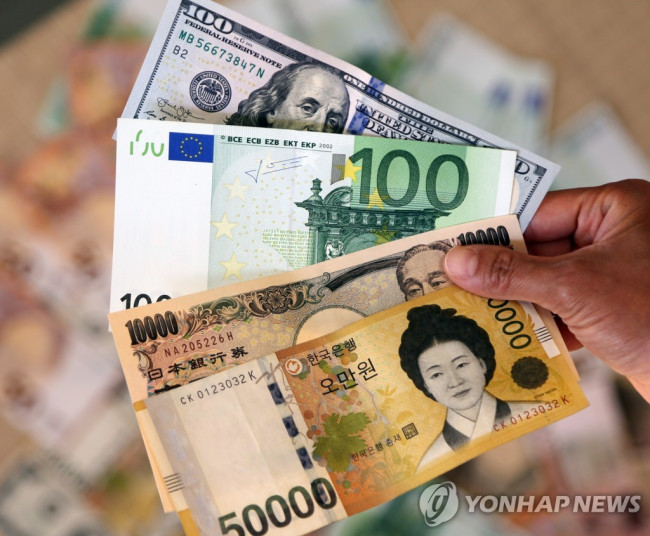 Currencies of various countries (Dollar·Euro·Yen·Won) [Yonhap News]
Furthermore, market participants, including investors, have already priced in the effects of the anticipated interest rate hikes, as the Bank of Japan has been signaling its intention to raise rates for several months.
In a recent report, Sumitomo Mitsui DS Asset Management predicted that even with the decision to raise the benchmark interest rate to 1% and halt the reduction of Japanese government bond purchases at today's Monetary Policy Meeting, the market's reaction in terms of the Japanese stock market, government bond market, and yen exchange rate would likely be limited, as the market has already accepted these developments as a fait accompli.
On April 26th, the day before the Bank of Japan's benchmark rate hike was largely anticipated, the scale of yen selling by speculative investors, including hedge funds, due to the yen carry trade, as estimated by the U.S. Commodity Futures Trading Commission (CFTC), reached 1.4 trillion yen (approximately 13.2 trillion Korean won), the largest since July 2024, just before a yen carry trade unwinding occurred.
Market focus is now shifting to the pace at which the anticipated increase in Japan's benchmark interest rate, beyond 1%, will proceed.
Nomura Securities anticipates that the Bank of Japan will continue to raise the benchmark interest rate by 25 basis points (1 basis point = 0.01 percentage point) every six months, reaching a policy rate of 1.5%, and then conclude the rate hikes.
Some analyses suggest that current market prices already reflect a scenario where Japan's benchmark interest rate could reach a final level of 2%.
However, given the cabinet's expansionary fiscal policy and the ongoing trade deficit for five consecutive years, a rapid increase in the Bank of Japan's benchmark interest rate could place undue strain on domestic fiscal policy. Therefore, the prevailing view is that a rapid pace of rate hikes is unlikely.
Much attention was directed towards Deputy Governor Shinichi Uchida, who conducted the press conference in place of Governor Ueda, who is hospitalized, for any indication of the Bank of Japan's stance on future rate hike speed. However, he maintained a principled position.
Regarding the speculation that the Bank of Japan estimates the neutral interest rate to be between 1.1% and 2.5%, Deputy Governor Uchida stated, "There is considerable variation in the estimation of the neutral interest rate," and that it is not useful for forecasting future interest rate hikes.
He emphasized, "We will judge the intensity of monetary tightening by observing the changes in the economy, prices, and financial conditions after the interest rate hikes."
With the Bank of Japan adopting a principled stance that is neither hawkish nor dovish regarding interest rate hikes, there were no immediate signs of yen appreciation in the Tokyo foreign exchange market following the rate increase.
In the Tokyo foreign exchange market this afternoon, the yen was weakening against the dollar, trading at around 160.30 yen to the dollar, up 0.20 yen from the previous day.
Daisuke Karakama, Chief Market Economist at Mizuho Bank, told the Nikkei newspaper that despite Japan's further benchmark interest rate hike, the lack of increased yen buying indicates that "Japan's real interest rates remain low."
Naomi Fink, Chief Global Strategist at Amundi, one of Asia's largest asset managers, noted that amid the AI investment frenzy, there is a tendency for abundant liquidity, represented by the yen, to flow into AI-related stocks and other risk assets.

 Trump pressures for rate cut again ahead of FOMC... "Should be the lowest in the world"
U.S. President Donald Trump. [Photo = The White House] U.S. President Donald Trump once again pressured the Federal Reserve, the U.S. central bank, to lower interest rates on the 27th (local time
Trump pressures for rate cut again ahead of FOMC... "Should be the lowest in the world"
U.S. President Donald Trump. [Photo = The White House] U.S. President Donald Trump once again pressured the Federal Reserve, the U.S. central bank, to lower interest rates on the 27th (local time
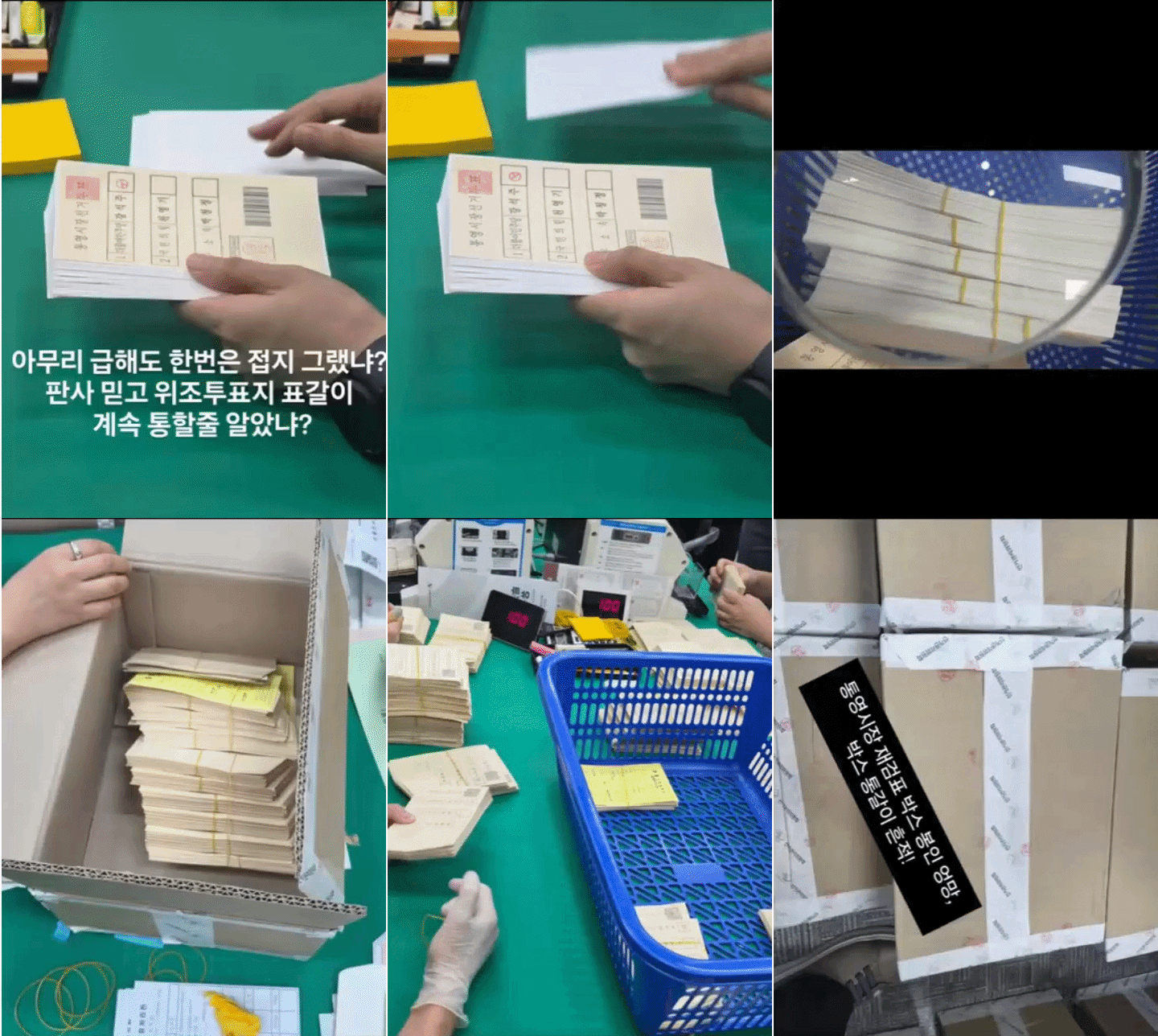 “Ignoring crisp ballots and damaged seals”… Tongyeong mayoral recount concludes with ‘no change in outcome,’ leaving suspicions and public outrage behind
Suspected counterfeit ballots discovered in Tongyeong [GIF from social media of Representative Hwang Kyo-ahn / Attorney Park Joo-hyun]During a recount of the Tongyeong mayoral election in South Gyeong
“Ignoring crisp ballots and damaged seals”… Tongyeong mayoral recount concludes with ‘no change in outcome,’ leaving suspicions and public outrage behind
Suspected counterfeit ballots discovered in Tongyeong [GIF from social media of Representative Hwang Kyo-ahn / Attorney Park Joo-hyun]During a recount of the Tongyeong mayoral election in South Gyeong
 President Yoon, regarding the first-instance ruling on the Public Official Election Act: “An excessive political verdict that distorts the facts… We will appeal immediately.”
The first-instance sentencing hearing for President Yoon Suk Yeol regarding violations of the Public Official Election Act is being broadcast live at Seoul Station on the 27th. [Photo=Yonhap News]Pres
President Yoon, regarding the first-instance ruling on the Public Official Election Act: “An excessive political verdict that distorts the facts… We will appeal immediately.”
The first-instance sentencing hearing for President Yoon Suk Yeol regarding violations of the Public Official Election Act is being broadcast live at Seoul Station on the 27th. [Photo=Yonhap News]Pres
 WSJ: "SK Hynix ADR Premium Is a Sign of AI Trading Overheat"
Advertisement for SK Hynix ADR listing in New York's Times Square [Reuters=Yonhap News file photo]The Wall Street Journal (WSJ) has pointed out that the price of SK Hynix’s American Depositary Recei
WSJ: "SK Hynix ADR Premium Is a Sign of AI Trading Overheat"
Advertisement for SK Hynix ADR listing in New York's Times Square [Reuters=Yonhap News file photo]The Wall Street Journal (WSJ) has pointed out that the price of SK Hynix’s American Depositary Recei
 'Godfather of Japanese Mystery Novels' Keigo Higashino Passes Away After Battle with Cancer at 68
Famous Japanese mystery novelist Keigo Higashino [AFP=Yonhap News]It has been belatedly reported that Keigo Higashino, the "godfather of Japanese mystery novels" and author of bestsellers such as "The
'Godfather of Japanese Mystery Novels' Keigo Higashino Passes Away After Battle with Cancer at 68
Famous Japanese mystery novelist Keigo Higashino [AFP=Yonhap News]It has been belatedly reported that Keigo Higashino, the "godfather of Japanese mystery novels" and author of bestsellers such as "The
 [Park Pil-kyu Security Column] To the Ignorant Trying to Clothe a Beast in Sheep's Clothing
Rep. Kim Byung-joo of the Democratic Party of Korea [Photo=Yonhap News]“The Air Force Academy doesn't teach you how to fly a plane!” “The Army, Navy, and Air Force academies are exactly the
[Park Pil-kyu Security Column] To the Ignorant Trying to Clothe a Beast in Sheep's Clothing
Rep. Kim Byung-joo of the Democratic Party of Korea [Photo=Yonhap News]“The Air Force Academy doesn't teach you how to fly a plane!” “The Army, Navy, and Air Force academies are exactly the
 [Issue Diagnosis] Two Effects of the Election Petition Review
 [Photo] Evidence of Election Fraud Flooding U.S. Media… Trump Had 2.7 Million Votes Stolen
 [Video] U.S. Semiquincentennial Air Show... 'Art in the Sky' streaks across New York
 [Editorial Cartoon] A Draconian Law That Undermines Freedom of Expression

 List
List