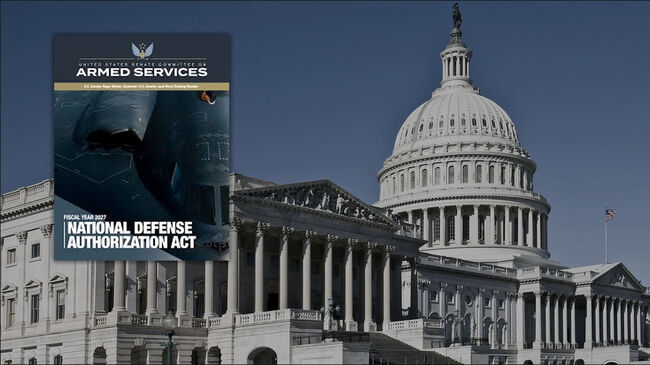
It was confirmed on the 18th that the National Defense Authorization Act for the next fiscal year, which passed the Senate Armed Services Committee, includes provisions requiring the Secretary of Defense (Secretary of War) to regularly report a roadmap for the transition of wartime operational control (OPCON).
As the South Korean government is accelerating the OPCON transfer, the U.S. Congress is demonstrating its intent to scrutinize the transfer process more closely, and the impact of this on future discussions is drawing attention.
The 'National Defense Authorization Act for Fiscal Year 2027 (NDAA)' approved by the Senate Armed Services Committee on the 11th stipulates that the Secretary of Defense shall submit a report on the ROK-U.S. roadmap for the implementation of the 'Conditions-Based OPCON Transition Plan,' signed by both countries on October 31, 2018, to the relevant standing committees every 90 days from March 1 of next year until 2030.
This report is to include an assessment of the ROK military's capability to lead combined defense, its ability to counter North Korea's nuclear and missile threats, and the security environment in the Indo-Pacific region.
These provisions are interpreted as reflecting Congress's determination to continuously oversee the OPCON transition process through regular reporting and evaluation by the executive branch.
Similar to last year, the NDAA that passed the Senate Armed Services Committee this time contains a provision stating that funds allocated by the bill cannot be used for the OPCON transfer procedures.
A proviso identical to last year's has been attached: budget use will be permitted only after 60 days have passed since the Secretary of Defense submits a certification and evaluation report to Congress stating that the reduction of U.S. Forces Korea or the transfer of OPCON is consistent with U.S. national security interests and that appropriate consultations have been held with allies, including those contributing militarily to the Republic of Korea, Japan, and the United Nations Command.
The difference this year is that while last year's NDAA specified that this certification process was only necessary if the OPCON transfer was to be carried out "in a manner that deviates from the agreed-upon plan by both parties," this year's NDAA removes that wording and instead stipulates that funds cannot be used "to complete the OPCON transfer."
This can be interpreted to mean that even if the ROK and U.S. proceed with the OPCON transfer according to their agreement, a certification and reporting process to Congress will still be required.
However, it is worth noting that last year, the NDAA bill that passed the Senate Armed Services Committee only stated that funds could not be used for the "completion of OPCON transfer." Subsequently, through the conference process between the Senate and the House, the final passed NDAA was amended to restrict the use of funds when the OPCON transfer is completed "in a manner that deviates from the agreed-upon plan by both parties."
The current NDAA, having passed the Senate Armed Services Committee, is awaiting floor action in the Senate.
The NDAA, an annual bill that authorizes defense spending and policy, is passed separately by the Senate and the House. Following this, provisions that are the same are retained, differing provisions are reconciled, and then a unified bill is created by both chambers for final passage.
The NDAA processed by the House Armed Services Committee on the 4th contains the phrase that funds cannot be used to complete the OPCON transfer "in a manner that deviates from the agreed-upon plan by both parties," showing a difference from the Senate bill. The House is scheduled to vote on it on the floor in early next month.
Meanwhile, in its report related to the NDAA, the Senate Armed Services Committee expressed concern about "malign influence operations" by the Chinese Communist Party within South Korea and directed the Secretary of Defense to provide a detailed report by May 1 of next year on its impact on U.S. national security, including U.S. Forces Korea, and commercial interests.
Previously, a report by the Congressional Research Service published on the 9th, titled "The ROK-U.S. Alliance: Issues for Congress to Consider," also contained concerns about Chinese influence.
The report stated, "Amidst evolving threats posed by the People's Republic of China (PRC, hereinafter referred to as China), Russia, and North Korea, the United States and South Korea appear ready for South Korea to play a more active role within the alliance and expand its mission scope. Congress can guide and influence the Administration's efforts to modernize the alliance, including strategic flexibility, wartime operational control, burden sharing, extended deterrence, and defense industrial cooperation, through legislation, oversight, and other means."
The report further noted, "Strategic flexibility' is regaining attention as the Trump administration has expressed its intent to modernize the ROK-U.S. alliance to deter not only North Korea but also China, and for South Korea to take a leading role in the defense of the Korean Peninsula."
In 2025, the two countries pledged to "strengthen the U.S. conventional deterrence posture in preparation for all regional threats to the alliance, including North Korea." Some observers suggest that the Trump administration appears to be positioning U.S. military assets in preparation for a contingency related to China and Taiwan. For instance, the U.S. Air Force deployed MQ-9 Reaper drones to Kunsan Air Base in 2025.
The release of these reports and the passage of the Senate NDAA bill came about a week before the confirmation of Michelle Steel's nomination as U.S. Ambassador to Korea by the Senate.
Yonhap News, News & Post

 Iranian Foreign Ministry: "Continuing Message Exchanges with the U.S. and Activities of Mediating Countries"
Esmaeil Baghaei, Spokesperson for the Iranian Ministry of Foreign Affairs [Xinhua, Yonhap News file photo]Esmaeil Baghaei, spokesperson for the Iranian Ministry of Foreign Affairs, stated on the 26th
Iranian Foreign Ministry: "Continuing Message Exchanges with the U.S. and Activities of Mediating Countries"
Esmaeil Baghaei, Spokesperson for the Iranian Ministry of Foreign Affairs [Xinhua, Yonhap News file photo]Esmaeil Baghaei, spokesperson for the Iranian Ministry of Foreign Affairs, stated on the 26th
 President Yoon: "Do You Think You Are Safe from the Special Counsel?"... Final Statement Video Released
President Yoon Suk Yeol rebuking the special prosecutor on the 24th. [Court video / @birds_justice X account subtitle GIF] A video of President Yoon Suk Yeol's closing statement at his trial rega
President Yoon: "Do You Think You Are Safe from the Special Counsel?"... Final Statement Video Released
President Yoon Suk Yeol rebuking the special prosecutor on the 24th. [Court video / @birds_justice X account subtitle GIF] A video of President Yoon Suk Yeol's closing statement at his trial rega
 President Yoon, regarding the first-instance ruling on the Public Official Election Act: “An excessive political verdict that distorts the facts… We will appeal immediately.”
The first-instance sentencing hearing for President Yoon Suk Yeol regarding violations of the Public Official Election Act is being broadcast live at Seoul Station on the 27th. [Photo=Yonhap News]Pres
President Yoon, regarding the first-instance ruling on the Public Official Election Act: “An excessive political verdict that distorts the facts… We will appeal immediately.”
The first-instance sentencing hearing for President Yoon Suk Yeol regarding violations of the Public Official Election Act is being broadcast live at Seoul Station on the 27th. [Photo=Yonhap News]Pres
 WSJ: "SK Hynix ADR Premium Is a Sign of AI Trading Overheat"
Advertisement for SK Hynix ADR listing in New York's Times Square [Reuters=Yonhap News file photo]The Wall Street Journal (WSJ) has pointed out that the price of SK Hynix’s American Depositary Recei
WSJ: "SK Hynix ADR Premium Is a Sign of AI Trading Overheat"
Advertisement for SK Hynix ADR listing in New York's Times Square [Reuters=Yonhap News file photo]The Wall Street Journal (WSJ) has pointed out that the price of SK Hynix’s American Depositary Recei
 'Godfather of Japanese Mystery Novels' Keigo Higashino Passes Away After Battle with Cancer at 68
Famous Japanese mystery novelist Keigo Higashino [AFP=Yonhap News]It has been belatedly reported that Keigo Higashino, the "godfather of Japanese mystery novels" and author of bestsellers such as "The
'Godfather of Japanese Mystery Novels' Keigo Higashino Passes Away After Battle with Cancer at 68
Famous Japanese mystery novelist Keigo Higashino [AFP=Yonhap News]It has been belatedly reported that Keigo Higashino, the "godfather of Japanese mystery novels" and author of bestsellers such as "The
 [Park Pil-kyu Security Column] To the Ignorant Trying to Clothe a Beast in Sheep's Clothing
Rep. Kim Byung-joo of the Democratic Party of Korea [Photo=Yonhap News]“The Air Force Academy doesn't teach you how to fly a plane!” “The Army, Navy, and Air Force academies are exactly the
[Park Pil-kyu Security Column] To the Ignorant Trying to Clothe a Beast in Sheep's Clothing
Rep. Kim Byung-joo of the Democratic Party of Korea [Photo=Yonhap News]“The Air Force Academy doesn't teach you how to fly a plane!” “The Army, Navy, and Air Force academies are exactly the
 [Issue Diagnosis] Two Effects of the Election Petition Review
 [Photo] Evidence of Election Fraud Flooding U.S. Media… Trump Had 2.7 Million Votes Stolen
 [Video] U.S. Semiquincentennial Air Show... 'Art in the Sky' streaks across New York
 [Editorial Cartoon] A Draconian Law That Undermines Freedom of Expression

 List
List