The KOSPI index is displayed on the board at the Hana Bank dealing room in Jung-gu, Seoul, on May 7, when the index surpassed the 7,500 mark for the first time during intraday trading. Although foreign investors engaged in record net selling that day, individual investors and financial investment firms absorbed the volume, pushing the index to an all-time high. [Photo: Yonhap News]
The KOSPI crash was not a sudden event that began on the day the stock market collapsed in late July.
While prices continued to rise, there was a day when the market's leadership shifted, and the warning signs of foreign withdrawal began to be obscured by the buying spree of retail investors and financial investment firms. That day was May 7, just 27 days before the June 3 local elections.
Foreigners, who had net bought over 3 trillion won in KOSPI stocks the previous day, turned to a net selling position of 7.1724 trillion won in a single day. This was the largest scale since records began.
However, the KOSPI did not fall. Retail investors net bought 5.9913 trillion won, and institutions net bought 1.0989 trillion won. Within the institutional sector, financial investment firms alone accounted for 1.886 trillion won in net purchases. The index actually rose 1.43% to reach a new all-time high of 7,490.05.
May 7 was not the day the index crashed. It was an inflection point in supply and demand, where retail investors began taking over the prices pushed up by foreign investors.
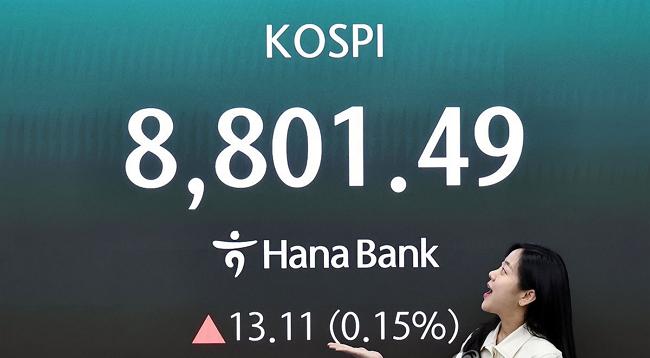 The KOSPI and other indices are displayed on the board at the Hana Bank dealing room in Jung-gu, Seoul, on the 2nd. On this day, the KOSPI closed at 8,801.49, up 13.11 points (0.15%) from the previous trading day, while the KOSDAQ closed at 1,026.03, down 24.00 points (2.29%). 2026.6.2 [Photo: Yonhap News]
Hanmi Ilbo Already Issued a Warning a Day Earlier
On May 6, one day before the record-breaking foreign sell-off began, the Hanmi Ilbo reported, "[Hanmi Data Lab] Report: Individuals must clean up debt-financed investments before the local elections."
At the time, the Hanmi Ilbo pointed out that while the semiconductor boom itself was real, the stock market rally could not be explained by industrial prospects alone. It described the market as an "artificial bull market driven by policy and supply-demand," attributing it to a combination of global passive funds, the National Pension Service’s portfolio adjustments, the government's real estate suppression policies, and individual credit-based investments.
In particular, it warned that since foreigners and institutions could exit first when risks intensified, while individuals chasing gains with borrowed money might be left behind, investors should check their credit ratios rather than their stock holdings before the local elections.
On May 7, investor deposits stood at 136.989 trillion won, and credit transaction loans were at 35.5072 trillion won. The ratio of credit to deposits was 25.9%. The Hanmi Ilbo viewed this not as capacity for additional buying, but as the final buffer zone before credit positions would have to be reduced.
On May 15, while individuals net bought 7.2291 trillion won, foreigners and institutions net sold 5.661 trillion won and 1.7336 trillion won, respectively. The credit loan ratio rose to 27.5%. The Hanmi Ilbo diagnosed that the trigger pulled by the U.S. bond market and the "debt-fueled" ticking time bomb within the Korean market were coinciding.
The July crash was not an unforeseen accident. Since May, the exit of foreign spot holdings, the defensive buying of debt-fueled individual investors, and the concentration in large semiconductor stocks had been taking place simultaneously.
Why Did the Index Rise When Foreigners Were Selling?
From May 7 to June 2, the day before the local elections, foreigners were net sellers of KOSPI stocks for 18 consecutive trading days. The cumulative net sell-off reached 59.347 trillion won.
Conversely, retail investors net bought 60.3961 trillion won during the same period.
Even on June 2, when foreigners sold 6.5935 trillion won, individuals bought 6.3482 trillion won. The KOSPI hit another record high, rising 0.15% to 8,801.49.
Even though foreigners were selling, the buying power of individuals pushed prices even higher.
At the time, it was impossible to conclude whether the foreign selling reflected an anticipation of slowing corporate earnings or if it was simply profit-taking and rebalancing following the surge. However, it was clear that the control of supply and demand had shifted from foreign investors to retail investors.
The problem was that as the index continued to climb, this change was not perceived as a risk signal.
For retail investors, the spectacle of the index rising despite foreigners selling over 7 trillion won in a single day became a powerful buy signal itself. They trusted the all-time highs displayed on their screens more than the foreign sell-off.
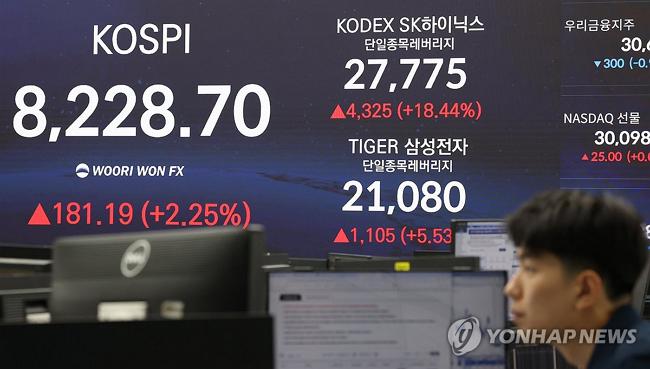 On the afternoon of the 27th, the closing prices of 'KODEX SK Hynix Single Stock Leverage' and 'TIGER Samsung Electronics Single Stock Leverage' are displayed at the Woori Bank dealing room in Jung-gu, Seoul. As 16 single-stock leverage and inverse products for Samsung Electronics and SK Hynix from 8 asset management companies were launched simultaneously that day, buying pressure appeared to be rapidly concentrating. 2026.5.27 [Photo: Yonhap News]
The Illusion Created by 'Financial Investment Buying'
Another signal that reinforced the confidence of retail investors was the buying by "financial investment" firms.
In Korea Exchange statistics, "financial investment" refers to the accounts of financial investment businesses such as securities firms. However, this category can include not only a firm's proprietary capital but also ETF settings, liquidity provision, market making, futures/spot arbitrage, and derivative hedging.
Therefore, net buying by "financial investment" should not be interpreted as long-term investments by securities firms based on their belief in high corporate value.
During the month of May, foreigners net sold a combined 36.6 trillion won of Samsung Electronics and SK Hynix. On the other hand, individuals net bought 25.5 trillion won, and institutions net bought 10.8 trillion won. Of the latter, financial investment firms accounted for 12.9 trillion won.
The fact that financial investment buying was greater than total institutional buying means that other institutions, excluding financial investment firms, were actually net sellers. In fact, pension funds, including the National Pension Service, net sold 2.1617 trillion won in the KOSPI in May and remained net sellers every month from January to June.
In other words, the core of institutional capital propping up semiconductor stock prices was not long-term pension funds.
When individuals buy semiconductor ETFs, securities firms may buy the constituent stocks, such as Samsung Electronics and SK Hynix, to supply the ETFs or balance prices. In this case, individual orders generate "financial investment buying," which in turn creates a self-reinforcing structure that sends a signal to individuals that "institutions are also buying."
However, it is impossible to isolate the proportions of proprietary accounts, ETF settings, arbitrage, and derivative hedging from public statistics alone. To determine the reality of this crash, one must examine the nature of these accounts and the transaction concentration levels of each securities firm from May 7 to June 2.
Three Beliefs of Retail Investors: Earnings, Supply-Demand, and Policy
Behind the fact that individuals continued to absorb foreign volume were three primary beliefs.
First, semiconductor earnings. The prospect that investments in AI data centers, demand for high-bandwidth memory (HBM), and rising memory prices would be long-term justified further gains for Samsung Electronics and SK Hynix.
Second, supply and demand. As the index hit new highs despite massive foreign selling—absorbed by individuals and financial investment firms—a belief emerged that there were stronger buyers in the market. However, if a significant portion of financial investment buying was product-driven, such as ETF settings and hedging, that belief was built on a fragile foundation rather than the conviction of long-term capital.
Third, policy. On May 27, 2x daily leverage and inverse ETFs based on Samsung Electronics and SK Hynix were launched. From the launch date until June 19, individuals net bought approximately 8.2 trillion won in leverage ETFs, while net buying of inverse ETFs was only around 300 billion won.
This product was not the cause of the supply-demand reversal on May 7. However, it is worth questioning whether it served as an amplifier that exacerbated the concentration and volatility in semiconductors afterward.
The fact that the government was pushing for stock market revitalization and even opened channels to bet 2x on flagship semiconductor stocks may have been read by individuals as a signal that "the government also wants a bull market." Whether expectations of a so-called "policy put"—that the government would not allow a crash ahead of local elections—were formed is also a subject for verification.
However, there is currently no direct evidence that the government instructed securities firms to buy stocks for the election. One must distinguish between the fact that the financial investment industry is a regulated sector under the supervision of financial authorities and actual buying instructions.
Nevertheless, the chronological arrangement—where individuals and financial firms absorbed foreign volume to push the index to record highs from May 7 through the day before the election, and single-stock 2x products were launched in between—is worthy of scrutiny.
New Listings Suspended 50 Days After Launch
As of July 15, the market capitalization of the 16 single-stock products had surged from 4.4 trillion won at launch to 11.9 trillion won. The proportion of Samsung Electronics and SK Hynix in the KOSPI market cap also rose from 34% at the end of last year to 52% on July 15.
On July 16, the Financial Services Commission temporarily suspended new listings of single-stock leverage, inverse, and covered call products until the market stabilized, and immediately banned promotional marketing and events by securities and asset management firms.
The basic deposit requirement for individual retail investors was also raised from 10 million won (including substitute securities) to 30 million won in cash. Although originally scheduled for August, the follow-up measures on July 24 brought the implementation date forward to July 31.
The financial authorities, who had authorized these products, suspended new listings and significantly tightened investment requirements just 50 days after launch. This can be read as an admission that even the authorities judged the speed of growth and the risk of concentration to be more serious than anticipated.
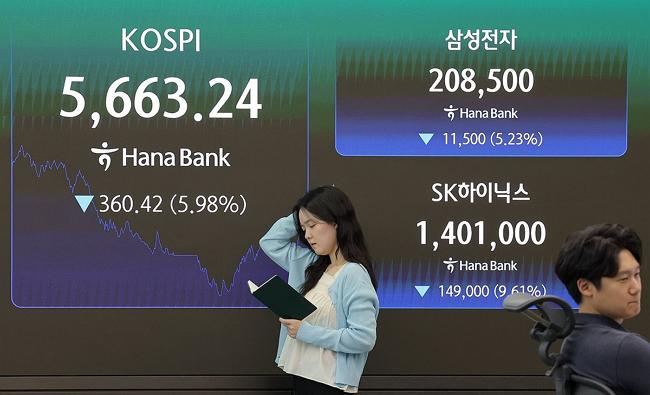 On the afternoon of the 29th, when the KOSPI closed at 5,663.24, down 360.42p (5.98%) from the previous day, the KOSPI index and the stock prices of Samsung Electronics and SK Hynix are displayed at the Hana Bank dealing room in Jung-gu, Seoul. As of 3:30 PM, the won/dollar exchange rate recorded 1,446.7 won, down 15.8 won, and the KOSDAQ closed at 662.68, down 43.17p (6.12%). 2026.7.29 [Photo: Yonhap News]
July 29, Individual Buying Capacity Exhausted
The KOSPI closed at 6,023.66 on July 28, plunging 10.84%. Foreigners net sold 4.9914 trillion won and institutions net sold 633.1 billion won, but retail investors net bought 4.3305 trillion won.
However, when the KOSPI fell another 5.98% to 5,663.24 on the 29th, individuals turned to net selling of 1.9766 trillion won. Foreigners also sold 1.2101 trillion won, while institutions net bought 3.1488 trillion won.
Retail investors, who had been absorbing foreign volume since May 7, finally turned into sellers.
Disappointment in SK Hynix's earnings, the pursuit by Chinese semiconductor firms, and geopolitical instability in the Middle East were cited as direct triggers. However, these negative factors alone cannot fully explain the exceptional depth of the drop.
One must examine whether the skewed structure where Samsung Electronics and SK Hynix accounted for more than half of the index, the prevalence of single-stock leverage products, and the vulnerability created by the overlap of foreign spot selling and individual credit investment amplified the decline.
Ultimately, the July crash can be seen as the result of the supply-demand structure created after May 7 reaching its limit.
Foreigners reduced their holdings at the top. Individuals bought that volume, trusting in the semiconductor super-cycle, rising prices, financial investment buying, and the government's stock market revitalization policy.
This structure reinforces gains while new money flows in, but moves in the opposite direction once foreign selling continues and retail capacity for additional buying is exhausted. ETF redemptions, reduced leverage exposure, collateral shortages, and forced liquidations can all occur simultaneously, amplifying the decline.
This situation should not be blamed solely on individual greed or reckless "debt-financed" investing.
We must ask: why did retail investors fail to perceive record foreign selling as a risk signal? Why did financial investment buying appear to be the conviction of long-term institutional capital? Did financial authorities sufficiently review the risks of authorizing 2x single-stock products in a situation where semiconductor stocks already accounted for half the index?
The chronological coincidence between the local elections and the index rise is also a subject for verification. What is needed is not speculation, but evidence of the reality of financial investment accounts and records of contact between financial authorities and securities firms.
Above all, the 59 trillion won sold by foreigners and the 60 trillion won bought by individuals from May 7 until the day before the election must be tracked again.
Foreigners were already leaving; who did the individuals trust when they bought that volume?
The starting point for understanding the July KOSPI crash is May 7.
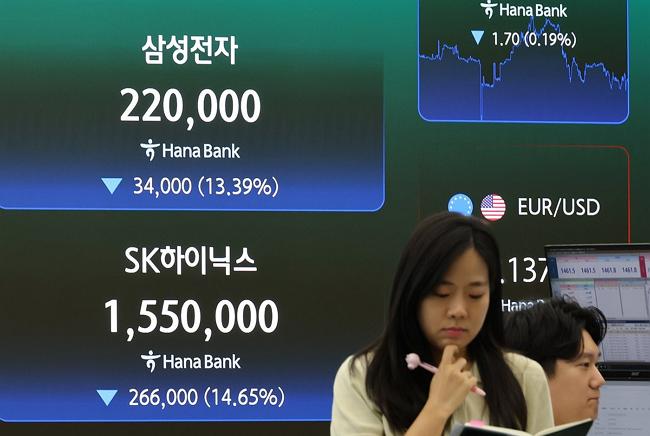 An employee is working at the Hana Bank headquarters dealing room in Seoul on the 28th. On this day, the KOSPI closed at 6,023.66, down 732.09 points (10.84%) from the previous day, and the KOSDAQ index closed at 705.85, down 59.01 points (7.72%). 2026.7.28 [Photo: Yonhap News]

 [Statement by the Seo-beo-kka Korea Military Academy Save-the-Nation Comrades Association] ㉛ Recount the Votes Publicly, as the Previous Recount Concealed Election Fraud
Tongyeong Mayoral Election Recount [Photo=Yonhap News]South Korea's liberal democracy is dying. The National Election Commission (NEC) and the judiciary, which have plummeted into criminal syndicates
[Statement by the Seo-beo-kka Korea Military Academy Save-the-Nation Comrades Association] ㉛ Recount the Votes Publicly, as the Previous Recount Concealed Election Fraud
Tongyeong Mayoral Election Recount [Photo=Yonhap News]South Korea's liberal democracy is dying. The National Election Commission (NEC) and the judiciary, which have plummeted into criminal syndicates
 US Brewery That Posted “Free Beer If Trump Dies” Has Liquor License Revoked
An American brewery that sparked controversy for social media posts promising free beer to customers upon the death of Donald Trump has had its liquor license revoked by the state government. [Getty I
US Brewery That Posted “Free Beer If Trump Dies” Has Liquor License Revoked
An American brewery that sparked controversy for social media posts promising free beer to customers upon the death of Donald Trump has had its liquor license revoked by the state government. [Getty I
 PPP on Speaker Woo's Remarks About 'Lee Jae-myung's Consecutive Term and Constitutional Amendment': "A True Act of Insurrection"
People Power Party Representative Jang Dong-hyeok holds a press conference at the National Assembly on the 28th to express his stance regarding National Assembly Speaker Cho Jeong-sik's remarks on a c
PPP on Speaker Woo's Remarks About 'Lee Jae-myung's Consecutive Term and Constitutional Amendment': "A True Act of Insurrection"
People Power Party Representative Jang Dong-hyeok holds a press conference at the National Assembly on the 28th to express his stance regarding National Assembly Speaker Cho Jeong-sik's remarks on a c
 Joint Investigation Headquarters Secures NEC Data for 2025 Presidential Election and 2024 General Election
It has been determined that the search and seizure warrant executed by the joint investigation headquarters on the 23rd—covering the National Election Commission (NEC), local election commissions in
Joint Investigation Headquarters Secures NEC Data for 2025 Presidential Election and 2024 General Election
It has been determined that the search and seizure warrant executed by the joint investigation headquarters on the 23rd—covering the National Election Commission (NEC), local election commissions in
 SK Hynix Posts Record-High 76% Operating Margin… Outpacing TSMC for Three Consecutive Quarters
In the second quarter of this year, SK hynix [000660] maintained top-tier profitability in the semiconductor industry, recording an operating profit margin of 76%, which surpassed that of Taiwan’s T
SK Hynix Posts Record-High 76% Operating Margin… Outpacing TSMC for Three Consecutive Quarters
In the second quarter of this year, SK hynix [000660] maintained top-tier profitability in the semiconductor industry, recording an operating profit margin of 76%, which surpassed that of Taiwan’s T
 Jogye Order faces internal turmoil ahead of the administrative chief election over allegations regarding Venerable Jinwoo's academic credentials and monastic registration.
Ven. Jinwoo, the current President of the Jogye Order. The Order is experiencing turmoil following recent allegations regarding his educational background and monastic credentials. [Photo=Yonhap News]
Jogye Order faces internal turmoil ahead of the administrative chief election over allegations regarding Venerable Jinwoo's academic credentials and monastic registration.
Ven. Jinwoo, the current President of the Jogye Order. The Order is experiencing turmoil following recent allegations regarding his educational background and monastic credentials. [Photo=Yonhap News]
 [Column by Writer Park Joo-hyun] “It’s All Because of Roh Moo-hyun”
Roh Moo-hyun (left) bowing his head, saying, "I am ashamed before the people. I am sorry for disappointing you." (April 2009). The first party to directly file a complaint with the Supreme Prosecutors
[Column by Writer Park Joo-hyun] “It’s All Because of Roh Moo-hyun”
Roh Moo-hyun (left) bowing his head, saying, "I am ashamed before the people. I am sorry for disappointing you." (April 2009). The first party to directly file a complaint with the Supreme Prosecutors
 [Photo] Evidence of Election Fraud Flooding U.S. Media… Trump Had 2.7 Million Votes Stolen
 [Video] U.S. Semiquincentennial Air Show... 'Art in the Sky' streaks across New York
 [Editorial Cartoon] A Draconian Law That Undermines Freedom of Expression

 List
List