Foreign Minister Wang Yi (center) attending the China-Pacific Island Countries Foreign Ministers' Meeting on May 28, 2025 [Yonhap News]
China has increased its development aid to Pacific Island nations by more than 40% in an effort to expand its influence in the Pacific region.
However, the Solomon Islands in the South Pacific, which had shown a pro-China stance for several years, announced that it is currently in negotiations with the U.S. for funding on a port construction project that China had previously set its sights on.
According to data from the Australian think tank Lowy Institute on the 29th (local time), China's development loans and grant aid to Pacific Island countries reached $255 million (approximately 370 billion won) in 2024, an increase of about 43% from the previous year (approximately $178 million).
As a result, China's share of the total aid received by countries in the region grew from about 5% the previous year to 6% in 2024.
Nevertheless, this figure is still below the annual level of $300 million to $400 million (approximately 436 billion to 581 billion won) seen during the 2010s, when China was aggressively pursuing regional expansion.
In response, U.S. aid also increased by 25%, rising from approximately $268 million (about 389 billion won) in 2023 to $335 million (about 487 billion won) in 2024, with its share of total aid increasing from 7% to 8%.
Previously, in 2022, China signed a secret security pact with the Solomon Islands, shocking Western nations in the Pacific, including the U.S. and Australia.
When the possibility of the deployment of Chinese military and police personnel to the islands was raised due to the pact, the U.S. acted urgently, reopening its embassy in the Solomon Islands in early 2023 for the first time in 30 years and increasing its support for Pacific Island nations.
However, such U.S. movements preceded the second term of President Donald Trump, and it is estimated that U.S. aid to the region has significantly decreased since 2025 as the Trump administration sharply cut foreign aid, including the abolition of the U.S. Agency for International Development (USAID) last year.
Amid these developments, Australia, the largest nation in the region, maintained its status as the largest aid partner to Pacific Island nations, providing approximately $1.5 billion (about 2.18 trillion won) in 2024, following approximately $1.6 billion (about 2.32 trillion won) in 2023.
In 2024, Australia's share of the total aid amount in the region was recorded at 37%.
The Lowy Institute noted that the loans provided to the region by Australia, the U.S., and China have been concentrated on strategic infrastructure such as ports, airports, and telecommunications, reflecting the intensifying geopolitical competition surrounding the region.
Previously, in March of last year, Australia increased its aid budget for Pacific Island nations, which had been hit by the suspension of U.S. aid, to 2.157 billion Australian dollars (about 2.18 trillion won), a 5.2% increase from the previous year.
The Australian government decided to use these funds to support projects related to health, education, climate, and refugees in Pacific Island nations to prevent China's penetration into the Pacific following the vacuum left by U.S. aid.
Furthermore, following the signing of the China-Solomon Islands security pact, Australia moved to strengthen relations with Pacific Island countries and has since signed a series of security agreements with Tuvalu, Nauru, Papua New Guinea, Vanuatu, and Fiji.
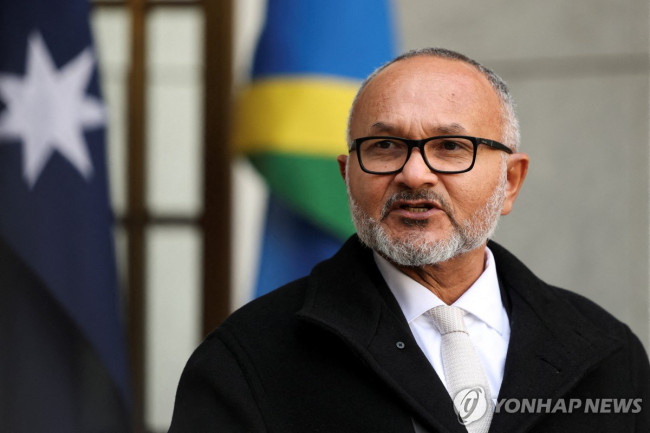 Solomon Islands Prime Minister Matthew Wale [Reuters Yonhap News File Photo]
Meanwhile, according to AFP on this day, Solomon Islands Prime Minister Matthew Wale, who recently visited the U.S., announced that he is in deep negotiations with the U.S. to receive funding for the development of the Bina Harbor, a deep-sea port on the island of Malaita.
Prime Minister Wale stated that "Bina Harbor is a very important port," adding that U.S. officials have made "firm commitments" regarding funding for the construction of wharves, power facilities, fuel storage facilities, and roads at the harbor.
In this regard, an official from the U.S. International Development Finance Corporation (DFC) also told AFP, "We are willing to do business in the Solomon Islands and are exploring investment opportunities with private capital."
However, the official did not mention any specific projects.
U.S. officials also reported that the DFC has signed agreements with the Solomon Islands and Vanuatu to review the feasibility of major infrastructure projects.
The Solomon Islands has long been seeking a large-scale project to build international port infrastructure and a tuna processing plant for export at Bina Harbor.
Since the Solomon Islands signed a fisheries agreement in 2023 with the China National Fisheries Corporation (CNFC), China's largest distant-water fishing company, following its security pact with Beijing, concerns have been raised in the West that China could build a dual-use military and civilian port at Bina Harbor.
It is known that Chinese companies had also lobbied the previous government of the Solomon Islands regarding the Bina Harbor project.
However, Prime Minister Wale, who took office last May, is accelerating cooperation with the West instead of the existing pro-China line, such as visiting the U.S., Japan, and Australia to seek investment support.
During his visit to the U.S., he also agreed to sign a "ship rider agreement" with the U.S., which allows the U.S. Coast Guard to patrol Solomon Islands waters with local police personnel on board.

 [Statement by the Seo-beo-kka Korea Military Academy Save-the-Nation Comrades Association] ㉛ Recount the Votes Publicly, as the Previous Recount Concealed Election Fraud
Tongyeong Mayoral Election Recount [Photo=Yonhap News]South Korea's liberal democracy is dying. The National Election Commission (NEC) and the judiciary, which have plummeted into criminal syndicates
[Statement by the Seo-beo-kka Korea Military Academy Save-the-Nation Comrades Association] ㉛ Recount the Votes Publicly, as the Previous Recount Concealed Election Fraud
Tongyeong Mayoral Election Recount [Photo=Yonhap News]South Korea's liberal democracy is dying. The National Election Commission (NEC) and the judiciary, which have plummeted into criminal syndicates
 Cuba, 74% of power supply cut off… effectively a 'blackout'
Power outage in Cuba [EPA=Yonhap News]Cuba, grappling with a worsening power crisis, continues to face outages that are nearing a total blackout. As the energy crisis accelerates, the government appea
Cuba, 74% of power supply cut off… effectively a 'blackout'
Power outage in Cuba [EPA=Yonhap News]Cuba, grappling with a worsening power crisis, continues to face outages that are nearing a total blackout. As the energy crisis accelerates, the government appea
 1st Corps conducted GP guard operations without live ammunition for heavy machine guns… JCS says it "was unaware"
K-6 Heavy Machine Gun [Yonhap News file photo]The Army's 1st Corps, which oversees the western front, has been conducting guard operations at General Outposts (GOP) and front-line Guard Posts (GP) wit
1st Corps conducted GP guard operations without live ammunition for heavy machine guns… JCS says it "was unaware"
K-6 Heavy Machine Gun [Yonhap News file photo]The Army's 1st Corps, which oversees the western front, has been conducting guard operations at General Outposts (GOP) and front-line Guard Posts (GP) wit
 Joint Investigation Headquarters Secures NEC Data for 2025 Presidential Election and 2024 General Election
It has been determined that the search and seizure warrant executed by the joint investigation headquarters on the 23rd—covering the National Election Commission (NEC), local election commissions in
Joint Investigation Headquarters Secures NEC Data for 2025 Presidential Election and 2024 General Election
It has been determined that the search and seizure warrant executed by the joint investigation headquarters on the 23rd—covering the National Election Commission (NEC), local election commissions in
 'Gap investment' with no capital leads to 67 billion won in stolen jeonse deposits… 15-year prison sentence upheld in second trial
Real estate gap investment [Yonhap News file photo]A businessman who swindled approximately 67 billion won from 349 victims through a "no-capital" gap investment scheme has been handed a heavy sentenc
'Gap investment' with no capital leads to 67 billion won in stolen jeonse deposits… 15-year prison sentence upheld in second trial
Real estate gap investment [Yonhap News file photo]A businessman who swindled approximately 67 billion won from 349 victims through a "no-capital" gap investment scheme has been handed a heavy sentenc
 Jogye Order faces internal turmoil ahead of the administrative chief election over allegations regarding Venerable Jinwoo's academic credentials and monastic registration.
Ven. Jinwoo, the current President of the Jogye Order. The Order is experiencing turmoil following recent allegations regarding his educational background and monastic credentials. [Photo=Yonhap News]
Jogye Order faces internal turmoil ahead of the administrative chief election over allegations regarding Venerable Jinwoo's academic credentials and monastic registration.
Ven. Jinwoo, the current President of the Jogye Order. The Order is experiencing turmoil following recent allegations regarding his educational background and monastic credentials. [Photo=Yonhap News]
 [Column by Writer Park Joo-hyun] “It’s All Because of Roh Moo-hyun”
Roh Moo-hyun (left) bowing his head, saying, "I am ashamed before the people. I am sorry for disappointing you." (April 2009). The first party to directly file a complaint with the Supreme Prosecutors
[Column by Writer Park Joo-hyun] “It’s All Because of Roh Moo-hyun”
Roh Moo-hyun (left) bowing his head, saying, "I am ashamed before the people. I am sorry for disappointing you." (April 2009). The first party to directly file a complaint with the Supreme Prosecutors
 [Photo] Evidence of Election Fraud Flooding U.S. Media… Trump Had 2.7 Million Votes Stolen
 [Video] U.S. Semiquincentennial Air Show... 'Art in the Sky' streaks across New York
 [Editorial Cartoon] A Draconian Law That Undermines Freedom of Expression

 List
List