 Jesse Kreier, a professor of law at Georgetown University, explains the outlook for the U.S. Supreme Court's ruling on reciprocal tariffs and the potential impact on South Korea during a seminar held at the Korea-U.S. Congressional Exchange Center in Washington, D.C., on the 26th (local time). Yonhap News.
An American expert has suggested that even if the U.S. Supreme Court ultimately rules that President Donald Trump's "reciprocal tariffs" are illegal, there are various other legal alternatives the President could use to impose tariffs, and that South Korea must prepare trade agreements accordingly.
During a seminar held at the Korea-U.S. Congressional Exchange Center in Washington, D.C., on the 26th (local time), Georgetown University law professor Jesse Kreier stated that even if the Supreme Court, like the lower courts, rules to limit the President's tariff-imposing authority, "it is difficult to expect the U.S. to suddenly return to the 'open economy' of 20 or even four years ago."
Professor Kreier, a trade law expert who previously served as an interim director at the World Trade Organization (WTO), cited Section 232 of the Trade Expansion Act as an example, noting that "a president determined to change trade relations with the entire world has a vast array of tools at their disposal."
Section 232 of the Trade Expansion Act grants the President the authority to restrict the import of goods that negatively affect national security; President Trump has already used this authority to impose item-specific tariffs on products such as automobiles and steel. The implication is that even if the reciprocal tariffs are struck down by a Supreme Court ruling, President Trump could significantly expand item-specific tariffs.
To impose tariffs based on the Trade Expansion Act, the Department of Commerce must investigate the impact of the relevant items on national security.
Professor Kreier explained that because it is a government department rather than an independent agency, it is highly likely that investigation results will follow the direction desired by the President.
As investigations under "Section 232 of the Trade Expansion Act" are already underway for various items, and the President's discretion regarding the results is quite broad, Professor Kreier predicted that the Trump administration would find alternative measures "quite quickly" even if the reciprocal tariffs are ruled illegal.
Additionally, he mentioned Section 301 of the Trade Act as a means of imposing tariffs.
He noted that Section 301 of the Trade Act focuses on identifying whether foreign countries are failing to uphold trade agreement commitments or engaging in discriminatory practices that place excessive burdens on trade, serving as a tool to respond to "unfair trade."
In fact, the Trump administration has initiated a "Section 301" investigation into China's maritime, logistics, and shipbuilding industries, and concluded last January that China is competing unfairly to dominate these industries, thereby harming the United States.
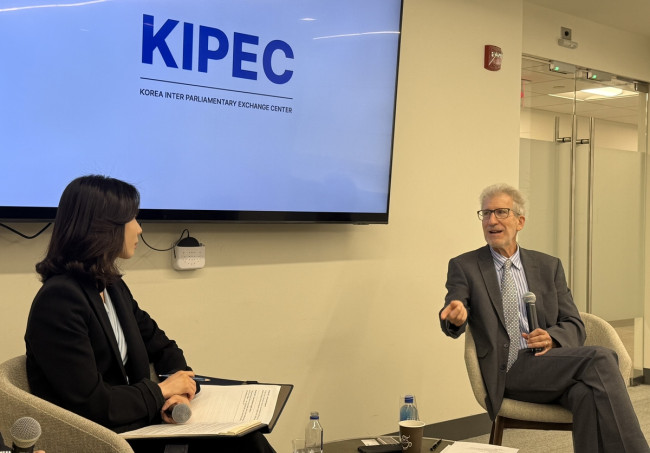 Jesse Kreier, a professor of law at Georgetown University, explains the outlook for the U.S. Supreme Court's ruling on reciprocal tariffs and the potential impact on South Korea during a seminar held at the Korea-U.S. Congressional Exchange Center in Washington, D.C., on the 26th (local time). Yonhap News.
Section 112 of the Trade Act could also serve as a tool, though Professor Kreier explained that it was specifically designed to resolve balance-of-payments issues, and that when and what measures can be taken under it are strictly defined.
"South Korea will likely need to find a negotiable agreement in some form from a practical standpoint," Professor Kreier said. "This is because it is difficult to expect the situation to revert to the status quo that South Korea is accustomed to through a court ruling. Such things will not happen under the Trump administration."
Regarding the outlook for the Supreme Court ruling, Professor Kreier said, "It is not simply a matter of yes or no (legal or illegal)," adding, "If the Supreme Court intends to invalidate the (tariff) measure, it could do so in a very narrow or very broad scope."
He continued, "For example, it could rule that 'tariffs can never be imposed under the International Emergency Economic Powers Act (IEEPA),' or it could determine that 'the problem (national emergency) and the solution (imposing tariffs) do not align.'"
The U.S. Supreme Court is scheduled to begin hearings on November 5 to make a final determination on whether there is a legal basis for the reciprocal tariffs that President Trump imposed on most items from countries around the world, including South Korea, by applying differential tax rates by country.
President Trump used the IEEPA as the basis for the executive order imposing reciprocal tariffs. However, the Court of International Trade (USCIT), the court of first instance, and the U.S. Court of Appeals for the Federal Circuit in Washington, D.C., the second instance, both ruled that while the IEEPA grants the President "authority to regulate imports," it does not extend to "broad authority to impose tariffs."
Yonhap News

 Trump pressures for rate cut again ahead of FOMC... "Should be the lowest in the world"
U.S. President Donald Trump. [Photo = The White House] U.S. President Donald Trump once again pressured the Federal Reserve, the U.S. central bank, to lower interest rates on the 27th (local time
Trump pressures for rate cut again ahead of FOMC... "Should be the lowest in the world"
U.S. President Donald Trump. [Photo = The White House] U.S. President Donald Trump once again pressured the Federal Reserve, the U.S. central bank, to lower interest rates on the 27th (local time
 “Ignoring crisp ballots and damaged seals”… Tongyeong mayoral recount concludes with ‘no change in outcome,’ leaving suspicions and public outrage behind
Suspected counterfeit ballots discovered in Tongyeong [GIF from social media of Representative Hwang Kyo-ahn / Attorney Park Joo-hyun]During a recount of the Tongyeong mayoral election in South Gyeong
“Ignoring crisp ballots and damaged seals”… Tongyeong mayoral recount concludes with ‘no change in outcome,’ leaving suspicions and public outrage behind
Suspected counterfeit ballots discovered in Tongyeong [GIF from social media of Representative Hwang Kyo-ahn / Attorney Park Joo-hyun]During a recount of the Tongyeong mayoral election in South Gyeong
 President Yoon, regarding the first-instance ruling on the Public Official Election Act: “An excessive political verdict that distorts the facts… We will appeal immediately.”
The first-instance sentencing hearing for President Yoon Suk Yeol regarding violations of the Public Official Election Act is being broadcast live at Seoul Station on the 27th. [Photo=Yonhap News]Pres
President Yoon, regarding the first-instance ruling on the Public Official Election Act: “An excessive political verdict that distorts the facts… We will appeal immediately.”
The first-instance sentencing hearing for President Yoon Suk Yeol regarding violations of the Public Official Election Act is being broadcast live at Seoul Station on the 27th. [Photo=Yonhap News]Pres
 WSJ: "SK Hynix ADR Premium Is a Sign of AI Trading Overheat"
Advertisement for SK Hynix ADR listing in New York's Times Square [Reuters=Yonhap News file photo]The Wall Street Journal (WSJ) has pointed out that the price of SK Hynix’s American Depositary Recei
WSJ: "SK Hynix ADR Premium Is a Sign of AI Trading Overheat"
Advertisement for SK Hynix ADR listing in New York's Times Square [Reuters=Yonhap News file photo]The Wall Street Journal (WSJ) has pointed out that the price of SK Hynix’s American Depositary Recei
 'Godfather of Japanese Mystery Novels' Keigo Higashino Passes Away After Battle with Cancer at 68
Famous Japanese mystery novelist Keigo Higashino [AFP=Yonhap News]It has been belatedly reported that Keigo Higashino, the "godfather of Japanese mystery novels" and author of bestsellers such as "The
'Godfather of Japanese Mystery Novels' Keigo Higashino Passes Away After Battle with Cancer at 68
Famous Japanese mystery novelist Keigo Higashino [AFP=Yonhap News]It has been belatedly reported that Keigo Higashino, the "godfather of Japanese mystery novels" and author of bestsellers such as "The
 [Park Pil-kyu Security Column] To the Ignorant Trying to Clothe a Beast in Sheep's Clothing
Rep. Kim Byung-joo of the Democratic Party of Korea [Photo=Yonhap News]“The Air Force Academy doesn't teach you how to fly a plane!” “The Army, Navy, and Air Force academies are exactly the
[Park Pil-kyu Security Column] To the Ignorant Trying to Clothe a Beast in Sheep's Clothing
Rep. Kim Byung-joo of the Democratic Party of Korea [Photo=Yonhap News]“The Air Force Academy doesn't teach you how to fly a plane!” “The Army, Navy, and Air Force academies are exactly the
 [Issue Diagnosis] Two Effects of the Election Petition Review
 [Photo] Evidence of Election Fraud Flooding U.S. Media… Trump Had 2.7 Million Votes Stolen
 [Video] U.S. Semiquincentennial Air Show... 'Art in the Sky' streaks across New York
 [Editorial Cartoon] A Draconian Law That Undermines Freedom of Expression

 List
List









