이번 기사는 대법원의 민주노총 간부 간첩 사건 확정 판결을 계기로, 한국 사회의 대공수사 현실과 제도적 한계를 분석한 글입니다. 판결은 “간첩은 맞지만 간첩단은 아니다”라는 결론을 내렸습니다. 이는 점조직과 사이버 침투가 결합된 현대 간첩 활동을 전통적 증거주의 체계로 입증하는 것이 얼마나 어려운지를 보여줍니다. 본 기사는 과거 사건과 비교하며, 4대 과제를 제시합니다. <편집자 주>
 Spies hidden in 0s and 1s, the reality of an elusive organization. The reality that while spies exist, spy rings do not. Hankyoreh Graphics
Supreme Court Upholds Second Instance Ruling in 'KCTU Executive Espionage' Case... Confirms Individual Espionage Acts, Denies Existence of 'Secret Organization'
On the 25th, the Supreme Court dismissed all appeals from both the prosecution and the defendants in the 'KCTU Executive Espionage' case, upholding the second instance ruling. The core conclusion is: "There are spies, but no spy ring." This ruling reaffirms that the secrecy of cell-like structures, online communication, and the ensuing complexities after the reorganization of investigative powers have made it even more difficult to prove the existence of an organization.
The Supreme Court's Second Division upheld the lower court's decision in case number 2025do8823. Former KCTU Organizational Struggle Department Head A received a confirmed sentence of 9 years and 6 months in prison and 9 years and 6 months of disqualification. Former Health and Medical Workers' Union Organizational Director B was sentenced to 3 years in prison and 3 years of disqualification. Conversely, former Metal Workers' Union Vice Chairman C and a union federation's organizational manager D were acquitted. The Supreme Court determined that the first instance court's factual findings did not exceed the limits of free judicial discretion and that there were no misinterpretations of the law.
The trajectory of the case clearly shows the divergence in judgments between the first, second, and Supreme Courts. The first instance court (Suwon District Court Criminal Division 14, November 6, 2024) broadly recognized the existence of a 'underground organization' based on directives and reports from North Korea's Cultural Exchange Bureau, sentencing A to a severe penalty of 15 years in prison. However, the second instance court (Suwon High Court Criminal Division 2-3, May 15, 2025) significantly reduced the sentence, stating, "The wording of the documents alone is insufficient to recognize the existence of an organization." The Supreme Court fully endorsed this judgment.
This ruling has reconfirmed that while individual espionage acts (meeting abroad, receiving directives/reporting, special infiltration/exfiltration, etc.) can be punished if evidence is secured, establishing a spy ring requires concrete evidence of continuous operation, such as membership lists, regular meetings, financial flows, and a command structure. The standard that documentation and statements alone are insufficient to reach "proof beyond a reasonable doubt" has become established.
Comparison with Past Cases
The flow of this case becomes even clearer when compared to past precedents. In the Wang Jaesan case (2011), the court recognized an organization operating under North Korean directives as an 'underground party' and imposed severe penalties. The Ilsimhoe case (2006) also acknowledged a leadership and a hierarchical structure to some extent. However, in the current case, the establishment of a spy ring was denied on the grounds of a lack of objective physical evidence of organizational operations. This is a result of the decentralization of anti-espionage investigation authority and the strengthening of evidentiary standards.
New Threats: Chinese Spies and Cyber Espionage
Today, espionage activities are not limited to North Korea. Recently, incidents of Chinese industrial espionage targeting South Korean semiconductor technology have been uncovered, and hacking attempts aimed at defense research institutions are frequent. Security experts warn, "North Korea focuses on political maneuvers for regime maintenance, while China concentrates on industrial and economic intelligence," and "Securing cyber evidence is impossible without international cooperation." Concerns have been raised that the legal limitations of this ruling could be repeated in addressing Chinese espionage.
Four Key Areas for Improvement Identified by Anti-Espionage Experts
Anti-espionage experts stated, "This ruling has demonstrated the reality that while individual spies can be punished, proving the existence of a spy ring is difficult," and proposed four areas for improvement.
First is the legalization of requirements for recognizing the existence of an organization. A former NIS executive said, "The same evidence can be interpreted differently depending on the judge's disposition," and added, "Indicators for determining an underground organization should be clearly stipulated in the law."
Second is the restoration of the cooperation system between intelligence and investigation. Since the transfer of NIS anti-espionage investigation authority, there have been criticisms that long-term surveillance, international cooperation, and the utilization of North Korea intelligence networks have weakened. A former prosecutor stated, "It is virtually impossible to prove the existence of a spy ring if the police, NIS, and prosecution operate separately," emphasizing the need for a joint protocol to convert intelligence into evidence.
Third is the strengthening of capabilities to counter cyber espionage. Recent espionage activities are dominated by infiltration through encrypted messengers, virtual assets, and the dark web. A security expert said, "Not only North Korea but also Chinese industrial spies are infiltrating online," and stressed the need to systematically enhance blockchain tracking and digital forensics capabilities.
Fourth is the expansion of infrastructure for long-term surveillance and investigative tracking. Due to the cell-like structure of organizations, uncovering them requires years of tracking and undercover operations abroad. However, the current investigative system is geared towards processing short-term cases. A police official pointed out, "Unless specialized long-term investigation teams are established for security cases and stable budgets are guaranteed, the reality of 'catching spies but not spy rings' will repeat itself."
This ruling confirms the effectiveness of punishing individual espionage acts while re-emphasizing the strict standard for proving the existence of an organization. However, in a reality where espionage and cyber operations, not only from North Korea but also from China, are intensifying, the paradox of "spies exist, but spy rings do not" could persist without systemic improvements.
There is a need for checks and balances that reduce security gaps while preventing human rights violations. The challenge for South Korean society is sophisticated institutional remodeling that balances both values of security and human rights.
It is a time to internalize the criticism that those who obstruct institutional improvement may themselves be the real spies.
※ ps. The experts who agreed to interviews unanimously requested anonymity. Who are they afraid of offending? It leaves a bitter aftertaste, feeling like a reflection of the reality of espionage investigations.
#SupremeCourt #KCTU #EspionageCase #NationalSecurityAct #SpyRing #CellOrganization #CyberEspionage #ChineseSpy #NIS #SecurityGap

 Trump pressures for rate cut again ahead of FOMC... "Should be the lowest in the world"
U.S. President Donald Trump. [Photo = The White House] U.S. President Donald Trump once again pressured the Federal Reserve, the U.S. central bank, to lower interest rates on the 27th (local time
Trump pressures for rate cut again ahead of FOMC... "Should be the lowest in the world"
U.S. President Donald Trump. [Photo = The White House] U.S. President Donald Trump once again pressured the Federal Reserve, the U.S. central bank, to lower interest rates on the 27th (local time
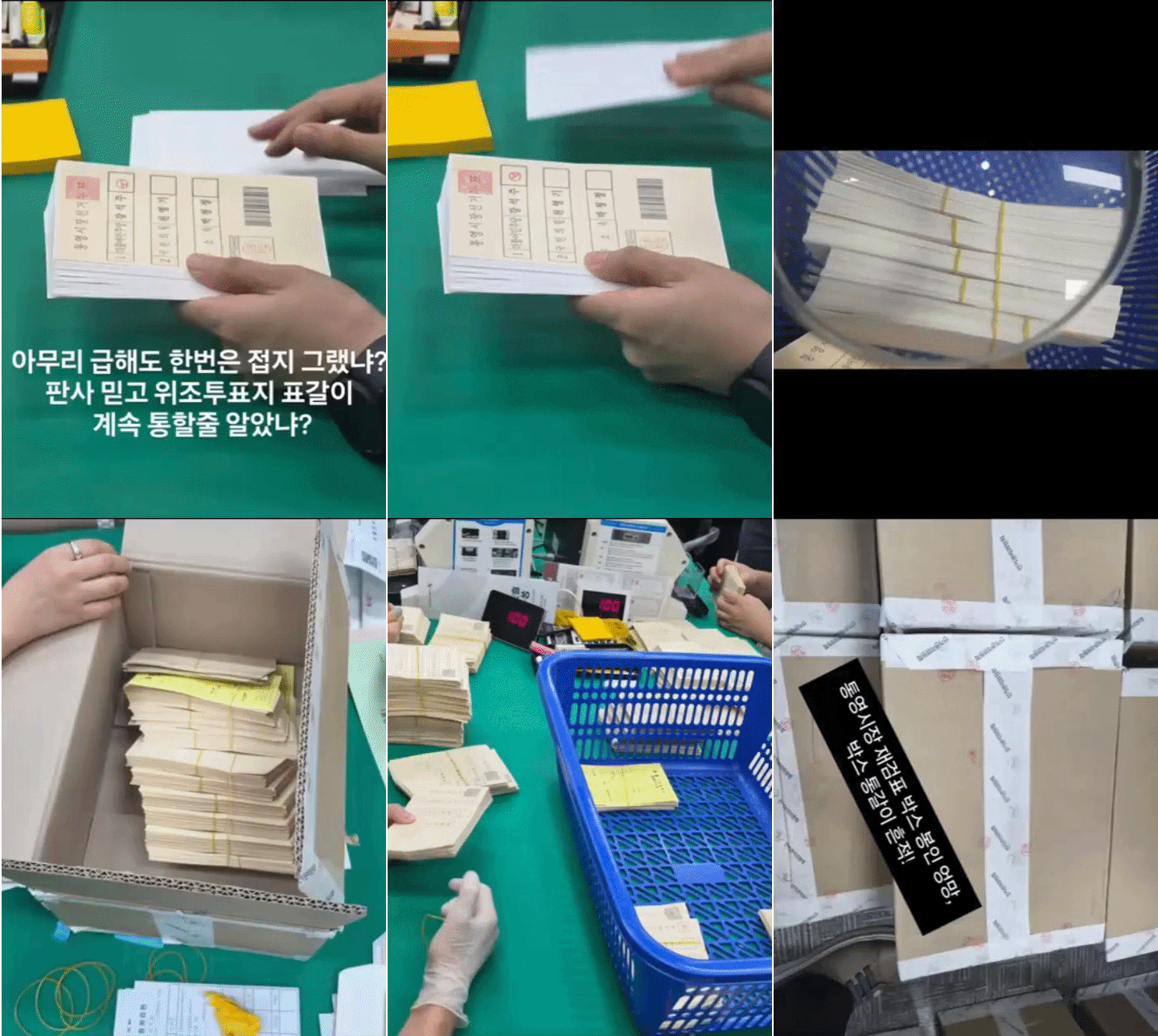 “Ignoring crisp ballots and damaged seals”… Tongyeong mayoral recount concludes with ‘no change in outcome,’ leaving suspicions and public outrage behind
Suspected counterfeit ballots discovered in Tongyeong [GIF from social media of Representative Hwang Kyo-ahn / Attorney Park Joo-hyun]During a recount of the Tongyeong mayoral election in South Gyeong
“Ignoring crisp ballots and damaged seals”… Tongyeong mayoral recount concludes with ‘no change in outcome,’ leaving suspicions and public outrage behind
Suspected counterfeit ballots discovered in Tongyeong [GIF from social media of Representative Hwang Kyo-ahn / Attorney Park Joo-hyun]During a recount of the Tongyeong mayoral election in South Gyeong
 President Yoon, regarding the first-instance ruling on the Public Official Election Act: “An excessive political verdict that distorts the facts… We will appeal immediately.”
The first-instance sentencing hearing for President Yoon Suk Yeol regarding violations of the Public Official Election Act is being broadcast live at Seoul Station on the 27th. [Photo=Yonhap News]Pres
President Yoon, regarding the first-instance ruling on the Public Official Election Act: “An excessive political verdict that distorts the facts… We will appeal immediately.”
The first-instance sentencing hearing for President Yoon Suk Yeol regarding violations of the Public Official Election Act is being broadcast live at Seoul Station on the 27th. [Photo=Yonhap News]Pres
 WSJ: "SK Hynix ADR Premium Is a Sign of AI Trading Overheat"
Advertisement for SK Hynix ADR listing in New York's Times Square [Reuters=Yonhap News file photo]The Wall Street Journal (WSJ) has pointed out that the price of SK Hynix’s American Depositary Recei
WSJ: "SK Hynix ADR Premium Is a Sign of AI Trading Overheat"
Advertisement for SK Hynix ADR listing in New York's Times Square [Reuters=Yonhap News file photo]The Wall Street Journal (WSJ) has pointed out that the price of SK Hynix’s American Depositary Recei
 'Godfather of Japanese Mystery Novels' Keigo Higashino Passes Away After Battle with Cancer at 68
Famous Japanese mystery novelist Keigo Higashino [AFP=Yonhap News]It has been belatedly reported that Keigo Higashino, the "godfather of Japanese mystery novels" and author of bestsellers such as "The
'Godfather of Japanese Mystery Novels' Keigo Higashino Passes Away After Battle with Cancer at 68
Famous Japanese mystery novelist Keigo Higashino [AFP=Yonhap News]It has been belatedly reported that Keigo Higashino, the "godfather of Japanese mystery novels" and author of bestsellers such as "The
 [Park Pil-kyu Security Column] To the Ignorant Trying to Clothe a Beast in Sheep's Clothing
Rep. Kim Byung-joo of the Democratic Party of Korea [Photo=Yonhap News]“The Air Force Academy doesn't teach you how to fly a plane!” “The Army, Navy, and Air Force academies are exactly the
[Park Pil-kyu Security Column] To the Ignorant Trying to Clothe a Beast in Sheep's Clothing
Rep. Kim Byung-joo of the Democratic Party of Korea [Photo=Yonhap News]“The Air Force Academy doesn't teach you how to fly a plane!” “The Army, Navy, and Air Force academies are exactly the
 [Issue Diagnosis] Two Effects of the Election Petition Review
 [Photo] Evidence of Election Fraud Flooding U.S. Media… Trump Had 2.7 Million Votes Stolen
 [Video] U.S. Semiquincentennial Air Show... 'Art in the Sky' streaks across New York
 [Editorial Cartoon] A Draconian Law That Undermines Freedom of Expression

 List
List