This image shows Chey Tae-won, chairman of SK Group, and Noh So-young, director of the Art Center Nabi, attending the appellate court hearing for their divorce lawsuit on April 16, in Seoul's Seocho District. Yonhap News.
The Supreme Court has overturned the appellate court's decision that ordered Chey Tae-won (65), chairman of SK Group, to pay over 1.3 trillion won in property division to Noh So-young (64), director of the Art Center Nabi, in their divorce.
The Supreme Court accepted Chey's appeal, overturning the appellate court's ruling which was based on the premise of a 30 billion won slush fund from former President Roh Tae-woo that allegedly flowed into SK. The court deemed this to be a "payment due to an illegal cause" under civil law. This implies that property received due to an illegal cause, being significantly unlawful and antisocial, falls outside the realm of legal protection and should not be considered in property division. However, the court did not rule on the actual existence of the slush fund. It established a principle that regardless of its existence, it cannot be legally recognized.
Furthermore, the Supreme Court ruled that stocks or money disposed of by Chey during the SK Group's management process, if related to the formation or maintenance of marital joint property, cannot be subject to division if they have already been disposed of and are no longer held as of the closing date of the factual trial (appellate trial). Lower court rulings have often included assets transferred shortly before divorce for purposes like "hiding assets" in property division. This ruling marks the first time the Supreme Court has established a precedent that assets disposed of by Chey to a third party for the purpose of maintaining management rights or in the course of business activities cannot be included in property division.
The Supreme Court's First Division (Presiding Justice Seo Kyung-hwan) on the 16th, in its ruling on the final appeal of the divorce lawsuit between Chey and Noh, overturned the appellate court's decision that ordered "the plaintiff (Chey) to pay the defendant (Noh) 1.3808 trillion won in property division" and sent the case back to the Seoul High Court.
Consequently, the "divorce of the century" lawsuit between Chey and Noh will have the property division aspect re-evaluated at the Seoul High Court. Regarding the historically largest alimony of 2 billion won, the court found no errors in the appellate court's decision and dismissed the appeal, making the ruling final.
The Supreme Court did not rule on whether the "Roh Tae-woo slush fund," which was a primary basis for the appellate court's decision, actually existed. However, it explained that even if the slush fund did exist and was transferred to SK, it was "illegal funds" and thus could not be considered as Noh's contribution in property division.
Citing Article 746 of the Civil Act, which states that "a claim for return of benefits shall not be made for a payment made due to an illegal cause," the Supreme Court stated, "The legislative intent of the provision excluding claims for return of payments due to an illegal cause must be considered in claims for property division due to divorce."
In other words, the Roh Tae-woo slush fund is a payment generated due to the illegal act of bribery, and thus a claim for return of unjust enrichment cannot be asserted. This principle should also apply to the division of inherited property.
The Supreme Court explained, "Even if, as acknowledged by the appellate court, the defendant's (Noh's) father, Roh Tae-woo, provided approximately 30 billion won to the plaintiff's (Chey's) father, Choi Jong-hyun, the source of this money appears to be bribes received by Roh Tae-woo during his presidency."
It further elaborated, "Roh Tae-woo's act of providing a large sum of money to his in-laws or his child's couple as part of bribes, and remaining silent about it, making it impossible for the state to trace and confiscate the funds, is contrary to good morals and other social order, and is so significantly unlawful, antisocial, unethical, and immoral that it is outside the realm of legal protection."
Although Noh's side argued that they were "not seeking the return of money provided by former President Roh, but asserting Noh's contribution in property division," the Supreme Court firmly stated that "in such cases, the illegality cannot be severed, and such an act is not deserving of protection in any form, including contribution in property division, as it is unacceptable from the perspective of the overall legal order." This means that as long as former President Roh's actions lack legal protection, they should not be considered as Noh's contribution in property division.
The Supreme Court stated, "If the contribution of the defendant's (Noh's) father, Roh Tae-woo, to the formation or maintenance of property can be considered as the defendant's contribution in property division due to divorce, then the illegality of the financial support act as part of Roh Tae-woo's contribution must also be considered alongside the defendant's claim of contribution."
The Supreme Court noted that "the appellate court's consideration of Roh Tae-woo's financial support as the defendant's (Noh's) contribution also influenced the calculation of the property division ratio," and thus overturned and remanded the portion of the appellate court's ruling concerning the property division claim.
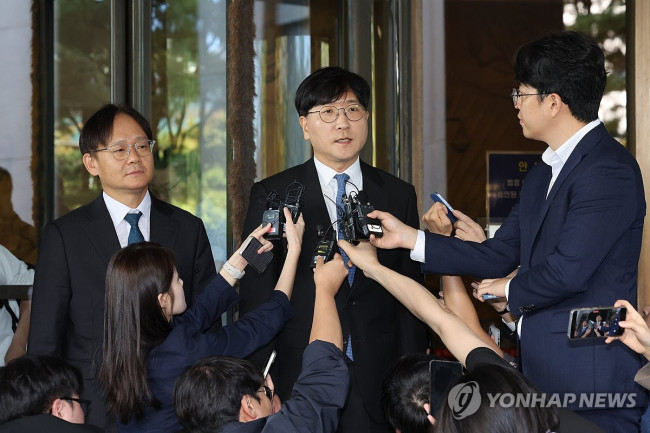 On October 16th, the day the Supreme Court ruled to overturn and remand the final appeal in the divorce lawsuit between Chey Tae-won, chairman of SK Group, and Noh So-young, director of the Art Center Nabi, Chey's legal representatives, including Min Chul-ki (from left) and Lee Jae-geun, attorneys, announce their stance on the ruling in front of the Supreme Court in Seocho District, Seoul. Yonhap News.
The Supreme Court also deemed the appellate court's decision to include, as divisible property, assets that Chey had disposed of and no longer held, by presuming they existed on the closing date of the factual trial, to be erroneous.
Chey gifted 91,895 shares of SK C&C to the Korea Foundation for Advanced Education etc. in August 2014, 200,000 shares of SK Holdings to the Choi Jong-hyun Academy in October of the same year, and 3.29 million shares of SK Holdings to 18 relatives and acquaintances in November. Furthermore, from around 2012, he disposed of 92.776 billion won through donations to SK Group Senior Vice Chairman Chey Jae-won and by returning his salary to SK Group, and he also paid the inheritance tax of 24.6 billion won for Senior Vice Chairman Chey Jae-won.
The appellate court calculated the value of these disposed assets at 1.1 trillion won and included them in the property division, bringing the total divisible assets to approximately 4 trillion won.
The principle is that if one party disposes of assets unrelated to the joint living or the formation and maintenance of joint property after the breakdown of the marital relationship, these assets can be considered as still held on the closing date of the appellate trial and included in the division. However, if the disposal is related to the joint living or the formation and maintenance of joint property, and the assets do not exist on the closing date of the appellate trial, they cannot be included in the division.
The Supreme Court stated, "The plaintiff's disposal of assets occurred before December 4, 2019, the date of the marital breakdown as acknowledged by the appellate court," and "it appears to have been done by the plaintiff as a manager of SK Group to secure stable management rights or control of the company, or as part of business activities, and it is plausible that it was for the maintenance or value increase of marital joint property, including SK Holdings shares in the plaintiff's name."
Chey and Noh married in September 1988, had three children, but their marriage broke down. In 2015, Chey revealed the existence of an extramarital child through the media, stating, "Noh and I have had a deep rift for over ten years."
Chey filed for divorce mediation for an amicable divorce against Noh in July 2017, but as no agreement was reached in February 2018, a formal lawsuit commenced. Noh filed a counterclaim in December 2019, agreeing to a divorce.
In December 2022, the first instance court ruled, "Chey shall pay Noh 100 million won in alimony and 66.5 billion won in cash as property division."
In May of last year, the appellate court estimated the total marital assets at approximately 4 trillion won and ordered Chey to give 35% of that amount, 1.3808 trillion won, to Noh, significantly increasing the property division amount, and also ordered the payment of 2 billion won in alimony. The division ratio was 65% for Chey and 35% for Noh.
 This image shows the SK building in Jongno District, Seoul, on the 16th, following the ruling to overturn and remand the property division in the Chey Tae-won-Noh So-young divorce lawsuit. Yonhap News.
With the Supreme Court's decision to order a new property division, citing the "Roh Tae-woo slush fund" issue, the "divorce of the century" property division case has returned to square one.
The Seoul High Court, which will handle the remanded case, must adhere to the Supreme Court's judgment. Firstly, according to the Supreme Court's ruling, Chey's disposed assets, known to be worth approximately 1.1 trillion won, will be excluded from the divisible property. As the Supreme Court ordered the exclusion of the Roh Tae-woo slush fund from Noh's contribution, the contribution amount (ratio) must be recalculated.
The Supreme Court did not make a ruling on Chey's claim that "SK shares are unique assets," as it is a legal judgment.
The Supreme Court made rulings on four aspects of the appeal: ▲ contribution through financial support (slush fund) from former President Roh Tae-woo, ▲ presumption of holding assets disposed of by Chairman Chey Tae-won through gifts to third parties, ▲ property division ratio, and ▲ alimony. These decisions were made on this day.
However, in its ruling, the Supreme Court stated, "Without ruling on the remaining grounds for appeal, the portion of the appellate court's judgment concerning the property division claim is overturned," implying that the judgment on unique assets was omitted.
Therefore, the issue of "unique assets" may again become a point of contention in the remanded trial. Chey's position is that SK shares (formerly Taehan Telecommunication) are clearly his unique assets, acquired with funds inherited or gifted from his late father, and therefore Noh has no involvement. Noh's side has argued that they are marital joint property.
For this lawsuit, Chey's side is represented by Yulchon LLC, led by attorney Hong Seung-myun, a former Seoul High Court judge, and attorney Lee Jae-geun, a former district court judge who is close to Hong. Hong is highly regarded as a top legal authority, having graduated at the top of his law school class, served in key positions such as Head of the Judicial Support Division at the Court Administration Office, and then as Senior Researcher and Chief Researcher at the Supreme Court. Lee served as the Civil Affairs Officer at the Court Administration Office, Judicial Support Review Officer, and Supreme Court Researcher. Noh's side is represented by Choi Jae-hyung, a prominent legal figure who served as a Court President and then as Chairman of the Board of Audit and Inspection.
Considering current court practices, the remanded trial is expected to proceed in earnest starting in about two months.
Yonhap News

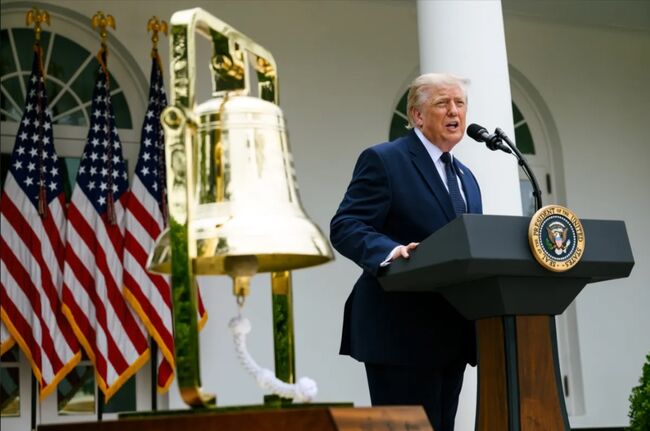 Trump pressures for rate cut again ahead of FOMC... "Should be the lowest in the world"
U.S. President Donald Trump. [Photo = The White House] U.S. President Donald Trump once again pressured the Federal Reserve, the U.S. central bank, to lower interest rates on the 27th (local time
Trump pressures for rate cut again ahead of FOMC... "Should be the lowest in the world"
U.S. President Donald Trump. [Photo = The White House] U.S. President Donald Trump once again pressured the Federal Reserve, the U.S. central bank, to lower interest rates on the 27th (local time
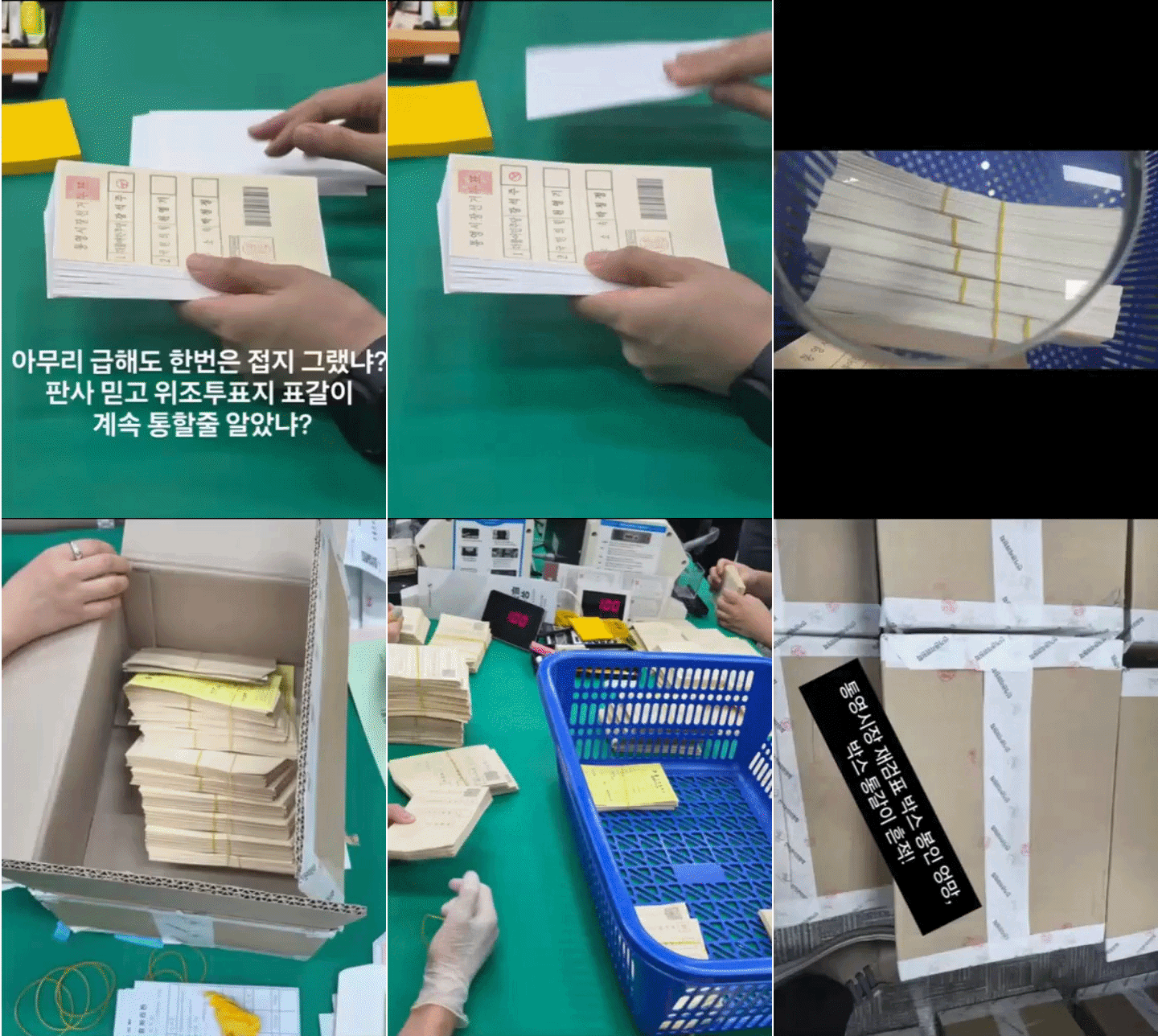 “Ignoring crisp ballots and damaged seals”… Tongyeong mayoral recount concludes with ‘no change in outcome,’ leaving suspicions and public outrage behind
Suspected counterfeit ballots discovered in Tongyeong [GIF from social media of Representative Hwang Kyo-ahn / Attorney Park Joo-hyun]During a recount of the Tongyeong mayoral election in South Gyeong
“Ignoring crisp ballots and damaged seals”… Tongyeong mayoral recount concludes with ‘no change in outcome,’ leaving suspicions and public outrage behind
Suspected counterfeit ballots discovered in Tongyeong [GIF from social media of Representative Hwang Kyo-ahn / Attorney Park Joo-hyun]During a recount of the Tongyeong mayoral election in South Gyeong
 President Yoon, regarding the first-instance ruling on the Public Official Election Act: “An excessive political verdict that distorts the facts… We will appeal immediately.”
The first-instance sentencing hearing for President Yoon Suk Yeol regarding violations of the Public Official Election Act is being broadcast live at Seoul Station on the 27th. [Photo=Yonhap News]Pres
President Yoon, regarding the first-instance ruling on the Public Official Election Act: “An excessive political verdict that distorts the facts… We will appeal immediately.”
The first-instance sentencing hearing for President Yoon Suk Yeol regarding violations of the Public Official Election Act is being broadcast live at Seoul Station on the 27th. [Photo=Yonhap News]Pres
 WSJ: "SK Hynix ADR Premium Is a Sign of AI Trading Overheat"
Advertisement for SK Hynix ADR listing in New York's Times Square [Reuters=Yonhap News file photo]The Wall Street Journal (WSJ) has pointed out that the price of SK Hynix’s American Depositary Recei
WSJ: "SK Hynix ADR Premium Is a Sign of AI Trading Overheat"
Advertisement for SK Hynix ADR listing in New York's Times Square [Reuters=Yonhap News file photo]The Wall Street Journal (WSJ) has pointed out that the price of SK Hynix’s American Depositary Recei
 'Godfather of Japanese Mystery Novels' Keigo Higashino Passes Away After Battle with Cancer at 68
Famous Japanese mystery novelist Keigo Higashino [AFP=Yonhap News]It has been belatedly reported that Keigo Higashino, the "godfather of Japanese mystery novels" and author of bestsellers such as "The
'Godfather of Japanese Mystery Novels' Keigo Higashino Passes Away After Battle with Cancer at 68
Famous Japanese mystery novelist Keigo Higashino [AFP=Yonhap News]It has been belatedly reported that Keigo Higashino, the "godfather of Japanese mystery novels" and author of bestsellers such as "The
 [Park Pil-kyu Security Column] To the Ignorant Trying to Clothe a Beast in Sheep's Clothing
Rep. Kim Byung-joo of the Democratic Party of Korea [Photo=Yonhap News]“The Air Force Academy doesn't teach you how to fly a plane!” “The Army, Navy, and Air Force academies are exactly the
[Park Pil-kyu Security Column] To the Ignorant Trying to Clothe a Beast in Sheep's Clothing
Rep. Kim Byung-joo of the Democratic Party of Korea [Photo=Yonhap News]“The Air Force Academy doesn't teach you how to fly a plane!” “The Army, Navy, and Air Force academies are exactly the
 [Issue Diagnosis] Two Effects of the Election Petition Review
 [Photo] Evidence of Election Fraud Flooding U.S. Media… Trump Had 2.7 Million Votes Stolen
 [Video] U.S. Semiquincentennial Air Show... 'Art in the Sky' streaks across New York
 [Editorial Cartoon] A Draconian Law That Undermines Freedom of Expression

 List
List