Deputy Prime Minister and Minister of Economy and Finance Koo Yoon-cheol answers questions from the press at the International Monetary Fund (IMF) headquarters in Washington, D.C., on the 16th (local time). Yonhap News. Deputy Prime Minister and Minister of Economy and Finance Koo Yoon-cheol stated on the 16th (local time) that while he had conveyed the South Korean government's concerns to the U.S. side regarding the "up-front" payment demand for a $350 billion (approximately 500 trillion KRW) investment fund—a key point of contention in final trade negotiations—it remains uncertain whether President Donald Trump can be persuaded.
Deputy Prime Minister Koo, who is currently visiting the U.S., met with reporters at the IMF headquarters in Washington, D.C., and said, "It is my understanding that the U.S. is pushing for an 'up-front' payment of $350 billion."
Koo explained, "The working-level ministers understand the South Korean government's position that an full up-front investment is difficult; however, there is genuine uncertainty regarding how much they can persuade President Trump to accept this."
Deputy Prime Minister Koo met with U.S. Treasury Secretary Scott Bessent the previous day to convey concerns that the demand for an up-front investment could undermine the stability of South Korea's foreign exchange market.
Koo stated, "I told Secretary Bessent that due to foreign exchange conditions, it is difficult for Korea to do so, and the Secretary is aware that it is hard for Korea to pay everything up-front." He added, "I requested that Secretary Bessent discuss this with others in the administration, such as Secretary of Commerce Howard Lutnick, and I received a positive response that he would explain it sufficiently."
When asked if Secretary Bessent’s response could be interpreted as a sign that the "up-front demand" would be withdrawn, he replied, "We are in a situation where we are asking the (U.S.) government to understand that it is impossible," adding, "It is difficult to say whether it has been withdrawn or not."
Koo explained, "We need to assess foreign exchange stability based on the scheme of how the $350 billion investment will be structured. If the $350 billion is paid up-front, it poses a problem for foreign exchange stability. If Korea's position is sufficiently reflected in the scheme so that the impact on foreign exchange is minimized, the areas we would need to supplement would be reduced."
This suggests that because the impact on the South Korean foreign exchange market depends on the ratio of cash equity investments, loans, and guarantees within the $350 billion package, measures to stabilize the foreign exchange market should be discussed once the investment structure is finalized.
The South Korean government maintains the position that loans and guarantees should be included in the U.S. investment package.
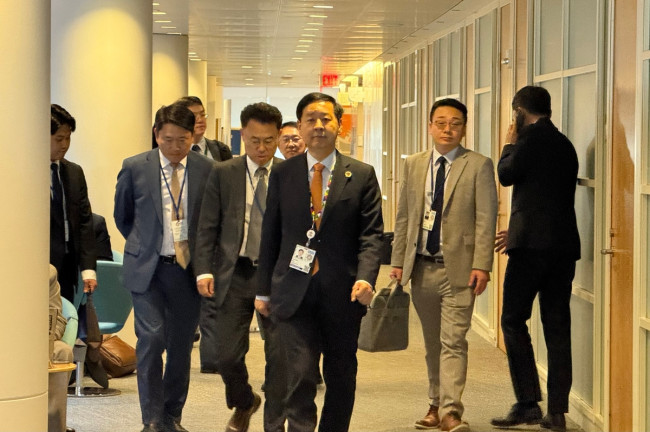 Deputy Prime Minister and Minister of Economy and Finance Koo Yoon-cheol is seen at the IMF headquarters in Washington, D.C., on the 16th (local time). Yonhap News.
Regarding the possibility of a "currency swap" between the two countries, Deputy Prime Minister Koo stated, "Once the scheme is finalized, foreign exchange requirements will emerge accordingly. We have stated that up-front payment is not feasible due to foreign exchange requirements, so if other alternatives emerge, new requirements will arise, and we will judge whether those requirements are feasible within the scope of ensuring the stability of the Korean foreign exchange market."
He added, "Depending on the changes here, we will determine whether a currency swap is completely impossible, whether it is necessary, or if it were to happen, how much would be needed and how feasible it is."
Regarding some reports that the two countries are discussing a plan to split the $350 billion investment over up to 10 years and fund it in Korean won, he said, "This is the first time I've heard of that."
When asked if the U.S. government had requested an increase in South Korean imports of U.S. soybeans, he replied, "It is difficult to confirm as we are in the middle of negotiations."
Regarding the meeting between Presidential Policy Chief Kim Yong-beom, Minister of Trade, Industry and Energy Kim Jung-kwan, and White House Office of Management and Budget (OMB) Director Russell Vought to discuss "MASGA" (Make American Shipbuilding Great Again) cooperation, Koo noted that while he had not yet been briefed on the results, "MASGA is an area where Korea performs well and the U.S. has a need, so there is common ground." He added, "I suspect Chief Kim went to explain this because persuading the relevant departments regarding MASGA would be advantageous for Korea in the trade negotiations."
When asked if the goal is to conclude a South Korea-U.S. trade agreement before the Asia-Pacific Economic Cooperation (APEC) summit at the end of this month, the Deputy Prime Minister said, "From the perspective of national interest, if the content of the negotiations is well-organized, I think it would be good to do it on the occasion of APEC."
Regarding whether South Korea and the U.S. could jointly respond to China's rare earth export controls or sanctions on five Hanwha Ocean subsidiaries, Koo said, "I need to check further," stating that they could review such measures if a proposal comes from the U.S.
Yonhap News

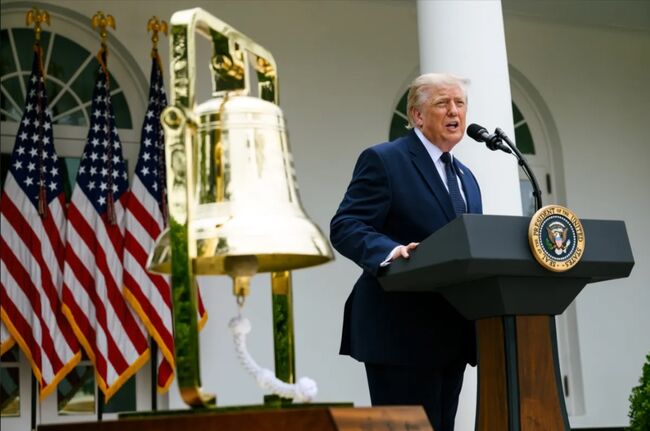 Trump pressures for rate cut again ahead of FOMC... "Should be the lowest in the world"
U.S. President Donald Trump. [Photo = The White House] U.S. President Donald Trump once again pressured the Federal Reserve, the U.S. central bank, to lower interest rates on the 27th (local time
Trump pressures for rate cut again ahead of FOMC... "Should be the lowest in the world"
U.S. President Donald Trump. [Photo = The White House] U.S. President Donald Trump once again pressured the Federal Reserve, the U.S. central bank, to lower interest rates on the 27th (local time
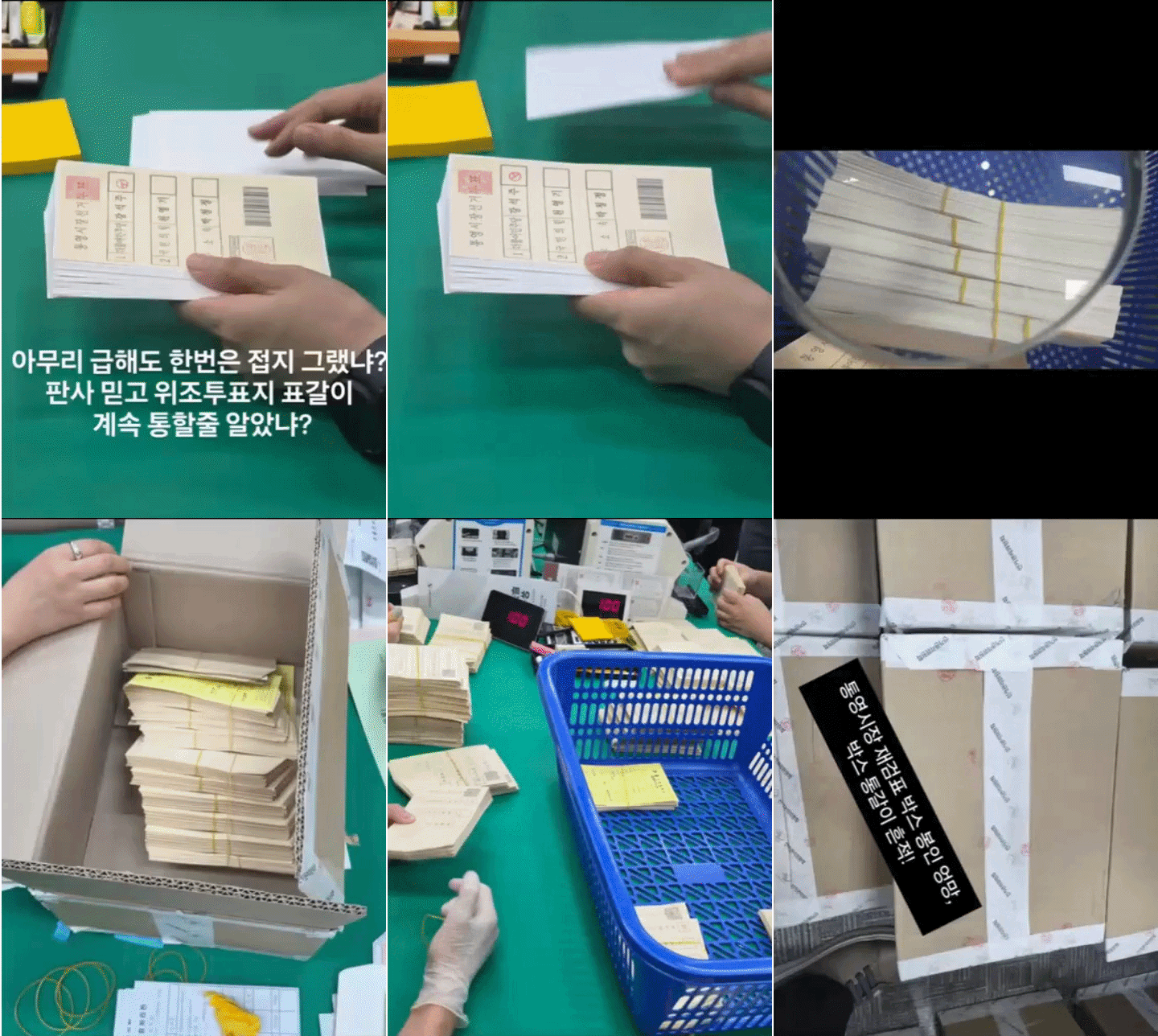 “Ignoring crisp ballots and damaged seals”… Tongyeong mayoral recount concludes with ‘no change in outcome,’ leaving suspicions and public outrage behind
Suspected counterfeit ballots discovered in Tongyeong [GIF from social media of Representative Hwang Kyo-ahn / Attorney Park Joo-hyun]During a recount of the Tongyeong mayoral election in South Gyeong
“Ignoring crisp ballots and damaged seals”… Tongyeong mayoral recount concludes with ‘no change in outcome,’ leaving suspicions and public outrage behind
Suspected counterfeit ballots discovered in Tongyeong [GIF from social media of Representative Hwang Kyo-ahn / Attorney Park Joo-hyun]During a recount of the Tongyeong mayoral election in South Gyeong
 President Yoon, regarding the first-instance ruling on the Public Official Election Act: “An excessive political verdict that distorts the facts… We will appeal immediately.”
The first-instance sentencing hearing for President Yoon Suk Yeol regarding violations of the Public Official Election Act is being broadcast live at Seoul Station on the 27th. [Photo=Yonhap News]Pres
President Yoon, regarding the first-instance ruling on the Public Official Election Act: “An excessive political verdict that distorts the facts… We will appeal immediately.”
The first-instance sentencing hearing for President Yoon Suk Yeol regarding violations of the Public Official Election Act is being broadcast live at Seoul Station on the 27th. [Photo=Yonhap News]Pres
 WSJ: "SK Hynix ADR Premium Is a Sign of AI Trading Overheat"
Advertisement for SK Hynix ADR listing in New York's Times Square [Reuters=Yonhap News file photo]The Wall Street Journal (WSJ) has pointed out that the price of SK Hynix’s American Depositary Recei
WSJ: "SK Hynix ADR Premium Is a Sign of AI Trading Overheat"
Advertisement for SK Hynix ADR listing in New York's Times Square [Reuters=Yonhap News file photo]The Wall Street Journal (WSJ) has pointed out that the price of SK Hynix’s American Depositary Recei
 'Godfather of Japanese Mystery Novels' Keigo Higashino Passes Away After Battle with Cancer at 68
Famous Japanese mystery novelist Keigo Higashino [AFP=Yonhap News]It has been belatedly reported that Keigo Higashino, the "godfather of Japanese mystery novels" and author of bestsellers such as "The
'Godfather of Japanese Mystery Novels' Keigo Higashino Passes Away After Battle with Cancer at 68
Famous Japanese mystery novelist Keigo Higashino [AFP=Yonhap News]It has been belatedly reported that Keigo Higashino, the "godfather of Japanese mystery novels" and author of bestsellers such as "The
 [Park Pil-kyu Security Column] To the Ignorant Trying to Clothe a Beast in Sheep's Clothing
Rep. Kim Byung-joo of the Democratic Party of Korea [Photo=Yonhap News]“The Air Force Academy doesn't teach you how to fly a plane!” “The Army, Navy, and Air Force academies are exactly the
[Park Pil-kyu Security Column] To the Ignorant Trying to Clothe a Beast in Sheep's Clothing
Rep. Kim Byung-joo of the Democratic Party of Korea [Photo=Yonhap News]“The Air Force Academy doesn't teach you how to fly a plane!” “The Army, Navy, and Air Force academies are exactly the
 [Issue Diagnosis] Two Effects of the Election Petition Review
 [Photo] Evidence of Election Fraud Flooding U.S. Media… Trump Had 2.7 Million Votes Stolen
 [Video] U.S. Semiquincentennial Air Show... 'Art in the Sky' streaks across New York
 [Editorial Cartoon] A Draconian Law That Undermines Freedom of Expression

 List
List