 Camp Humphreys, a U.S. military base in Pyeongtaek, Gyeonggi Province. Yonhap News.
 Dr. Seo Sang-moon, Historian, Chairman of the Korea Military Commentators Association, President of the Future East Sea Institute
With President Lee Jae-myung and the Democratic Party relying on 'pandas' and acting arrogantly, there is a growing possibility that they will end up transferring ownership of the land where the 'eagles' are currently residing as tenants. This is due to the "3-2-1 Assignment Normalization" policy initiated by the U.S. Eighth Army in Korea on October 1st, driven by the Trump administration's strategic shift. The U.S. Forces Korea is transitioning to a "community-based stationing" model, allowing three years of accompanied tours for families, two years for unaccompanied soldiers, and only one year in unavoidable circumstances.
Under this plan, U.S. soldiers stationed in Korea can reside and serve with their families for three years, enabling greater stability and long-term stays for U.S. forces. The 3-2-1 Assignment Normalization policy, which began phased implementation on October 1st, is scheduled for full implementation by October 2027. U.S. forces currently stationed in Korea will not be affected by this policy change; it will only apply to those arriving after the implementation date.
This system, initiated by the U.S. Department of War and military leadership with the aim of "normalization," reclassifies Korea not as a "wartime deployment location" but as a "peace-time garrisonable location." The intention is to enhance combat proficiency by allowing soldiers to remain in one location for extended periods without frequent relocation. This policy signifies more than just a change in the duty system for U.S. Forces Korea; it represents a transformation in the nature of their presence. It is evaluated not merely as a personnel policy adjustment but as the initial step in a geopolitical "Re-deployment Realignment," shifting the structure from temporary deployment to permanent stationing.
To conclude upfront, while this measure appears on the surface to be a change or adjustment in personnel policy related to the welfare of U.S. Forces Korea, at a higher level, it is linked to America's global and China strategies. It lays the groundwork for expanding the Guam model to the Korean theater, potentially implying that parts of Korean territory could become U.S. territory. In other words, it is the first step in establishing a permanent operational forward base system within the "Trilateral Pacific Axis" framework: Korea (ground) – Japan (maritime) – Guam (air and missile defense). The implementation of the "3-2-1 system" is the initial action, and existing U.S. military bases in Korea could potentially become U.S. territory. This marks a concerted effort to solidify the permanent basing infrastructure for U.S. forces in Korea. There are concerns that if the infrastructure, economy, and administration associated with U.S. military bases in Korea begin to operate like a U.S. territory, similar to the "Guam-type security structure," they could effectively become permanent U.S. territories. This is not unrelated to President Trump's mention of "U.S. ownership of land where U.S. military bases are located" during the bilateral meeting between South Korea and the U.S. at the White House on August 25th.
As is well known, Guam, though a U.S. territory, is not legally a U.S. state; it has only been granted partial autonomy. While Guam has an autonomous government, it only has one non-voting delegate in the U.S. Congress. As a strategic forward base for the U.S. military in the Western Pacific, Guam is heavily militarized and operates as an integral part of the U.S. administratively, economically, and militarily. This is why Guam is considered a "de facto U.S. territory," akin to Hawaii or Puerto Rico. If Camp Humphreys, the largest U.S. Army base globally, which is equipped with new family housing, large Department of Defense schools, and recreational facilities, is converted to the Guam model, the recovery of independent operational control (OPCON) by the ROK military, which would eventually be necessary, could become uncertain.
Why does the United States need "peace-time garrisonable locations" for its military bases in Korea? The macro background is the U.S.-China confrontation, and it is undeniable that this policy is being pursued with China in mind. As China's A2/AD (anti-access/area denial) strategy, which restricts the operational range of the U.S. Navy, strengthens, and as symbolized by the Second Island Chain, China is transitioning from a continental power to a continental-maritime dual development power, simultaneously expanding its influence into the Pacific. This makes an inevitable confrontation with the United States unavoidable. As the relationship between the U.S. and China shifts from engagement to competition, and from competition to overt hostility, the U.S. political establishment has increasingly defined the Chinese Communist Party as a clear adversary in recent years.
Furthermore, the Korean Peninsula, historically a contact point between continental and maritime powers, has now become the frontline of the U.S.-China confrontation. With Taiwan, Japan, and Korea, which have served as forward bases against China, being sequentially encroached upon or infiltrated by Chinese forces, or seeing pro-China governments emerge, the so-called "Gray zone," remotely controlled by Chinese intentions, has expanded. Japan, the "Cornerstone" of U.S. security against China, is wavering in the face of Chinese advances, and Korea, the "Linchpin," is on the verge of falling to China. Depending on which country Korea belongs to or what its aspirations are, it has become a crucial tipping point in the U.S.-China confrontation.
Facing this situation, the Trump administration, sensing a crisis, appears to intend to "preemptively anchor" the Korean Peninsula before it completely falls under China's sphere of influence, under the guise of containing China. In other words, they plan to establish the Korean Peninsula as a "fixed anchor" on the Indo-Pacific front to secure permanent superiority in deterrence by operating intelligence, surveillance, and reconnaissance systems continuously. Against this backdrop, the U.S. is fundamentally altering the nature of its presence in Korea and reconfiguring U.S. Forces Korea by changing the way the existing ROK-U.S. alliance is managed, focusing on the purpose of their stationing and their relationship with the host country. It is important to note that the Trump administration is independently pursuing this, bypassing the supposedly pro-China Lee Jae-myung government and abandoning the framework of managing the existing ROK-U.S. alliance in cooperation with the Korean government.
Regarding the discord in the ROK-U.S. alliance and these U.S. actions, many domestic commentators are directing blame towards Lee Jae-myung. The direction of their criticism is not entirely misplaced; it is difficult to deny that Lee Jae-myung is a contributing factor. However, that is not the whole story. There might also be an element of retaliation for Lee Jae-myung's deception and trickery of Trump. But on a higher level, it is a more realistic interpretation that this is unfolding as part of the execution of America's global strategy and China strategy. Trump's America is not the America we remember from the past. There is concern that we are transitioning from an era where the ROK-U.S. alliance was jointly "managed" by both countries to one where it is unilaterally "controlled" by the U.S. Even if Lee Jae-myung had not deceived Trump, the U.S. was already devising its Indo-Pacific strategy and exploring strategic changes, having accepted Japan's proposal to jointly develop it. In essence, it's a situation where Lee Jae-myung's pro-China and anti-U.S. tendencies have provided Trump with an opportunity to fully leverage them for changes in U.S. national security policy. The visit of Ambassador Mosseutan to Korea in July, intended to destabilize Lee Jae-myung, could have been part of a coordinated tactic with Trump to further corner him.
A responsible political leader of the Republic of Korea, especially if aware of China's strategic motive to divide the ROK and the U.S., should have long ago been wary of and countered China, which is using united front tactics to disrupt Korean society, and at the same time, should have been cautious of the U.S. by understanding Trump's objectives and his strategic gambit. It is problematic that the opposition and the general public are only now beginning to realize China's strategic intentions and its infiltration of Korea. It is also a problem that there is a lack of insight into the changes in U.S. global strategy and a failure to properly grasp the warnings issued by Trump. Lee Jae-myung, who provided Trump with a pretext, should have articulated his principles on this issue by acting in a way that would not leave him vulnerable to being bypassed. His failure to do so has placed him in a highly disadvantageous negotiating position should negotiations occur.
Currently, South Korea is helpless and in a dilemma. Can lies and schemes truly be effective political tools for even the most cunning individual? Can the governance of a nation be normal when a leader facing numerous criminal allegations has not properly explained them? It seems they are unconcerned about the fate of the country. They appear to be "running wild without understanding the world," seemingly solely focused on covering up their own criminal allegations by disrupting the nation's discipline and order. While the change in the nature of U.S. military presence might be welcomed at first glance as it aims to expel "panda" forces, with Lee Jae-myung's "pro-China, U.S.-deceiving" stance, it will be impossible to expel the "panda" forces, and even after their expulsion, the territorial integrity of the Republic of Korea is a significant concern.
How did this nation arrive at such a state? It is deeply disheartening these days, as the future of the Republic of Korea seems to be sinking further into a quagmire of uncertainty. Is there no solution other than experiencing utter devastation and ruin, predicting tears of blood and a complete downfall? Should not Lee Jae-myung, before it is too late, abandon his zigzagging path between pro-China and anti-U.S. sentiments and earnestly seek dialogue with the U.S. to prevent Korean territory from becoming U.S. territory?
Dr. Seo Sang-moon, Historian, Chairman of the Korea Military Commentators Association, President of the Future East Sea Institute

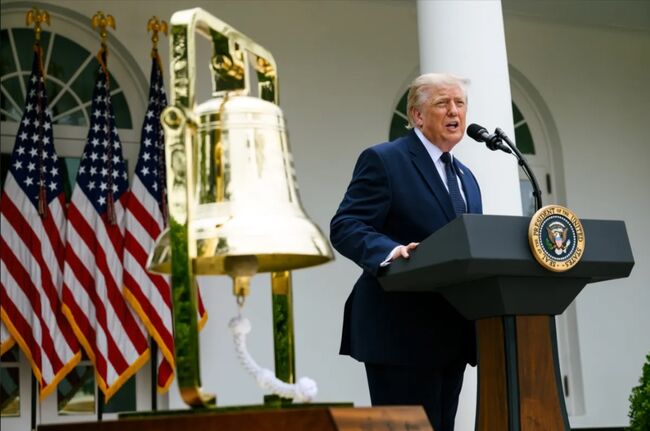 Trump pressures for rate cut again ahead of FOMC... "Should be the lowest in the world"
U.S. President Donald Trump. [Photo = The White House] U.S. President Donald Trump once again pressured the Federal Reserve, the U.S. central bank, to lower interest rates on the 27th (local time
Trump pressures for rate cut again ahead of FOMC... "Should be the lowest in the world"
U.S. President Donald Trump. [Photo = The White House] U.S. President Donald Trump once again pressured the Federal Reserve, the U.S. central bank, to lower interest rates on the 27th (local time
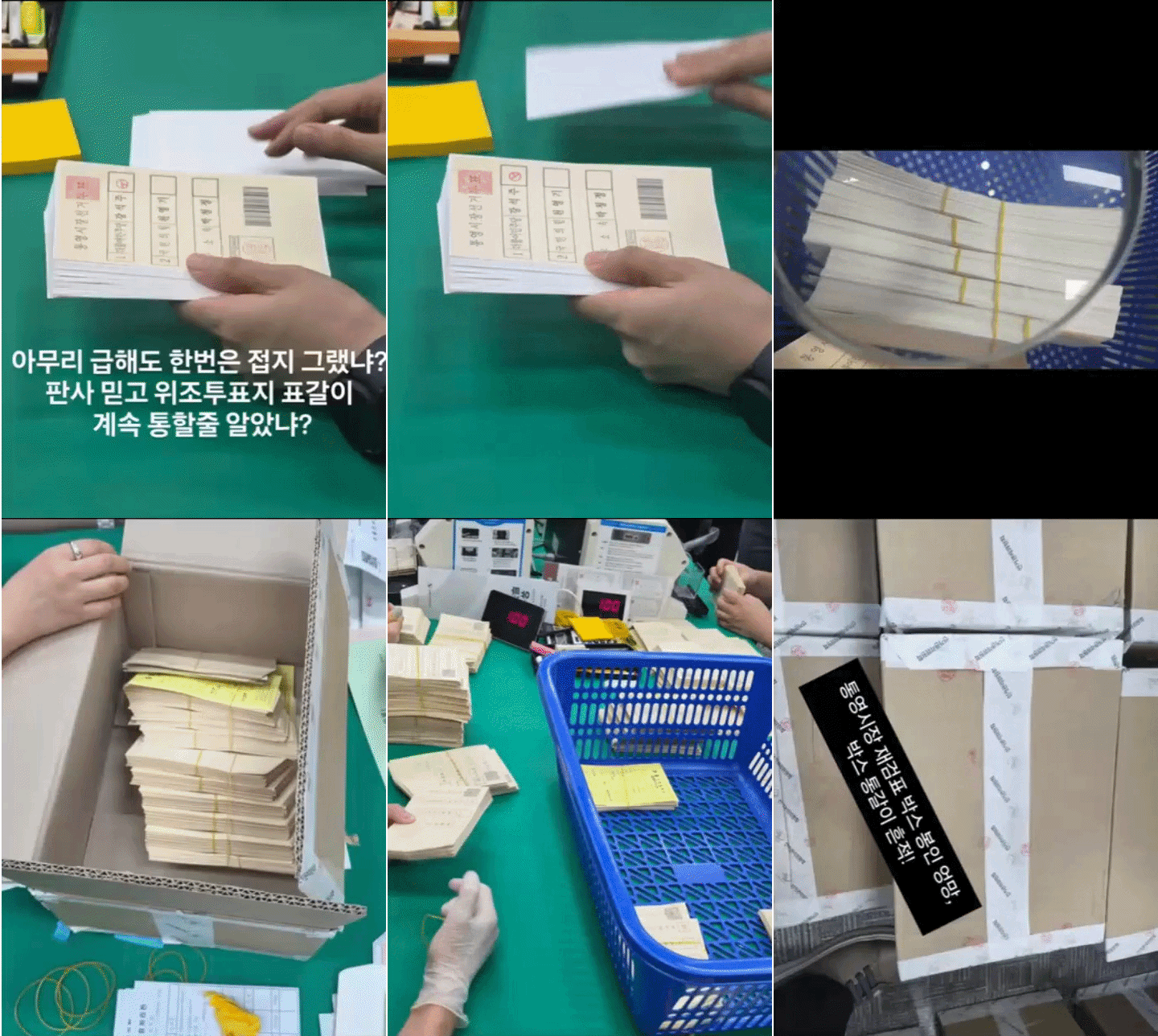 “Ignoring crisp ballots and damaged seals”… Tongyeong mayoral recount concludes with ‘no change in outcome,’ leaving suspicions and public outrage behind
Suspected counterfeit ballots discovered in Tongyeong [GIF from social media of Representative Hwang Kyo-ahn / Attorney Park Joo-hyun]During a recount of the Tongyeong mayoral election in South Gyeong
“Ignoring crisp ballots and damaged seals”… Tongyeong mayoral recount concludes with ‘no change in outcome,’ leaving suspicions and public outrage behind
Suspected counterfeit ballots discovered in Tongyeong [GIF from social media of Representative Hwang Kyo-ahn / Attorney Park Joo-hyun]During a recount of the Tongyeong mayoral election in South Gyeong
 President Yoon, regarding the first-instance ruling on the Public Official Election Act: “An excessive political verdict that distorts the facts… We will appeal immediately.”
The first-instance sentencing hearing for President Yoon Suk Yeol regarding violations of the Public Official Election Act is being broadcast live at Seoul Station on the 27th. [Photo=Yonhap News]Pres
President Yoon, regarding the first-instance ruling on the Public Official Election Act: “An excessive political verdict that distorts the facts… We will appeal immediately.”
The first-instance sentencing hearing for President Yoon Suk Yeol regarding violations of the Public Official Election Act is being broadcast live at Seoul Station on the 27th. [Photo=Yonhap News]Pres
 WSJ: "SK Hynix ADR Premium Is a Sign of AI Trading Overheat"
Advertisement for SK Hynix ADR listing in New York's Times Square [Reuters=Yonhap News file photo]The Wall Street Journal (WSJ) has pointed out that the price of SK Hynix’s American Depositary Recei
WSJ: "SK Hynix ADR Premium Is a Sign of AI Trading Overheat"
Advertisement for SK Hynix ADR listing in New York's Times Square [Reuters=Yonhap News file photo]The Wall Street Journal (WSJ) has pointed out that the price of SK Hynix’s American Depositary Recei
 'Godfather of Japanese Mystery Novels' Keigo Higashino Passes Away After Battle with Cancer at 68
Famous Japanese mystery novelist Keigo Higashino [AFP=Yonhap News]It has been belatedly reported that Keigo Higashino, the "godfather of Japanese mystery novels" and author of bestsellers such as "The
'Godfather of Japanese Mystery Novels' Keigo Higashino Passes Away After Battle with Cancer at 68
Famous Japanese mystery novelist Keigo Higashino [AFP=Yonhap News]It has been belatedly reported that Keigo Higashino, the "godfather of Japanese mystery novels" and author of bestsellers such as "The
 [Park Pil-kyu Security Column] To the Ignorant Trying to Clothe a Beast in Sheep's Clothing
Rep. Kim Byung-joo of the Democratic Party of Korea [Photo=Yonhap News]“The Air Force Academy doesn't teach you how to fly a plane!” “The Army, Navy, and Air Force academies are exactly the
[Park Pil-kyu Security Column] To the Ignorant Trying to Clothe a Beast in Sheep's Clothing
Rep. Kim Byung-joo of the Democratic Party of Korea [Photo=Yonhap News]“The Air Force Academy doesn't teach you how to fly a plane!” “The Army, Navy, and Air Force academies are exactly the
 [Issue Diagnosis] Two Effects of the Election Petition Review
 [Photo] Evidence of Election Fraud Flooding U.S. Media… Trump Had 2.7 Million Votes Stolen
 [Video] U.S. Semiquincentennial Air Show... 'Art in the Sky' streaks across New York
 [Editorial Cartoon] A Draconian Law That Undermines Freedom of Expression

 List
List










