Silla's Golden Culture Awakens from a 1,500-Year Slumber... "Not 100% Pure Gold"
Six crowns gathered in Gyeongju: their features and the stories behind the artifacts
First discovered thanks to a blue glass bead... Swedish Prince also participated in excavations
Once looted and confiscated... Symbol of kings? Funeral items? Research continues
 Silla golden crowns excavated by our hands. From left, National Treasure 'Hwangnamdaechong North Mound Gold Crown' and National Treasure 'Cheonmachong Gold Crown'. Photographed by Goo Bon-chang. [Provided by Gyeongju National Museum & Goo Bon-chang. Resale and database prohibited]
In September 1921, Miyake Yosan (三宅與三), a policeman in Gyeongju, then called Geumnyeong-ri, Eupnam, Gyeongju, was observing the local children.
The children were acting as if they were on a treasure hunt early in the morning.
What might have been overlooked by a mere passerby caught the eye of the Japanese policeman: a blue glass bead. He later stated in a report to the police chief that he suspected it might be jade from an old tomb.
A tomb, revealed by chance, held the golden splendor of Silla. It represents the peak of its golden culture, which lasted for about 150 years from the 5th to the first half of the 6th century.
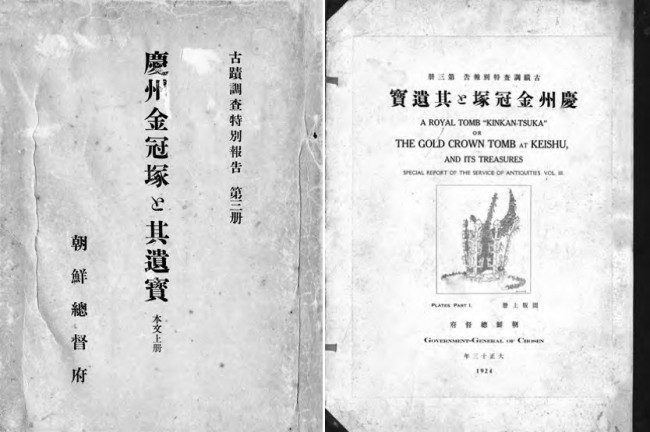 Cover and plates from 'Gyeongju Geumgwanchong Excavation Report'. Photos from the Korean translation of the 'Gyeongju Geumgwanchong Excavation Report' published in 2011. [Provided by Gyeongju National Research Institute of Cultural Heritage. Resale and database prohibited]
Among the six Silla gold crowns discovered in Korea, the Geumgwanchong crown was the first to be known.
It features three branch-shaped and two antler-shaped upright ornaments on a headband, reaching a height of 27.7 cm and weighing 692g. It is a typical Silla gold crown.
The crown's discovery led to the tomb being named Geumgwanchong (Gold Crown Tomb).
In 2013, during the preservation process of a large sword excavated from Geumgwanchong, the inscription 'King Isaji' (尒斯智王) was newly confirmed, and later, a fragment of a scabbard with the inscription 'King Isaji's Sword' was also found.
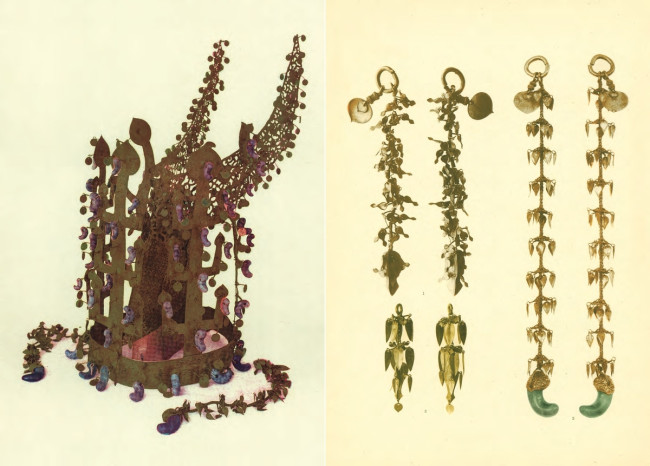 Plates from the Korean translation of 'Gyeongju Geumgwanchong Excavation Report' published in 2011. [Provided by Gyeongju National Research Institute of Cultural Heritage. Resale and database prohibited]
The Gyodong crown is considered the oldest among the existing Silla gold crowns.
In 1969, tomb robbers secretly dug up a tomb in Gyodong, Gyeongju, and found a small gold crown. The robbers were arrested in 1972 while trying to sell it. The crown was later confiscated and is now kept at the Gyeongju National Museum.
Estimated to have been made in the 5th century, about 1,500 years ago, there is not much information about it, and it carries the "stigma" of being a looted artifact. Unlike other national treasures and treasures, it has not been designated as a national heritage.
The headband has no decoration, only circular pendants (thin metal ornaments attached to crowns and other items to make them sparkle). With a diameter of only 14.3 cm, it is sometimes considered to belong to a child.
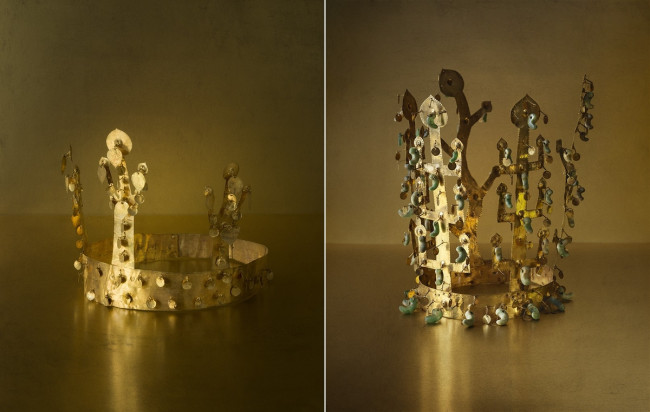 Silla golden crown. From left, the Gyodong crown and National Treasure 'Geumgwanchong Gold Crown'. Photographed by Goo Bon-chang. [Provided by Gyeongju National Museum & Goo Bon-chang. Resale and database prohibited]
The owner of the Geumnyeongchong crown, discovered in 1924 along with a pair of finely crafted gold bells (金鈴·geumnyeong), is also presumed to be a young royal. The Geumnyeongchong crown is 27 cm high and weighs 356.4g.
Compared to artifacts from other tombs, the gold waistband and earrings are also relatively small.
Lee Hyun-tae, a curator at the Gyeongju National Museum, gained attention last year for his research suggesting the owner of Geumnyeongchong was a "male under six years old" and "the son of King Isaji, the owner of Geumgwanchong."
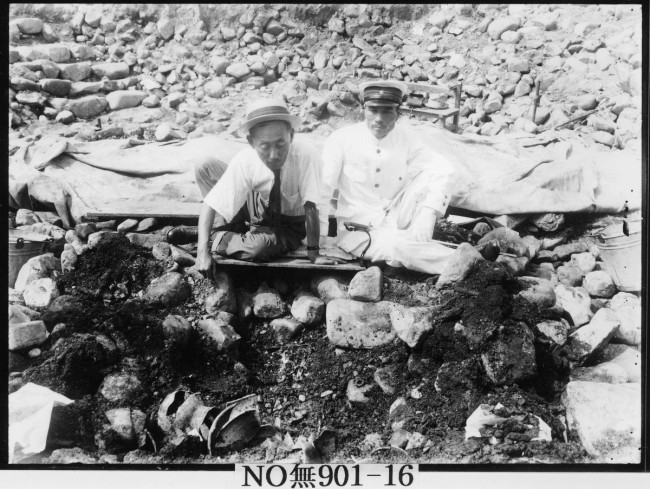 Appearance of the Silla Seobongchong Gold Crown during excavation in 1926. [Provided by National Museum of Korea. Resale and database prohibited]
The Seobongchong crown is noteworthy for its connection with a Swedish prince.
Discovered in 1926 during the construction of a locomotive shed, this tomb yielded gold crowns, silver boxes (盒·a shallow, round-lidded vessel), and other metalwork, as well as lacquerware and pottery.
Gustaf VI Adolf (1882-1973), who later became the King of Sweden, was traveling in East Asia at the time and participated in the excavation process.
The tomb was named Seobongchong, derived from the Chinese characters for Sweden, "Seojeon" (瑞典), and "Bonghwang" (鳳凰, phoenix), a decorative element on the crown.
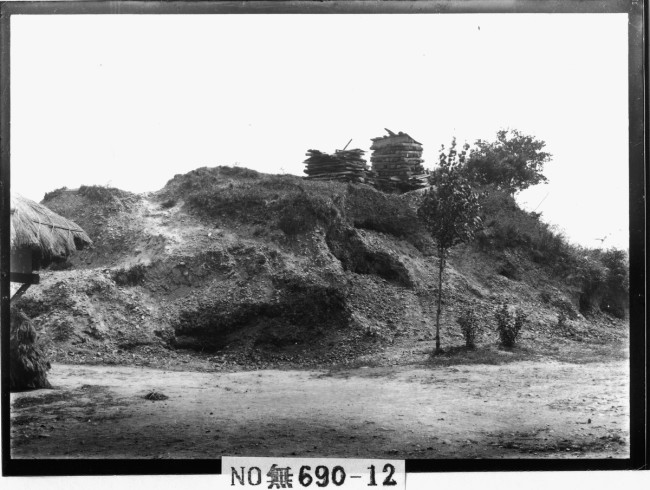 Glass plate photograph of the western facade of Gyeongju Geumgwanchong. [Provided by National Museum of Korea. Resale and database prohibited]
The Cheonmachong and Hwangnamdaechong crowns hold significant meaning as artifacts excavated by our own hands.
Among the six crowns, the Cheonmachong crown is the largest and heaviest. The headband is 63 cm long and weighs 1.3 kg, adorned with 58 crescent-shaped jade ornaments, giving it a magnificent appearance.
Cheonmachong was excavated in 1973 under the leadership of the Cultural Properties Administration (now the Cultural Heritage Administration) as part of the 'Gyeongju Tourism Comprehensive Development Plan.' The site yielded Silla gold crowns and 11,526 other artifacts, attracting academic attention.
This exhibition also features two gold crown ornaments shaped like spread bird wings.
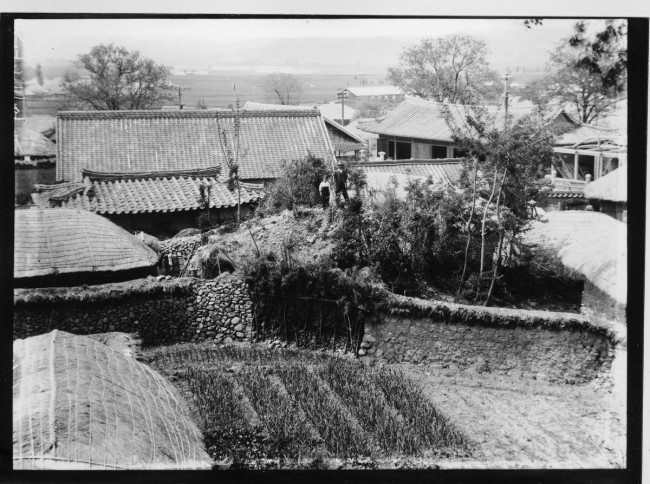 Appearance of Gyeongju Geumnyeongchong before excavation. [Provided by National Museum of Korea. Resale and database prohibited]
The gold crown from Hwangnamdaechong North Mound (北墳·northern tomb) is presumed to be the earliest among the excavated gold crowns, excluding the Gyodong crown.
Hwangnamdaechong, known as the largest existing Silla tomb, consists of two mounds: one to the north and one to the south.
While a bronze-gilt crown was found in the southern mound, a magnificent gold crown was discovered in the northern one. The inscription 'Buingdae' (夫人帶, Queen's Belt) on the waistband unearthed with the crown suggests it belonged to a queen.
Kim Dae-hwan, a curator at the Gyeongju National Museum, explained, "If the owner of the southern mound was King Naemul (reigned 356-402), the queen would be Lady Kim of Bopano; if it was King Silseong (reigned 402-417), it would be Lady Aryu; and if it was King Nulji (reigned 417-458), it would be Lady Kim, the daughter of King Silseong."
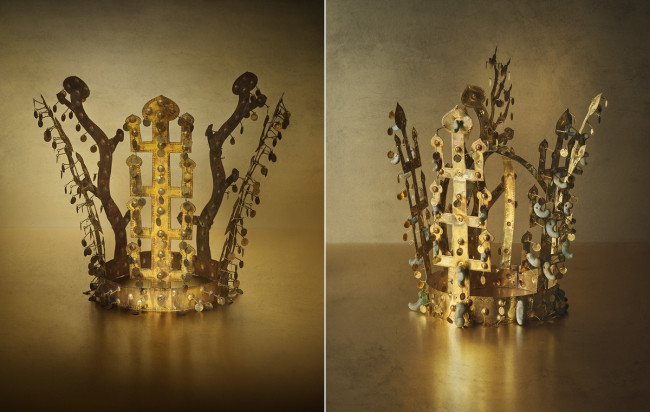 Silla golden crown. From left, Treasure 'Geumnyeongchong Gold Crown' and Treasure 'Seobongchong Gold Crown'. Photographed by Goo Bon-chang. [Provided by Gyeongju National Museum & Goo Bon-chang. Resale and database prohibited]
Were the gold crowns made during the golden age of Silla's culture made of 100% pure gold?
The museum explains, "Although they shine brilliantly on the outside, they are actually alloys of gold and silver. This was done to reinforce the gold, which is too soft and easily bent when pure."
The Gyodong crown has a purity of 21.4k, while the Seobongchong crown is 19.3k, showing a difference.
A museum official stated, "The purity of gold varies by era. Early gold crowns tended to have higher purity, but as time went on, the silver content gradually increased, lowering the purity."
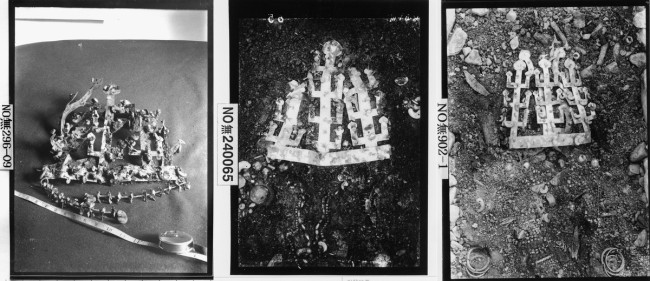 Appearance of Silla gold crowns excavated during the Japanese colonial period. From left, glass plate materials of Geumgwanchong, Geumnyeongchong, and Seobongchong crowns. [Provided by National Museum of Korea. Resale and database prohibited]
It remains an unanswered question whether Silla kings actually wore gold crowns.
Observing the state of the crowns as they were excavated from their respective tombs, they are found bent in a conical shape. Some theories suggest they were used as death masks to cover the faces of the deceased.
In the exhibition catalog, the museum points to a round cap found inside the Seobongchong crown as an example, stating, "It is not limited to funeral use, and it is possible that it was actually worn in specific situations."
The exhibition, which brings together six Silla gold crowns for the first time, can be viewed at the Gyeongju National Museum. Public viewing begins November 2nd. Yonhap News
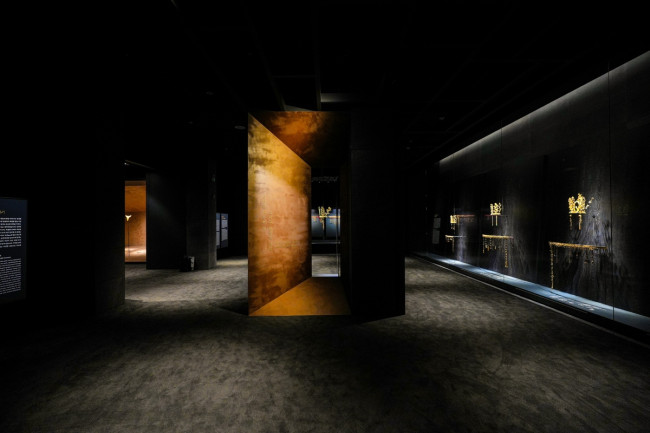 Exhibition hall view. [Provided by Gyeongju National Museum. Resale and database prohibited]

 [Statement by the Seobeokka KMA Patriots Association] ㉛ Recount the ballots openly, as the previous recount covered up election fraud
Recount of the Tongyeong mayoral election [Photo=Yonhap News]South Korea's liberal democracy is dying. The National Election Commission (NEC), which has degraded into a criminal organization through t
[Statement by the Seobeokka KMA Patriots Association] ㉛ Recount the ballots openly, as the previous recount covered up election fraud
Recount of the Tongyeong mayoral election [Photo=Yonhap News]South Korea's liberal democracy is dying. The National Election Commission (NEC), which has degraded into a criminal organization through t
 Bill Pulte to Restructure ‘Deep State’… Announces 4th Round of Layoffs at the Office of the Director of National Intelligence
Acting Director of National Intelligence Bill Pulte announced Sunday that he has carried out a fourth "deliberate and measured" reduction in personnel since taking office on June 19, as part of the Tr
Bill Pulte to Restructure ‘Deep State’… Announces 4th Round of Layoffs at the Office of the Director of National Intelligence
Acting Director of National Intelligence Bill Pulte announced Sunday that he has carried out a fourth "deliberate and measured" reduction in personnel since taking office on June 19, as part of the Tr
 First U.S. Ambassador of Trump's Second Term to Arrive This Week… Will It Provide Momentum to Resolve Pending Issues?
U.S. Ambassador to South Korea Michelle Steel speaks at the opening ceremony of the Korea-U.S. Shipbuilding Cooperation Center held at the Mayflower Hotel in Washington, D.C., on the 23rd (local time)
First U.S. Ambassador of Trump's Second Term to Arrive This Week… Will It Provide Momentum to Resolve Pending Issues?
U.S. Ambassador to South Korea Michelle Steel speaks at the opening ceremony of the Korea-U.S. Shipbuilding Cooperation Center held at the Mayflower Hotel in Washington, D.C., on the 23rd (local time)
 President Yoon, regarding the first-instance ruling on the Public Official Election Act: “An excessive political verdict that distorts the facts… We will appeal immediately.”
The first-instance sentencing hearing for President Yoon Suk Yeol regarding violations of the Public Official Election Act is being broadcast live at Seoul Station on the 27th. [Photo=Yonhap News]Pres
President Yoon, regarding the first-instance ruling on the Public Official Election Act: “An excessive political verdict that distorts the facts… We will appeal immediately.”
The first-instance sentencing hearing for President Yoon Suk Yeol regarding violations of the Public Official Election Act is being broadcast live at Seoul Station on the 27th. [Photo=Yonhap News]Pres
 91% of Net Influx of MZ Generation Goes to Seoul Metropolitan Area… Population Migration Also Shows 'K-shaped Polarization' by Industry
[Provided by Leaders Index]Over the past four years, the MZ generation population has become increasingly concentrated in the Seoul metropolitan area and the Chungcheong region. While cities cen
91% of Net Influx of MZ Generation Goes to Seoul Metropolitan Area… Population Migration Also Shows 'K-shaped Polarization' by Industry
[Provided by Leaders Index]Over the past four years, the MZ generation population has become increasingly concentrated in the Seoul metropolitan area and the Chungcheong region. While cities cen
 'Godfather of Japanese Mystery Novels' Keigo Higashino Passes Away After Battle with Cancer at 68
Famous Japanese mystery novelist Keigo Higashino [AFP=Yonhap News]It has been belatedly reported that Keigo Higashino, the "godfather of Japanese mystery novels" and author of bestsellers such as "The
'Godfather of Japanese Mystery Novels' Keigo Higashino Passes Away After Battle with Cancer at 68
Famous Japanese mystery novelist Keigo Higashino [AFP=Yonhap News]It has been belatedly reported that Keigo Higashino, the "godfather of Japanese mystery novels" and author of bestsellers such as "The
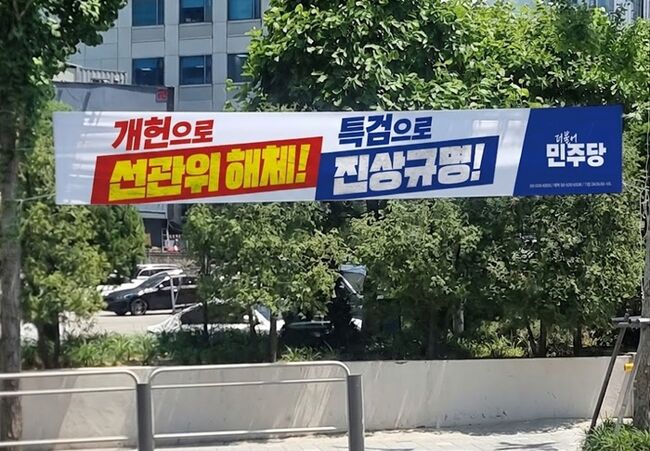 [Cho Yang-geon Column] The NEC: Facing a Fate of "Discarding the Dog After the Hunt"
Banner calling for the "dissolution of the NEC" posted by the Democratic Party. [AI-generated image]Banners calling for the "dissolution of the National Election Commission (NEC)" posted by the Democr
[Cho Yang-geon Column] The NEC: Facing a Fate of "Discarding the Dog After the Hunt"
Banner calling for the "dissolution of the NEC" posted by the Democratic Party. [AI-generated image]Banners calling for the "dissolution of the National Election Commission (NEC)" posted by the Democr
 [Photo] Evidence of Election Fraud Flooding U.S. Media… Trump Had 2.7 Million Votes Stolen
 [Video] U.S. Semiquincentennial Air Show... 'Art in the Sky' streaks across New York
 [Editorial Cartoon] A Draconian Law That Undermines Freedom of Expression

 List
List