The Supreme Court of the United States. AP Yonhap News.
As South Korea and the United States recently concluded trade negotiations, the Supreme Court is set to hear arguments next week in a lawsuit challenging the legality of broad tariffs imposed by U.S. President Donald Trump on countries including South Korea.
While lower courts have already ruled the tariffs illegal, there is speculation that the outcome is uncertain, given the Supreme Court's history of favoring President Trump in major cases, with a conservative majority (6-3).
The Supreme Court will hold oral arguments on November 5 (local time) regarding lawsuits challenging various tariffs imposed by President Trump under the International Emergency Economic Powers Act (IEEPA).
Enacted in 1977, the IEEPA grants the President several authorities to respond to a "national emergency," one of which is the power to "regulate" imports.
On April 2, President Trump declared a national emergency, asserting that the chronic, large-scale U.S. trade deficit posed a significant threat to national security and the economy. He then announced his intention to impose "reciprocal tariffs" on a country-by-country basis under the IEEPA.
At the time, a 25% IEEPA tariff was applied to South Korea, but subsequently, South Korea's tariffs were reduced to 15% in exchange for a commitment to invest $350 billion in the U.S.
U.S. small and medium-sized businesses harmed by the tariffs, along with 12 Democratic-leaning states, filed lawsuits against President Trump. Lower courts ruled that the IEEPA does not grant the President the authority to impose tariffs through executive orders, as President Trump did.
The reasoning was that "tariffs" are not explicitly mentioned as a measure the President can take in response to a national emergency under the IEEPA, and Congress, which holds taxing authority under the Constitution, would not have intended to grant the President "unfettered authority" to impose tariffs.
The central issue to be addressed in the arguments on the 5th is whether Congress delegated its inherent tariff authority to the President through the IEEPA.
Whether the trade deficit constitutes a national emergency as defined by the IEEPA is also a point of contention.
In a brief filed with the Supreme Court on October 30, Deputy Attorney General John Sauer, representing President Trump, argued that the authority to regulate imports includes tariffs and that the trade deficit poses a severe enough threat to declare a national emergency.
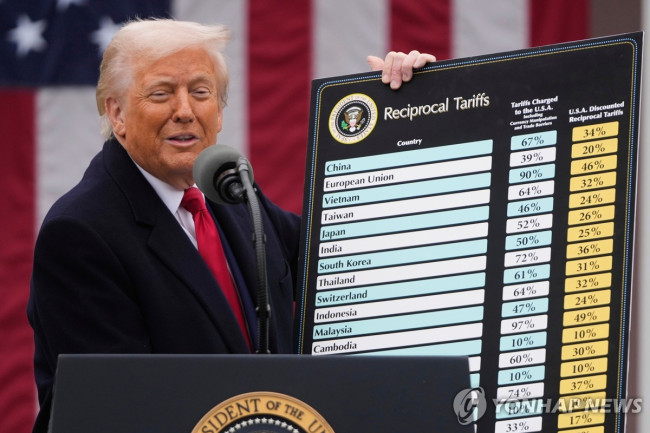 U.S. President Donald Trump announces country-specific tariffs. AP Yonhap News.
In addition to the interpretation of the IEEPA, attention is also focused on whether the Supreme Court will apply the "major questions doctrine."
This doctrine stipulates that executive agencies cannot make unilateral policy decisions with significant economic or political impact on the nation unless Congress has explicitly delegated such authority to the executive branch.
The plaintiffs in the lawsuit argue that this doctrine should apply because tariffs have a substantial economic impact, emphasizing that no president before President Trump had imposed tariffs under the IEEPA.
The Supreme Court has previously invoked this "major questions doctrine" to block several Democratic policies, including former President Joe Biden's student loan forgiveness plan.
However, the fact that six of the nine justices, including three appointed by President Trump during his first term, are conservative is seen as a variable.
According to The New York Times (NYT), conservative Justice Brett Kavanaugh stated in a majority opinion in a case unrelated to tariffs in June that there is no precedent for the Supreme Court applying the major questions doctrine to national security or foreign policy matters.
Deputy Attorney General Sauer also argued in his brief that the President has the authority to impose tariffs for the same reason.
Sauer claimed that President Trump used IEEPA tariffs as leverage to negotiate framework agreements with major trading partners, including the European Union (EU), the United Kingdom, Japan, South Korea, and China, and that the plaintiffs are attempting to invalidate trade agreements worth trillions of dollars.
The Trump administration has consistently warned that losing tariff lawsuits would disrupt trade negotiations and lead to retaliation from other countries.
However, it remains unclear whether the trade agreements would be completely invalidated even if the Supreme Court deems the IEEPA tariffs illegal.
President Trump has imposed tariffs on various individual items, such as automobiles and steel, under Section 232 of the Trade Expansion Act. Additionally, he can utilize Section 301, Section 122 of the Trade Act, and Section 338 of the Tariff Act as means to impose tariffs.
Yonhap News

 Trump pressures for rate cut again ahead of FOMC... "Should be the lowest in the world"
U.S. President Donald Trump. [Photo = The White House] U.S. President Donald Trump once again pressured the Federal Reserve, the U.S. central bank, to lower interest rates on the 27th (local time
Trump pressures for rate cut again ahead of FOMC... "Should be the lowest in the world"
U.S. President Donald Trump. [Photo = The White House] U.S. President Donald Trump once again pressured the Federal Reserve, the U.S. central bank, to lower interest rates on the 27th (local time
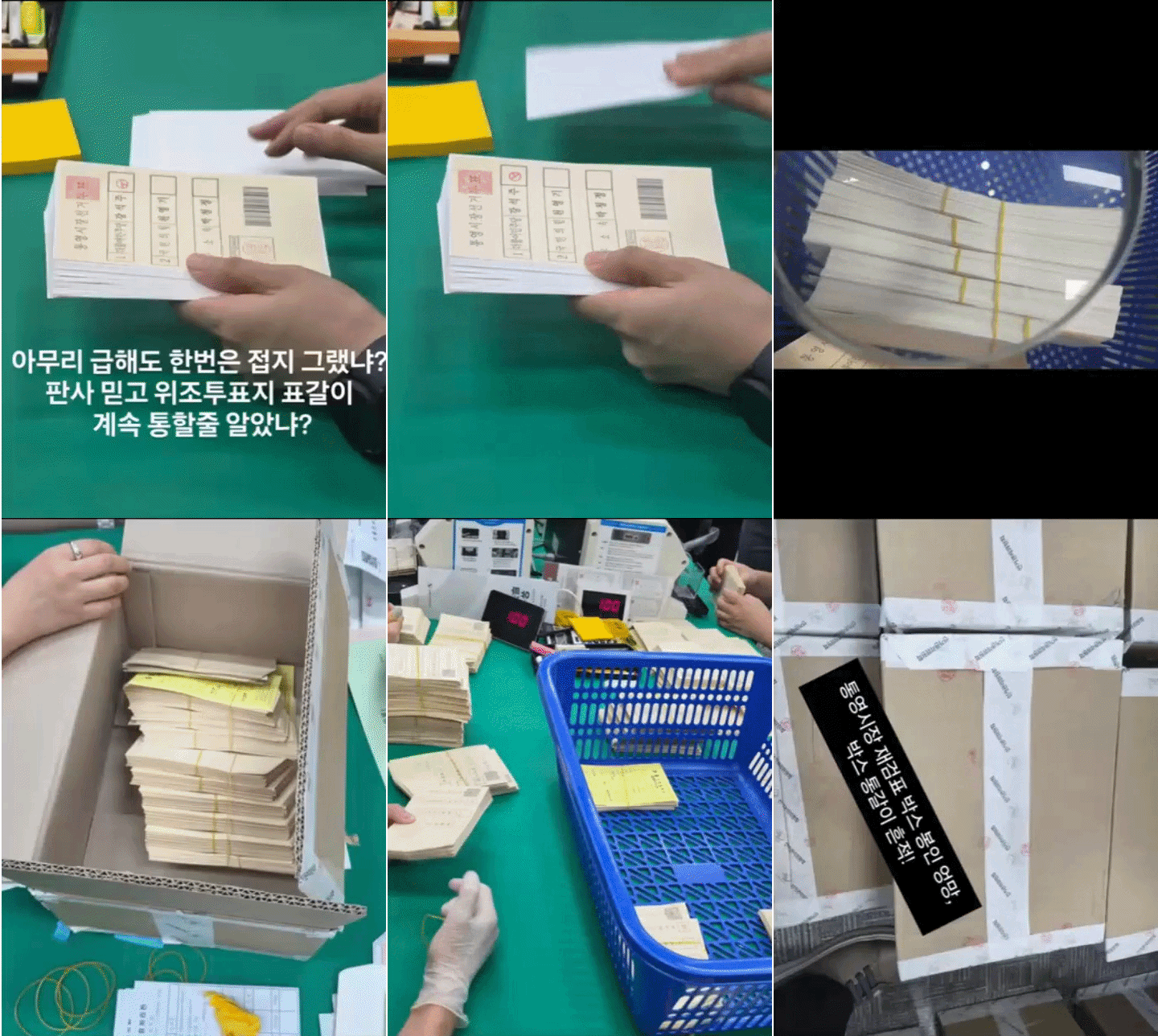 “Ignoring crisp ballots and damaged seals”… Tongyeong mayoral recount concludes with ‘no change in outcome,’ leaving suspicions and public outrage behind
Suspected counterfeit ballots discovered in Tongyeong [GIF from social media of Representative Hwang Kyo-ahn / Attorney Park Joo-hyun]During a recount of the Tongyeong mayoral election in South Gyeong
“Ignoring crisp ballots and damaged seals”… Tongyeong mayoral recount concludes with ‘no change in outcome,’ leaving suspicions and public outrage behind
Suspected counterfeit ballots discovered in Tongyeong [GIF from social media of Representative Hwang Kyo-ahn / Attorney Park Joo-hyun]During a recount of the Tongyeong mayoral election in South Gyeong
 President Yoon, regarding the first-instance ruling on the Public Official Election Act: “An excessive political verdict that distorts the facts… We will appeal immediately.”
The first-instance sentencing hearing for President Yoon Suk Yeol regarding violations of the Public Official Election Act is being broadcast live at Seoul Station on the 27th. [Photo=Yonhap News]Pres
President Yoon, regarding the first-instance ruling on the Public Official Election Act: “An excessive political verdict that distorts the facts… We will appeal immediately.”
The first-instance sentencing hearing for President Yoon Suk Yeol regarding violations of the Public Official Election Act is being broadcast live at Seoul Station on the 27th. [Photo=Yonhap News]Pres
 WSJ: "SK Hynix ADR Premium Is a Sign of AI Trading Overheat"
Advertisement for SK Hynix ADR listing in New York's Times Square [Reuters=Yonhap News file photo]The Wall Street Journal (WSJ) has pointed out that the price of SK Hynix’s American Depositary Recei
WSJ: "SK Hynix ADR Premium Is a Sign of AI Trading Overheat"
Advertisement for SK Hynix ADR listing in New York's Times Square [Reuters=Yonhap News file photo]The Wall Street Journal (WSJ) has pointed out that the price of SK Hynix’s American Depositary Recei
 'Godfather of Japanese Mystery Novels' Keigo Higashino Passes Away After Battle with Cancer at 68
Famous Japanese mystery novelist Keigo Higashino [AFP=Yonhap News]It has been belatedly reported that Keigo Higashino, the "godfather of Japanese mystery novels" and author of bestsellers such as "The
'Godfather of Japanese Mystery Novels' Keigo Higashino Passes Away After Battle with Cancer at 68
Famous Japanese mystery novelist Keigo Higashino [AFP=Yonhap News]It has been belatedly reported that Keigo Higashino, the "godfather of Japanese mystery novels" and author of bestsellers such as "The
 [Park Pil-kyu Security Column] To the Ignorant Trying to Clothe a Beast in Sheep's Clothing
Rep. Kim Byung-joo of the Democratic Party of Korea [Photo=Yonhap News]“The Air Force Academy doesn't teach you how to fly a plane!” “The Army, Navy, and Air Force academies are exactly the
[Park Pil-kyu Security Column] To the Ignorant Trying to Clothe a Beast in Sheep's Clothing
Rep. Kim Byung-joo of the Democratic Party of Korea [Photo=Yonhap News]“The Air Force Academy doesn't teach you how to fly a plane!” “The Army, Navy, and Air Force academies are exactly the
 [Issue Diagnosis] Two Effects of the Election Petition Review
 [Photo] Evidence of Election Fraud Flooding U.S. Media… Trump Had 2.7 Million Votes Stolen
 [Video] U.S. Semiquincentennial Air Show... 'Art in the Sky' streaks across New York
 [Editorial Cartoon] A Draconian Law That Undermines Freedom of Expression

 List
List