Supreme Court to review legality of 'Trump Tariffs.' AP=Yonhap News.
The U.S. Supreme Court has begun its first hearing to determine the legality of broad tariffs imposed by President Donald Trump on various countries, including South Korea. A ruling is expected within weeks.
According to reports from Newsmax and others on the 5th (local time), Justice Neil Gorsuch, a conservative appointed by President Trump, debated the issues with Deputy Assistant Attorney General D. John Sauer, who represented the government.
Justice Gorsuch pressed the government's representatives, asking, "If it is true that foreign affairs are the domain of the executive branch and the president has inherent authority, does that mean Congress has to give up all its responsibilities in regulating foreign trade, or can we not even prevent the president from declaring war?" He persistently questioned the government's justifications and logic for imposing tariffs.
In response, Deputy Assistant Attorney General Sauer immediately retorted, "The government is not claiming it can do whatever it wants, but the president, like Congress, has inherent authority and broad delegated powers." He argued that it was an "emergency situation" necessitating the imposition of tariffs, a key tool of President Trump's economic and foreign policies, and requested the Supreme Court to make a thoughtful legal judgment.
The Supreme Court held oral arguments for approximately three hours at its courthouse in Washington D.C. regarding the tariff lawsuit. Lawyers representing the government, as well as the small and medium-sized businesses and 12 Democratic-leaning states that filed the lawsuit, presented their arguments sequentially.
President Trump had initially planned to attend the oral arguments in person but announced his withdrawal three days prior, stating, "I do not want to muddy the waters of this decision."
Instead, underscoring the significance of the case, key government officials responsible for tariffs and trade policy negotiations, such as Treasury Secretary Steven Mnuchin, Commerce Secretary Wilbur Ross, and U.S. Trade Representative Robert Lighthizer, sat in the front rows of the courtroom to observe the proceedings.
The central issue was whether President Trump's use of the International Emergency Economic Powers Act (IEEPA) as the legal basis for imposing tariffs was legitimate.
Enacted in 1977, the IEEPA grants the president various powers to respond to "national emergencies," including the authority to "regulate" imports.
On April 2nd, President Trump declared a national emergency, asserting that the United States' large trade deficit posed a significant threat to national security and the economy, and announced his intention to impose "reciprocal tariffs" on over 100 countries based on the IEEPA.
At the time, a 25% tariff was applied to South Korea, but South Korea later negotiated this down to 15% in exchange for a commitment to invest $350 billion in the U.S.
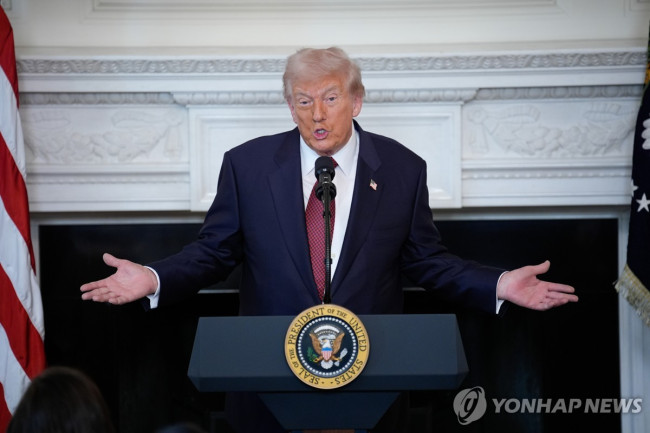 President Trump. UPI=Yonhap News.
Sauer repeatedly emphasized that President Trump used his emergency powers because he determined that the U.S. trade deficit had pushed the nation to the brink of economic and national security disaster.
Sauer stated that the imposition of tariffs had helped President Trump conclude various trade negotiations, and that reversing these trade agreements would expose the United States to "relentless trade retaliation from far more aggressive nations, leading to devastating economic and national security consequences, causing America to fall from a strong nation to a failed one."
In response, Neil Katyal, an attorney representing the affected small and medium-sized businesses, argued, "Tariffs are essentially taxes," and "(Our) Founding Fathers granted the power to tax solely to Congress."
Lower courts, including the U.S. Court of International Trade (USCIT) in its initial ruling and the U.S. Court of Appeals for the D.C. Circuit in its appellate review, had previously ruled that President Trump's actions of imposing tariffs worldwide using his emergency powers were illegal.
However, the Supreme Court currently has a conservative majority (6 conservative, 3 liberal justices), and has a track record of issuing decisions favorable to President Trump in major cases, making it uncertain whether the lower court rulings will be upheld.
Chief Justice John Roberts acknowledged that the power to tax "was a core power of Congress," but simultaneously noted that the tariffs implemented by President Trump "were quite effective in achieving certain goals."
Justice Amy Coney Barrett asked the government's counsel, "Is the government's argument that tariffs must be imposed on all countries due to threats to national defense and industrial base?" She continued, "While I can see that being the case for some countries, explain why so many countries needed to be subject to reciprocal tariffs."
Conversely, Justice Brett Kavanaugh, another conservative justice, pointed to a precedent from lower courts where former President Richard Nixon had imposed tariffs under a similar law, suggesting that Congress intended to provide the president with "tools to respond to emergencies in an appropriate manner."
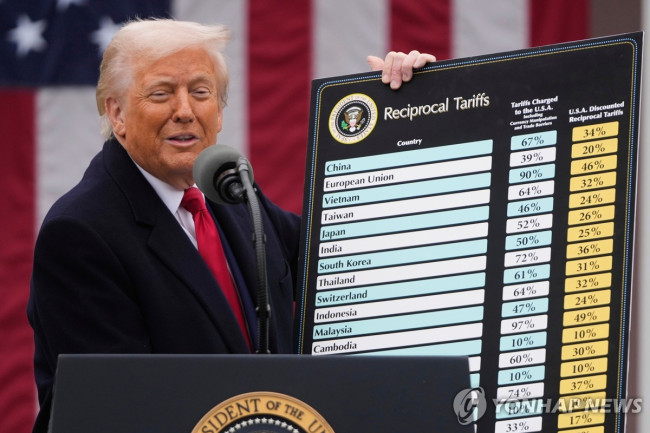 President Trump announcing reciprocal tariff rates by country in April. AP=Yonhap News.
The Supreme Court's ruling following the hearings will be the judiciary's final determination on President Trump's tariff policy, and is expected to have a significant impact not only on the United States but also on countries worldwide affected by the tariffs.
While high-profile cases at the Supreme Court typically take over six months to finalize, there are predictions that a ruling in this tariff lawsuit could come within weeks, given the gravity of the matter.
Even if President Trump loses this case, he still has "Plan B" options for imposing tariffs, such as Section 232 of the Trade Expansion Act and Section 301 of the Trade Act.
However, some predict that if the Supreme Court intervenes, it will become difficult for President Trump to unilaterally impose tariffs on desired items at desired levels without restriction.
Furthermore, the Trump administration estimates that the amount of tariffs to be refunded if they lose could reach up to $1 trillion (approximately 1,390 trillion won).
Conversely, if President Trump wins, his all-encompassing tariff policy is expected to gain momentum. This is because, under the pretext of a "national emergency" as defined by the IEEPA, President Trump could effectively continue to impose tariffs without congressional oversight.
Hankyoreh/Yonhap News

 Trump pressures for rate cut again ahead of FOMC... "Should be the lowest in the world"
U.S. President Donald Trump. [Photo = The White House] U.S. President Donald Trump once again pressured the Federal Reserve, the U.S. central bank, to lower interest rates on the 27th (local time
Trump pressures for rate cut again ahead of FOMC... "Should be the lowest in the world"
U.S. President Donald Trump. [Photo = The White House] U.S. President Donald Trump once again pressured the Federal Reserve, the U.S. central bank, to lower interest rates on the 27th (local time
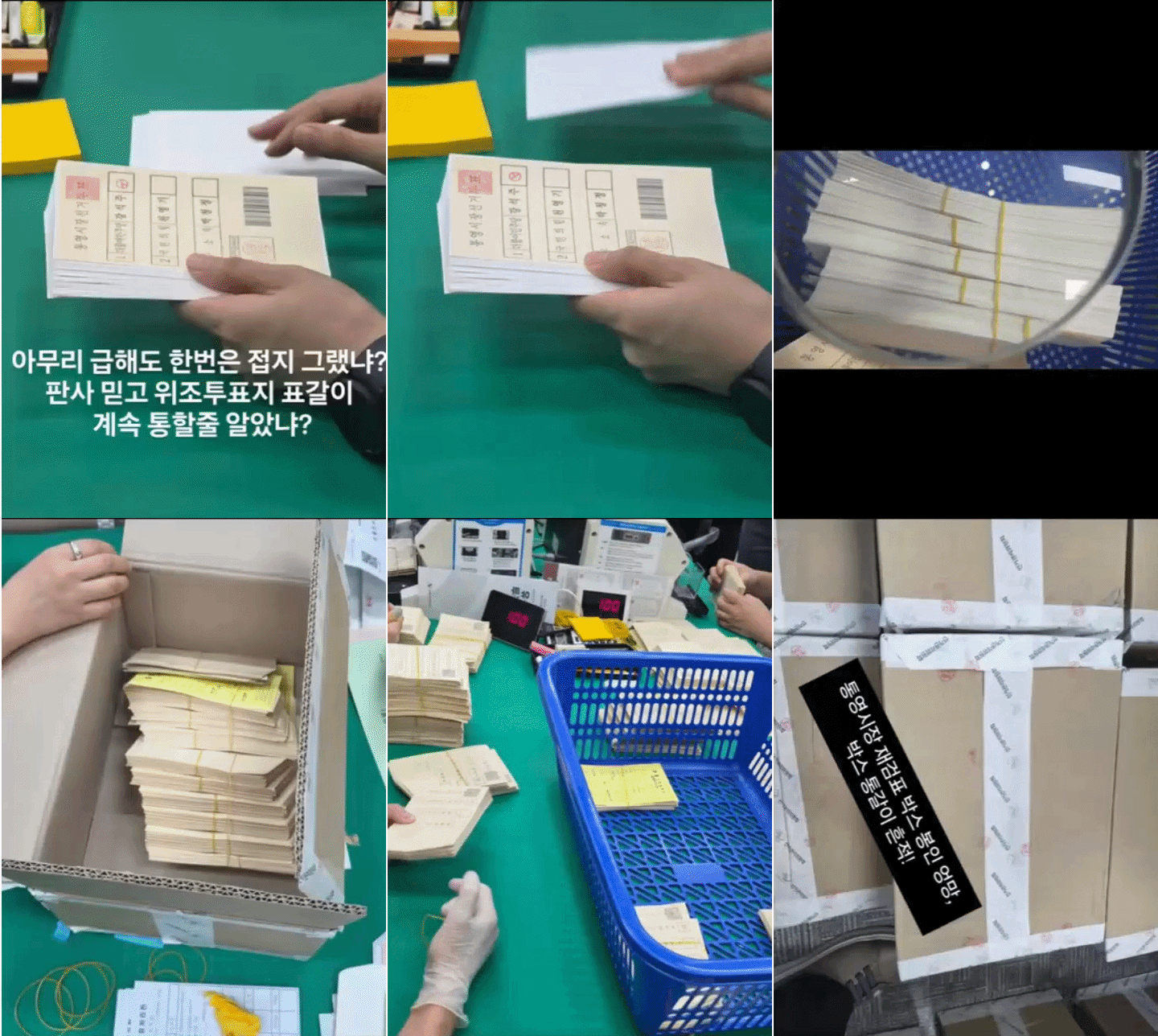 “Ignoring crisp ballots and damaged seals”… Tongyeong mayoral recount concludes with ‘no change in outcome,’ leaving suspicions and public outrage behind
Suspected counterfeit ballots discovered in Tongyeong [GIF from social media of Representative Hwang Kyo-ahn / Attorney Park Joo-hyun]During a recount of the Tongyeong mayoral election in South Gyeong
“Ignoring crisp ballots and damaged seals”… Tongyeong mayoral recount concludes with ‘no change in outcome,’ leaving suspicions and public outrage behind
Suspected counterfeit ballots discovered in Tongyeong [GIF from social media of Representative Hwang Kyo-ahn / Attorney Park Joo-hyun]During a recount of the Tongyeong mayoral election in South Gyeong
 President Yoon, regarding the first-instance ruling on the Public Official Election Act: “An excessive political verdict that distorts the facts… We will appeal immediately.”
The first-instance sentencing hearing for President Yoon Suk Yeol regarding violations of the Public Official Election Act is being broadcast live at Seoul Station on the 27th. [Photo=Yonhap News]Pres
President Yoon, regarding the first-instance ruling on the Public Official Election Act: “An excessive political verdict that distorts the facts… We will appeal immediately.”
The first-instance sentencing hearing for President Yoon Suk Yeol regarding violations of the Public Official Election Act is being broadcast live at Seoul Station on the 27th. [Photo=Yonhap News]Pres
 WSJ: "SK Hynix ADR Premium Is a Sign of AI Trading Overheat"
Advertisement for SK Hynix ADR listing in New York's Times Square [Reuters=Yonhap News file photo]The Wall Street Journal (WSJ) has pointed out that the price of SK Hynix’s American Depositary Recei
WSJ: "SK Hynix ADR Premium Is a Sign of AI Trading Overheat"
Advertisement for SK Hynix ADR listing in New York's Times Square [Reuters=Yonhap News file photo]The Wall Street Journal (WSJ) has pointed out that the price of SK Hynix’s American Depositary Recei
 'Godfather of Japanese Mystery Novels' Keigo Higashino Passes Away After Battle with Cancer at 68
Famous Japanese mystery novelist Keigo Higashino [AFP=Yonhap News]It has been belatedly reported that Keigo Higashino, the "godfather of Japanese mystery novels" and author of bestsellers such as "The
'Godfather of Japanese Mystery Novels' Keigo Higashino Passes Away After Battle with Cancer at 68
Famous Japanese mystery novelist Keigo Higashino [AFP=Yonhap News]It has been belatedly reported that Keigo Higashino, the "godfather of Japanese mystery novels" and author of bestsellers such as "The
 [Park Pil-kyu Security Column] To the Ignorant Trying to Clothe a Beast in Sheep's Clothing
Rep. Kim Byung-joo of the Democratic Party of Korea [Photo=Yonhap News]“The Air Force Academy doesn't teach you how to fly a plane!” “The Army, Navy, and Air Force academies are exactly the
[Park Pil-kyu Security Column] To the Ignorant Trying to Clothe a Beast in Sheep's Clothing
Rep. Kim Byung-joo of the Democratic Party of Korea [Photo=Yonhap News]“The Air Force Academy doesn't teach you how to fly a plane!” “The Army, Navy, and Air Force academies are exactly the
 [Issue Diagnosis] Two Effects of the Election Petition Review
 [Photo] Evidence of Election Fraud Flooding U.S. Media… Trump Had 2.7 Million Votes Stolen
 [Video] U.S. Semiquincentennial Air Show... 'Art in the Sky' streaks across New York
 [Editorial Cartoon] A Draconian Law That Undermines Freedom of Expression

 List
List