Taiwanese President Lai Ching-te. Yonhap News Agency
Faced with military pressure from China and demands for increased defense spending from the United States, Taiwanese President Lai Ching-te has stated his intention to increase defense expenditures, including an additional defense budget of approximately 58 trillion Korean won.
In a speech on the morning of the 26th, after convening a National Security Council emergency meeting, President Lai stated, "The Beijing authorities are targeting the 'unification of Taiwan by force' by 2027, accelerating military preparations for an invasion of Taiwan, and continuing to conduct exercises around Taiwan and incursions into the gray zone." He added, "In addition to military force, they are intensifying legal warfare, psychological warfare, and public opinion warfare to extinguish Taiwan's sovereignty in the world."
President Lai emphasized, "A 'democratic Taiwan' is a sovereign and independent nation, and its people and international friends refer to our country as the Republic of China, Taiwan, or the Republic of China, Taiwan." He further stated, "The Republic of China and the People's Republic of China (China) are not subordinate to each other, and Taiwan's sovereignty does not permit invasion or annexation. This is the status quo we will defend."
He announced that the national security sector and relevant ministries will form a permanent project team to foster social cohesion in Taiwan and conduct public opinion campaigns with allied nations. He also pledged to prevent Chinese interference in Taiwan's government policies or elections.
President Lai further stated that the Taiwanese military's joint combat units will establish a high state of combat readiness before 2027 to deter Chinese threats, and a comprehensive deterrence defense force will be built by 2033.
He reiterated his plan to increase next year's defense budget to over 3% of the Gross Domestic Product (GDP), in accordance with North Atlantic Treaty Organization (NATO) standards, and to reach 5% of GDP by 2030.
Specifically, he revealed that a special defense budget of 1.25 trillion Taiwanese dollars (approximately 39.86 billion US dollars) will be allocated over the next eight years (2026-2033) for the establishment of a "Taiwanese Iron Dome" capable of multi-layered defense, high-altitude detection, and effective interception, as well as the introduction of advanced technologies and artificial intelligence (AI), and the construction of a defense operational system for precision strikes.
President Lai, who has been continuously urged to increase defense expenditure by the incoming "second Trump administration" in the United States, personally expressed his commitment to increasing defense spending through a prominent American media outlet.
Regarding the "40 billion dollar special defense budget," President Lai emphasized, "This groundbreaking package will not only support major new weapons purchases from the United States but also significantly enhance Taiwan's asymmetric capabilities."
Raymond Greene, Chargé d'Affaires of the American Institute in Taiwan (AIT), which serves as the de facto U.S. embassy in Taiwan, issued a statement welcoming Taiwan's "40 billion dollar special defense budget," saying, "The United States supports Taiwan's rapid acquisition of key asymmetric capabilities necessary to enhance its deterrence."
China responded with a relatively brief statement of opposition.
During a press briefing, Chinese Foreign Ministry spokesperson Mao Ning, in response to questions about President Lai's defense budget announcement and Greene's remarks, stated, "China's position of opposing official and military exchanges between the U.S. and Taiwan is consistent." She added, "The Democratic Progressive Party authorities in Taiwan's attempt to refuse unification by force and pursue independence will not succeed."
Meanwhile, in an op-ed published in the WP on the same day, President Lai also pledged to respond to threats and increase domestic and international jobs through advanced investment, expansion of the defense industry base, cooperation with countries of "similar ideology," and strengthening the defense supply chain using Taiwan's manufacturing capabilities.
He expressed gratitude for the international community's continued strong voice for peace in the Taiwan Strait, noting that recent statements from Japan, the United States, Europe, South Korea, Australia, New Zealand, and the Group of Seven (G7) have all contributed to strengthening regional deterrence. He added, "We are grateful to President Trump for making the importance of U.S. leadership clear globally, and the international community is safer thanks to the Trump administration's pursuit of peace through strength."
During his presidential campaign, President Trump had demanded that Taiwan pay "protection fees" to the United States and increase its defense spending to 10% of its GDP.
Amid rising tensions in the Taiwan Strait due to intensified Chinese assertiveness, Taiwan faces the situation of having to accept increased investment in the U.S. by advanced companies like TSMC and increased defense spending, compounded by pressure on tariffs and defense from the incoming "second Trump administration."
In August, the Taiwanese government finalized its central government budget for the following year, including a defense budget of 949.5 billion Taiwanese dollars (approximately 44.2 trillion Korean won). The defense budget for the upcoming year is 22.9% higher than this year and accounts for 3.32% of Taiwan's GDP. This marks the first time since 2009 that Taiwan's defense spending as a percentage of its GDP has exceeded 3%.
Yonhap News Agency

 [Statement by the Seobeokka KMA Patriots Association] ㉛ Recount the ballots openly, as the previous recount covered up election fraud
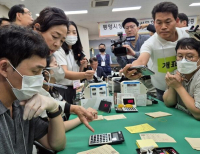
Recount of the Tongyeong mayoral election [Photo=Yonhap News]South Korea's liberal democracy is dying. The National Election Commission (NEC), which has degraded into a criminal organization through t
[Statement by the Seobeokka KMA Patriots Association] ㉛ Recount the ballots openly, as the previous recount covered up election fraud
Recount of the Tongyeong mayoral election [Photo=Yonhap News]South Korea's liberal democracy is dying. The National Election Commission (NEC), which has degraded into a criminal organization through t
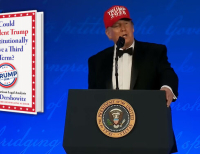
 What is the significance of the "Trump 2028" red hat that keeps reappearing?
It is noteworthy that while it is "highly likely" that President Donald Trump is "seriously considering" a run for the presidency in 2028, he is also "deliberately" fueling speculation regarding wheth
What is the significance of the "Trump 2028" red hat that keeps reappearing?
It is noteworthy that while it is "highly likely" that President Donald Trump is "seriously considering" a run for the presidency in 2028, he is also "deliberately" fueling speculation regarding wheth
 First U.S. Ambassador of Trump's Second Term to Arrive This Week… Will It Provide Momentum to Resolve Pending Issues?
U.S. Ambassador to South Korea Michelle Steel speaks at the opening ceremony of the Korea-U.S. Shipbuilding Cooperation Center held at the Mayflower Hotel in Washington, D.C., on the 23rd (local time)
First U.S. Ambassador of Trump's Second Term to Arrive This Week… Will It Provide Momentum to Resolve Pending Issues?
U.S. Ambassador to South Korea Michelle Steel speaks at the opening ceremony of the Korea-U.S. Shipbuilding Cooperation Center held at the Mayflower Hotel in Washington, D.C., on the 23rd (local time)
 President Yoon, regarding the first-instance ruling on the Public Official Election Act: “An excessive political verdict that distorts the facts… We will appeal immediately.”
The first-instance sentencing hearing for President Yoon Suk Yeol regarding violations of the Public Official Election Act is being broadcast live at Seoul Station on the 27th. [Photo=Yonhap News]Pres
President Yoon, regarding the first-instance ruling on the Public Official Election Act: “An excessive political verdict that distorts the facts… We will appeal immediately.”
The first-instance sentencing hearing for President Yoon Suk Yeol regarding violations of the Public Official Election Act is being broadcast live at Seoul Station on the 27th. [Photo=Yonhap News]Pres
 91% of Net Influx of MZ Generation Goes to Seoul Metropolitan Area… Population Migration Also Shows 'K-shaped Polarization' by Industry
[Provided by Leaders Index]Over the past four years, the MZ generation population has become increasingly concentrated in the Seoul metropolitan area and the Chungcheong region. While cities cen
91% of Net Influx of MZ Generation Goes to Seoul Metropolitan Area… Population Migration Also Shows 'K-shaped Polarization' by Industry
[Provided by Leaders Index]Over the past four years, the MZ generation population has become increasingly concentrated in the Seoul metropolitan area and the Chungcheong region. While cities cen
 'Godfather of Japanese Mystery Novels' Keigo Higashino Passes Away After Battle with Cancer at 68
Famous Japanese mystery novelist Keigo Higashino [AFP=Yonhap News]It has been belatedly reported that Keigo Higashino, the "godfather of Japanese mystery novels" and author of bestsellers such as "The
'Godfather of Japanese Mystery Novels' Keigo Higashino Passes Away After Battle with Cancer at 68
Famous Japanese mystery novelist Keigo Higashino [AFP=Yonhap News]It has been belatedly reported that Keigo Higashino, the "godfather of Japanese mystery novels" and author of bestsellers such as "The
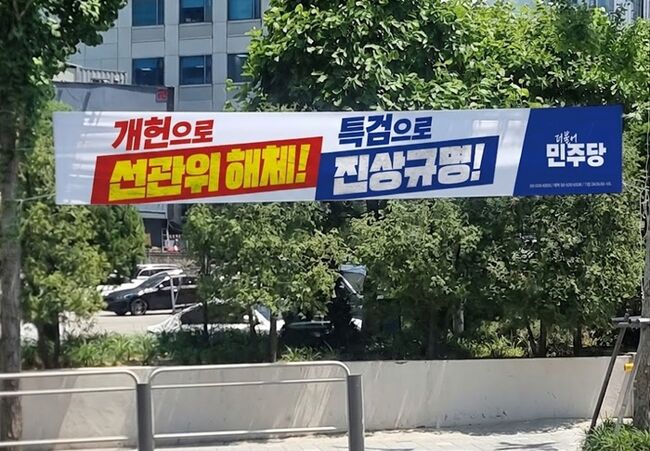 [Cho Yang-geon Column] The NEC: Facing a Fate of "Discarding the Dog After the Hunt"
Banner calling for the "dissolution of the NEC" posted by the Democratic Party. [AI-generated image]Banners calling for the "dissolution of the National Election Commission (NEC)" posted by the Democr
[Cho Yang-geon Column] The NEC: Facing a Fate of "Discarding the Dog After the Hunt"
Banner calling for the "dissolution of the NEC" posted by the Democratic Party. [AI-generated image]Banners calling for the "dissolution of the National Election Commission (NEC)" posted by the Democr
 [Photo] Evidence of Election Fraud Flooding U.S. Media… Trump Had 2.7 Million Votes Stolen
 [Video] U.S. Semiquincentennial Air Show... 'Art in the Sky' streaks across New York
 [Editorial Cartoon] A Draconian Law That Undermines Freedom of Expression

 List
List