[Photo=Yonhap News]
1,470 won per dollar! The won's exchange rate against the dollar is on the verge of entering the 1,500 won era. When the Lee Jae-myung administration first took office, the exchange rate was around 1,360 won. This is an increase of nearly 110 won in just five months. Economic experts warn that it could reach 1,600 won. The social atmosphere is similar to the period just before the bankruptcies of Kia Motors and Hanbo Construction in 1997. At this point, it's a second foreign exchange crisis.
Are they flustered? The Lee Jae-myung administration has begun a search for culprits. They are pointing fingers everywhere, looking for scapegoats. What's strange, however, is that their fingers never point towards themselves. Their attitude is that the Lee Jae-myung administration bears absolutely no responsibility.
Conversely, the International Monetary Fund (IMF) firmly states that it is due to the Lee Jae-myung administration. The IMF issued a warning message regarding the South Korean government's expansionary fiscal policy, stating, "If it continues, it could lead to inflation and a deterioration of fiscal soundness." This was through the "2025 Republic of Korea Article IV Consultation Report" released on the 24th.
Meanwhile, South Korea's fiscal rules are already in the trash. Consequently, the national debt ratio is soaring at a rapid pace. The national debt as a percentage of Gross Domestic Product (GDP) is estimated at 48.2% in 2025 (IMF estimate), but it is projected to reach 58% by 2029. This is a structure where it will rise by 10 percentage points in four years under the Lee Jae-myung administration. This is why the IMF warned, "You need to take care of the national debt first."
Isn't it clear? This teaches us that the recent surge in the exchange rate stems from the government's lax fiscal management. The Lee Jae-myung administration remains completely silent on this matter. Then what? They suddenly drag retail investors who buy overseas stocks into a back alley and beat them up. They claim that the exchange rate is skyrocketing due to the reckless (!) overseas stock investments of these retail investors.
They say the sister-in-law who tries to mediate is more hated than the mother-in-law who hits. What's truly surprising is the attitude of the Bank of Korea, which should be stabilizing the nation. Governor Lee Chang-yong, at the recent Monetary Policy Committee meeting, directly cited the increase in overseas stock investments by individual investors as a cause for the rise in the exchange rate. He responded, "It's not because of the US-Korea interest rate differential, but simply because overseas stock investment has increased."
Governor Lee, who holds a Ph.D. in economics, added, "When I asked young people who are investing heavily overseas why they are doing so, they replied 'because it's cool.'" He even offered his expert analysis, saying, "I am concerned about these things growing like a trend. I believe this phenomenon is unique to our country."
Unique? Then what about the "Watanabe women" in Japan, who borrow heavily from financial institutions and seek overseas stocks or bonds with higher interest rates following the Bank of Japan's adoption of a zero-interest rate policy? Calling a phenomenon where money flows to where it's lower "unique" reeks of denying the fundamental characteristics of a free market economy. Such a statement can only be made intentionally.
If the host of the TV program "Unanswered Questions" were here, they would say, "But then..." and show the following statistics. These are the trends in overseas investments by retail investors that Governor Lee knows better than anyone.
Looking at the year-by-year trends of overseas stock investments by retail investors, this phenomenon is not new. It has been ongoing for over five years since it showed rapid growth from 2020. The balance of overseas stock investments by individual investors increased from approximately $15.2 billion at the end of 2019 to about $116.1 billion at the end of 2024. This is a 7.6-fold increase in five years. As of early September 2025, it stands at $196.3 billion.
The media has repeatedly reported this, like a broken record. It is by no means a peculiar phenomenon of 2025. In contrast, the surge in the exchange rate is a peculiar phenomenon that has occurred since Lee Jae-myung's rise to power this year. The correlation between the two is virtually zero. Yet, Governor Lee aligns himself with the current government's Venezuela-style economic interpretation.
There are further remarks from Governor Lee that are difficult to comprehend. He said, "When the National Pension Service takes a large amount of money abroad, it leads to a depreciation of the won, and when it brings money in, it leads to appreciation." He also stated, "We must also consider the inflow of overseas assets for pension payments." Are National Pension Service payments a new phenomenon? They have been consistently occurring for decades. Eating makes you full. In the past, such things were not used to explain exchange rate fluctuations.
According to a Channel A report, Governor Lee Chang-yong's children's study abroad expenses amount to 2 billion won. So, how many young people among retail investors have overseas investment balances reaching 2 billion won? One Monetary Policy Committee member reportedly holds 4.17 billion won in overseas stocks. Found him. This person was the culprit.
Now, it's your turn to scratch your head. It's suspicious that Governor Lee Chang-yong's sudden remarks coincide with the Lee Jae-myung administration beginning to present a Nero-esque interpretation and arguments about the surge in the exchange rate.
Governor Lee Chang-yong took office on April 21, 2022, beginning his four-year term. Therefore, his term ends in April 2026, next year. The Governor of the Bank of Korea is appointed by the President. In this regard, former Governor Lee Ju-yeol was successfully reappointed after taking office in 2014. Perhaps?
Well, is it impossible? However, if one dreams of reappointment, they must be able to answer the following entrance exam questions correctly.
Is the current surge in prices due to the government's indiscriminate money printing, or due to overseas stock investments by retail investors? Is the surge in the exchange rate also due to the Lee Jae-myung administration's indiscriminate money printing and fiscal expansion, or due to retail investors?
Lee Shin-woo, Former Editorial Writer for the Culture Ilbo & Author of "Electoral Fraud and Traitors"

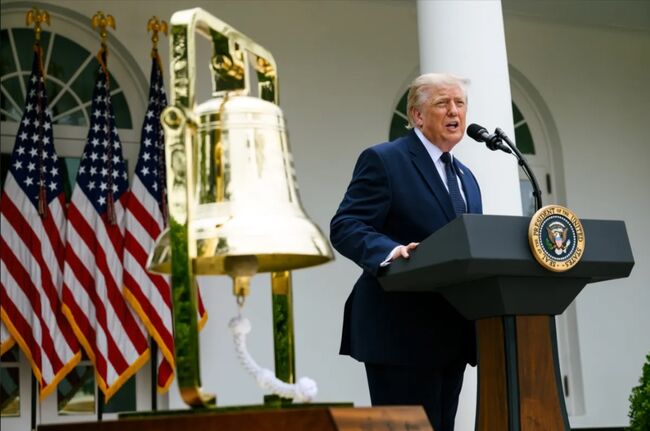 Trump pressures for rate cut again ahead of FOMC... "Should be the lowest in the world"
U.S. President Donald Trump. [Photo = The White House] U.S. President Donald Trump once again pressured the Federal Reserve, the U.S. central bank, to lower interest rates on the 27th (local time
Trump pressures for rate cut again ahead of FOMC... "Should be the lowest in the world"
U.S. President Donald Trump. [Photo = The White House] U.S. President Donald Trump once again pressured the Federal Reserve, the U.S. central bank, to lower interest rates on the 27th (local time
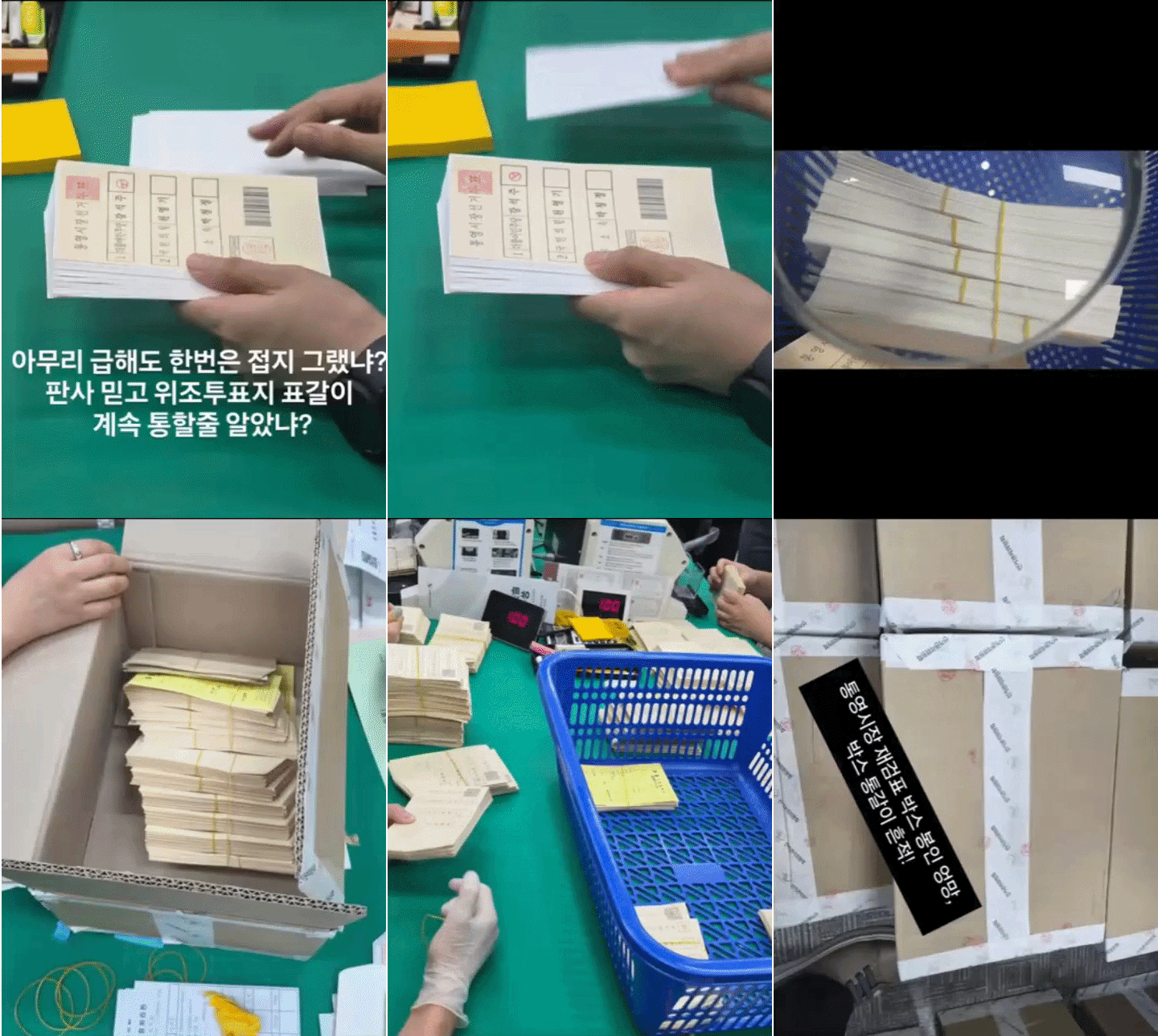 “Ignoring crisp ballots and damaged seals”… Tongyeong mayoral recount concludes with ‘no change in outcome,’ leaving suspicions and public outrage behind
Suspected counterfeit ballots discovered in Tongyeong [GIF from social media of Representative Hwang Kyo-ahn / Attorney Park Joo-hyun]During a recount of the Tongyeong mayoral election in South Gyeong
“Ignoring crisp ballots and damaged seals”… Tongyeong mayoral recount concludes with ‘no change in outcome,’ leaving suspicions and public outrage behind
Suspected counterfeit ballots discovered in Tongyeong [GIF from social media of Representative Hwang Kyo-ahn / Attorney Park Joo-hyun]During a recount of the Tongyeong mayoral election in South Gyeong
 President Yoon, regarding the first-instance ruling on the Public Official Election Act: “An excessive political verdict that distorts the facts… We will appeal immediately.”
The first-instance sentencing hearing for President Yoon Suk Yeol regarding violations of the Public Official Election Act is being broadcast live at Seoul Station on the 27th. [Photo=Yonhap News]Pres
President Yoon, regarding the first-instance ruling on the Public Official Election Act: “An excessive political verdict that distorts the facts… We will appeal immediately.”
The first-instance sentencing hearing for President Yoon Suk Yeol regarding violations of the Public Official Election Act is being broadcast live at Seoul Station on the 27th. [Photo=Yonhap News]Pres
 WSJ: "SK Hynix ADR Premium Is a Sign of AI Trading Overheat"
Advertisement for SK Hynix ADR listing in New York's Times Square [Reuters=Yonhap News file photo]The Wall Street Journal (WSJ) has pointed out that the price of SK Hynix’s American Depositary Recei
WSJ: "SK Hynix ADR Premium Is a Sign of AI Trading Overheat"
Advertisement for SK Hynix ADR listing in New York's Times Square [Reuters=Yonhap News file photo]The Wall Street Journal (WSJ) has pointed out that the price of SK Hynix’s American Depositary Recei
 'Godfather of Japanese Mystery Novels' Keigo Higashino Passes Away After Battle with Cancer at 68
Famous Japanese mystery novelist Keigo Higashino [AFP=Yonhap News]It has been belatedly reported that Keigo Higashino, the "godfather of Japanese mystery novels" and author of bestsellers such as "The
'Godfather of Japanese Mystery Novels' Keigo Higashino Passes Away After Battle with Cancer at 68
Famous Japanese mystery novelist Keigo Higashino [AFP=Yonhap News]It has been belatedly reported that Keigo Higashino, the "godfather of Japanese mystery novels" and author of bestsellers such as "The
 [Park Pil-kyu Security Column] To the Ignorant Trying to Clothe a Beast in Sheep's Clothing
Rep. Kim Byung-joo of the Democratic Party of Korea [Photo=Yonhap News]“The Air Force Academy doesn't teach you how to fly a plane!” “The Army, Navy, and Air Force academies are exactly the
[Park Pil-kyu Security Column] To the Ignorant Trying to Clothe a Beast in Sheep's Clothing
Rep. Kim Byung-joo of the Democratic Party of Korea [Photo=Yonhap News]“The Air Force Academy doesn't teach you how to fly a plane!” “The Army, Navy, and Air Force academies are exactly the
 [Issue Diagnosis] Two Effects of the Election Petition Review
 [Photo] Evidence of Election Fraud Flooding U.S. Media… Trump Had 2.7 Million Votes Stolen
 [Video] U.S. Semiquincentennial Air Show... 'Art in the Sky' streaks across New York
 [Editorial Cartoon] A Draconian Law That Undermines Freedom of Expression

 List
List