President Trump. AP=Yonhap News
The National Security Strategy (NSS) released by the Trump administration's second term on the 5th (local time) made no mention of North Korea, a stark contrast to previous administrations' NSS which proclaimed the goal of denuclearizing North Korea.
This NSS, which serves as the compass for the Trump administration's second term security policy, also declared its intention to readjust the US-China economic relationship based on "reciprocity and fairness" and to prevent moves that undermine the free trade order, such as export controls on rare earth elements.
Furthermore, it clearly stated its opposition to unilateral changes in Taiwan's status or changes to the status quo in the Taiwan Strait, and specified a policy to prevent any single country from dominating the South China Sea.
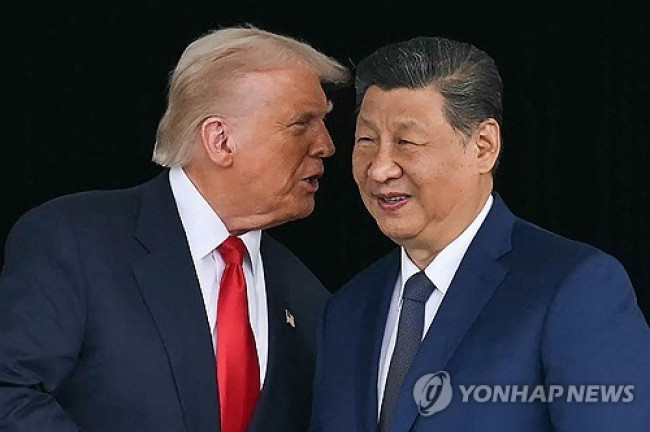 President Trump and President Xi Jinping met in Busan in October. AFP=Yonhap News
◇ North Korea, which appeared '3 times' under Biden and '17 times' in Trump's first term, is 'absent' this time... Denuclearization goal and extended deterrence provision not specified
North Korea was not mentioned even once in this 29-page (33 pages including cover and table of contents) NSS.
This is an unusual omission when compared to the Biden administration's 2022 NSS, where North Korea was mentioned three times, and the Trump administration's first term NSS released in 2017, which mentioned North Korea 17 times.
The 2022 NSS referred to North Korea as a "smaller" dictatorial state that, along with Iran, caused instability by pursuing nuclear weapons expansion.
At the time, the NSS reaffirmed the dual policy of pursuing denuclearization of North Korea while strengthening extended deterrence against North Korea's weapons of mass destruction (WMD) and missile threats, stating, "We will pursue continuous diplomacy with North Korea to achieve visible progress towards complete denuclearization of the Korean Peninsula, while also strengthening extended deterrence against North Korea's WMD and missile threats."
The Trump administration's 2017 NSS stated, "We are prepared to respond to North Korean aggression with overwhelming power, and we will enhance our options for compelling denuclearization of the Korean Peninsula."
This was a period when tensions between the US and North Korea were escalating, with President Trump using the phrase "fire and fury" towards North Korea, clearly identifying North Korea's nuclear and missile programs as an immediate security threat that needed to be resolved urgently.
The Trump administration's second term also maintains a policy of pursuing the complete denuclearization of North Korea.
However, the absence of North Korea in this NSS, which is meant to be a guideline for establishing concrete security strategies, is expected to lead to interpretations that North Korea has been relatively deprioritized in US foreign policy and security objectives.
This may also be related to President Trump's repeated expressions of willingness to engage in dialogue with North Korean leader Kim Jong Un.
President Trump met with Kim Jong Un three times between 2018 and 2019 during his first term. He also expressed his willingness to meet with Kim Jong Un ahead of the Asia-Pacific Economic Cooperation (APEC) meeting in Busan, South Korea, in October, but the meeting ultimately did not materialize.
Notably, President Trump made no mention of North Korea in his keynote address at the UN General Assembly in September.
Experts on the Korean Peninsula in the United States have offered various interpretations.
Robert Rapson, former acting US Ambassador to South Korea, told Yonhap News that "such an omission will raise serious questions and concerns in South Korea and Japan, not to mention potential misreactions from North Korea, China, and Russia."
He added that the absence of North Korea's mention "will reinforce the perception of the United States as an increasingly unreliable ally in the region (and beyond)."
Conversely, Patrick Cronin, Senior Director of the Asia-Pacific Security Program at the Hudson Institute, suggested to Yonhap News that the omission of North Korea might be a way to "maintain diplomatic flexibility in preparation for a potential summit meeting between President Trump and Chairman Kim in the coming months."
Andrew Yeo, Korea Chair at the Brookings Institution, stated to Yonhap News that while the omission of North Korea could be interpreted as a signal that "the United States is lowering its priority on Korean Peninsula issues or expecting South Korea to handle North Korean issues more directly, I don't think it needs to be seen that way," adding, "Given the previous Trump administration's stance, North Korea remains a threat and denuclearization is the ultimate goal."
He also noted that "the lack of any mention of nuclear non-proliferation or nuclear weapons proliferation in the NSS is also noteworthy," and suggested that "it is possible that the Trump administration will specifically address nuclear threats, including those from North Korea, in the National Defense Strategy (NDS) to be released later."
Teresa Gweon, Director of Strategy and Security at the Atlantic Council's Scowcroft Center for Strategy and Security, commented in an Atlantic Council piece that the NSS "leaves several strategic gaps regarding how, and indeed whether, the US will respond to the continued influence of adversarial nations." She added, "While North Korea was not explicitly mentioned this time, North Korea will undoubtedly have plans to capture global attention over the next three years."
Furthermore, unlike the Biden administration's 2022 edition, which clearly outlined a policy of providing nuclear umbrellas to allies through "extended deterrence," this NSS did not directly mention extended deterrence.
However, it stated, "We want the world's strongest, most reliable, and most modern nuclear deterrent to protect the American people, American overseas military assets, and America's allies, and in addition, we want next-generation missile defense systems, including Golden Dome (Trump's space-based missile defense system) for the US mainland."
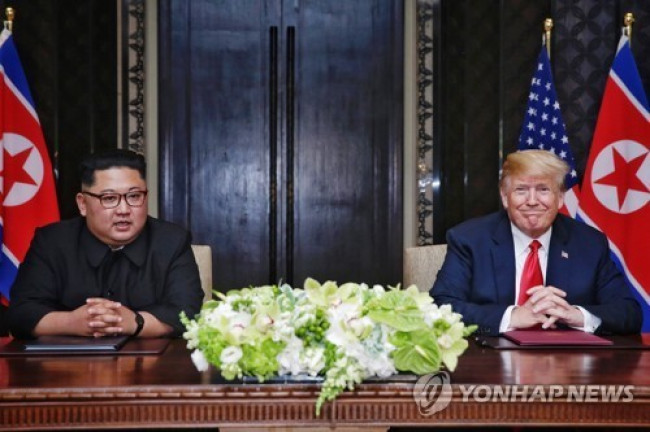 Kim Jong Un and Trump met in Singapore in 2018. Yonhap News
◇ US, 3 years ago "outcompete China"→This time, emphasizes 'balance and mutual benefit' together
The NSS defines the Indo-Pacific region as a "crucial economic and geopolitical arena" and outlines securing US competitive advantage and preventing military conflict as basic principles of its Asian strategy.
Specifically regarding China, the NSS pointed out that the commercial imbalance between the two countries has continued since China's economic reopening in 1979, stating, "This relationship, which began with a mature and prosperous economic system and one of the world's poorest countries, has now transformed into a relationship between almost equal partners."
It further declared, "Going forward, we will readjust our economic relationship with China to restore America's economic independence, prioritizing reciprocity and fairness."
Specifically, it stated, "Trade with China must be balanced and focused on non-sensitive elements," and added, "If the United States can maintain its growth trajectory and sustain a mutually beneficial economic relationship with China, we will grow from the current $30 trillion economy to $40 trillion in the 2030s."
This appears to be a somewhat softened tone compared to the Biden administration's 2022 NSS, which identified China as the "only competitor" capable of challenging the US in the future and declared its intention to win that competition.
The 2022 NSS assessed China as "the only competitor with the economic, diplomatic, military, and technological capabilities and the intent to reshape the international order," and stated, "We will outcompete China through effective competition." It also characterized China as "America's most significant geopolitical challenge."
In contrast, this NSS appears to place emphasis on forming economic relationships based on reciprocity and fairness, while remaining vigilant of China's rapid economic growth.
Caroline Costello, Associate Director of the Atlantic Council's Global China Hub, commented through the Atlantic Council, "This is a significant shift in how the United States perceives US-China competition," adding, "The Trump administration has made it clear that it views US-China competition not as a clash of values, but as competition based on interests."
The new NSS designated threats to critical resource supply chains, such as rare earth elements, the export of fentanyl precursors, state-led subsidies and industrial strategies, and unfair trade practices as "issues to be terminated."
The Trump administration has strongly criticized China's export controls on rare earth elements and other critical minerals, as well as its unfair trade practices. The inclusion of such specific items in the NSS is interpreted as a de facto check on China.
◇ 'Taiwan' prominently cited as an Asian security threat
The new NSS strongly reaffirmed its commitment to Taiwan's defense in the context of Asian security threats.
The NSS stated, "We will maintain our long-standing declarative policy towards Taiwan," and declared its opposition to both unilateral changes in Taiwan's status and changes to the status quo in the Taiwan Strait.
In particular, it stated, "Ideally, the priority is to deter conflict over Taiwan by maintaining military superiority," and specified, "We will build a military capable of deterring aggression anywhere along the First Island Chain (from Okinawa, Japan, to Taiwan, the Philippines, and the Strait of Malacca)."
The 2022 NSS also reaffirmed the "One China" policy regarding Taiwan while emphasizing its opposition to any unilateral changes to the status quo.
The new NSS, without explicitly mentioning China, also expressed concern over China's recent actions in the South China Sea by citing the "possibility of any one competitor dominating the South China Sea."
The NSS stated, "Potential adversaries could impose a toll system on one of the world's busiest commercial shipping lanes, or worse, close and reopen it at will," and emphasized the need for additional investment in military power and strong cooperation with relevant countries such as India and Japan to prevent this.
While the 2022 NSS stated that the US would continue to hold China accountable for human rights abuses in Xinjiang, Tibet, and Hong Kong, there was no mention of these issues in the current NSS. In the new NSS, China was mentioned 19 times, Russia 10 times, and Taiwan 8 times.
The NSS is a document that proclaims the US's foreign security strategy and policy, and the White House has been regularly developing and publicizing it since the 1980s.

 Trump pressures for rate cut again ahead of FOMC... "Should be the lowest in the world"
U.S. President Donald Trump. [Photo = The White House] U.S. President Donald Trump once again pressured the Federal Reserve, the U.S. central bank, to lower interest rates on the 27th (local time
Trump pressures for rate cut again ahead of FOMC... "Should be the lowest in the world"
U.S. President Donald Trump. [Photo = The White House] U.S. President Donald Trump once again pressured the Federal Reserve, the U.S. central bank, to lower interest rates on the 27th (local time
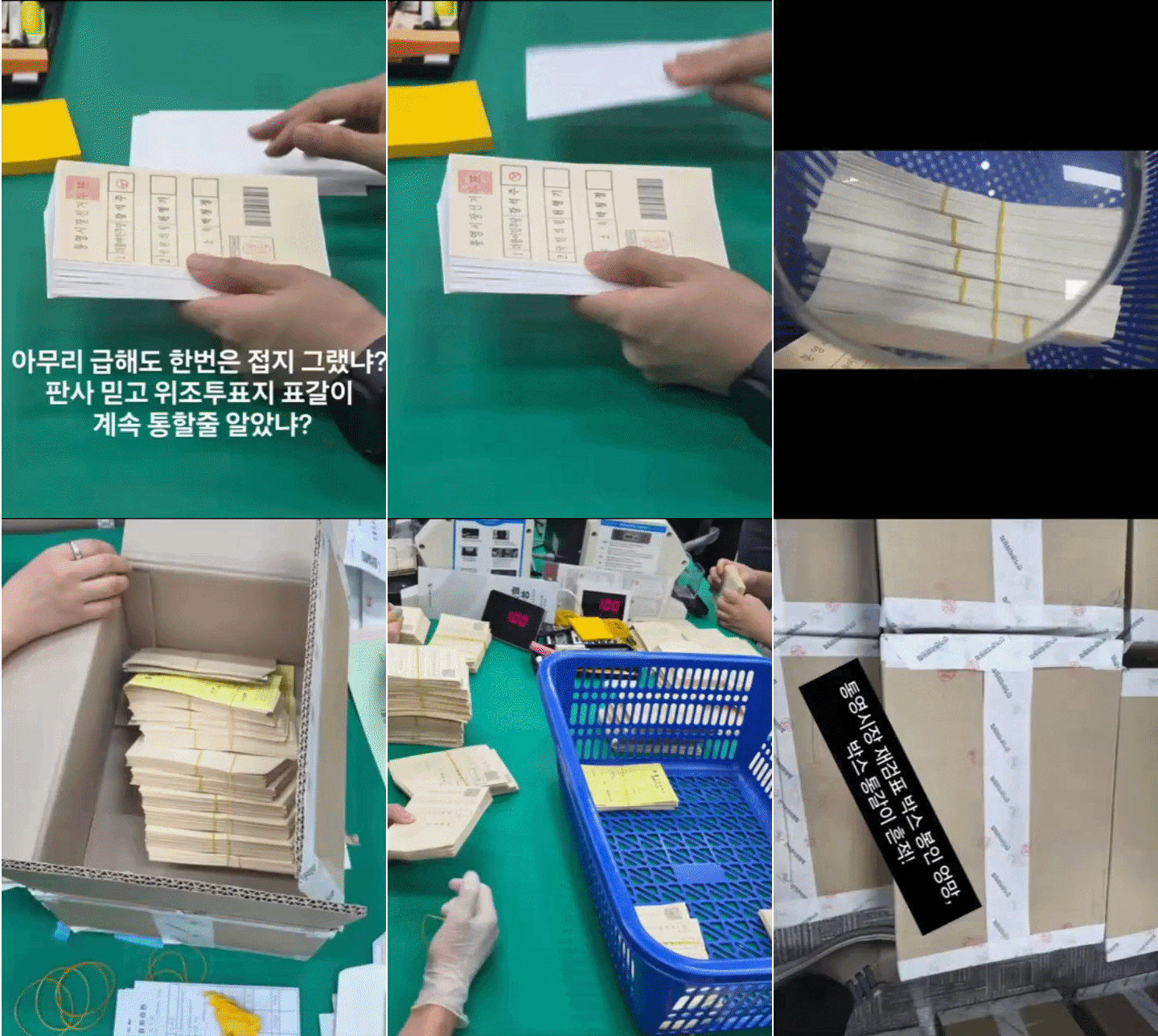 “Ignoring crisp ballots and damaged seals”… Tongyeong mayoral recount concludes with ‘no change in outcome,’ leaving suspicions and public outrage behind
Suspected counterfeit ballots discovered in Tongyeong [GIF from social media of Representative Hwang Kyo-ahn / Attorney Park Joo-hyun]During a recount of the Tongyeong mayoral election in South Gyeong
“Ignoring crisp ballots and damaged seals”… Tongyeong mayoral recount concludes with ‘no change in outcome,’ leaving suspicions and public outrage behind
Suspected counterfeit ballots discovered in Tongyeong [GIF from social media of Representative Hwang Kyo-ahn / Attorney Park Joo-hyun]During a recount of the Tongyeong mayoral election in South Gyeong
 President Yoon, regarding the first-instance ruling on the Public Official Election Act: “An excessive political verdict that distorts the facts… We will appeal immediately.”
The first-instance sentencing hearing for President Yoon Suk Yeol regarding violations of the Public Official Election Act is being broadcast live at Seoul Station on the 27th. [Photo=Yonhap News]Pres
President Yoon, regarding the first-instance ruling on the Public Official Election Act: “An excessive political verdict that distorts the facts… We will appeal immediately.”
The first-instance sentencing hearing for President Yoon Suk Yeol regarding violations of the Public Official Election Act is being broadcast live at Seoul Station on the 27th. [Photo=Yonhap News]Pres
 WSJ: "SK Hynix ADR Premium Is a Sign of AI Trading Overheat"
Advertisement for SK Hynix ADR listing in New York's Times Square [Reuters=Yonhap News file photo]The Wall Street Journal (WSJ) has pointed out that the price of SK Hynix’s American Depositary Recei
WSJ: "SK Hynix ADR Premium Is a Sign of AI Trading Overheat"
Advertisement for SK Hynix ADR listing in New York's Times Square [Reuters=Yonhap News file photo]The Wall Street Journal (WSJ) has pointed out that the price of SK Hynix’s American Depositary Recei
 'Godfather of Japanese Mystery Novels' Keigo Higashino Passes Away After Battle with Cancer at 68
Famous Japanese mystery novelist Keigo Higashino [AFP=Yonhap News]It has been belatedly reported that Keigo Higashino, the "godfather of Japanese mystery novels" and author of bestsellers such as "The
'Godfather of Japanese Mystery Novels' Keigo Higashino Passes Away After Battle with Cancer at 68
Famous Japanese mystery novelist Keigo Higashino [AFP=Yonhap News]It has been belatedly reported that Keigo Higashino, the "godfather of Japanese mystery novels" and author of bestsellers such as "The
 [Park Pil-kyu Security Column] To the Ignorant Trying to Clothe a Beast in Sheep's Clothing
Rep. Kim Byung-joo of the Democratic Party of Korea [Photo=Yonhap News]“The Air Force Academy doesn't teach you how to fly a plane!” “The Army, Navy, and Air Force academies are exactly the
[Park Pil-kyu Security Column] To the Ignorant Trying to Clothe a Beast in Sheep's Clothing
Rep. Kim Byung-joo of the Democratic Party of Korea [Photo=Yonhap News]“The Air Force Academy doesn't teach you how to fly a plane!” “The Army, Navy, and Air Force academies are exactly the
 [Issue Diagnosis] Two Effects of the Election Petition Review
 [Photo] Evidence of Election Fraud Flooding U.S. Media… Trump Had 2.7 Million Votes Stolen
 [Video] U.S. Semiquincentennial Air Show... 'Art in the Sky' streaks across New York
 [Editorial Cartoon] A Draconian Law That Undermines Freedom of Expression

 List
List