Yonhap News
 Former Professor at Kangnam University, Ph.D. in Business Administration, Current Co-CEO of JagyomoOn November 29th, Coupang, a leading e-commerce company in Korea, admitted that the personal information of 33.7 million consumers had been leaked. The leaked information includes consumers' names, delivery addresses, email addresses, and recent order details. The Ministry of Science and ICT and the Personal Information Protection Commission confirmed that login-related information, which some had raised concerns about, and personal customs clearance codes used for overseas direct purchases were not leaked.
The individual responsible for this information leak was a former Coupang employee from China who was a developer of the authentication system, granting them unrestricted access to customer personal information. It was revealed that they used an authentication key that had not been discarded even after six months of their departure to leak the information.
Undeniably, Coupang bears the fundamental responsibility for this entire incident. The responsibility for allowing such a massive amount of information to be leaked by an employee from the security department, which directly handles consumer data, after their resignation is particularly grave. In response, the government is currently discussing the imposition of punitive fines.
Nevertheless, observing the recent Coupang incident, the government's stance, and the behavior of the established media reporting on it, one cannot help but feel a sense of bitterness. The truth is that consumer information being compromised by China is so common that it has become almost endemic.
In March 2014, Korea's leading telecommunications company, KT, suffered a leak of personal information of as many as 12 million individuals, which included their resident registration numbers. In 2016, LG Uplus experienced an incident where 300,000 pieces of personal information were leaked to China over eight years, starting shortly after the implementation of Huawei equipment. Kakao Pay saw approximately 40 million customer personal information records (26 items including names, mobile phone numbers, email addresses, and payment history) illegally transferred to the Chinese company Alipay in January 2025. Furthermore, in April of this year, SKT experienced the astonishing event of 23 million mobile phone SIM card information being leaked.
While it is essential for private companies, especially those in e-commerce and telecommunications, to establish robust security systems, in a situation where so much of South Korea's personal information is being breached, one must question what the government ministries and agencies, such as the Ministry of Science and ICT and the Personal Information Protection Commission, have supervised and prevented through post-incident measures.
It is reported that all of Koreans' personal information is openly being sold in China for 5,000 won per person. What is our government doing in the face of this absurd reality? Is the personal information of our citizens public property? We await an answer from our government.
Moreover, the scale of fines imposed on these companies thus far is a cause for despair when compared to the current Coupang incident. For KT, which experienced its first large-scale information leak in 2014, the fine was a mere 700 million won. In 2016, LG Uplus, where the former Minister of Information and Communication served as vice president, was fined 6.8 billion won for the leak. The fine for Kakao Pay, which transferred 40 million records, was only 5.9 billion won. Given that Alibaba's Ant Group is a major shareholder in Kakao Pay with a 39% stake, there are suspicions that this leniency might have been due to hesitations in taking strong action.
Most recently, even for SKT, from which all personal information of 23 million people was thoroughly leaked, the fine was 134.8 billion won, which amounts to only 0.75% of its 2024 revenue. In contrast, for Coupang, a maximum punitive fine of 3% of revenue, amounting to 1.3 trillion won, is being considered.
The profit structures of telecommunications and retail companies differ. For telecommunications companies, a significant portion of revenue translates into operating profit. However, e-commerce companies like Coupang are essentially retailers, with operating profit margins around 10%. In simple terms, this situation can only be interpreted as the government having waited for an opportunity to strike decisively. Of course, it is acknowledged that addressing damages to citizens warrants strict punishment. But haven't the bridges already been burned multiple times?
What has the government done to strengthen personal information security all this time? And now that an incident has occurred, is it pouncing on Coupang with the attitude of "gotcha"? What is even more astounding is that a few months ago, following the death of a Chinese worker, the President himself took the lead in suggesting a business suspension for POSCO E&C, and now they are targeting Coupang, a company composed of purely domestic Korean-American capital, and urging the realization of punitive damages.
There is a reason why the author is criticizing the government so strongly. It is because, just two weeks ago, the government itself was discussing the prohibition of early morning deliveries, a proposal submitted by the Korean Confederation of Trade Unions (KCTU) to prevent overwork-related deaths among workers. This discussion occurred despite early morning deliveries by AliExpress and Temu, subsidiaries of Alibaba, a Chinese e-commerce company in the same industry, being permitted on the same day.
At the time, over 20 million users protested the ban on early morning deliveries, and approximately 70,000 of Coupang's 95,000 employees involved in delivery vehemently resisted. The Coupang Union, which joined the KCTU shortly after its establishment in 2020, withdrew from the KCTU in November 2023 with the approval of 93% of its members, citing the KCTU's excessive political activism and exorbitant membership fees.
Unlike other domestic e-commerce companies, Coupang adopts a direct employment system for its delivery personnel and offers American-style management in terms of salary, working conditions, and welfare benefits, resulting in high employee satisfaction. This is because, while competitors largely outsource their delivery personnel, Coupang plans to have a workforce of 50,000 directly employed staff by the end of the year.
Conversely, the working conditions for Coupang's managerial staff, who are the primary point of contact for this incident, are indeed not as favorable as those in other large corporations.
Meanwhile, let us examine the management rights and responsibilities of Coupang's Chairman, Bom Kim, who has been criticized by the left recently.
Coupang, which listed on the New York Stock Exchange (NYSE) on March 11, 2021, had CEO Bom Kim holding only a 10.1% stake at its inception. One of the primary reasons for choosing an overseas stock exchange instead of a domestic one was the lack of protective measures, such as dual-class shares, necessary for defending the CEO's management rights under the regulations of Korean exchanges and KOSDAQ.
Bom Kim could exercise 76% of the total voting rights through Class B shares, which carry 29 times the voting power of Class A shares. Of course, for capital raising, pure U.S. institutional investors like SB Investment Advisory (17.4% stake, UK), Baillie Gifford Company (9.0%), and Morgan Stanley (4.1%) actively participated, holding the majority of Class A shares, which follow a one-share, one-vote principle.
Had Coupang listed in Korea, in a situation like the current incident, it is highly probable that CEO Bom Kim would have had to sell all his shares and liquidate the company. In November 2024, for financial reasons such as tax payments, he converted 15 million Class B shares (out of a total of 17 million convertible shares) into Class A shares at a 1:1 ratio by early 2025, raising 485 billion won. An additional 2 million shares (approximately 67.2 billion won) were fully donated to a U.S. charity fund.
Even after selling a portion of his shares, Chairman Bom Kim maintains a 73.7% ownership stake in management control. Therefore, the claim by some that he "cashed out" to evade responsibility for this leak is entirely false. In Korea, it would have been impossible to raise the approximately 60 trillion won in institutional investor capital required to secure the necessary shareholding for management control, unlike in the U.S. Thus, it is only natural to make donations to the U.S., which led the capital procurement.
Fortunately, there are no Chinese nationals among Coupang's delivery personnel, and no fatalities occurred. Furthermore, the claim made by some former employees (fabricated figures instigated by the left) that 70% of Coupang's management staff are Chinese has been proven to be a complete fabrication. Had Coupang listed in Korea, Chairman Bom Kim might have had to close the company due to sheer bad luck, facing charges under the Serious Accidents Punishment Act in the event of fatalities.
It is truly regrettable that Coupang has exposed its laxity in customer information security management. Nevertheless, Coupang is undoubtedly a proud company that has primarily employed and grown its workforce with domestic Koreans. There is absolutely no reason to ostracize it simply because the representative's nationality and the company's headquarters are in the U.S.
Coupang, which adapted to Korea's unique "ppalli-ppalli" (hurry, hurry) culture and perfected "Rocket Delivery," has at least succeeded in challenging the global giant Amazon in Korea. Moreover, it has significantly contributed to counteracting overseas direct purchase platforms like China's Ali, Temu, and Shein, which are causing numerous problems.
Given their track record, Chinese companies are inherently integrated with the Chinese Communist Party, and it is common sense that domestic citizens' information is compromised immediately upon transaction, with unimaginable consequences arising from that data. Yet, Lee Jae-myung and the current administration are relentlessly targeting Coupang. This is likely due to their deep-seated pro-China and anti-American sentiments. Established media outlets also need to exercise self-restraint. It is crucial to foster an environment where companies like Coupang, which can grow into giant enterprises with just an idea, can thrive, rather than merely paying lip service to startups and ventures a hundred times over.
We sincerely hope that Coupang will correct its mistakes and be reborn as a fully mature company through this opportunity. We also earnestly hope that the public will exercise restraint in their emotions, focus on self-security rather than relying solely on the government, and once again give a favorable rating to trustworthy companies.
Former Professor at Kangnam University, Ph.D. in Business Administration, Current Co-CEO of Jagyomo

 Trump pressures for rate cut again ahead of FOMC... "Should be the lowest in the world"
U.S. President Donald Trump. [Photo = The White House] U.S. President Donald Trump once again pressured the Federal Reserve, the U.S. central bank, to lower interest rates on the 27th (local time
Trump pressures for rate cut again ahead of FOMC... "Should be the lowest in the world"
U.S. President Donald Trump. [Photo = The White House] U.S. President Donald Trump once again pressured the Federal Reserve, the U.S. central bank, to lower interest rates on the 27th (local time
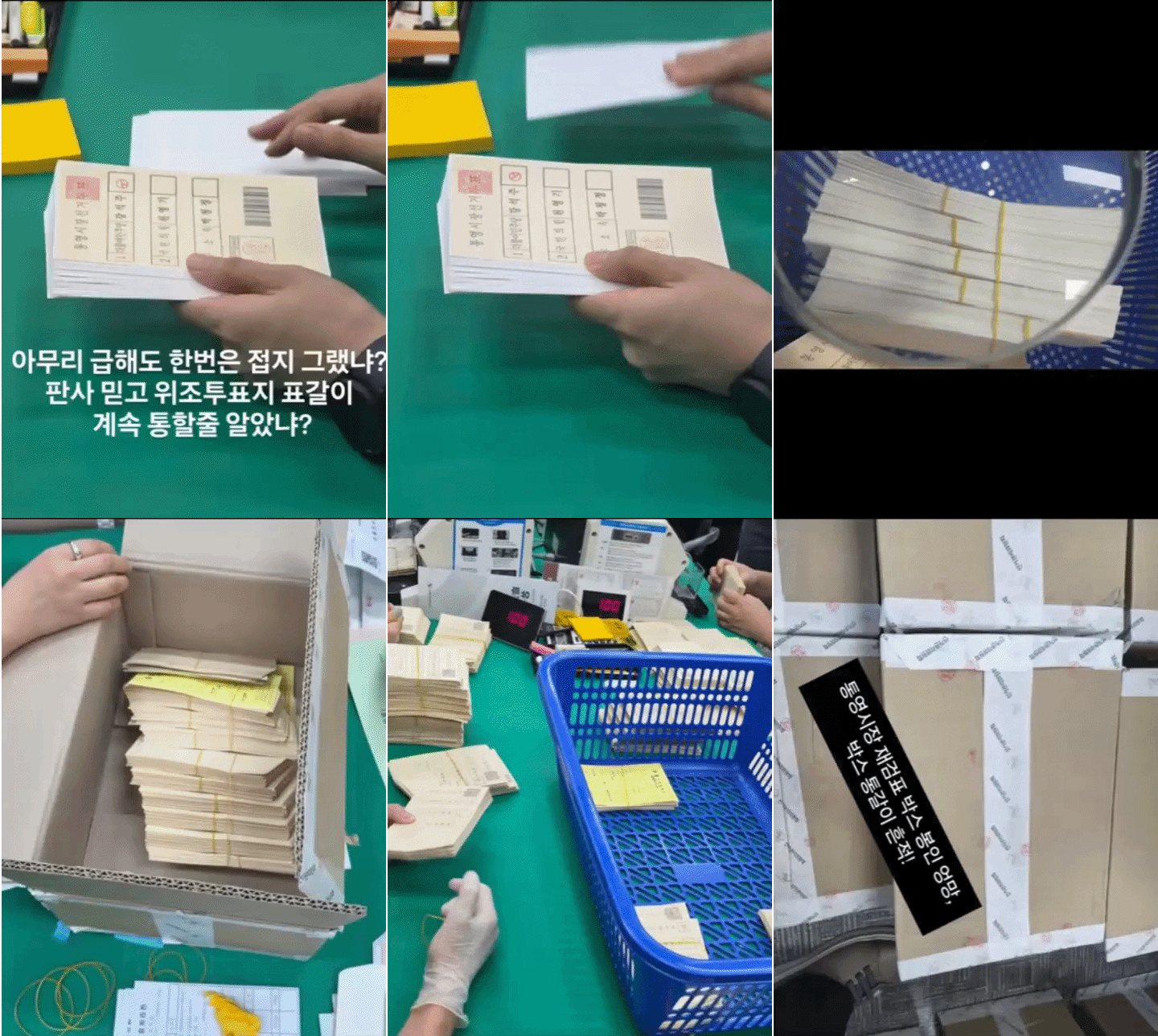 “Ignoring crisp ballots and damaged seals”… Tongyeong mayoral recount concludes with ‘no change in outcome,’ leaving suspicions and public outrage behind
Suspected counterfeit ballots discovered in Tongyeong [GIF from social media of Representative Hwang Kyo-ahn / Attorney Park Joo-hyun]During a recount of the Tongyeong mayoral election in South Gyeong
“Ignoring crisp ballots and damaged seals”… Tongyeong mayoral recount concludes with ‘no change in outcome,’ leaving suspicions and public outrage behind
Suspected counterfeit ballots discovered in Tongyeong [GIF from social media of Representative Hwang Kyo-ahn / Attorney Park Joo-hyun]During a recount of the Tongyeong mayoral election in South Gyeong
 President Yoon, regarding the first-instance ruling on the Public Official Election Act: “An excessive political verdict that distorts the facts… We will appeal immediately.”
The first-instance sentencing hearing for President Yoon Suk Yeol regarding violations of the Public Official Election Act is being broadcast live at Seoul Station on the 27th. [Photo=Yonhap News]Pres
President Yoon, regarding the first-instance ruling on the Public Official Election Act: “An excessive political verdict that distorts the facts… We will appeal immediately.”
The first-instance sentencing hearing for President Yoon Suk Yeol regarding violations of the Public Official Election Act is being broadcast live at Seoul Station on the 27th. [Photo=Yonhap News]Pres
 WSJ: "SK Hynix ADR Premium Is a Sign of AI Trading Overheat"
Advertisement for SK Hynix ADR listing in New York's Times Square [Reuters=Yonhap News file photo]The Wall Street Journal (WSJ) has pointed out that the price of SK Hynix’s American Depositary Recei
WSJ: "SK Hynix ADR Premium Is a Sign of AI Trading Overheat"
Advertisement for SK Hynix ADR listing in New York's Times Square [Reuters=Yonhap News file photo]The Wall Street Journal (WSJ) has pointed out that the price of SK Hynix’s American Depositary Recei
 'Godfather of Japanese Mystery Novels' Keigo Higashino Passes Away After Battle with Cancer at 68
Famous Japanese mystery novelist Keigo Higashino [AFP=Yonhap News]It has been belatedly reported that Keigo Higashino, the "godfather of Japanese mystery novels" and author of bestsellers such as "The
'Godfather of Japanese Mystery Novels' Keigo Higashino Passes Away After Battle with Cancer at 68
Famous Japanese mystery novelist Keigo Higashino [AFP=Yonhap News]It has been belatedly reported that Keigo Higashino, the "godfather of Japanese mystery novels" and author of bestsellers such as "The
 [Park Pil-kyu Security Column] To the Ignorant Trying to Clothe a Beast in Sheep's Clothing
Rep. Kim Byung-joo of the Democratic Party of Korea [Photo=Yonhap News]“The Air Force Academy doesn't teach you how to fly a plane!” “The Army, Navy, and Air Force academies are exactly the
[Park Pil-kyu Security Column] To the Ignorant Trying to Clothe a Beast in Sheep's Clothing
Rep. Kim Byung-joo of the Democratic Party of Korea [Photo=Yonhap News]“The Air Force Academy doesn't teach you how to fly a plane!” “The Army, Navy, and Air Force academies are exactly the
 [Issue Diagnosis] Two Effects of the Election Petition Review
 [Photo] Evidence of Election Fraud Flooding U.S. Media… Trump Had 2.7 Million Votes Stolen
 [Video] U.S. Semiquincentennial Air Show... 'Art in the Sky' streaks across New York
 [Editorial Cartoon] A Draconian Law That Undermines Freedom of Expression

 List
List