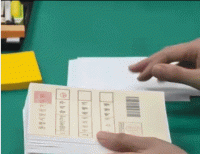
A view of the dealing room at Hana Bank in Jung-gu, Seoul, on the 12th. Yonhap News
 Director of the Free Market Institute & Chairman of the Korea Financial ICT Convergence SocietyThe won-dollar exchange rate has surged and shows no signs of stabilizing anytime soon. The won-dollar exchange rate, which was 1352 won per dollar on July 2nd of this year, began to rise in September and has remained in the 1470 won range since mid-November. Notably, the dollar has shown a weakening trend during this period. The dollar index, which indicates the dollar's strength, was around 129 at the beginning of the year but has recently fallen to 120, continuing its weakness. The most significant factor is the expectation of a US Federal Reserve interest rate cut. With the dollar weakening, it would normally be expected for the Korean won to strengthen against the dollar, leading to a decline in the won-dollar exchange rate. However, the won-dollar exchange rate shows no signs of declining from the 1470 won range.
The Real Effective Exchange Rate (REER) is also declining. According to the Bank of Korea and the Bank for International Settlements (BIS), South Korea's REER index stood at 89.09 (2020=100) as of the end of October this year. This is a decrease of 1.44 points from the previous month, marking the lowest level since August 2009 (88.88), a period of 16 years and 2 months. This is even lower than the level recorded in March (89.29), when domestic uncertainty was at its peak due to the aftermath of a state of emergency martial law.
A weaker won would normally benefit exports, but the issue is that it is abnormally excessive. With the exchange rate soaring, there are concerns that it could break through the 1500 won mark next year. During the 2008 global financial crisis, the exchange rate was 1453 won in March 2009. In December 1997, when the foreign exchange crisis occurred, it was 1499 won, and it surged to 1701 won in January 1998 following the crisis. This highlights the urgency for exchange rate measures.
The government has hastily introduced exchange rate measures. Reports indicate that on the 9th, the Ministry of Economy and Finance formed its own task force (TF) to respond to exchange rate instability and is preparing measures for key foreign exchange supply and demand entities: exporting companies, securities firms, and the National Pension Service. The government is considering policy tools such as △regularly monitoring export companies' foreign exchange transaction trends and overseas investment status, and providing incentives for foreign exchange transactions. This is a response to situations where companies withhold dollars from the market in anticipation of a rising exchange rate. Tax incentives are also being discussed, such as expanding the tax exemption for dividends received from overseas subsidiaries from the current 95% to 100% (income exclusion).
△The intensity of supervision over securities firms will also increase. Centered around the Financial Supervisory Service, the suitability of securities firms' disclosure obligations to investors for overseas investments, the adequacy of risk disclosures, and marketing practices that encourage "debt investing" (investing with borrowed money) will be reviewed by January of next year. △A four-party consultative body comprising the Ministry of Economy and Finance, the Ministry of Health and Welfare, the Bank of Korea, and the National Pension Service will establish a "new framework" to harmonize the profitability of the National Pension Service with foreign exchange market stability. For the immediate future, the primary agenda item for discussion is the extension of the annual $65 billion foreign exchange swap agreement between the foreign exchange authorities and the National Pension Service, which is set to expire at the end of this year.
△The Ministry of Health and Welfare has begun preparations for the National Pension Service to issue foreign currency bonds. The Pension Finance Division of the Ministry of Health and Welfare has commenced a full review of the necessity and feasibility of the National Pension Service issuing foreign currency bonds. This move is intended to diversify foreign currency procurement if needed to stabilize the exchange rate, and it would involve pursuing legislative amendments. The current National Pension Act limits the fund's financial resources to pension premiums, operating profits, reserves, and surplus from the settlement of income and expenditure by the fund. As the structure does not allow for securing fund resources through debt issuance, amending the National Pension Act is necessary to issue foreign currency bonds. The market anticipates that if a portion of overseas investment funds is directly raised through foreign currency bonds, the scale of selling won in the spot foreign exchange market to secure dollars will decrease.
These are truly comprehensive measures. The government's measures aim to reduce the outflow of investment funds, as the cause of the rising exchange rate is attributed to more investment capital flowing out than dollars entering the foreign exchange market. Despite a surplus in the current account for 30 consecutive months, overseas investments by economic actors such as individuals, corporations, and the National Pension Service have increased significantly. Concerns are rising that high exchange rates are becoming entrenched as investment outflows exceed incoming dollars.
△In October, domestic investors' securities investments abroad, including foreign stocks and bonds, increased by $17.27 billion. This marks the largest record since the compilation of balance of payments statistics. While foreign investment in Korea also increased by $5.2 billion, it did not even reach one-third of the outflow abroad. "Seohak-aemi" (retail investors investing in overseas stocks) net purchases of foreign stocks (purchases exceeding sales) in 2022 reached $10.1 billion (approximately 14.87 trillion won), but this figure has already reached $28.7 billion (approximately 42.26 trillion won) for the period up to November 24th this year. △In terms of direct investment by corporations, etc. (FDI), domestic investment abroad increased by $1.88 billion. This is more than 10 times the foreign investment in Korea ($150 million). This figure is expected to increase further once MAGA and MASGA are fully operational.
Cumulatively, including securities investments and direct investments, the net outflow of funds in October reached $6.99 billion. This marks a significant shift from a net inflow of $7.49 billion in September. The phenomenon of the exchange rate skyrocketing has been observed consistently throughout the year as the scale of capital outflow increases.
△It has been reported that foreign currency leaving the country for subscriptions to YouTube, Netflix, various cloud services, and internet advertising fees amounts to nearly $20 billion annually. Concerns are growing that the "digital deficit" generated by digital services, including subscription fees for generative artificial intelligence (AI) such as OpenAI's ChatGPT and Google's Gemini, will snowball.
△The outstanding balance of overseas direct investment (FDI) by domestic companies has surpassed $700 billion for the first time. Simultaneously, retained earnings of overseas subsidiaries of domestic companies have reached an all-time high. This indicates a structural environment is solidifying where it is difficult to prevent the depreciation of the won as dollars continue to flow out of the country instead of coming in. In the first half of this year, direct investment abroad amounted to $29.89 billion, but foreign investment into Korea was only $13.09 billion. There is a clear tendency for companies to retain earnings in their overseas subsidiaries rather than remitting them to their domestic headquarters when profits are generated. According to the Bank of Korea, the retained earnings of overseas subsidiaries of domestic companies reached $114.4 billion (approximately 169 trillion won) as of the end of the third quarter.
Ultimately, the primary reasons for dollars not entering Korea are securities investments such as overseas stocks and bonds, overseas direct investment (FDI) by domestic companies, and the local retention of profits abroad. To alleviate these problems and curb the rise in the exchange rate, pressure and incentives are being applied to corporations, securities firms, and even the National Pension Service.
The question is whether these measures will be effective. Firstly, can the overseas stock investments of "Seohak-aemi" be reversed? Although the KOSPI is surpassing the 4000 mark, investors do not seem to have a bright outlook for Korean companies' future due to the unreasonable amendment of the Commercial Act, corporate tax increases, the enforcement of the "Yellow Envelope Law," and a series of anti-business policies. Some even suggest that unreasonable amendments to the Commercial Act and the incineration of treasury stock will increase the risk of exposure to foreign corporate raiders.
With chronic increases in fiscal deficits due to populist fiscal spending, government bond yields are rising, and bond prices are falling, making it unlikely for foreign bond investment to increase. Overseas investment and the local retention of profits are also increasing due to a series of anti-business policies. Foreign investment will only flow in when uncertainties are resolved, such as through a reduction in fiscal deficits and an improvement in the domestic investment environment.
The involvement of the National Pension Service, which is crucial for the future income of young people, could cause significant repercussions. Recognizing this, Gu Yoon-cheol, the Deputy Prime Minister for Economic Affairs, recently dismissed speculation about the National Pension Service's intervention in "exchange rate defense" related to the high exchange rate, stating, "The government absolutely does not intervene in the asset management of the National Pension Service."
Ultimately, as fiscal deficits are reduced and the policy direction shifts to pro-business policies, uncertainties will be resolved, improving the investment environment. This will lead to an increase in foreign direct investment and in stock and bond investments, thereby increasing dollar supply and stabilizing the won-dollar exchange rate. Such policies are also crucial for recovering the declining potential economic growth. In the end, the economic truth is that the financial market, including the exchange rate, will regain stability when uncertainties are resolved by following the right path.
Director of the Free Market Institute & Chairman of the Korea Financial ICT Convergence Society

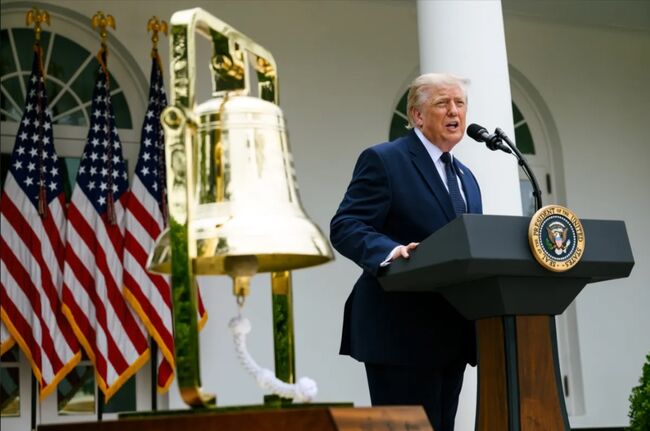 Trump pressures for rate cut again ahead of FOMC... "Should be the lowest in the world"
U.S. President Donald Trump. [Photo = The White House] U.S. President Donald Trump once again pressured the Federal Reserve, the U.S. central bank, to lower interest rates on the 27th (local time
Trump pressures for rate cut again ahead of FOMC... "Should be the lowest in the world"
U.S. President Donald Trump. [Photo = The White House] U.S. President Donald Trump once again pressured the Federal Reserve, the U.S. central bank, to lower interest rates on the 27th (local time
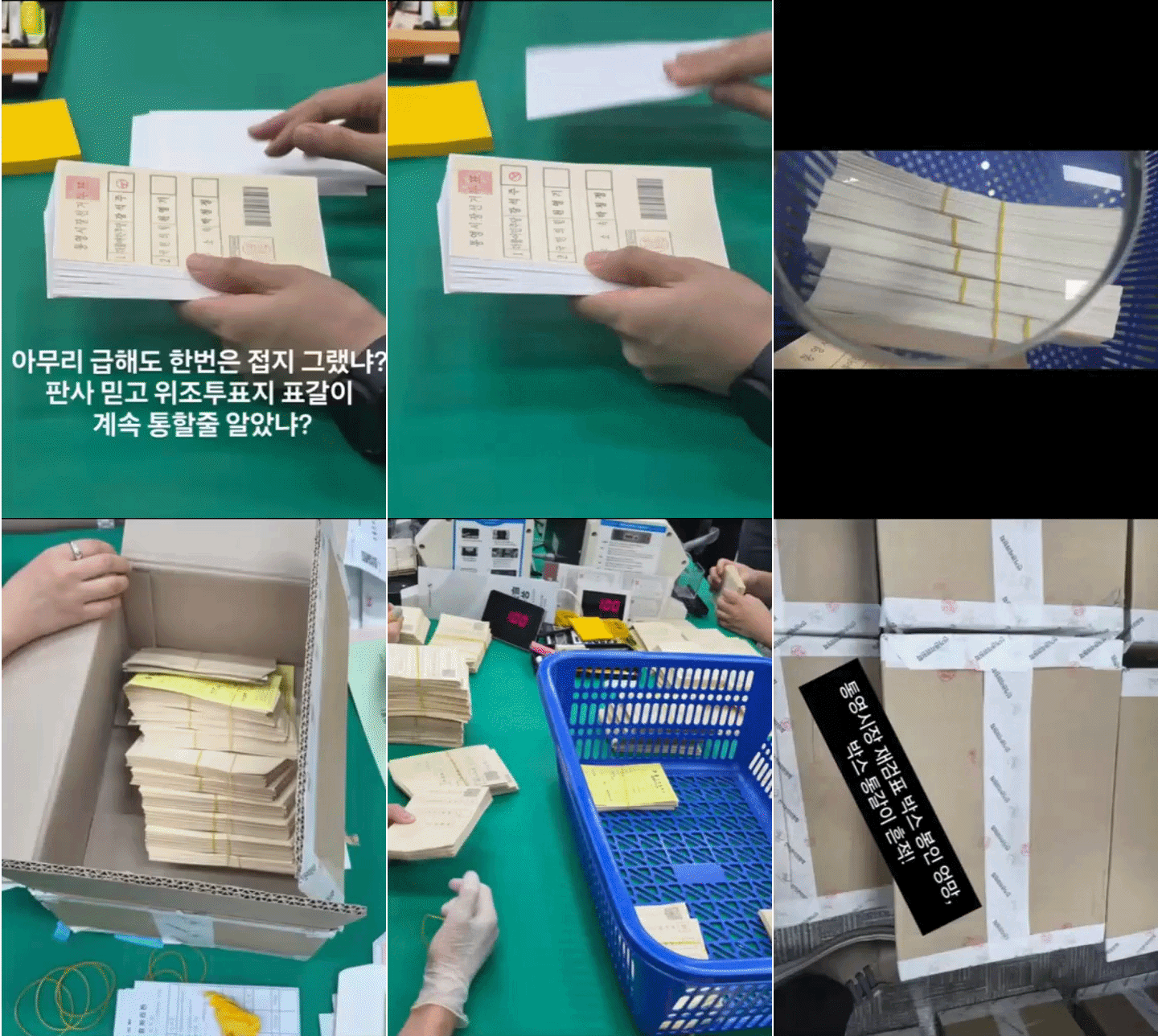 “Ignoring crisp ballots and damaged seals”… Tongyeong mayoral recount concludes with ‘no change in outcome,’ leaving suspicions and public outrage behind
Suspected counterfeit ballots discovered in Tongyeong [GIF from social media of Representative Hwang Kyo-ahn / Attorney Park Joo-hyun]During a recount of the Tongyeong mayoral election in South Gyeong
“Ignoring crisp ballots and damaged seals”… Tongyeong mayoral recount concludes with ‘no change in outcome,’ leaving suspicions and public outrage behind
Suspected counterfeit ballots discovered in Tongyeong [GIF from social media of Representative Hwang Kyo-ahn / Attorney Park Joo-hyun]During a recount of the Tongyeong mayoral election in South Gyeong
 President Yoon, regarding the first-instance ruling on the Public Official Election Act: “An excessive political verdict that distorts the facts… We will appeal immediately.”
The first-instance sentencing hearing for President Yoon Suk Yeol regarding violations of the Public Official Election Act is being broadcast live at Seoul Station on the 27th. [Photo=Yonhap News]Pres
President Yoon, regarding the first-instance ruling on the Public Official Election Act: “An excessive political verdict that distorts the facts… We will appeal immediately.”
The first-instance sentencing hearing for President Yoon Suk Yeol regarding violations of the Public Official Election Act is being broadcast live at Seoul Station on the 27th. [Photo=Yonhap News]Pres
 WSJ: "SK Hynix ADR Premium Is a Sign of AI Trading Overheat"
Advertisement for SK Hynix ADR listing in New York's Times Square [Reuters=Yonhap News file photo]The Wall Street Journal (WSJ) has pointed out that the price of SK Hynix’s American Depositary Recei
WSJ: "SK Hynix ADR Premium Is a Sign of AI Trading Overheat"
Advertisement for SK Hynix ADR listing in New York's Times Square [Reuters=Yonhap News file photo]The Wall Street Journal (WSJ) has pointed out that the price of SK Hynix’s American Depositary Recei
 'Godfather of Japanese Mystery Novels' Keigo Higashino Passes Away After Battle with Cancer at 68
Famous Japanese mystery novelist Keigo Higashino [AFP=Yonhap News]It has been belatedly reported that Keigo Higashino, the "godfather of Japanese mystery novels" and author of bestsellers such as "The
'Godfather of Japanese Mystery Novels' Keigo Higashino Passes Away After Battle with Cancer at 68
Famous Japanese mystery novelist Keigo Higashino [AFP=Yonhap News]It has been belatedly reported that Keigo Higashino, the "godfather of Japanese mystery novels" and author of bestsellers such as "The
 [Park Pil-kyu Security Column] To the Ignorant Trying to Clothe a Beast in Sheep's Clothing
Rep. Kim Byung-joo of the Democratic Party of Korea [Photo=Yonhap News]“The Air Force Academy doesn't teach you how to fly a plane!” “The Army, Navy, and Air Force academies are exactly the
[Park Pil-kyu Security Column] To the Ignorant Trying to Clothe a Beast in Sheep's Clothing
Rep. Kim Byung-joo of the Democratic Party of Korea [Photo=Yonhap News]“The Air Force Academy doesn't teach you how to fly a plane!” “The Army, Navy, and Air Force academies are exactly the
 [Issue Diagnosis] Two Effects of the Election Petition Review
 [Photo] Evidence of Election Fraud Flooding U.S. Media… Trump Had 2.7 Million Votes Stolen
 [Video] U.S. Semiquincentennial Air Show... 'Art in the Sky' streaks across New York
 [Editorial Cartoon] A Draconian Law That Undermines Freedom of Expression

 List
List