Gori Nuclear Power Plant in Gijang-gun, Busan Metropolitan City. [Photo=Korea Hydro & Nuclear Power]
 Oh Jeong-geun, President of the Free Market Research Institute and President of the Korea Financial ICT Convergence Society
The year 2026 will be the Year of the Bingwu (丙午). Bing (丙) symbolizes fire and the color red, while Wu (午) symbolizes the horse. With the strong convergence of yang energy, the Year of the Bingwu is highly anticipated to be a year full of passion and vitality, true to its name, the "Year of the Red Horse."
South Korea has been going through a dark tunnel over the past year. Politically, the foundations of liberal democracy have been undermined, pushing Korean liberal democracy to a precarious edge.
There are also numerous economic challenges. First, due to the expansionary fiscal policy, fiscal deficits are increasing, national debt is rising with increased government bond issuance. This is further exacerbated by the fact that a significant portion of the fiscal increase has been used for basic income and livelihood support rather than expanding growth engines.
The increasing national debt due to expanded fiscal spending on populist policies only adds to the burden for future generations. As the Bank of Korea purchases unsold government bonds by issuing currency, the money supply has surged, pushing the won-dollar exchange rate to a dangerous level.
Real estate policies have focused on regulation rather than supply, leading to soaring housing prices, jeonse, and monthly rents, exacerbating the suffering of the public. Potential growth rates continue to plummet.
Amidst this, Korea's industrial structure is facing a major transformation called Artificial Intelligence Transformation (AX). The success of this AI transformation will determine the trajectory of the Korean economy for decades to come.
Energy, Semiconductors, Data, and Education are Key to AI Transformation
Recently, President Lee Jae-myung met with Chairman Masayoshi Son and asked for advice regarding AI. On this occasion, Chairman Son emphasized the need to "focus on securing energy" for AI transformation. Chairman Son stressed that four resources are essential: △ Energy △ Semiconductors △ Data △ Education.
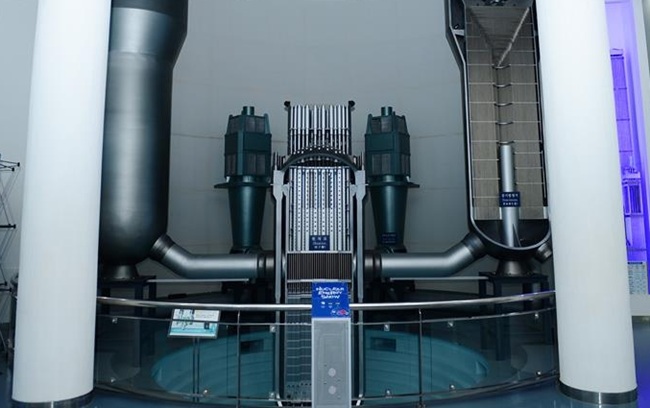 A model of a nuclear reactor displayed in the exhibition hall of the Korea Hydro & Nuclear Power Hanul Nuclear Power Headquarters in Uljin, Gyeongbuk Province. [Photo=Hanul Nuclear Power Headquarters]
Approximately 150 new data centers are expected to be built in Korea over the next five years. According to data from Rep. Kim Sung-won's office and Korea Electric Power Corporation (KEPCO) as of August, KEPCO has received applications from a total of 150 new data centers requesting to use electricity.
The amount of electricity required by these facilities (9.4 GW) is a staggering figure, approximately 3.6 times the total capacity (2.57 GW) of the 161 data centers currently operating nationwide.
This is an enormous amount that would require the simultaneous operation of six to seven large nuclear reactors to meet. By simple calculation, this means that power infrastructure close to four times the current capacity must be in place within five years.
An IT industry official stated, "The demand for data centers, which are essential infrastructure in the AI era, continues to grow. If the burden of electricity costs continues to increase as it is now, not only will operations be difficult, but investment in new construction itself could be blocked."
With the exponential surge in power demand due to the spread of AI, there are virtually no institutional measures in place to alleviate the burden of electricity costs. Concerns are growing that "it will be difficult to properly operate the exploding number of data centers in this situation." Naturally, the AI transformation is also likely to remain an empty slogan.
Unlike manufacturing and mining industries that pay industrial electricity rates, data centers are subject to general electricity rates applied to commercial buildings and other facilities. The problem is that general electricity rates are rising sharply, comparable to industrial rates, hindering the growth of the IT industry.
According to KEPCO, as of the end of last year, the general electricity rate was 172.99 won per kWh (kilowatt-hour), an increase of 35% from 128.47 won four years ago. This is a direct blow to companies that need to operate servers and cooling systems 24 hours a day.
Especially as power consumption continues to increase with the expansion of AI learning and cloud services, the increased electricity rates directly translate into higher operating costs.
An IT executive pointed out, "Data centers packed with AI learning servers and high-performance GPUs (Graphics Processing Units) consume incomparably more power than general factories. The risk of electricity costs has emerged as a new burden that erodes the future competitiveness of Korea's advanced industries."
Indeed, for Naver and Kakao, whose data center operations have increased, their electricity consumption surged by 117% and 44% respectively between 2021 and 2023. The problem is that while the government has designated "AI fostering" as a national task, it has done nothing about the core cost of electricity.
The industrial and academic sectors are vocal, stating, "The government should not just talk about promoting AI but should create a medium- to long-term plan for the electricity cost burden structure." While Korea hesitates, overseas competitors are engaging in a race to attract data centers by offering attractive "electricity rate incentives."
Medium- to Long-Term Plan Needed for Electricity Rate System
According to the credit rating agency S&P Global, the Indian government and state authorities are offering incentives such as electricity rate exemptions and subsidies for land and building use to attract AI data center investments.
Some regions, such as Maharashtra, are implementing measures to reduce electricity rates for data centers by about 40%. It is estimated that competitive efforts to attract investments, including electricity rate reductions, can become a key competitive advantage in the global AI market.
There are also proposals for Korea to introduce a "dedicated tariff system" that applies electricity rates flexibly to data centers or to lift regulations to allow direct power purchase, for example, through the introduction of SMRs (Small Modular Reactors).
Even universities, which are nurturing future talent, are directly hit by electricity costs. Seoul National University, which operates an AI graduate school, paid approximately 31.5 billion won solely for electricity costs last year.
While electricity consumption increased by 13% over four years, the electricity bills paid increased by 62%. This is due to the approximately 38% surge in educational electricity rates over the same period.
Although the rate increase is smaller than for industrial use, universities, for which tuition increases are difficult, are facing rapidly growing fixed costs due to electricity charges, forcing them to reduce research funding. Some university professors are even paying tens of millions of won annually for electricity costs from their personal research funds and reducing the number of research assistants.
Although the government has set "Leap to the Top 3 AI Powerhouse" as a national task, rapidly rising electricity costs are hindering the AI transformation at AI companies and R&D sites.
The electricity consumption of Korea's "Big 3" IT companies, including Naver, Kakao, and KT, for data center operations and other uses increased by approximately 75% from 447 GWh (gigawatt-hours) in 2020 to 783 GWh last year.
During the same period, electricity bills more than doubled, from 45.2 billion won to 115.5 billion won, a 156% increase. This is because the general electricity rates applied to data centers have increased by about 31% in the last four years, causing the bills to soar at a rate more than double that.
Data centers, the core infrastructure of the AI era, are known as "electricity-guzzlers" because they require massive amounts of electricity to operate servers and cooling systems 24/7.
If the current situation continues, where electricity demand will increase exponentially and there are no measures to reduce the electricity cost burden, the "AI transformation" is likely to remain an empty slogan.
An IT industry official said, "While global big tech companies are engaged in a battle for power procurement, in Korea, aggressive infrastructure expansion is faltering due to the burden of electricity costs."
No Time to Falter in Discussions of Nuclear Phase-Out
Amidst this, the remarks made by Minister Kim Seong-hwan of Trade, Industry and Energy raise questions as to whether he recognizes the serious problem of electricity costs for AI transformation.
On the 22nd, Minister Kim stated, "Nuclear power and renewable energy are not energy sources that cannot go together. How to design a combination of nuclear power and renewable energy, which are carbon-free power sources, will be the core task of the 12th Electricity Supply and Demand Plan (Electricity Plan) to be established at the end of next year."
Minister Kim, who had previously indicated a "nuclear phase-out" policy, has decided to reopen public discussion on the plan to "build two new large nuclear reactors," which was finalized in the 11th Electricity Plan at the beginning of this year.
While his mention of coexistence between nuclear power and renewable energy to reduce fossil fuels is seen as somewhat progressive, it is unclear whether his nuclear phase-out stance has changed.
Regarding Small Modular Reactors (SMRs), Minister Kim also said, "We will provide good support for R&D so that the roadmap of commencing construction of one SMR in 2030 and starting power generation in 2035 can proceed as planned."
He added, "Energy transition is not a regulation but a new growth engine. We will help companies overcome hurdles." In this way, Minister Kim defines green transition not as a regulation but as a new growth engine for Korean companies.
His argument is that Korea, as a manufacturing powerhouse, can take another leap forward with AI transformation (AX) and green transition (GX) as its twin pillars.
Japan Reactivates World's Largest Nuclear Power Plant 14 Years After Fukushima Accident
In contrast, Japan, which is calling for a revival of its semiconductor industry, has declared that it will provide half of the investment costs if 100% nuclear power is used and has decided to reactivate Japan's largest nuclear power plant after 15 years, marking a major turning point in Japan's energy policy.
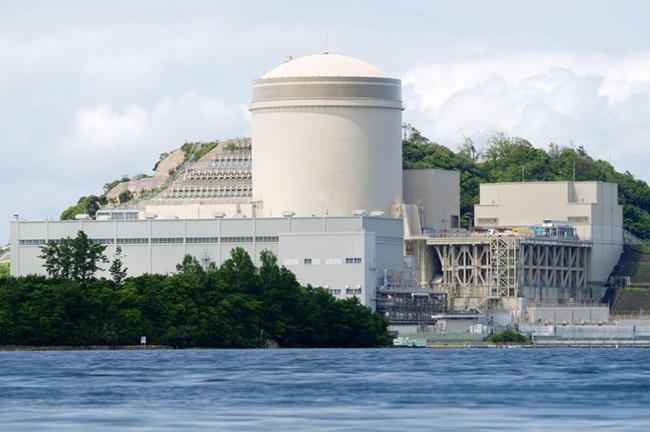 Mihama Nuclear Power Plant Unit 3 in Japan. [Photo=Yonhap News]
This marks the reactivation of Japan's world's largest nuclear power plant, 14 years after the Fukushima accident. Furthermore, the plan is to invest 210 billion yen over the next five years to focus support on fields such as chips, robots, and biotechnology, and to promote the improvement of power transmission grids and the relaxation of water usage regulations.
This reactivation of the Kashiwazaki Kariwa Nuclear Power Plant, which had been suspended since the Great East Japan Earthquake in 2011, is considered a "critical turning point" in Japanese energy policy.
Behind this decision lies the persistent persuasion of the Japanese government, which is desperately trying to foster the AI industry and revive its semiconductor sector. Until just before the reactivation decision, the support rate for nuclear power reactivation among residents of Niigata Prefecture was neck and neck at 50.6% in favor and 47.1% against.
As a result, the Japanese government secured the residents' consent by promising to fully cover the cost of evacuation route improvements, estimated to be over 100 billion yen (approximately 941 billion won).
Consequently, Unit 6 of the Kashiwazaki Kariwa Nuclear Power Plant's seven units will be reactivated on January 20 next year. Tokyo Electric Power Company plans to proceed with the reactivation procedures for other reactors, including Unit 7, sequentially.
Nomura Research Institute analyzed that the reactivation of Units 6 and 7 of the Kashiwazaki Kariwa Nuclear Power Plant is expected to create an economic effect of 439.6 billion yen (approximately 4.14 trillion won) in Niigata Prefecture.
In addition, the Japanese government has presented a concrete plan to provide half of the facility investment costs to companies that draw 100% of their electricity from nuclear power to secure demand for the electricity generated by the reactivated nuclear power plants.
At the Green Transformation (GX) Executive Meeting held on the 22nd, the Japanese Ministry of Economy, Trade and Industry proposed a plan to subsidize up to half of the investment costs for factories and data centers that use 100% decarbonized electricity.
To this end, a total of 210 billion yen (1.98 trillion won) will be invested over the next five years. Support will be particularly focused on companies with high industrial competitiveness, such as semiconductors, industrial robots, and pharmaceuticals.
Nikkei also reported that efforts are underway to expedite the maintenance of power transmission grids required for data centers and to relax regulations to facilitate the use of industrial water.
The cabinet led by Prime Minister Sanae Takaichi, who took office in October of this year, designated six fields last month as national strategic technologies: AI and advanced robots, quantum, semiconductors and communications, bio and healthcare, and nuclear fusion and space, and announced its intention to promote investment in these areas.
The commonality among these industries is that they all require massive power supply. The Japanese government has long been taking various measures to reactivate nuclear power plants.
Following the Fukushima nuclear accident, Japan returned to being a "nuclear power nation" by reactivating Unit 1 of the Kyushu Sendai Nuclear Power Plant in 2015. With the reactivation of the Kashiwazaki Kariwa Nuclear Power Plant next month, the number of reactivated nuclear power plants in Japan will increase to 15.
Prime Minister Kishida has also emphasized since taking office, "While renewable energy is necessary, nuclear power is the key to supporting stable supply. The development of next-generation nuclear technologies such as small modular reactors (SMRs) and fusion reactors, as well as domestic nuclear technology, is the core of our energy strategy, with the goal of achieving 100% energy self-sufficiency."
Thus, Japan has moved away from "nuclear phase-out" and entered an era of "pro-nuclear power." This is an aggressive choice to secure stable power, which is the core foundation of the AI era.
The Japanese government has declared that "nuclear power is a carbon-free energy source" and aims to increase the proportion of nuclear power generation from the current 8.5% to double that, 20%, by 2040.
US Plans to Increase Nuclear Power Generation Threefold by 2050
In the United States, former President Trump has labeled climate change a "rip-off" and is pursuing anti-climate policies. Indeed, he announced his intention to withdraw from the Paris Agreement after taking office and officially withdrew in 2020.
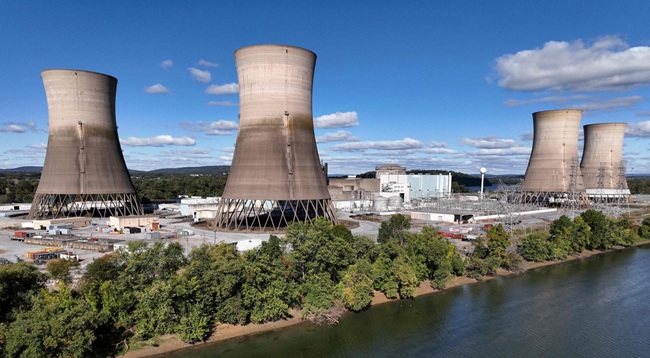 Three Mile Island Nuclear Power Plant in Pennsylvania, USA. [Reuters=Yonhap News]
Although the Biden administration rejoined the Paris Agreement in 2021, a second Trump administration in January 2025 would notify its withdrawal, and the United States would officially withdraw again in January 2026, one year after the notification.
The climate goals set by the Biden administration for December 2024 (reducing greenhouse gas emissions by 61-66% by 2035 compared to 2005 levels) will be automatically nullified. The US government has removed all "climate change" related content from its website and abolished the position of National Climate Advisor, which was established by the Biden administration.
With the small modular reactor (SMR) market growing rapidly, it is estimated that nearly 120 large nuclear reactors will need to be built over the next 30 years to revive the US nuclear power industry. This includes replacing 90 aging reactors with an average age of 43 and an additional 30 needed to meet AI power demand.
Currently, the United States operates 93 reactors at 54 nuclear power plants across 28 states. The problem is that the average age of these reactors is 43 years.
While the Nuclear Regulatory Commission (NRC) has extended the operating period of some reactors from their initial design life of 40 years to 60 or 80 years, many reactors are expected to cease operation within the next 30 years due to a lack of competitiveness or costly repairs.
As the US nuclear power market reopens, opportunities for the Korean nuclear power industry are expanding. Last month, Hyundai Engineering and Construction signed a basic design service contract with Fermi America, a US energy company, for the construction of four AP1000 large nuclear reactors at the "Integrated Energy and AI Campus" outside Amarillo, Texas.
This is the first time a domestic company has signed a basic design contract for large nuclear reactors on the US mainland. Doosan Enerbility has secured a unique global presence as the only company to supply six reactors and twelve steam generators simultaneously for the US government's $80 billion (approximately 118 trillion won) AP1000 nuclear power project.
In October, it also secured a contract for the fabrication of primary component materials for four AP1000 nuclear reactors to be built at an AI campus site in Texas. The industry predicts that the role of Korean companies will expand as the global nuclear power industry transitions to a hybrid power portfolio combining existing large nuclear reactors and SMRs.
The United States plans to triple its nuclear power generation by 2050.
Korea's Ambiguous Energy Policy Slows AI Transformation
In contrast, Korea has yet to escape the shadow of "nuclear phase-out." The decision to build two new nuclear reactors, finalized in February of this year, is still subject to further judgment after public forums and opinion polls, which is frustrating.
With the explosive growth of the AI industry leading to a surge in electricity demand, it is an anachronistic approach to decide on the construction of nuclear power plants, the main baseload power source, through public forums and opinion polls.
The world is currently engaged in an energy procurement war. Strengthening AI industry competitiveness, which is crucial for our economy's future, and securing stable energy through nuclear power are no longer options but necessities. From now on, the decision-making process for nuclear power plant reactivation and new construction must be based solely on scientific evidence, excluding political logic.
While we are struggling in the quagmire of public deliberation on new nuclear power plant construction, the United States and Japan are unfettered in their pursuit of becoming AI powerhouses by pouring out generous nuclear support policies.
We must remember that if Korea's AI transformation is delayed due to its ambiguous energy policy, Korea could fall decades behind economically, let alone become a "Top 3 AI Powerhouse."
President of the Free Market Research Institute and President of the Korea Financial ICT Convergence Society

 Trump pressures for rate cut again ahead of FOMC... "Should be the lowest in the world"
U.S. President Donald Trump. [Photo = The White House] U.S. President Donald Trump once again pressured the Federal Reserve, the U.S. central bank, to lower interest rates on the 27th (local time
Trump pressures for rate cut again ahead of FOMC... "Should be the lowest in the world"
U.S. President Donald Trump. [Photo = The White House] U.S. President Donald Trump once again pressured the Federal Reserve, the U.S. central bank, to lower interest rates on the 27th (local time
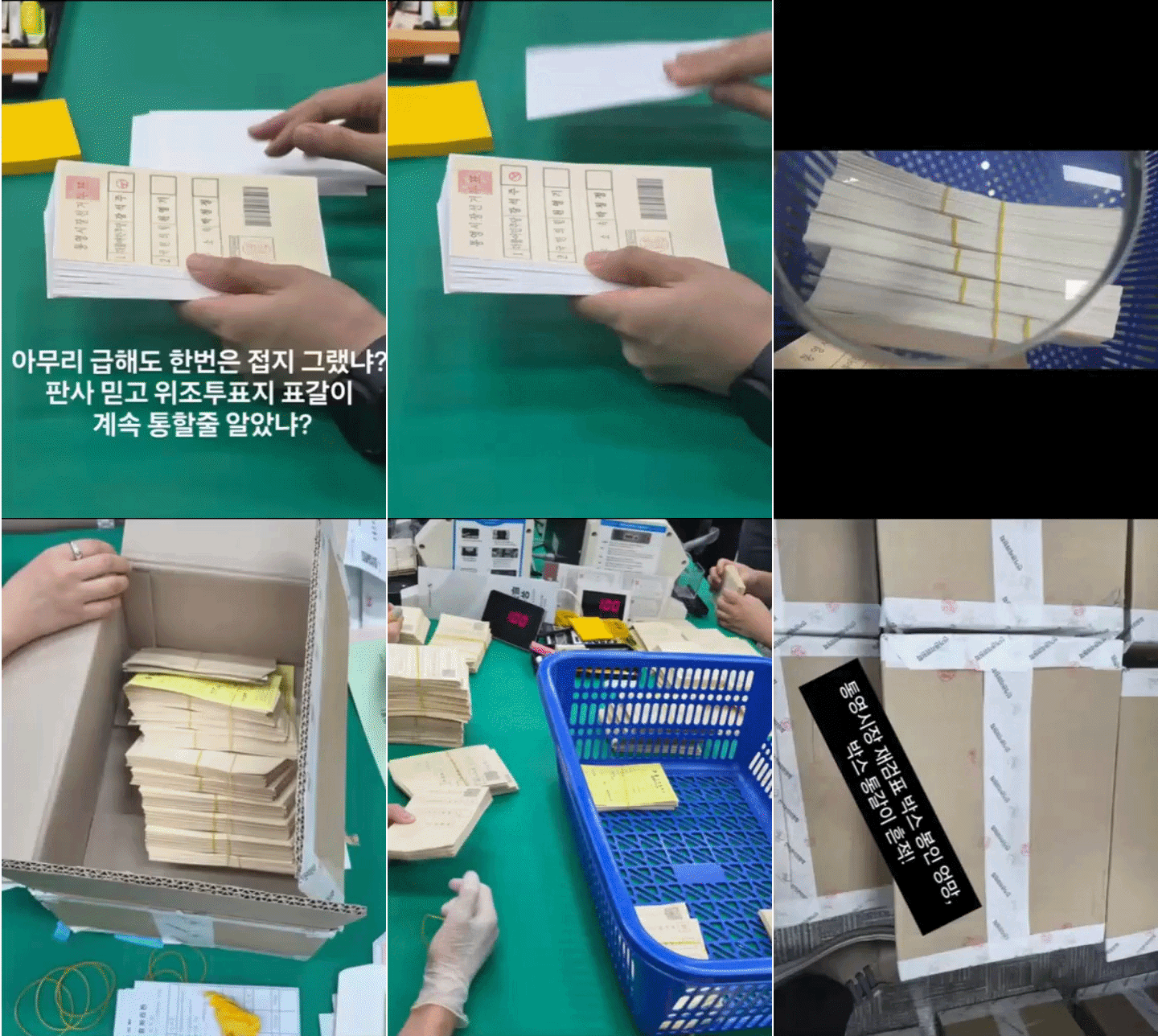 “Ignoring crisp ballots and damaged seals”… Tongyeong mayoral recount concludes with ‘no change in outcome,’ leaving suspicions and public outrage behind
Suspected counterfeit ballots discovered in Tongyeong [GIF from social media of Representative Hwang Kyo-ahn / Attorney Park Joo-hyun]During a recount of the Tongyeong mayoral election in South Gyeong
“Ignoring crisp ballots and damaged seals”… Tongyeong mayoral recount concludes with ‘no change in outcome,’ leaving suspicions and public outrage behind
Suspected counterfeit ballots discovered in Tongyeong [GIF from social media of Representative Hwang Kyo-ahn / Attorney Park Joo-hyun]During a recount of the Tongyeong mayoral election in South Gyeong
 President Yoon, regarding the first-instance ruling on the Public Official Election Act: “An excessive political verdict that distorts the facts… We will appeal immediately.”
The first-instance sentencing hearing for President Yoon Suk Yeol regarding violations of the Public Official Election Act is being broadcast live at Seoul Station on the 27th. [Photo=Yonhap News]Pres
President Yoon, regarding the first-instance ruling on the Public Official Election Act: “An excessive political verdict that distorts the facts… We will appeal immediately.”
The first-instance sentencing hearing for President Yoon Suk Yeol regarding violations of the Public Official Election Act is being broadcast live at Seoul Station on the 27th. [Photo=Yonhap News]Pres
 WSJ: "SK Hynix ADR Premium Is a Sign of AI Trading Overheat"
Advertisement for SK Hynix ADR listing in New York's Times Square [Reuters=Yonhap News file photo]The Wall Street Journal (WSJ) has pointed out that the price of SK Hynix’s American Depositary Recei
WSJ: "SK Hynix ADR Premium Is a Sign of AI Trading Overheat"
Advertisement for SK Hynix ADR listing in New York's Times Square [Reuters=Yonhap News file photo]The Wall Street Journal (WSJ) has pointed out that the price of SK Hynix’s American Depositary Recei
 'Godfather of Japanese Mystery Novels' Keigo Higashino Passes Away After Battle with Cancer at 68
Famous Japanese mystery novelist Keigo Higashino [AFP=Yonhap News]It has been belatedly reported that Keigo Higashino, the "godfather of Japanese mystery novels" and author of bestsellers such as "The
'Godfather of Japanese Mystery Novels' Keigo Higashino Passes Away After Battle with Cancer at 68
Famous Japanese mystery novelist Keigo Higashino [AFP=Yonhap News]It has been belatedly reported that Keigo Higashino, the "godfather of Japanese mystery novels" and author of bestsellers such as "The
 [Park Pil-kyu Security Column] To the Ignorant Trying to Clothe a Beast in Sheep's Clothing
Rep. Kim Byung-joo of the Democratic Party of Korea [Photo=Yonhap News]“The Air Force Academy doesn't teach you how to fly a plane!” “The Army, Navy, and Air Force academies are exactly the
[Park Pil-kyu Security Column] To the Ignorant Trying to Clothe a Beast in Sheep's Clothing
Rep. Kim Byung-joo of the Democratic Party of Korea [Photo=Yonhap News]“The Air Force Academy doesn't teach you how to fly a plane!” “The Army, Navy, and Air Force academies are exactly the
 [Issue Diagnosis] Two Effects of the Election Petition Review
 [Photo] Evidence of Election Fraud Flooding U.S. Media… Trump Had 2.7 Million Votes Stolen
 [Video] U.S. Semiquincentennial Air Show... 'Art in the Sky' streaks across New York
 [Editorial Cartoon] A Draconian Law That Undermines Freedom of Expression

 List
List