‘1984’와 ‘동물농장’의 작가 조지 오웰(George Orwell)은 “국민을 망치는 가장 효율적인 방법은 그들 역사의 의미를 부정하고 말살하는 것”이라는 명언을 남겼다. 역사와 지성, 그리고 독서를 잊은 민족에게는 자유도 미래도 없다는 것이 역사가 증명하는 냉엄한 진리이다.
 General Walton Harris Walker (left) and his biography titled "the man who saved Korea." [Photo=Public Domain]
 Ha Bong-gyu, Professor Emeritus at Pukyong National University, Director of the UN Research InstituteThe 23rd marked the anniversary of the death of General Walton Harris Walker (1889-1950). He is the hero who saved the Republic of Korea from a dire crisis in the early stages of the Korean War as the commander of the U.S. Eighth Army.
There are two books that chronicle the life of General Walker. One of them has the subtitle, "the man who saved Korea."
General Patton Personally Awarded Walker's Stars
The author, who has long lectured on military history and leadership, has focused on the "Naktong River Line (also known as Walker Line)." This is because it was the only decisive victory the U.S. military achieved in its confrontation with Asian communism, following its victories in World War I and World War II. The U.S. military attempted to apply the Walker Line in the Vietnam War but ultimately failed.
General George S. Patton, a renowned warrior of World War II, personally awarded his three-star general insignia to General Walker, famously known by his nickname "Bulldog."
In April 1945, as World War II neared its end, General Patton personally removed his own insignia and placed it on Walker's shoulder, commending his valor, when Walker, a Major General who had achieved swift victories under Patton's command, earning him the moniker "Ghost Division," was promoted to Lieutenant General.
Tragically, both men died after being struck by friendly trucks shortly before Christmas. General Patton passed away first on December 21, 1945, and General Walker followed him on December 23, 1950.
During the Korean War, General Walker, who entered the conflict as the Commander of Ground Forces (Eighth Army) under an urgent order from General Douglas MacArthur, was met with the unexpected strength of the North Korean army.
Outmatched in firepower, including tanks, and in terms of troop numbers, the U.S. and ROK forces suffered repeated defeats, leading to a dire situation where 80% of the nation's territory was ravaged in just one month. The MacArthur Command, which had boasted, "North Korean forces will flee in surprise when they see the U.S. military," ultimately decided on a full retreat.
Do Not Retreat! Defend to the Death!
However, the usually reticent General Walker, in front of the frightened ROK and U.S. soldiers, roared, "I will stay here to protect Korea until my death," and issued the final order, "Stand or die."
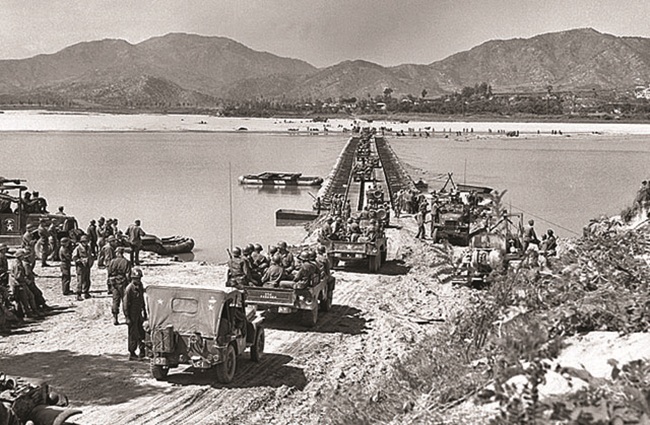 U.S. 24th Division troops crossing the Naktong River via a pontoon bridge during the Naktong River battle, considered the greatest crisis of the Korean War. [Photo=Public Domain]
The Naktong River Line, stretching 90km east to west and 150km north to south, was a massive defensive line combining terrain, urban areas, and strategy. It was a historic turning point, comparable to the 20th-century siege of Alesia by Caesar, where the commander's exceptional strategy and determination to fight to the death converged for a decisive victory.
During the Battle of Alesia, Caesar, with an army of only 50,000, built a double line of fortifications to achieve an immortal feat by decisively defeating the full-scale offensive of the 340,000 Gallic forces (80,000 within the city, 260,000 outside) led by Vercingetorix.
The Naktong River front was a stage of strategic innovation, combining trench warfare by the army with the three-dimensional maneuver warfare of the air force and marines. The courage, leadership, and exceptional strategy displayed by General Walker in this battle saved the Republic of Korea from peril and laid the crucial foundation for the Incheon Landing Operation.
Later, General Walker voiced his opposition to General MacArthur's strategy of a swift advance in relation to the northward push. He advocated for caution, considering the seasonal factor of severe cold and the variables of neighboring countries, but ultimately had to comply with the overall commander's intentions.
As he continued his northward advance, Chinese forces intervened as he had predicted, devastating the ROK forces and causing considerable difficulty in restoring their strength.
Walker's Death Leads to the January 4th Retreat in Korea
General Walker's sudden death while leading the defense of the Seoul metropolitan area against the Chinese offensive delivered a tremendous shock and confusion to the UN forces, which ultimately became one of the causes of the January 4th Retreat.
General Walker, who participated in the Korean War alongside his only son, Sam Walker, formed a special bond with Korea over three generations, as his grandson was later deployed to Korea.
George Orwell, the author of "1984" and "Animal Farm," left the profound statement, "The most effective way to destroy a people is to deny and obliterateiterate the meaning of their history."
The grim truth, as history has proven, is that a nation that forgets its history, intellect, and reading has neither freedom nor future.
Professor Emeritus at Pukyong National University, Director of the UN Research Institute

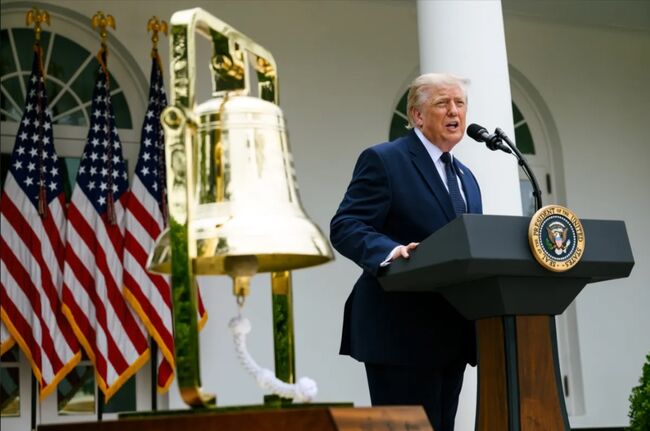 Trump pressures for rate cut again ahead of FOMC... "Should be the lowest in the world"
U.S. President Donald Trump. [Photo = The White House] U.S. President Donald Trump once again pressured the Federal Reserve, the U.S. central bank, to lower interest rates on the 27th (local time
Trump pressures for rate cut again ahead of FOMC... "Should be the lowest in the world"
U.S. President Donald Trump. [Photo = The White House] U.S. President Donald Trump once again pressured the Federal Reserve, the U.S. central bank, to lower interest rates on the 27th (local time
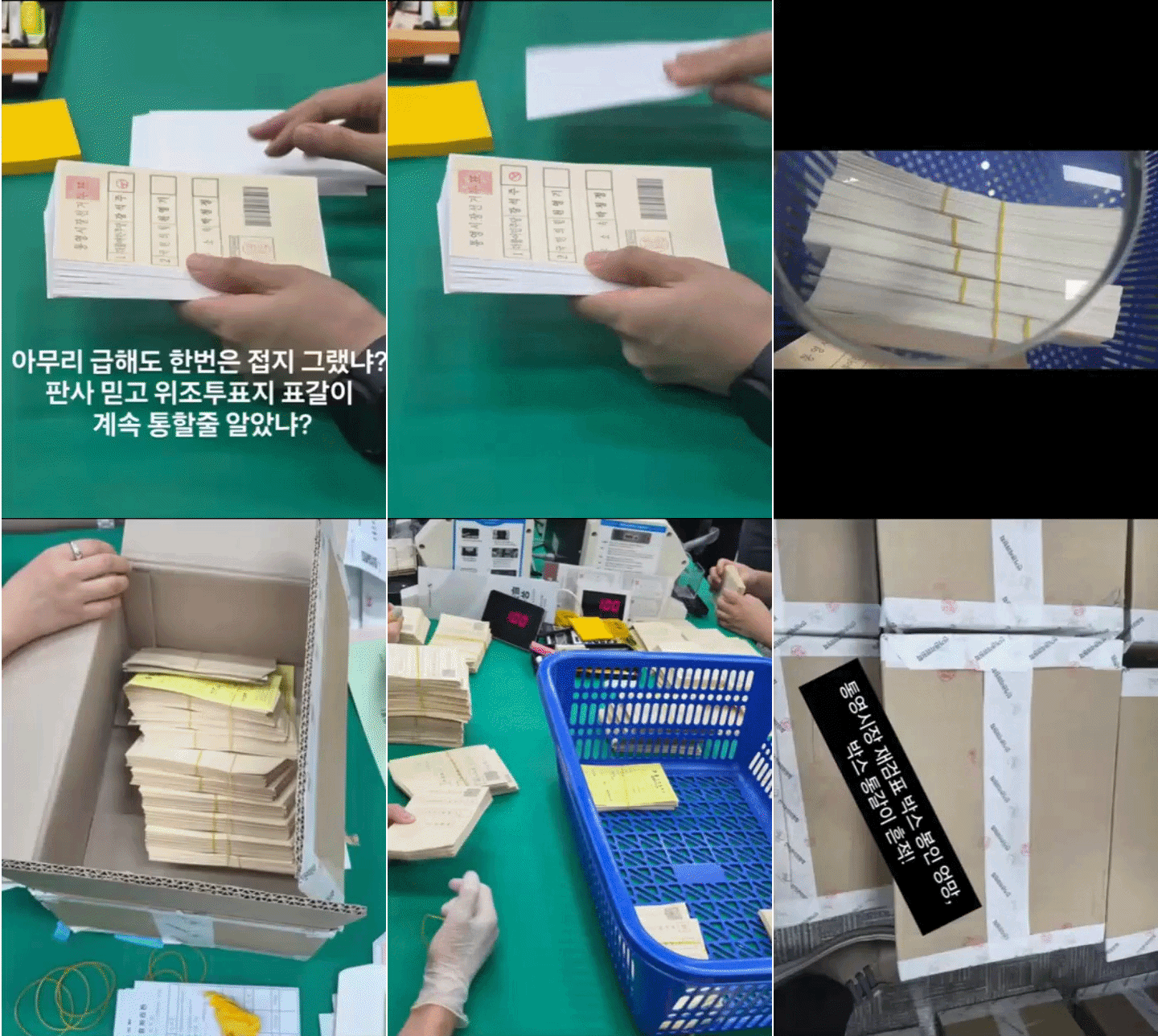 “Ignoring crisp ballots and damaged seals”… Tongyeong mayoral recount concludes with ‘no change in outcome,’ leaving suspicions and public outrage behind
Suspected counterfeit ballots discovered in Tongyeong [GIF from social media of Representative Hwang Kyo-ahn / Attorney Park Joo-hyun]During a recount of the Tongyeong mayoral election in South Gyeong
“Ignoring crisp ballots and damaged seals”… Tongyeong mayoral recount concludes with ‘no change in outcome,’ leaving suspicions and public outrage behind
Suspected counterfeit ballots discovered in Tongyeong [GIF from social media of Representative Hwang Kyo-ahn / Attorney Park Joo-hyun]During a recount of the Tongyeong mayoral election in South Gyeong
 President Yoon, regarding the first-instance ruling on the Public Official Election Act: “An excessive political verdict that distorts the facts… We will appeal immediately.”
The first-instance sentencing hearing for President Yoon Suk Yeol regarding violations of the Public Official Election Act is being broadcast live at Seoul Station on the 27th. [Photo=Yonhap News]Pres
President Yoon, regarding the first-instance ruling on the Public Official Election Act: “An excessive political verdict that distorts the facts… We will appeal immediately.”
The first-instance sentencing hearing for President Yoon Suk Yeol regarding violations of the Public Official Election Act is being broadcast live at Seoul Station on the 27th. [Photo=Yonhap News]Pres
 WSJ: "SK Hynix ADR Premium Is a Sign of AI Trading Overheat"
Advertisement for SK Hynix ADR listing in New York's Times Square [Reuters=Yonhap News file photo]The Wall Street Journal (WSJ) has pointed out that the price of SK Hynix’s American Depositary Recei
WSJ: "SK Hynix ADR Premium Is a Sign of AI Trading Overheat"
Advertisement for SK Hynix ADR listing in New York's Times Square [Reuters=Yonhap News file photo]The Wall Street Journal (WSJ) has pointed out that the price of SK Hynix’s American Depositary Recei
 'Godfather of Japanese Mystery Novels' Keigo Higashino Passes Away After Battle with Cancer at 68
Famous Japanese mystery novelist Keigo Higashino [AFP=Yonhap News]It has been belatedly reported that Keigo Higashino, the "godfather of Japanese mystery novels" and author of bestsellers such as "The
'Godfather of Japanese Mystery Novels' Keigo Higashino Passes Away After Battle with Cancer at 68
Famous Japanese mystery novelist Keigo Higashino [AFP=Yonhap News]It has been belatedly reported that Keigo Higashino, the "godfather of Japanese mystery novels" and author of bestsellers such as "The
 [Park Pil-kyu Security Column] To the Ignorant Trying to Clothe a Beast in Sheep's Clothing
Rep. Kim Byung-joo of the Democratic Party of Korea [Photo=Yonhap News]“The Air Force Academy doesn't teach you how to fly a plane!” “The Army, Navy, and Air Force academies are exactly the
[Park Pil-kyu Security Column] To the Ignorant Trying to Clothe a Beast in Sheep's Clothing
Rep. Kim Byung-joo of the Democratic Party of Korea [Photo=Yonhap News]“The Air Force Academy doesn't teach you how to fly a plane!” “The Army, Navy, and Air Force academies are exactly the
 [Issue Diagnosis] Two Effects of the Election Petition Review
 [Photo] Evidence of Election Fraud Flooding U.S. Media… Trump Had 2.7 Million Votes Stolen
 [Video] U.S. Semiquincentennial Air Show... 'Art in the Sky' streaks across New York
 [Editorial Cartoon] A Draconian Law That Undermines Freedom of Expression

 List
List









