Venezuelan residents celebrating Maduro's arrest by waving national flags in Bolivar Square on the 3rd (local time) [Caracas AFP=Yonhap News]
The history of Venezuela's leftist rule, which once garnered international attention beyond Latin America, is on the verge of ending with a single overnight strike by the Donald Trump administration.
In Venezuela, which has experienced a tumultuous history of ups and downs over the past 27 years, a journey from heaven to hell, President Nicolás Maduro (63) has been forced to step down from power in the worst possible way, after extending his reign amidst controversy over fraudulent elections and severe economic hardship.
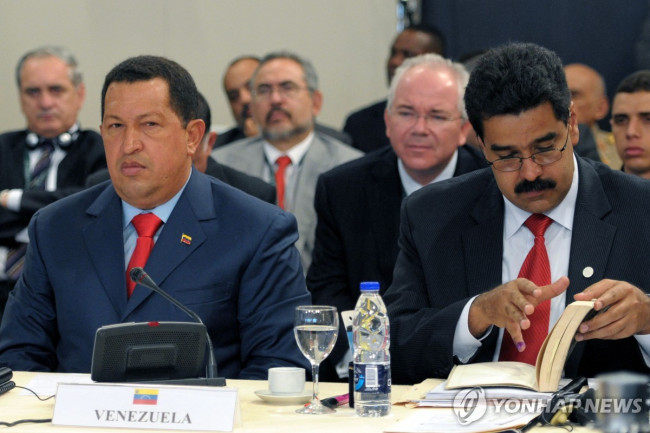 Venezuelan President Hugo Chávez (left) and Foreign Minister Maduro in 2010 [AFP Yonhap News]
◇ Chávez's Rule: Advocating 'Socialism of the 21st Century'
The history of Venezuela's leftist rule is summarized by the term 'Chavismo.' This term, generally encompassing nationalist socialist populist ideology, originated from the name of former President Hugo Chávez (1954-2013), a prominent figure in Venezuelan politics.
After attempting a failed military coup in 1992 and serving time in prison, Chávez was elected president in the December 1998 election and inaugurated in February of the following year.
Immediately, in December 1999, he spearheaded the drafting of a new constitution through a constituent assembly, which extended presidential terms from five to six years and strengthened executive powers. He won a landslide victory in the presidential election held in 2000. In April 2002, he was briefly ousted in a coup but returned to power two days later with the support of loyal military factions.
Having laid the foundation for a long-term rule through a referendum, Chávez won consecutive presidential elections in 2006 and 2012. During this period, he sowed the seeds of 'Socialism of the 21st Century,' characterized by a rejection of free trade, poverty alleviation, expansion of direct democracy, and strengthening of nationalist sentiment.
The Chávez government, under the banner of 'anti-Americanism' and Socialism of the 21st Century, implemented free welfare programs for the underprivileged and nationalized key infrastructure such as the oil industry, which had been dominated by foreign capital, as well as electricity and telecommunications.
In particular, from around 2004 to 2008, as international oil prices surged to over $100 per barrel at one point, Venezuela's economy experienced a boom.
According to a 2009 economic report on Venezuela by the Korea Trade-Investment Promotion Agency (KOTRA), the GDP growth rate reached 10.3% in 2006.
During this period, the Chávez government reinvested some of the 'surplus money' into industry while allocating a substantial portion to social welfare distribution, which led to a decrease in the poverty rate from 62.1% (2003) to 31.9% (2011).
Neighboring countries in Central and South America and the international community, recalling Venezuela's past glory as a 'top 10 global economy' in the mid-to-late 20th century, began to re-evaluate it.
However, with the collapse of international oil prices, Venezuela's economy also plummeted. Venezuela, with its weak fundamentals, wasted time without finding a way to stop the leakage of fiscal expenditure. To make matters worse, President Chávez died of cancer in 2013, further destabilizing the political situation.
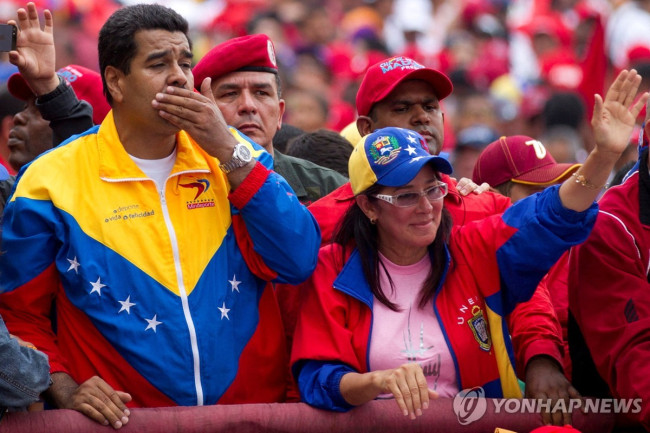 President Maduro (left) and First Lady Cilia Flores blowing kisses to supporters in 2013 [Reuters Yonhap News]
◇ Successor Maduro Inherits Chávez's Policies... Inflation Soars to 60,000%
Maduro, who was vice president just before Chávez's death, succeeded 'Chavismo' by winning the April 2013 election by a narrow margin of only 1.59 percentage points against the unified opposition candidate.
Maduro, a former bus driver, served as Speaker of the National Assembly and Minister of Foreign Affairs during Chávez's 14-year tenure. In December 2012, before leaving for Cuba for cancer treatment, Chávez officially designated Maduro as his successor.
He fully leveraged Chávez's political influence and continued policies of strict price controls on essential goods and increased state control over industries, a move that is seen as exacerbating the economic crisis on top of the impact of low oil prices.
Inflation soared uncontrollably, reaching an annual rate of 60,000% (600-fold), and the national economy deteriorated with shortages of food, essential goods, and medicines, as well as a lack of public security.
This was compounded by strong economic and financial sanctions from the U.S. government, plunging Venezuela into a deep quagmire.
Anti-government protests also continued in 2014, leading to a bloody crackdown with over 40 deaths and more than 800 injuries in clashes between police and protesters, raising international concern.
Around 2015, media reports frequently showed Venezuelan residents rummaging through garbage cans and graves for food and daily necessities, or abandoning their homes and migrating to neighboring countries, indicating the economy had hit rock bottom.
The capital city, Caracas, recorded the world's highest murder rate per 100,000 population (119 cases) outside of conflict zones.
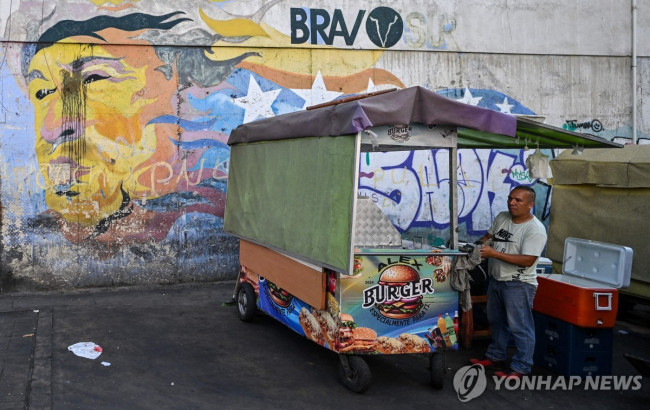 A vendor selling hamburgers in front of a Chávez mural on December 29 last year (local time) [Caracas AFP=Yonhap News]
◇ Poverty, Repression, and Emigration... The Tragedy Born of Unchanging Populism
Public discontent with the leftist government, which aimed to reduce socio-economic inequality through income redistribution, began to be clearly felt.
This was evident in the general election held in December 2015, two years after President Maduro took office, where the opposition secured an overwhelming majority of seats.
Analysis suggested that the working class, which had supported Chavismo out of extreme hardship, had turned away from the ruling party. Subsequently, the political scene experienced extreme turmoil, including attempts to impeach the president and dissolve parliament.
In 2017, large-scale anti-government and pro-government demonstrations swept Venezuela, resulting in over 120 deaths.
The U.S. government imposed successive economic sanctions, citing the need to check the Maduro regime's dictatorship, while Maduro countered by framing it as a conspiracy between domestic right-wing conservatives and the United States, who were after oil interests.
Maduro subsequently won re-election in the presidential election held in 2018 without the participation of the opposition.
In response, the opposition-controlled National Assembly, in January 2019, appointed Juan Guaidó (42) as 'interim president.' The international community, including the United States, supported this, creating a 'one house, two presidents' system.
However, after failing in an attempted military uprising in April 2019, the opposition began to lose cohesion. In the 2020 general election, with the number of seats increased to 277, the ruling party (253 seats) achieved a decisive victory, allowing Maduro to regain strength. Guaidó subsequently resigned in disgrace in December 2022.
In 2020, the number of Venezuelans leaving the country also increased. According to the UNHCR and IOM, the number of Venezuelan refugees and migrants worldwide reached 3.4 million at that time.
This number has since grown to approximately 8 million.
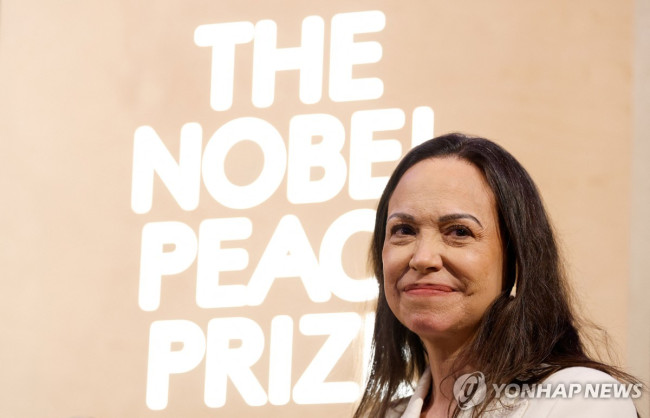 María Corina Machado holding a press conference for the Nobel Peace Prize on December 11 last year (local time) [AFP Yonhap News]
However, President Maduro, without any significant change in his policy direction, relied on aid diplomacy through solidarity with leftist governments in neighboring countries. He also strengthened his populist tendencies by bringing to the forefront a long-standing territorial claim over the disputed region of Guyana, another resource-rich neighbor.
Ahead of the 2024 presidential election, Venezuela's Comptroller General's Office and Supreme Court banned opposition leader María Corina Machado (58) from running for office for 15 years, drawing backlash from opponents. Machado, known as the 'Iron Lady of Venezuela' for leading anti-government protests, received the Nobel Peace Prize last year.
Despite controversy over fraudulent elections, President Maduro, who began his third six-year term in January last year, remained in the crosshairs of U.S. President Trump. He faced economic sanctions and military pressure, and was eventually arrested and brought to U.S. court as a suspect in drug trafficking.
However, the prospect of a transition from 'Chavismo' to a more democratic form of government remains uncertain. Although the United States has stated it will govern Venezuela until a stable transfer of power to a new government occurs, instability may continue for some time depending on the backlash from pro-Maduro forces and the level of cohesion among the opposition.
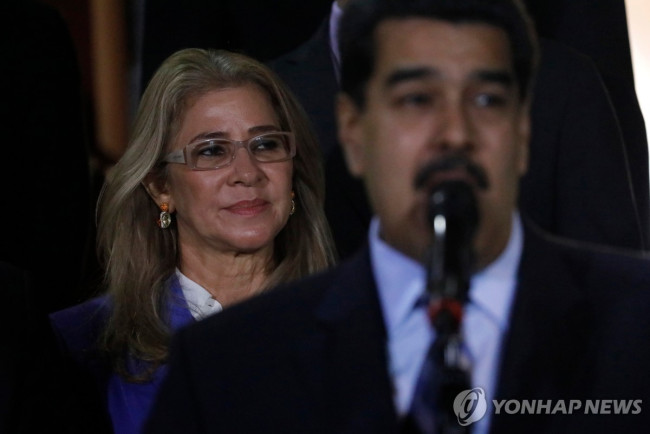 First Lady Cilia Flores standing behind Maduro in 2019 [AP Yonhap News]
◇ First Lady, Arrested Together, Was the 'Hidden Power of Venezuela'
The Trump administration arrested Venezuelan First Lady Cilia Flores (69) along with President Maduro and brought her to the United States.
Flores, a former lawyer, was a 'hidden power' who served as Speaker of the National Assembly (2006-2011) and Attorney General (2012-2013) during the Chávez era.
Flores, who was a law student, married her police officer boyfriend in college and had three sons. After graduating, she worked as a lawyer at a law firm.
Initially uninterested in politics, she became interested in the 'revolution' following the gasoline price hike protests in 1989 and was captivated by former President Chávez, coming to work under him.
She met President Maduro, then a Caracas union leader who also assisted Chávez, around the same time.
Coincidentally, both had divorced their respective spouses and became a couple, and they officially married after Maduro took office in 2013.
She is known to have been involved in the removal of Maduro's political rivals and to have secured high positions for her family members and relatives. Manuel Cristopher Figuera, who headed Venezuela's intelligence agency, stated in a Reuters interview in 2020 that "Flores always operated behind the scenes, pulling the strings."
Flores has been implicated in numerous allegations, including money laundering, nepotism in hiring, attempted control of the judiciary, and drug trafficking charges against her nephews, but she has reportedly not faced any significant internal repercussions.
Flores is on sanctions lists in countries including the United States, Canada, and Panama.

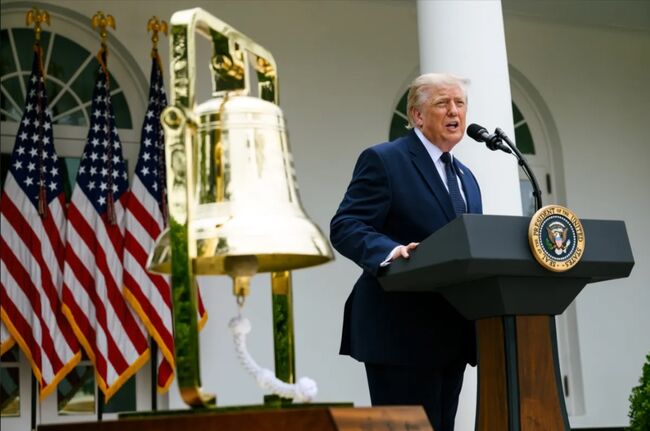 Trump pressures for rate cut again ahead of FOMC... "Should be the lowest in the world"
U.S. President Donald Trump. [Photo = The White House] U.S. President Donald Trump once again pressured the Federal Reserve, the U.S. central bank, to lower interest rates on the 27th (local time
Trump pressures for rate cut again ahead of FOMC... "Should be the lowest in the world"
U.S. President Donald Trump. [Photo = The White House] U.S. President Donald Trump once again pressured the Federal Reserve, the U.S. central bank, to lower interest rates on the 27th (local time
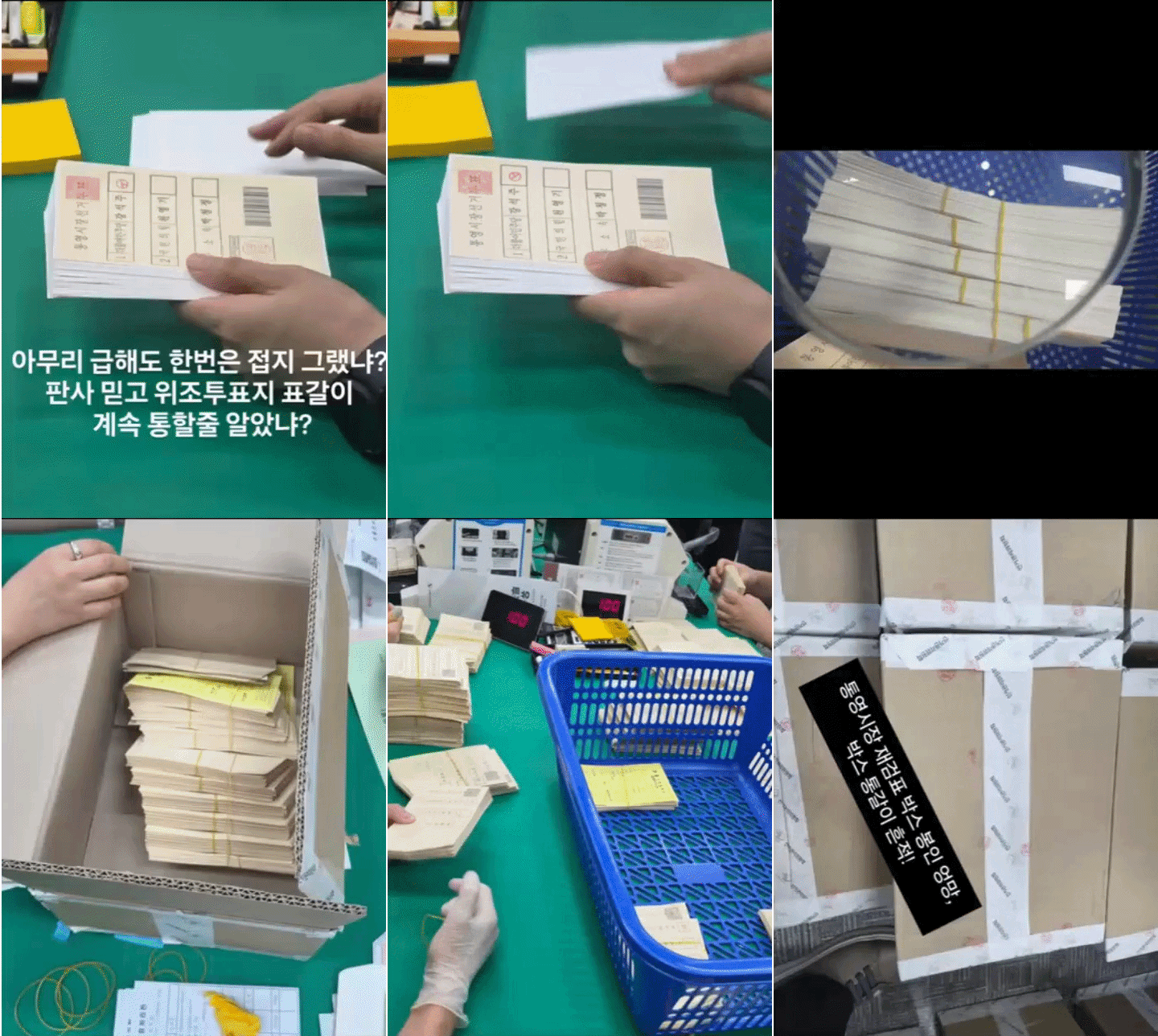 “Ignoring crisp ballots and damaged seals”… Tongyeong mayoral recount concludes with ‘no change in outcome,’ leaving suspicions and public outrage behind
Suspected counterfeit ballots discovered in Tongyeong [GIF from social media of Representative Hwang Kyo-ahn / Attorney Park Joo-hyun]During a recount of the Tongyeong mayoral election in South Gyeong
“Ignoring crisp ballots and damaged seals”… Tongyeong mayoral recount concludes with ‘no change in outcome,’ leaving suspicions and public outrage behind
Suspected counterfeit ballots discovered in Tongyeong [GIF from social media of Representative Hwang Kyo-ahn / Attorney Park Joo-hyun]During a recount of the Tongyeong mayoral election in South Gyeong
 President Yoon, regarding the first-instance ruling on the Public Official Election Act: “An excessive political verdict that distorts the facts… We will appeal immediately.”
The first-instance sentencing hearing for President Yoon Suk Yeol regarding violations of the Public Official Election Act is being broadcast live at Seoul Station on the 27th. [Photo=Yonhap News]Pres
President Yoon, regarding the first-instance ruling on the Public Official Election Act: “An excessive political verdict that distorts the facts… We will appeal immediately.”
The first-instance sentencing hearing for President Yoon Suk Yeol regarding violations of the Public Official Election Act is being broadcast live at Seoul Station on the 27th. [Photo=Yonhap News]Pres
 WSJ: "SK Hynix ADR Premium Is a Sign of AI Trading Overheat"
Advertisement for SK Hynix ADR listing in New York's Times Square [Reuters=Yonhap News file photo]The Wall Street Journal (WSJ) has pointed out that the price of SK Hynix’s American Depositary Recei
WSJ: "SK Hynix ADR Premium Is a Sign of AI Trading Overheat"
Advertisement for SK Hynix ADR listing in New York's Times Square [Reuters=Yonhap News file photo]The Wall Street Journal (WSJ) has pointed out that the price of SK Hynix’s American Depositary Recei
 'Godfather of Japanese Mystery Novels' Keigo Higashino Passes Away After Battle with Cancer at 68
Famous Japanese mystery novelist Keigo Higashino [AFP=Yonhap News]It has been belatedly reported that Keigo Higashino, the "godfather of Japanese mystery novels" and author of bestsellers such as "The
'Godfather of Japanese Mystery Novels' Keigo Higashino Passes Away After Battle with Cancer at 68
Famous Japanese mystery novelist Keigo Higashino [AFP=Yonhap News]It has been belatedly reported that Keigo Higashino, the "godfather of Japanese mystery novels" and author of bestsellers such as "The
 [Park Pil-kyu Security Column] To the Ignorant Trying to Clothe a Beast in Sheep's Clothing
Rep. Kim Byung-joo of the Democratic Party of Korea [Photo=Yonhap News]“The Air Force Academy doesn't teach you how to fly a plane!” “The Army, Navy, and Air Force academies are exactly the
[Park Pil-kyu Security Column] To the Ignorant Trying to Clothe a Beast in Sheep's Clothing
Rep. Kim Byung-joo of the Democratic Party of Korea [Photo=Yonhap News]“The Air Force Academy doesn't teach you how to fly a plane!” “The Army, Navy, and Air Force academies are exactly the
 [Issue Diagnosis] Two Effects of the Election Petition Review
 [Photo] Evidence of Election Fraud Flooding U.S. Media… Trump Had 2.7 Million Votes Stolen
 [Video] U.S. Semiquincentennial Air Show... 'Art in the Sky' streaks across New York
 [Editorial Cartoon] A Draconian Law That Undermines Freedom of Expression

 List
List