 Shin Young-bok is the most dramatically repackaged figure in modern Korean history. Reconstructed from Yonhap News photos.
Shin Young-bok (申榮福, 1941~2016) is perhaps the most dramatically repackaged figure in modern Korean history.
Today, he is cemented as a calligrapher, essayist, and an 'intellectual of introspection.' Indeed, the calligraphy for the soju brand 'Chum Churum,' the inscription on the National Intelligence Service's founder's monument, and his gentle lectures on university campuses are used as markers that describe him.
The Truth About Shin Young-bok: An Activist for North Korea's Anti-South Propaganda Operations
In the mid-1960s, Shin Young-bok was involved in the activities of the underground organization, the Revolutionary Party for Reunification (Tongil Hyukmyong Dang), which aligned with North Korea's anti-South propaganda directives.
On March 15, 1964, a meeting held in a secret location discussed the preparations for founding the Revolutionary Party for Reunification and the publication of its organ, 'Revolutionary Front.' Records indicate that Kim Jong-tae (Chairman of the Seoul City Chapter of the Revolutionary Party for Reunification), Kim Jil-rak, Lee Moon-gyu, and Shin Young-bok were present.
This organ prominently featured phrases calling Kim Il-sung the 'Sun of the Nation' and explicitly advocated the Juche ideology.
This newspaper was not a legal publication. The description of Kim Il-sung as the 'Sun of the Nation' is confirmed as the direct narration of individuals within the organization, not an assessment by a third party. This aspect is detailed in a compilation of related materials published by Daedong Publishing in 1989.
The so-called Tonghyokdang incident of 1968 was a consequence of this movement. Shin Young-bok was arrested on charges of violating the National Security Act and sentenced to life imprisonment, serving over 20 years.
The court ruling contains documents detailing his role beyond mere involvement, including: △ connection with university organizations △ management of subordinate organizations △ regular reporting system △ provision of seditious books.
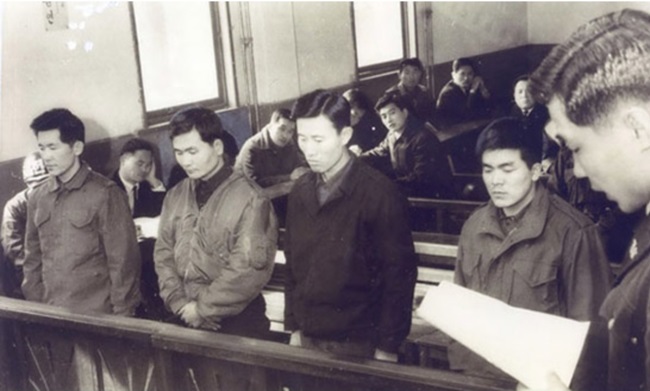 Defendants in the Revolutionary Party for Reunification case at a military court in November 1968. From left to right: Shin Young-bok, Lee Young-yoon, Song Joon-cheol, Shin Nam-hyu. On this day, the military prosecutor sought the death penalty for Shin Young-bok and prison sentences of 7-10 years for the other three.
Nevertheless, since the 2000s, Shin Young-bok has reappeared with a different persona. After his release in 1988, he worked as a professor at Sungkonghoe University, nurturing his students. His book 'Meditation from Prison,' published in 1998, became a bestseller and was widely read by the public.
Prominent figures with strong public voices, such as Noh Hoe-chan and Kim Je-dong, quoted his writings and expressed their admiration. These citations mostly focus on literary inspiration and ethical reflection.
In contrast, his organizational activities and ideological choices in the 1960s were either glossed over with phrases like "scars of the era," "exaggerated rhetoric," or "false accusations," or were omitted entirely.
In this process, explanations and defenses were also repeatedly offered. An article in 'Hankyoreh21' in 2006 quoted remarks suggesting that Shin Young-bok did not know the core leadership.
However, during the same period, the illegal organ 'Revolutionary Front,' court rulings, and the writings of Kim Jil-rak, a key figure in the Tonghyokdang, titled 'Juisan Mountain,' clearly describe the nature of the organization, its reporting system, and its links to North Korea.
Specifically, the name of Heo Bong-hak, who was in charge of North Korea's South Korea operations, and the records of the operational funds provided to Kim Jong-tae—△ $70,000 USD, △ 30 million Korean Won, and △ 500,000 Japanese Yen—along with facts such as the Gold Star Medal and the First Class National Flag Medal awarded by the North Korean cabinet after Kim Jong-tae's execution on July 10, 1969, remain as clear records.
Starting as a Kim Il-sungist, he led the Preparatory Committee for the Revolutionary Party for Reunification
March 15, 1964, is a date that is rarely mentioned in modern Korean history, but it clearly marks the starting point of a figure who would be repeatedly distorted and glorified for decades to come.
This was the day when the preparations for the founding of the Revolutionary Party for Reunification were officially formalized internally, and records indicate that the core figures who gathered at a secret meeting agreed on the nature and direction of the organization.
The meeting was attended by Kim Jong-tae (then Chairman of the Seoul City Chapter of the Revolutionary Party for Reunification), Kim Jil-rak, and Lee Moon-gyu, among others. It is repeatedly mentioned that Shin Young-bok was also present.
The core of the meeting was the 'identity of the party.' They did not define their organization as a mere academic gathering or discussion group.
They defined themselves as 'the vanguard party of the Korean revolution,' and they clarified the ideological basis of that vanguard. That was the Kim Il-sung Juche ideology systematized in North Korea.
The matters discussed at the meeting were specific. They included the party's name, code of conduct, organizational structure, and means of public propaganda.
Of particular note is the discussion about the publication of an 'organ.' As a key means to unite the organization and spread its ideology externally, the proposal to regularly produce and distribute small mimeographed publications was adopted.
This scene is consistently confirmed in the compilation of Tonghyokdang-related materials published by Daedong Publishing in 1989, as well as in subsequent memoirs and testimonies. Given the consistency in dates, attendees, and the gist of the statements, it is difficult to consider it as a post-mortem fabrication or exaggeration.
The year 1964 is also significant. This was four years before the large-scale crackdown of the Tonghyokdang incident in 1968, and it was a period when the organization was stably establishing its direction and expanding its activities.
"General Kim Il-sung, the Sun of the Nation"... The Reality of the Founding Declaration of 'Revolutionary Front'
The name of the organ decided at this meeting was 'Revolutionary Front.' The name itself is symbolic. The term 'front' is a concept premised on ideological and political struggle, a concept repeatedly used in North Korean Workers' Party documents at the time. The ideological roots are even more explicitly revealed in the founding declaration.
The declaration referred to Kim Il-sung as the 'Sun of the Nation' and stated that the party's reason for existence was to embody his revolutionary ideology.
This was not a rhetorical expression but had the same structure as the official praise used in North Korean internal documents. In other words, although it was a document written within South Korea, the language and ideological system already borrowed the political grammar of North Korea as it was.
Another goal emphasized in the declaration was the 'unity of patriotic masses from all walks of life.' The 'patriotism' referred to here did not mean the constitutional order of the Republic of Korea or the liberal democratic system. The standard was 'revolutionary unification' based on Kim Il-sungism.
They did not view South Korean society as an object of indigenous reform but defined it as an object of revolutionary transformation. Phrases like 'one revolutionary front' and 'the banner of revolutionary unification' that appear in the declaration were directly carried over into the names and activities of organizations under the Tonghyokdang.
'Revolutionary Front' was not a newspaper distributed in large quantities for external propaganda. It was produced in tens of copies using a mimeograph machine and was only distributed within the organization and to trusted individuals. In other words, it was a document that used candid language for internal cohesion, rather than using exaggerated rhetoric under the guise of criticizing the system.
A Kim Il-sungist Juche Newspaper Printed in Korea
'Revolutionary Front' is more than just a clandestine newspaper. It is considered one of the first publications in the Kim Il-sungist lineage produced and distributed in South Korea.
While there were personal memos and study materials from individuals following North Korea before this, this was the first periodical under the name of a clear political organization that frontally advocated Kim Il-sung's revolutionary ideology.
This newspaper was directly linked to the Tonghyokdang's organizational expansion strategy. While the magazine 'Chongmaek,' operating under a legal guise, was distributed on university campuses, 'Revolutionary Front' served as the ideological core behind it.
This was a dual structure of legality and illegality, publicity and secrecy. This method is consistent with the strategy typically used in North Korea's revolutionary line towards South Korea.
In the mid-1960s, the number of university students in South Korea was around 200,000. The Tonghyokdang organized a portion of these as 'core activists' and aimed to spread sympathizers around them.
Although the numbers were not large, the organization's goal was 'vanguard' rather than a mass party, so efficiency was prioritized. The calculation was to exert influence on society as a whole through a small but tightly bound group.
In this context, Shin Young-bok was not a mere reader or bystander. From his days at the Seoul National University of Commerce, he was deeply involved in related circles. Even while serving as an instructor at the Korea Military Academy, he maintained connections with student and intellectual networks. These details repeatedly appear in the 1968 court ruling and investigation records.
In summary, March 15, 1964, is a starting point. Shin Young-bok was not an 'intellectual who got involved late' but a figure who began his political activities with Kim Il-sungism as his starting point. The records calmly illustrate this fact.
Shin Young-bok's Position: A Writer and Activist for the Tonghyokdang's 'Revolutionary Front'
The attempt to define Shin Young-bok as a 'peripheral figure' does not align with the records. Based on the wording in the Revolutionary Party for Reunification's illegal organ 'Revolutionary Front' and the event records, he played a certain role in the organization's core decision-making and propaganda activities.
The statement that 'all unanimously agreed' to Kim Jong-tae's proposal during the secret meeting on March 15, 1964, where the nature of the party and the purpose of publishing the organ were discussed, is not just a simple sentence. In a meeting premised on internal cohesion, 'agreement' is an expression of commitment. It is important that he was present, did not object, and that this was followed by actual action.
'Revolutionary Front' was a mimeographed publication of tens of copies. As it was a medium for internal cohesion and limited dissemination rather than public propaganda, participation as a writer implied trust and responsibility. The mention of Shin Young-bok's name as a writer is not a one-off occurrence.
Records repeatedly indicate that Shin Young-bok was involved in drafting texts that explained the organization's political goals and applied Kim Il-sung's revolutionary ideology to the Korean reality. This cannot be explained by simply saying he 'only read it' or 'encountered it by chance.'
Another criterion is action. There was a reporting system in place for the preparation of rallies and demonstrations that took place in university areas of Seoul in 1966-1967.
Activity reports submitted to Kim Jil-rak included details on student organization, timing of gatherings, and slogans. The Supreme Court ruling specifies Shin Young-bok's involvement in managing subordinate organizations and reporting. The court ruling lists specific times, places, and actions. Such a ruling would be difficult to obtain if he were merely a 'peripheral figure.'
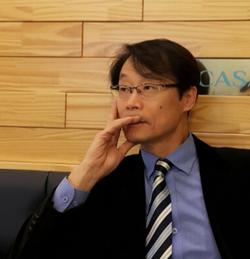
◆ Songsan
Poet and researcher of history and philosophy. Formerly a director of the Rhee Syngman Institute, he currently serves as a research advisor for the Korean Modern and Contemporary History Research Association and the representative of the philosophy forum Lyceum. He has published four poetry collections and co-translated 'Heroes of Hooko Island.' Songsan is a pen name.

 Iranian Foreign Ministry: "Continuing Message Exchanges with the U.S. and Activities of Mediating Countries"
Esmaeil Baghaei, Spokesperson for the Iranian Ministry of Foreign Affairs [Xinhua, Yonhap News file photo]Esmaeil Baghaei, spokesperson for the Iranian Ministry of Foreign Affairs, stated on the 26th
Iranian Foreign Ministry: "Continuing Message Exchanges with the U.S. and Activities of Mediating Countries"
Esmaeil Baghaei, Spokesperson for the Iranian Ministry of Foreign Affairs [Xinhua, Yonhap News file photo]Esmaeil Baghaei, spokesperson for the Iranian Ministry of Foreign Affairs, stated on the 26th
 President Yoon: "Do You Think You Are Safe from the Special Counsel?"... Final Statement Video Released
President Yoon Suk Yeol rebuking the special prosecutor on the 24th. [Court video / @birds_justice X account subtitle GIF] A video of President Yoon Suk Yeol's closing statement at his trial rega
President Yoon: "Do You Think You Are Safe from the Special Counsel?"... Final Statement Video Released
President Yoon Suk Yeol rebuking the special prosecutor on the 24th. [Court video / @birds_justice X account subtitle GIF] A video of President Yoon Suk Yeol's closing statement at his trial rega
 President Yoon, regarding the first-instance ruling on the Public Official Election Act: “An excessive political verdict that distorts the facts… We will appeal immediately.”
The first-instance sentencing hearing for President Yoon Suk Yeol regarding violations of the Public Official Election Act is being broadcast live at Seoul Station on the 27th. [Photo=Yonhap News]Pres
President Yoon, regarding the first-instance ruling on the Public Official Election Act: “An excessive political verdict that distorts the facts… We will appeal immediately.”
The first-instance sentencing hearing for President Yoon Suk Yeol regarding violations of the Public Official Election Act is being broadcast live at Seoul Station on the 27th. [Photo=Yonhap News]Pres
 WSJ: "SK Hynix ADR Premium Is a Sign of AI Trading Overheat"
Advertisement for SK Hynix ADR listing in New York's Times Square [Reuters=Yonhap News file photo]The Wall Street Journal (WSJ) has pointed out that the price of SK Hynix’s American Depositary Recei
WSJ: "SK Hynix ADR Premium Is a Sign of AI Trading Overheat"
Advertisement for SK Hynix ADR listing in New York's Times Square [Reuters=Yonhap News file photo]The Wall Street Journal (WSJ) has pointed out that the price of SK Hynix’s American Depositary Recei
 'Godfather of Japanese Mystery Novels' Keigo Higashino Passes Away After Battle with Cancer at 68
Famous Japanese mystery novelist Keigo Higashino [AFP=Yonhap News]It has been belatedly reported that Keigo Higashino, the "godfather of Japanese mystery novels" and author of bestsellers such as "The
'Godfather of Japanese Mystery Novels' Keigo Higashino Passes Away After Battle with Cancer at 68
Famous Japanese mystery novelist Keigo Higashino [AFP=Yonhap News]It has been belatedly reported that Keigo Higashino, the "godfather of Japanese mystery novels" and author of bestsellers such as "The
 [Park Pil-kyu Security Column] To the Ignorant Trying to Clothe a Beast in Sheep's Clothing
Rep. Kim Byung-joo of the Democratic Party of Korea [Photo=Yonhap News]“The Air Force Academy doesn't teach you how to fly a plane!” “The Army, Navy, and Air Force academies are exactly the
[Park Pil-kyu Security Column] To the Ignorant Trying to Clothe a Beast in Sheep's Clothing
Rep. Kim Byung-joo of the Democratic Party of Korea [Photo=Yonhap News]“The Air Force Academy doesn't teach you how to fly a plane!” “The Army, Navy, and Air Force academies are exactly the
 [Issue Diagnosis] Two Effects of the Election Petition Review
 [Photo] Evidence of Election Fraud Flooding U.S. Media… Trump Had 2.7 Million Votes Stolen
 [Video] U.S. Semiquincentennial Air Show... 'Art in the Sky' streaks across New York
 [Editorial Cartoon] A Draconian Law That Undermines Freedom of Expression

 List
List









