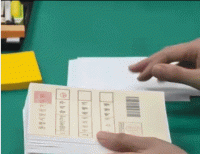
Shin Young-bok's way of speaking about his past changed after his release from prison in August 1988. [Photo: Shin Young-bok's Website]
Shin Young-bok's way of speaking about his past clearly changed after his release from prison in August 1988.
Until his release, the Revolutionary Party for National Unification (RPNU) case was treated strictly as a political organization case. The focus of the investigation and trial was on what kind of organization existed, what its ideology was, and what the individual did within it.
What the individual felt or the 고민 (internal struggles) they experienced were not subjects for judgment. The court looked at actions, not thoughts.
An Individual's 'Moral Judgment' Cannot Conceal Criminal Acts
The "Interim Investigation Results of the Revolutionary Party for National Unification Case," announced by the Korean Central Intelligence Agency in August 1968, defined the case as an "attempt to subvert the system through the organization of a vanguard party." The trial proceeded according to this definition.
Shin Young-bok was arrested in 1968, sentenced to life imprisonment in the first trial in 1969, and his sentence was finalized after appeals and further appeals. He served 20 years and 20 days from 1968 to 1988.
During this period, the issue was not his ideology or inner motivations. The focus was on his role within the RPNU organization and whether he was involved in maintaining and expanding the organization.
The court ruling and investigation records list specific actions. The criteria for judgment were whether the illegal production and distribution of a publication, the sharing of vanguard party regulations, the management of subordinate members, and the reporting of activity results to superiors were repeated.
Records also remain of when meetings were held, who attended, and what documents were seized. The court viewed this connection as having continued for a certain period. The judgment was that he acted as a member of an organization, not as an individual acting in isolation.
After his release, Shin Young-bok's explanation differed. He rarely used the name "Revolutionary Party for National Unification."
Instead, he placed the word "conscience" at the forefront. He explained that he acted not according to North Korean ideology or vanguard party theory, but based on what he felt was right as a human being.
His explanation was that it was an individual's moral judgment, not the activities of a political organization. This narrative spread quickly amidst the social atmosphere of the time, following the release and restoration of political prisoners since 1987.
As this method of explanation took hold, the nature of the case also changed. The organization receded into the background, leaving only the individual. The fact that RPNU members moved by dividing roles became blurred, and only the story of one person agonizing in prison was emphasized.
The nature of responsibility also shifted. Organizational activities were transformed into personal emotions, and political cases were reframed as moral stories. This approach was repeatedly used in subsequent lectures and writings. Shin Young-bok gradually came to be accepted not as a defendant in a political case, but as an "intellectual who experienced the pain of the era."
Court Rulings Record Actions, Not Emotions
However, the court rulings remained unchanged. Court rulings do not record emotions. They only record when someone was arrested, what actions were problematic, and whether those actions were repeated.
As long as the verdict stands, the actions written within it also remain. No matter how popular or well-received subsequent interpretations or recollections may be, they cannot replace this record.
The scale of the Revolutionary Party for National Unification case demonstrates the reality of the organization.
According to the Korean Central Intelligence Agency's 1968 announcement, 158 people were arrested and 73 were indicted. This is a number difficult to explain as mere deviations by a few individuals.
In this process, Park Sung-joon (husband of former Prime Minister Han Myeong-sook) was identified as a key figure. He was sentenced to 15 years in prison in 1969 and served approximately 13 years, being released in 1981. At the time, the judiciary ruled his actions as involvement in organizational operations, not mere 동조 (agreement/support).
In August 2022, the Seoul High Court granted Park Sung-joon a retrial acquittal. The reasons cited were illegal detention, coercive investigation, and lack of voluntariness in his confession. This ruling confirmed the illegality of state power.
However, the acquittal did not mean that the organization called the Revolutionary Party for National Unification did not exist in the 1960s. The illegality of the investigation and the existence of the organization were legally separate issues.
In the late 1960s, such organizations spread through everyday spaces in university circles and intellectual society. Circles at major universities like Seoul National University, Korea University, and Yonsei University, reading groups, legitimate magazine editing, seminars, and cafe gatherings served as connecting channels.
Although these activities appeared legitimate on the surface, an illegal ideology ran parallel within them. This was a common method for underground organizations at the time.
Park Sung-joon's activities extended to his wife, Han Myeong-sook. Han Myeong-sook was sentenced to one year in prison, one year of probation, and one year of disqualification for her involvement in the Revolutionary Party for National Unification case.
This case illustrates how organizational activities spread through personal connections and everyday social networks. Political organizations did not operate in separate spaces; they overlapped with daily life.
A National Security Offender Transformed into an 'Intellectual of Our Time'
After his release, Shin Young-bok began lecturing at Sungkonghoe University. He was appointed professor in the Department of Social Sciences in 1998, and remained as a distinguished professor after his retirement in 2006.
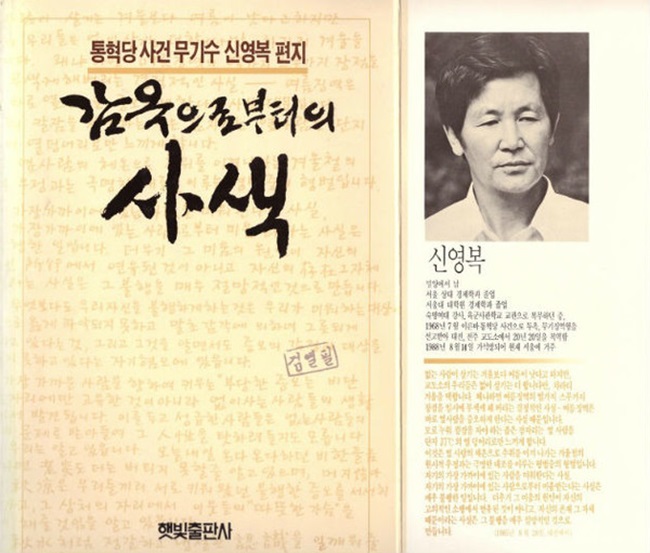 Cover and book flap of 'Reflections from Prison'. [Photo: Dolbegae Publishing]
From this point on, he was referred to as an "intellectual of our time" rather than a party involved in the Revolutionary Party for National Unification case.
His calligraphy was used in logos for public institutions and corporations, and "Reflections from Prison," published by Dolbegae in 1998, was widely read. In this process, the issues of the organization and its ideology were rarely mentioned; only his time in prison and his introspection were emphasized.
"Reflections from Prison" should be read within the context of the following sequence: △The Revolutionary Party for National Unification case in 1968 △Serving 20 years and 20 days △Release from prison in 1988. Without this connection, the book leaves a completely different impression.
Comparisons of Shin Young-bok to Nelson Mandela also emerged from this context. However, while Mandela worked to change institutions and relinquish power after his imprisonment, Shin Young-bok's case was intertwined with subversion of the system and North Korean ideology.
In modern Korean history, the prison experience of political ideologues often automatically became a credential that guaranteed truth. Of course, illegal investigations and organizational activities can coexist. However, one cannot hide organizational activities by using the guise of illegal investigations.
Shin Young-bok skillfully used the language of imprisonment, conscience, and illegal investigation to transform himself into an intellectual of the era. As a result, he performed a magic trick of remaining a symbol while the case disappeared.
To understand Shin Young-bok accurately, one must first examine the actions he took and the events he was involved in, rather than his eloquent sentences or speeches.
◆ Songsan
A poet and researcher of history and philosophy. He served as a director of the Syngman Rhee Institute and is currently active as a research advisor for the Korean Modern and Contemporary History Research Society and as the representative of the Philosophy Forum Lyceion. He has published four poetry collections and co-translated "The Hero of Hooko Coast." Songsan is a pen name.

 Trump pressures for rate cut again ahead of FOMC... "Should be the lowest in the world"
U.S. President Donald Trump. [Photo = The White House] U.S. President Donald Trump once again pressured the Federal Reserve, the U.S. central bank, to lower interest rates on the 27th (local time
Trump pressures for rate cut again ahead of FOMC... "Should be the lowest in the world"
U.S. President Donald Trump. [Photo = The White House] U.S. President Donald Trump once again pressured the Federal Reserve, the U.S. central bank, to lower interest rates on the 27th (local time
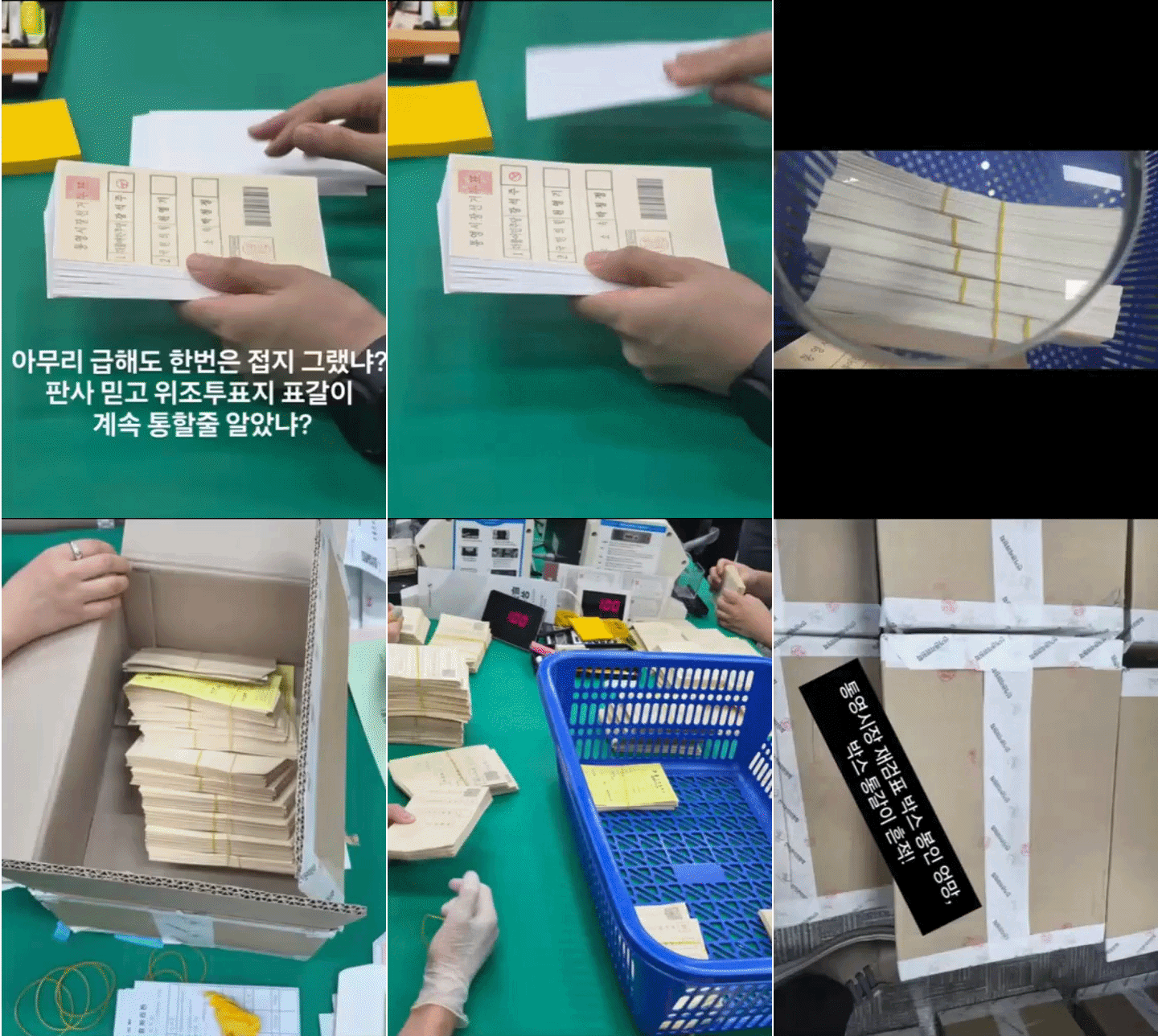 “Ignoring crisp ballots and damaged seals”… Tongyeong mayoral recount concludes with ‘no change in outcome,’ leaving suspicions and public outrage behind
Suspected counterfeit ballots discovered in Tongyeong [GIF from social media of Representative Hwang Kyo-ahn / Attorney Park Joo-hyun]During a recount of the Tongyeong mayoral election in South Gyeong
“Ignoring crisp ballots and damaged seals”… Tongyeong mayoral recount concludes with ‘no change in outcome,’ leaving suspicions and public outrage behind
Suspected counterfeit ballots discovered in Tongyeong [GIF from social media of Representative Hwang Kyo-ahn / Attorney Park Joo-hyun]During a recount of the Tongyeong mayoral election in South Gyeong
 President Yoon, regarding the first-instance ruling on the Public Official Election Act: “An excessive political verdict that distorts the facts… We will appeal immediately.”
The first-instance sentencing hearing for President Yoon Suk Yeol regarding violations of the Public Official Election Act is being broadcast live at Seoul Station on the 27th. [Photo=Yonhap News]Pres
President Yoon, regarding the first-instance ruling on the Public Official Election Act: “An excessive political verdict that distorts the facts… We will appeal immediately.”
The first-instance sentencing hearing for President Yoon Suk Yeol regarding violations of the Public Official Election Act is being broadcast live at Seoul Station on the 27th. [Photo=Yonhap News]Pres
 WSJ: "SK Hynix ADR Premium Is a Sign of AI Trading Overheat"
Advertisement for SK Hynix ADR listing in New York's Times Square [Reuters=Yonhap News file photo]The Wall Street Journal (WSJ) has pointed out that the price of SK Hynix’s American Depositary Recei
WSJ: "SK Hynix ADR Premium Is a Sign of AI Trading Overheat"
Advertisement for SK Hynix ADR listing in New York's Times Square [Reuters=Yonhap News file photo]The Wall Street Journal (WSJ) has pointed out that the price of SK Hynix’s American Depositary Recei
 'Godfather of Japanese Mystery Novels' Keigo Higashino Passes Away After Battle with Cancer at 68
Famous Japanese mystery novelist Keigo Higashino [AFP=Yonhap News]It has been belatedly reported that Keigo Higashino, the "godfather of Japanese mystery novels" and author of bestsellers such as "The
'Godfather of Japanese Mystery Novels' Keigo Higashino Passes Away After Battle with Cancer at 68
Famous Japanese mystery novelist Keigo Higashino [AFP=Yonhap News]It has been belatedly reported that Keigo Higashino, the "godfather of Japanese mystery novels" and author of bestsellers such as "The
 [Park Pil-kyu Security Column] To the Ignorant Trying to Clothe a Beast in Sheep's Clothing
Rep. Kim Byung-joo of the Democratic Party of Korea [Photo=Yonhap News]“The Air Force Academy doesn't teach you how to fly a plane!” “The Army, Navy, and Air Force academies are exactly the
[Park Pil-kyu Security Column] To the Ignorant Trying to Clothe a Beast in Sheep's Clothing
Rep. Kim Byung-joo of the Democratic Party of Korea [Photo=Yonhap News]“The Air Force Academy doesn't teach you how to fly a plane!” “The Army, Navy, and Air Force academies are exactly the
 [Issue Diagnosis] Two Effects of the Election Petition Review
 [Photo] Evidence of Election Fraud Flooding U.S. Media… Trump Had 2.7 Million Votes Stolen
 [Video] U.S. Semiquincentennial Air Show... 'Art in the Sky' streaks across New York
 [Editorial Cartoon] A Draconian Law That Undermines Freedom of Expression

 List
List