Regarding North Korea's nuclear program, Shin Young-bok viewed its fundamental nature as a “negotiation tool designed to transition from an armistice to a peace regime and to create conditions for North Korea to concentrate all efforts on economic issues.”
If the Unification Revolutionary Party (URP) were viewed as a “spontaneous movement within South Korea,” the numbers, medals, and operational patterns remaining in the documents would be inexplicable.
Levels of Equipment and Operational Funds Confirm an Underground Party
Documents summarizing the URP case state that 158 people were apprehended and 73 were referred for prosecution. At the same time, the list of confiscated items includes 7 walkie-talkies, 12 submachine guns, 7 hand grenades, 1 recoilless rifle, 7 pistols, 140 rounds of live ammunition, one 12.7mm anti-aircraft gun, 1 heavy machine gun, 1 radar unit, and 6 radio receivers.
The funds confiscated at the scene were reported to be approximately 30,000 U.S. dollars and 730,000 South Korean won. This is far from a club-level gathering; it implies that the organization was operating as an “underground party.”
There are two elements that define an underground party: first, instructions and reporting; second, money.
Kim Jong-tae, identified as the leader of the URP, confessed to contacting the North Korean spy Kim Su-sang and traveling to and from North Korea four times by sea via Imjado in Sinan-gun, South Jeolla Province.
He also did not deny the charge that he published the magazine ‘Cheongmaek’ with funds brought in from North Korea. “The money to print the magazine” was essentially “the air the organization breathed to survive.”
Another clue is the “award” North Korea bestowed post-factum. The execution date of the primary culprit, Kim Jong-tae, is recorded as July 10, 1969.
Following his execution, North Korea granted Kim Jong-tae the title of Hero and posthumously awarded him the Gold Star Medal—known as North Korea's highest order—and the Order of the National Flag, 1st Class.
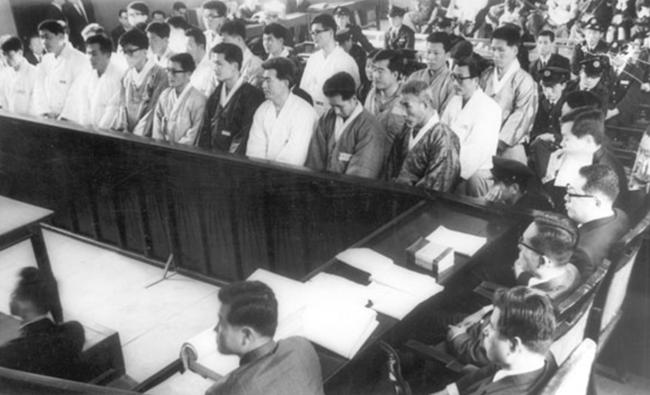 Individuals involved in the URP trial in November 1968. Kim Jong-tae is on the far right in the front row of the defendants' bench, and Kim Jil-rak is next to him.
Data from the Korea Institute for National Unification (KINU) also confirms that North Korea held memorial services and bestowed the title of hero and medals after Kim Jong-tae’s execution. In the North Korean system, a medal is an official recognition of “contribution to the regime.”
The Jeju Armed Spy Incident and the Attempt to Rescue the URP
What most accurately reveals the nature of the underground party is the “rescue operation.” After the URP incident broke, North Korea did not simply “give up” and walk away.
On August 20, 1968, North Korea’s No. 753 Unit, Vessel No. 51, an armed spy ship, approached the coast of Seogwipo, Jeju Island. There were 14 people on board.
The anchoring point was about 500 meters offshore from Namseong Coast (commonly known as Hwangwuji) in Seohong-dong, Seogwipo. They intended to send two guides in a rubber boat to make contact with operative Lee Moon-gyu and then return.
However, they were discovered; 12 were killed, and 2 were captured. The spy ship was sunk the following morning. Monthly Chosun covered this incident in the context of “an armed spy ship sent by North Korea to rescue core URP officials,” noting that the ship was intercepted through a joint operation by the military, police, and intelligence services.
The “spy ship infiltration incident” and the “URP incident” are not separate events. The timing coincides exactly with the apprehension of the URP, the targets of contact were individuals related to the URP, and the mode of operation was armed infiltration.
The Jeju incident should not be dismissed as a “simple reconnaissance” by North Korea. Common sense dictates that simple reconnaissance is typically conducted on a small scale and in secret. However, this incident involved 14 armed operatives, a spy ship, a rubber boat, contact protocols, and an extraction plan.
The Nature of the Organization Revealed Through ‘Juamsan’
Government announcements or media reports are always met with counterarguments of “political bias.” Therefore, what warrants attention is the testimony of an insider of the URP.
‘Juamsan,’ a posthumous manuscript written in prison by Kim Jil-rak, who is cited as a core figure of the URP, contains a passage defining the URP as a “secret underground party receiving instructions from North Korea.”
A representative passage states, “There is no reason to dispute that the Unification Revolutionary Party was a secret underground organization that received instructions from North Korea, and it is an undeniable fact that the status of the organization and its activities were reported directly to Kim Il-sung.”
If this statement is true, the URP was not an “indigenous South Korean” organization but one “connected to North Korea.” This means it was not a matter of “individual conscience,” as Shin Young-bok often claimed after his release.
There is a part that is frequently omitted here. An underground party cannot be established by ideology alone. It requires organizational techniques.
The dual structure of legal and illegal activities, circles to recruit people, the shell of a magazine, the inner workings of an official organ, funding, contacts, hideouts, and, when necessary, armed infiltration.
Articles dealing with the URP incident record that the ‘Haksa Pub’ in Mugyo-dong, Seoul, was a regular hangout for young elites at the time, and that ‘Cheongmaek’ was known among intellectuals.
There is also mention that 39 people were arrested and indicted. It is with such a social facade that an underground party “blends in.” Outwardly, it was a forum for discussion; inwardly, it was an organization aligned with North Korea’s path and reporting to the North. At the very least, it was a fully functional underground party “until it was exposed.”
Persistent Anti-American and Anti-Capitalist Remarks After Release
Discussions surrounding Shin Young-bok usually stop at his “past (URP).” However, the period when he had a greater influence on the public was actually after his release from prison.
After being released in 1988 (often introduced as a special parole), he began lecturing at Sungkonghoe University the following year in 1989 and continued to teach as a chair professor even after his retirement in 2006.
The podium and publishing reinvent people. Underground organizational activities need places to hide, but the podium and books shine light on their own. And the brighter that light, the faster the records of the past vanish.
The core perspective he left behind after his release can be summarized in two lines: an anti-American view that defines the United States as the “architect of the division system,” and an anti-capitalist stance that fundamentally doubts capitalism.
These two were not separate preferences but twins that relied on each other. If one places the U.S. at the root of the problem, it becomes easy to explain South Korea’s market economy system as a “subordinate structure created by the U.S.”
This is confirmed by his actual statements.
Shin Young-bok’s remarks, cited by various media outlets, include the sentence: “We must liquidate the fantasy that the U.S. is a benefactor of South Korea.” He is also quoted as saying that the U.S. “created a pro-American separatist regime” and “organized the South Korean economy as a subordinate structure to the U.S. economy.”
Looking at the sentences alone, they may seem like “one position in historical interpretation.” However, these sentences represent an attempt to change an entire axis of how modern Korean history is explained. That is, the direction of causality and responsibility shifts from “North Korea’s choices and actions” to “U.S. design.”
“As Long as There Is Sympathy for Socialism, It Will Survive in History”
His anti-capitalist tendencies are even more evident. In an interview with ‘Monthly Mal’ in August 1996, Shin Young-bok said, “It is true that the socialist experiment failed,” but added, “As long as there is sympathy for the positivity of socialism, its merits will continue to survive in history.”
This is not a simple critical reflection. It is an attitude that preserves the “positivity” of socialism as a core asset even after the collapse of the socialist system. It is precisely at this point that the image of “humanist scholar Shin Young-bok” and his “political convictions” cannot be separated. Shin Young-bok’s words are, in effect, his ideological path.
The year of publication is also important. ‘Discourse,’ which he summarized as his “last lecture,” was published by Dolbegae in April 2015 (while publication dates vary between April 20 and April 27, there is consensus that it was released in April 2015).
The publication occurred during the Park Geun-hye administration. At that time, he was no longer a “defendant from the past,” but was circulated as an “elder intellectual.” The promotional phrases used by bookstores to introduce the book prioritized emotional language such as “comfort and encouragement.”
By prioritizing emotion, the reader becomes indifferent to the record of facts. “Good writing” disarms the reader’s vigilance. As a result, anti-American and anti-capitalist perceptions were packaged not as “arguments” but as “dignity.”
There is one more fact to verify here. Shin Young-bok’s anti-American and pro-North Korean perceptions were not a “phase he once had.” They were exposed repeatedly over a long period through the podium (1989–) and publishing (1990s–2015).
Repeated exposure is the most powerful technique for persuading people of an ideology. The goal is not to win an argument. It is to plant an automatic response of “I suppose that’s possible” in people’s minds. This method is actually far more durable than political speeches.
Views on North Korean Nuclear Weapons… Denial of Reality and Shifting Responsibility
Shin Young-bok’s anti-American perception also appears in the framework through which he views the North Korean nuclear issue. He tended to interpret nuclear weapons not as “preparations for invasion” or “intent to attack,” but as “regime security” and a “negotiation card.”
Regarding North Korea’s nuclear program, Shin Young-bok viewed its fundamental nature as a “negotiation tool designed to transition from an armistice to a peace regime and to create conditions for North Korea to concentrate all efforts on economic issues.” He further stated that it is a “mistake” to explain North Korean nuclear weapons in terms of “the ambitions of political leaders” or “political miscalculation.”
The implication is that North Korea is not responsible for its nuclear program. Although North Korea is the entity that armed itself with nuclear weapons, the logic shifts the causes and drivers to U.S. strategy and the international order. Consequently, North Korea’s choices become a “reaction” rather than a “cause.”
Acts defined as a “reaction” inevitably have diminished moral culpability. Who did what becomes blurred, and instead, Shin Young-bok left behind a sentiment that “it could not be helped.”
The bigger problem with Shin Young-bok’s type of explanation is that it automatically attaches the “U.S. responsibility theory.” Shin Young-bok said, “The danger of war on the Korean Peninsula does not begin with North Korea, but can come from the United States.”
Once the framework is set this way, the six nuclear tests by North Korea (2006–2017) become a “series of reactions” rather than a “cause.” From that moment, the direction of criticism shifts. The logic of pressure and deterrence to make them stop nuclear testing weakens, and instead, the hope remains that “if the U.S. changes, North Korea will also change.”
This expectation has contradicted reality in the actual diplomatic process since the 1990s. The argument to change the armistice system into a peace system has been a long-standing diplomatic agenda (a “transition to a peace system” is also mentioned in the Inter-Korean Basic Agreement, etc.), and that in itself does not make one pro-North Korean.
The problem arises when the term “peace regime” is used as a tool to justify nuclear armament. When one attaches the explanation that it is “nuclear power to create conditions for North Korea to concentrate on its economy” to a nation that has conducted six nuclear tests, nuclear power becomes a policy rather than a crime. Once it becomes a policy, it becomes impossible to hold them accountable.
Criticism Based on Record, Not Personal Attacks
Shin Young-bok did not remain silent or sever ties with his past after his release in 1988. He stood at the podium at Sungkonghoe University starting in 1989, and later moved into the position of professor and elder intellectual. 2015’s ‘Discourse’ was the terminus of that move. The problem lies not in what he said, but in what he never cleared up.
His anti-American perception was compressed into the expression “liquidating the fantasy of a benefactor.” This is an argument to define the framework of perceiving the U.S. as a moral benefactor in the context of the Korean War, security, and aid as a fiction, and to eliminate that perception itself. This expression is neither neutral nor analytical.
It is a translation of explicit anti-American slogans from the past into the language of an intellectual. His radical political position did not disappear; it simply wore the outer garment of a cultural discourse.
The same applies to socialism. The attitude confirmed in the 1996 interview was not one of severance or reflection, but a reservation that left its “positivity” intact.
Instead of a clear evaluation of a failed system, he preserved his ideology by separating its possibilities and ideals. It is a typical way to maintain conviction without taking responsibility.
Reality during the same period was cold and harsh. From 2006 to 2017, North Korea carried out six nuclear tests. Socialism was no longer a subject of contemplation, but existed as a concrete threat.
Nevertheless, his language did not bring this reality into a field of clear evaluation. The tension between ideology and reality was not sorted out, nor was it resolved. That tension was not neglected; it was maintained to the end.
This is the crux of the criticism. Shin Young-bok’s ideology did not disappear. It was merely transformed. The language of the organization moved to the language of the podium, the language of the podium to the language of books, and the language of books to public sentiment. Struggle was replaced by reflection, and revolution by discourse. However, the direction was maintained, and the responsibility was erased.
Therefore, the problem surrounding Shin Young-bok is not “whether his ideology remains or not.” The core of the issue is that Shin Young-bok’s ideology was never liquidated, but instead repackaged in respectful, mythical language.
As a result, Shin Young-bok’s political ideology has not been dismantled; it remains intact in South Korean society, wearing the face of refined culture and noble morality.
◆ Songsan
A poet and researcher of history and philosophy. He served as a director of the Syngman Rhee Institute and currently serves as a research advisor to the Korea Modern History Research Association and representative of the philosophy forum Lyceum. He has published four collections of poetry and co-translated ‘The Hero of Hook Hill.’ Songsan is his pen name.

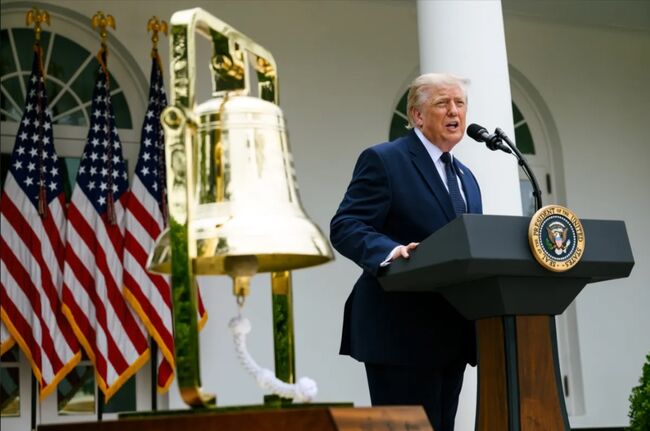 Trump pressures for rate cut again ahead of FOMC... "Should be the lowest in the world"
U.S. President Donald Trump. [Photo = The White House] U.S. President Donald Trump once again pressured the Federal Reserve, the U.S. central bank, to lower interest rates on the 27th (local time
Trump pressures for rate cut again ahead of FOMC... "Should be the lowest in the world"
U.S. President Donald Trump. [Photo = The White House] U.S. President Donald Trump once again pressured the Federal Reserve, the U.S. central bank, to lower interest rates on the 27th (local time
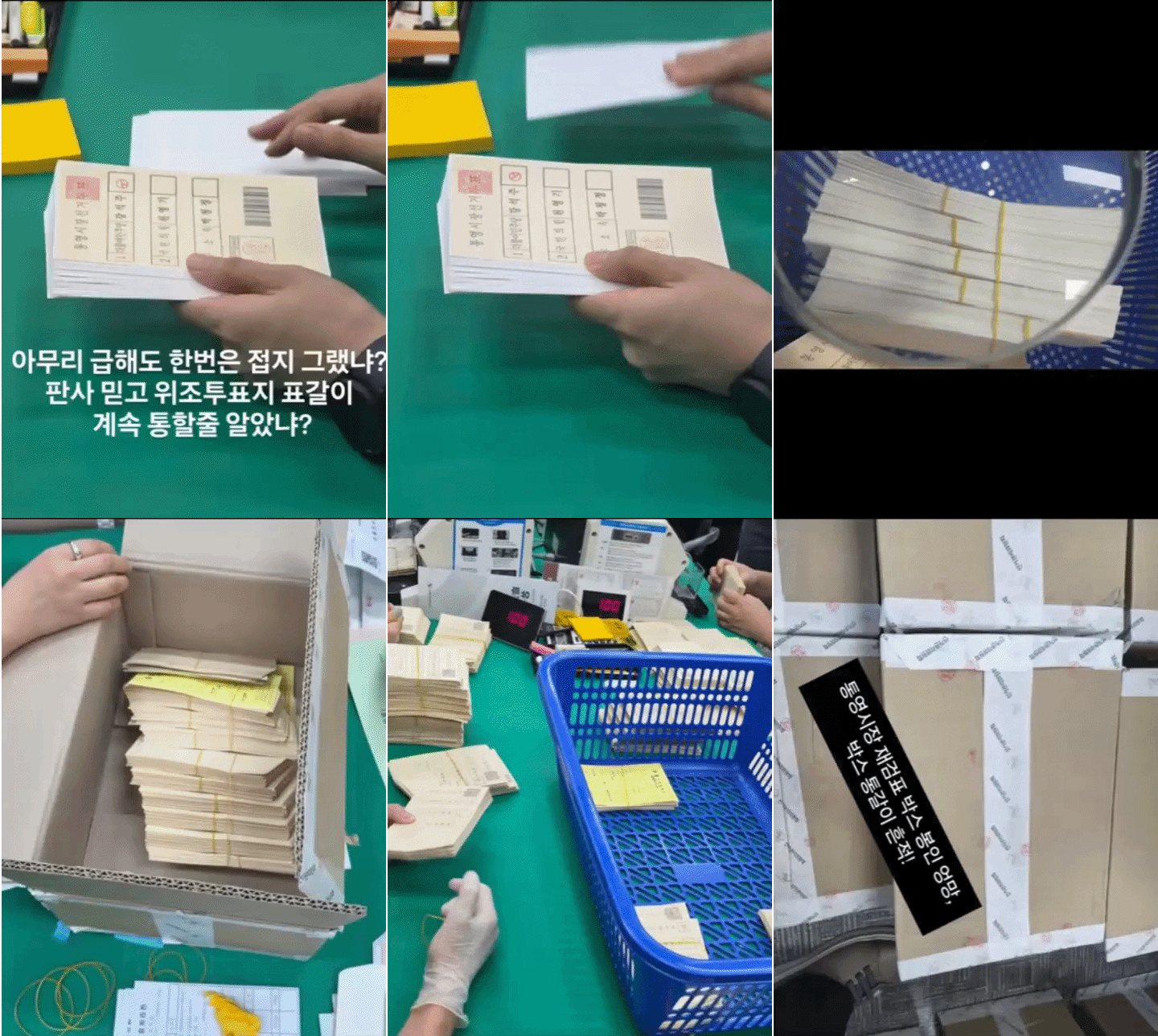 “Ignoring crisp ballots and damaged seals”… Tongyeong mayoral recount concludes with ‘no change in outcome,’ leaving suspicions and public outrage behind
Suspected counterfeit ballots discovered in Tongyeong [GIF from social media of Representative Hwang Kyo-ahn / Attorney Park Joo-hyun]During a recount of the Tongyeong mayoral election in South Gyeong
“Ignoring crisp ballots and damaged seals”… Tongyeong mayoral recount concludes with ‘no change in outcome,’ leaving suspicions and public outrage behind
Suspected counterfeit ballots discovered in Tongyeong [GIF from social media of Representative Hwang Kyo-ahn / Attorney Park Joo-hyun]During a recount of the Tongyeong mayoral election in South Gyeong
 President Yoon, regarding the first-instance ruling on the Public Official Election Act: “An excessive political verdict that distorts the facts… We will appeal immediately.”
The first-instance sentencing hearing for President Yoon Suk Yeol regarding violations of the Public Official Election Act is being broadcast live at Seoul Station on the 27th. [Photo=Yonhap News]Pres
President Yoon, regarding the first-instance ruling on the Public Official Election Act: “An excessive political verdict that distorts the facts… We will appeal immediately.”
The first-instance sentencing hearing for President Yoon Suk Yeol regarding violations of the Public Official Election Act is being broadcast live at Seoul Station on the 27th. [Photo=Yonhap News]Pres
 WSJ: "SK Hynix ADR Premium Is a Sign of AI Trading Overheat"
Advertisement for SK Hynix ADR listing in New York's Times Square [Reuters=Yonhap News file photo]The Wall Street Journal (WSJ) has pointed out that the price of SK Hynix’s American Depositary Recei
WSJ: "SK Hynix ADR Premium Is a Sign of AI Trading Overheat"
Advertisement for SK Hynix ADR listing in New York's Times Square [Reuters=Yonhap News file photo]The Wall Street Journal (WSJ) has pointed out that the price of SK Hynix’s American Depositary Recei
 'Godfather of Japanese Mystery Novels' Keigo Higashino Passes Away After Battle with Cancer at 68
Famous Japanese mystery novelist Keigo Higashino [AFP=Yonhap News]It has been belatedly reported that Keigo Higashino, the "godfather of Japanese mystery novels" and author of bestsellers such as "The
'Godfather of Japanese Mystery Novels' Keigo Higashino Passes Away After Battle with Cancer at 68
Famous Japanese mystery novelist Keigo Higashino [AFP=Yonhap News]It has been belatedly reported that Keigo Higashino, the "godfather of Japanese mystery novels" and author of bestsellers such as "The
 [Park Pil-kyu Security Column] To the Ignorant Trying to Clothe a Beast in Sheep's Clothing
Rep. Kim Byung-joo of the Democratic Party of Korea [Photo=Yonhap News]“The Air Force Academy doesn't teach you how to fly a plane!” “The Army, Navy, and Air Force academies are exactly the
[Park Pil-kyu Security Column] To the Ignorant Trying to Clothe a Beast in Sheep's Clothing
Rep. Kim Byung-joo of the Democratic Party of Korea [Photo=Yonhap News]“The Air Force Academy doesn't teach you how to fly a plane!” “The Army, Navy, and Air Force academies are exactly the
 [Issue Diagnosis] Two Effects of the Election Petition Review
 [Photo] Evidence of Election Fraud Flooding U.S. Media… Trump Had 2.7 Million Votes Stolen
 [Video] U.S. Semiquincentennial Air Show... 'Art in the Sky' streaks across New York
 [Editorial Cartoon] A Draconian Law That Undermines Freedom of Expression

 List
List