 Han Kang's novel 'The Vegetarian' is displayed at a bookstore. [Photo=Yonhap News]
Han Kang's novel 'The Requiem' is regarded as the most influential literary work dealing with the May 18th Gwangju Uprising, especially since it garnered a Nobel Prize.
Many readers interpret this work as a record of suffering, a testimony of victims, and a restoration of human dignity. However, if we move beyond the realm of emotion and analyze the novel in terms of its narrative structure and ideological effect, it transcends a simple reenactment of tragedy.
A Strategy of Deep Immersion in the Victims' Bodies and Inner Selves
This work places the events within a specific ethical framework, guiding the reader's judgment in a particular direction through a path of emotion. In other words, this novel is a text that organizes memory through suffering and shapes political sensibility through that memory.
The core strategy of this work is its deep immersion in the victims' bodies and inner selves. The boy's death, the bodies in the gymnasium, the scars left after torture, and the guilt of the survivors are repeatedly depicted.
Explanations of the political background or analyses of internal power structures are rarely offered. The military appears as the executor of violence, and the citizens are positioned as those who suffer. The narrative unfolds against the moral contrast between these two.
What is important here is not the truth of the facts, but the method of their presentation. Literature creates interpretation through what it emphasizes and what it excludes.
This novel prioritized the intensity of suffering over the complex context of the events. That choice alters the reader's thought process. Readers empathize before they analyze the events. Empathy is powerful. However, when empathy precedes analysis, critical questions cannot be asked.
From a liberal perspective, this is the crucial issue. Liberalism posits that state power must be limited. However, it also questions why the institution of the state exists in the first place.
The state functions to maintain order and protect rights. While the abuse of power must be controlled, the state itself is not reduced to an entity of moral evil.
However, the narrative of 'The Requiem' presents the state as an almost unilateral instrument of violence. Divisions within power, the complexity of responsibility structures, and the historical conditions of institutional failure do not come to the forefront.
The understanding that readers gain through the work is the perception that 'the state oppresses citizens,' 'power is structurally violent,' and 'citizens have moral superiority.' This schema easily connects with political stances. Even if the work does not directly propagate ideology, its narrative structure itself shapes a particular political sensibility.
Conveying a Worldview Without Overtly Preaching Ideology
Another issue is the absolutization of memory. The May 18th Uprising is an event that already possesses legal judgments and national commemoration systems. Historical scholarship researches events through cross-verification of documents and testimonies.
However, literature combines fact and fiction. The suffering of fictional characters overlaps with actual historical scenes, solidifying into a unified memory in the reader's mind.
This memory acquires a powerful moral authority. That authority can stifle discussion. When an event is fixed as an area of ethical absolutism, attempts to approach it from different angles are easily misunderstood as moral corruption.
Liberalism respects memory but also believes that any event should be subject to critical review. Sanctification can easily be converted into political energy, and literature can accelerate that conversion with the power of emotion.
Literature is not overt. Political speeches deliver slogans. Literature shows scenes. Readers internalize value judgments without realizing they are being persuaded.
'The Requiem' emotionally imprints a deep distrust of state power by meticulously depicting suffering. This is different from incitement. However, in terms of its effect, it is political. The work leaves a particular sensibility in the reader's mind.
That sensibility can influence subsequent political judgments. This is how literature conveys a worldview without overtly preaching ideology.
Setting aside its literary achievements, this work is not politically neutral. Its narrative structure, centered on suffering, guides the reader's judgment in a specific direction.
From a liberal perspective, the problem is not criticism itself, but the lack of balance. The violence of state power certainly deserves criticism. However, if the complexity of institutions and historical conditions are not illuminated alongside, the event is reduced to a moral play.
When emotion overwhelms reason, the public sphere narrows. Reading literature is not merely about feeling moved. It is also about examining the value premises underlying that emotion and the questions it excludes. Freedom is not defended by anger alone. It is maintained through institutions, debate, and sober analysis.
◆ Songsan
A poet and researcher of history and philosophy. Former director of the Syngman Rhee Institute. Currently serves as a senior advisor at the Korean Modern and Contemporary History Research Society and the head of the philosophy forum Lyceum. He has published four poetry collections, co-translated 'Heroes of Hakko-ji,' and published the historical psychology commentary 'Joseon That Became a Myth' (2026). He is actively engaged in research and practice for liberal cultural movements. Songsan is a pen name.

 Trump pressures for rate cut again ahead of FOMC... "Should be the lowest in the world"
U.S. President Donald Trump. [Photo = The White House] U.S. President Donald Trump once again pressured the Federal Reserve, the U.S. central bank, to lower interest rates on the 27th (local time
Trump pressures for rate cut again ahead of FOMC... "Should be the lowest in the world"
U.S. President Donald Trump. [Photo = The White House] U.S. President Donald Trump once again pressured the Federal Reserve, the U.S. central bank, to lower interest rates on the 27th (local time
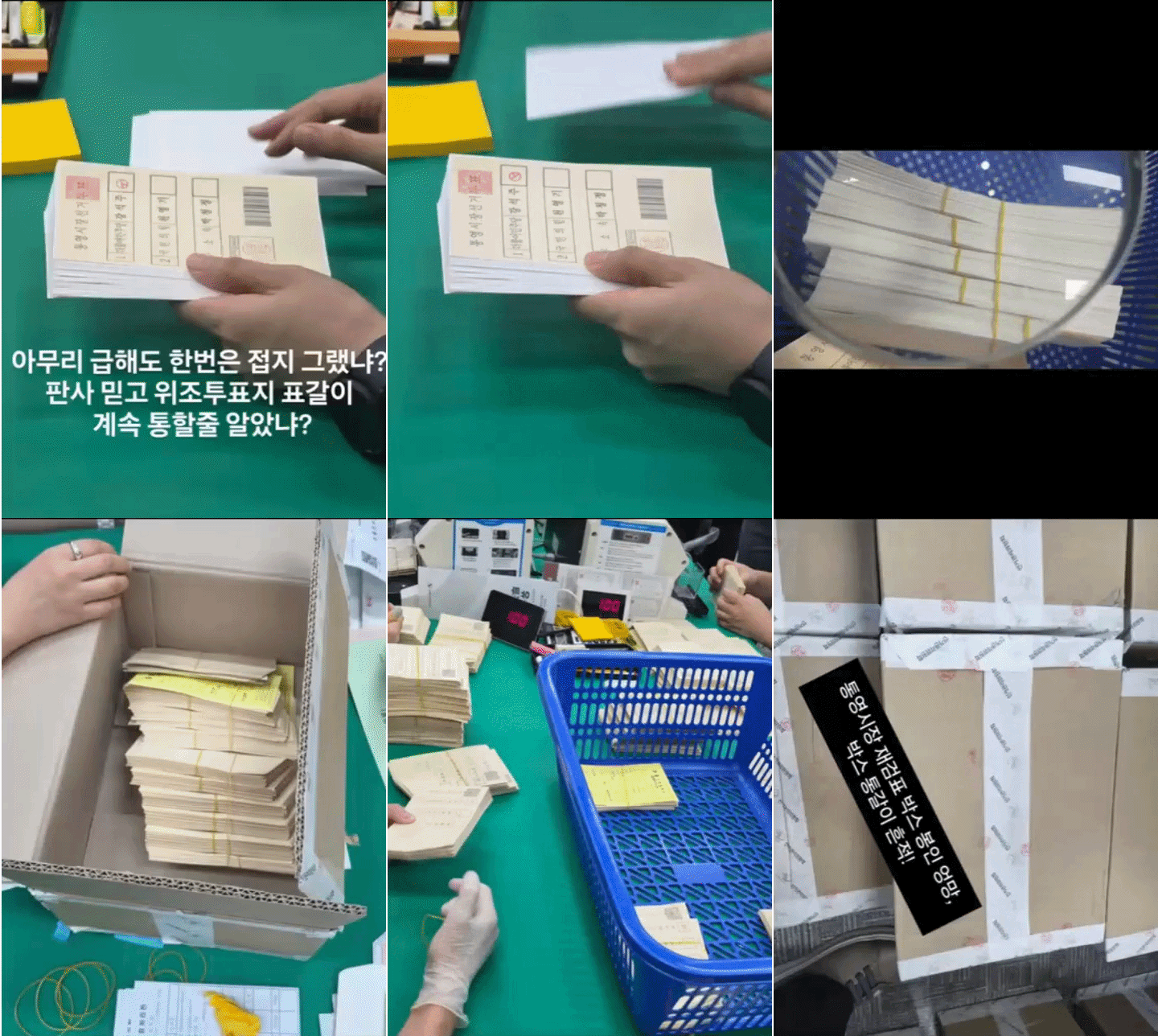 “Ignoring crisp ballots and damaged seals”… Tongyeong mayoral recount concludes with ‘no change in outcome,’ leaving suspicions and public outrage behind
Suspected counterfeit ballots discovered in Tongyeong [GIF from social media of Representative Hwang Kyo-ahn / Attorney Park Joo-hyun]During a recount of the Tongyeong mayoral election in South Gyeong
“Ignoring crisp ballots and damaged seals”… Tongyeong mayoral recount concludes with ‘no change in outcome,’ leaving suspicions and public outrage behind
Suspected counterfeit ballots discovered in Tongyeong [GIF from social media of Representative Hwang Kyo-ahn / Attorney Park Joo-hyun]During a recount of the Tongyeong mayoral election in South Gyeong
 President Yoon, regarding the first-instance ruling on the Public Official Election Act: “An excessive political verdict that distorts the facts… We will appeal immediately.”
The first-instance sentencing hearing for President Yoon Suk Yeol regarding violations of the Public Official Election Act is being broadcast live at Seoul Station on the 27th. [Photo=Yonhap News]Pres
President Yoon, regarding the first-instance ruling on the Public Official Election Act: “An excessive political verdict that distorts the facts… We will appeal immediately.”
The first-instance sentencing hearing for President Yoon Suk Yeol regarding violations of the Public Official Election Act is being broadcast live at Seoul Station on the 27th. [Photo=Yonhap News]Pres
 WSJ: "SK Hynix ADR Premium Is a Sign of AI Trading Overheat"
Advertisement for SK Hynix ADR listing in New York's Times Square [Reuters=Yonhap News file photo]The Wall Street Journal (WSJ) has pointed out that the price of SK Hynix’s American Depositary Recei
WSJ: "SK Hynix ADR Premium Is a Sign of AI Trading Overheat"
Advertisement for SK Hynix ADR listing in New York's Times Square [Reuters=Yonhap News file photo]The Wall Street Journal (WSJ) has pointed out that the price of SK Hynix’s American Depositary Recei
 'Godfather of Japanese Mystery Novels' Keigo Higashino Passes Away After Battle with Cancer at 68
Famous Japanese mystery novelist Keigo Higashino [AFP=Yonhap News]It has been belatedly reported that Keigo Higashino, the "godfather of Japanese mystery novels" and author of bestsellers such as "The
'Godfather of Japanese Mystery Novels' Keigo Higashino Passes Away After Battle with Cancer at 68
Famous Japanese mystery novelist Keigo Higashino [AFP=Yonhap News]It has been belatedly reported that Keigo Higashino, the "godfather of Japanese mystery novels" and author of bestsellers such as "The
 [Park Pil-kyu Security Column] To the Ignorant Trying to Clothe a Beast in Sheep's Clothing
Rep. Kim Byung-joo of the Democratic Party of Korea [Photo=Yonhap News]“The Air Force Academy doesn't teach you how to fly a plane!” “The Army, Navy, and Air Force academies are exactly the
[Park Pil-kyu Security Column] To the Ignorant Trying to Clothe a Beast in Sheep's Clothing
Rep. Kim Byung-joo of the Democratic Party of Korea [Photo=Yonhap News]“The Air Force Academy doesn't teach you how to fly a plane!” “The Army, Navy, and Air Force academies are exactly the
 [Issue Diagnosis] Two Effects of the Election Petition Review
 [Photo] Evidence of Election Fraud Flooding U.S. Media… Trump Had 2.7 Million Votes Stolen
 [Video] U.S. Semiquincentennial Air Show... 'Art in the Sky' streaks across New York
 [Editorial Cartoon] A Draconian Law That Undermines Freedom of Expression

 List
List










