
The Korean Peninsula is No Longer a Peripheral Variable.
As the United States' military action against Iran becomes a reality, the Middle Eastern front has entered an expansion phase. This is not a simple regional conflict.
The moment additional U.S. military and diplomatic resources are deployed, global strategic allocation becomes subject to readjustment. As the burden increases, the role of alliances and their cost structures are consequently reassessed, as is the structural order.
The "fair share" that President Donald Trump has consistently emphasized should be understood in this context. It is closer to a strategic principle than a political slogan.
This means that as the U.S. military burden expands, alliances shift from a framework of protection to a structure of shared responsibility.
An Iran War Does Not Leave Taiwan and the Korean Peninsula as Separate Issues.
As the burden in the Middle East increases, the Indo-Pacific front becomes an even more strategic area for management. The most sensitive variable here is the Taiwan Strait.
The U.S. Department of Defense has, in its annual report on China's military power, assessed that China is developing various military options against Taiwan, including blockade.
While a seaborne invasion is high-risk, a blockade is a strategy that can apply pressure incrementally through maritime control, aerial threats, and justifications for customs and quarantine.
The U.S. think tank CSIS also analyzes that while a blockade has a lower threshold than a full-scale invasion, its impact on the global economy could be immediate.
The Taiwan Strait is not just a military space. It is a crucial corridor for global maritime trade and the nexus of global advanced semiconductor production.
If a blockade or quasi-blockade situation becomes a reality, maritime insurance premiums will skyrocket, shipping routes will be rerouted, and freight costs will rise. For the Korean economy, which is heavily export-dependent, this will directly translate into cost pressures.
Disruptions to the semiconductor supply chain are not limited to a specific industry.
They will create a ripple effect across all downstream industries, including automotive, electronics, and defense. Considering short-term supply and demand instability, medium-term price increases, and long-term supply chain restructuring costs, the impact will be structural.
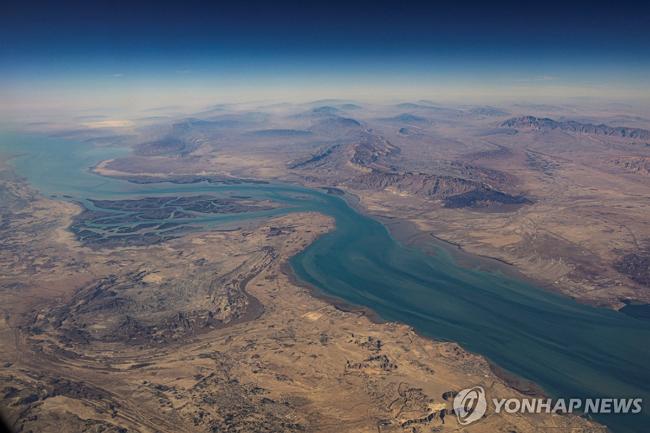 The Strait of Hormuz, photographed from the air on December 10, 2023 [Photo=Yonhap News]
To this, energy instability due to the Iran variable is added.
Volatility in oil and LNG prices directly affects inflation and the trade balance. If geopolitical risks escalate, downward pressure on the Korean won and financial market volatility may also follow. Security uncertainties can quickly transition into financial risks.
This dual shock ultimately leads back to the issue of alliance structure.
It is not inconceivable that a package of demands will emerge, encompassing defense cost sharing, strategic asset deployment costs, restructuring of semiconductor and battery supply chains, energy procurement cooperation, and defense industry cooperation. The U.S. is increasingly approaching issues in a way that does not separate trade, security, and industry.
The situation becomes even more complex when the North Korean variable is added.
If North Korea's military tensions escalate during a multi-crisis phase, the Korean Peninsula will be reclassified not as a simple regional security issue, but as a forward intersection point of U.S.-China strategic competition.
The strategic status of U.S. Forces Korea and the operation of extended deterrence may also be subject to review.
If the current administration fails to demonstrate consistent strategic alignment and predictability in a crisis situation, the U.S. may approach alliance management in a more calculative manner.
This is not a matter of emotion. President Trump's diplomatic style is more about maximizing contributions than severing relationships. It is a way of maintaining alliances while readjusting costs.
South Korea is not a weak player. It possesses tangible capabilities in semiconductors, batteries, shipbuilding, and defense, as well as strategic assets in its geopolitical location.
However, these strategic assets also serve as grounds for demands for greater roles.
The international order following the Iran crisis is expected to enter a phase not of additional fronts, but of overlapping fronts.
If the military variables in the Middle East, the possibility of a blockade in the Taiwan Strait, and North Korea's strategic calculations move simultaneously, the Korean Peninsula will become a junction of structures, not an observer.
If a blockade of Taiwan materializes or moves into a quasi-blockade phase, the impact will not be confined to the military domain.
Semiconductor supply chains, shipping costs, energy prices, and financial market volatility will all be shaken simultaneously. Security risks will quickly become economic risks, and economic risks will, in turn, lead to pressure for alliance reassessment.
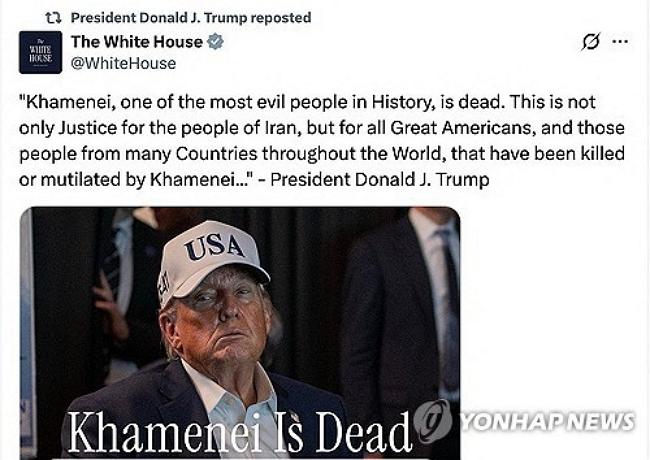 White House social media post conveying Trump's 'announcement of Khamenei's death' [Photo=Yonhap News]
The United States does not abandon its alliances. Instead, it reassesses costs and roles. If strategy is unclear, others will set the price.
In an environment where multiple crises unfold simultaneously, responses must also be structurally designed.
The approach of separating security, trade, and industry is already showing its limitations. Defense cost sharing, strategic asset deployment, semiconductor cooperation, and energy coordination are no longer individual matters.
Without an integrated negotiation structure, bargaining power is bound to weaken.
Preparations for the Taiwan Strait variable also need to be redesigned based on the possibility of a quasi-blockade, rather than a full-scale invasion.
Rerouting strategies for partial maritime transport blockades, securing alternative supply chains for key components, expanding energy stockpiles and long-term contracts, and creating buffers for financial market volatility are issues of prior design, not post-response measures.
Ultimately, the key is strategic trust.
In a multi-crisis phase, the most dangerous element is not military conflict but policy confusion.
If messages within an alliance are mixed, costs will increase exponentially.
Strategy must be aligned with the language of calculation, not emotion.
The Korean Peninsula is likely to stand at the confluence of three fronts in the near future.
When crises overlap, a nation that does not choose will be chosen.
In the era of multiple crises, South Korea's greatest risk is not external shocks but internal strategic confusion. And confusion always comes at a cost.
• U.S. Department of Defense, Annual Report on Military and Security Developments Involving the PRC
• CSIS, Lights Out: Wargaming a Chinese Blockade of Taiwan
• U.S. Indo-Pacific Strategy Report
• White House / Trump statements on burden sharing and fair share
• U.S. Department of Defense statements on “ironclad” extended deterrence

 Iranian Foreign Ministry: "Continuing Message Exchanges with the U.S. and Activities of Mediating Countries"
Esmaeil Baghaei, Spokesperson for the Iranian Ministry of Foreign Affairs [Xinhua, Yonhap News file photo]Esmaeil Baghaei, spokesperson for the Iranian Ministry of Foreign Affairs, stated on the 26th
Iranian Foreign Ministry: "Continuing Message Exchanges with the U.S. and Activities of Mediating Countries"
Esmaeil Baghaei, Spokesperson for the Iranian Ministry of Foreign Affairs [Xinhua, Yonhap News file photo]Esmaeil Baghaei, spokesperson for the Iranian Ministry of Foreign Affairs, stated on the 26th
 President Yoon: "Do You Think You Are Safe from the Special Counsel?"... Final Statement Video Released
President Yoon Suk Yeol rebuking the special prosecutor on the 24th. [Court video / @birds_justice X account subtitle GIF] A video of President Yoon Suk Yeol's closing statement at his trial rega
President Yoon: "Do You Think You Are Safe from the Special Counsel?"... Final Statement Video Released
President Yoon Suk Yeol rebuking the special prosecutor on the 24th. [Court video / @birds_justice X account subtitle GIF] A video of President Yoon Suk Yeol's closing statement at his trial rega
 President Yoon, regarding the first-instance ruling on the Public Official Election Act: “An excessive political verdict that distorts the facts… We will appeal immediately.”
The first-instance sentencing hearing for President Yoon Suk Yeol regarding violations of the Public Official Election Act is being broadcast live at Seoul Station on the 27th. [Photo=Yonhap News]Pres
President Yoon, regarding the first-instance ruling on the Public Official Election Act: “An excessive political verdict that distorts the facts… We will appeal immediately.”
The first-instance sentencing hearing for President Yoon Suk Yeol regarding violations of the Public Official Election Act is being broadcast live at Seoul Station on the 27th. [Photo=Yonhap News]Pres
 WSJ: "SK Hynix ADR Premium Is a Sign of AI Trading Overheat"
Advertisement for SK Hynix ADR listing in New York's Times Square [Reuters=Yonhap News file photo]The Wall Street Journal (WSJ) has pointed out that the price of SK Hynix’s American Depositary Recei
WSJ: "SK Hynix ADR Premium Is a Sign of AI Trading Overheat"
Advertisement for SK Hynix ADR listing in New York's Times Square [Reuters=Yonhap News file photo]The Wall Street Journal (WSJ) has pointed out that the price of SK Hynix’s American Depositary Recei
 'Godfather of Japanese Mystery Novels' Keigo Higashino Passes Away After Battle with Cancer at 68
Famous Japanese mystery novelist Keigo Higashino [AFP=Yonhap News]It has been belatedly reported that Keigo Higashino, the "godfather of Japanese mystery novels" and author of bestsellers such as "The
'Godfather of Japanese Mystery Novels' Keigo Higashino Passes Away After Battle with Cancer at 68
Famous Japanese mystery novelist Keigo Higashino [AFP=Yonhap News]It has been belatedly reported that Keigo Higashino, the "godfather of Japanese mystery novels" and author of bestsellers such as "The
 [Park Pil-kyu Security Column] To the Ignorant Trying to Clothe a Beast in Sheep's Clothing
Rep. Kim Byung-joo of the Democratic Party of Korea [Photo=Yonhap News]“The Air Force Academy doesn't teach you how to fly a plane!” “The Army, Navy, and Air Force academies are exactly the
[Park Pil-kyu Security Column] To the Ignorant Trying to Clothe a Beast in Sheep's Clothing
Rep. Kim Byung-joo of the Democratic Party of Korea [Photo=Yonhap News]“The Air Force Academy doesn't teach you how to fly a plane!” “The Army, Navy, and Air Force academies are exactly the
 [Issue Diagnosis] Two Effects of the Election Petition Review
 [Photo] Evidence of Election Fraud Flooding U.S. Media… Trump Had 2.7 Million Votes Stolen
 [Video] U.S. Semiquincentennial Air Show... 'Art in the Sky' streaks across New York
 [Editorial Cartoon] A Draconian Law That Undermines Freedom of Expression

 List
List










