 Supreme Court Chief Justice Cho Hee-dae is seen with his eyes closed during a parliamentary audit by the Legislation and Judiciary Committee at the National Assembly in October of last year. [Yonhap News]
Named as Supreme Court Justice on a 2016 Bupyeong Gap election invalidation lawsuit verification record
26 votes to 23, verdict on 26 ballots deferred in close election... 5 ballots mixed with wrong candidates
Judges serving as election committee chairs creates a contradiction with 'judges judging themselves'; countermeasures urgently needed
Cheon Dae-yeop's flawed verification also involved Ji Gwi-yeon... Cho Hee-dae nominated Cheon Dae-yeop as election committee chair
Ruling party relentlessly attacks Cho Hee-dae's impeachment... Some express worried views of 'pity'
Criticism mounts that the judiciary has undermined its own independence by abandoning 'self-preservation'
Amidst sharp criticism that Supreme Court Chief Justice Cho Hee-dae is showing a lukewarm response to the ruling party's relentless push for judicial revisions, it has been revealed that Chief Justice Cho participated in a Supreme Court on-site verification that was previously embroiled in controversy over flawed verification. This has led to criticism that judges, trapped by their own past experiences, are now helpless against the blatant infringement of judicial independence from external forces.
Existing Korean law stipulates that judges concurrently serve as election committee chairpersons, a situation that has long been pointed out as making it difficult for the judiciary to apply strict standards to the suspicions raised by election authorities. In essence, the courts and election committees are intertwined, making it nearly impossible for courts to issue search and seizure warrants requested by the police or prosecutors in relation to alleged misconduct by election committees. Coupled with the persistent practice of the courts "covering for their own," public opinion is directing its criticism at the judiciary, arguing that its neutrality has been shaken and its very foundation undermined.
Consequently, there are growing accusations that the judicial cartel is indirectly contributing to silencing individuals or media outlets seeking to investigate electoral fraud, while ironically, 'search and seizure warrants' are being issued against those striving for fair elections and electoral justice.
According to an investigation by <한미일보>, then-Supreme Court Justice Cho Hee-dae was listed on the Supreme Court verification record (2016su40) for the 2016 Bupyeong Gap parliamentary election invalidation lawsuit.
This record pertains to an election lawsuit filed by Moon Byung-ho, a candidate from the People's Party who narrowly lost the parliamentary election on April 13, 2016 (the 4.13 general election or the 20th general election) by a margin of 26 votes.
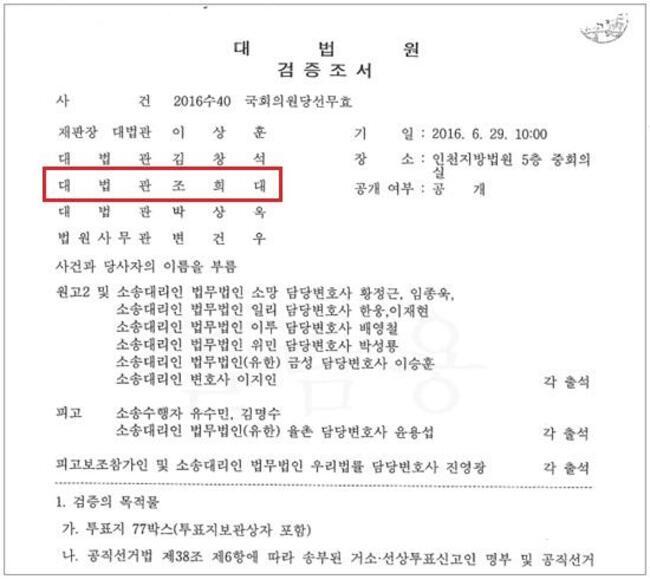 The name 'Supreme Court Justice Cho Hee-dae' is found on the cover of the Supreme Court verification record for the 2016 Bupyeong Gap parliamentary election invalidation lawsuit.
The verification at that time took place on June 29, just over two months after the April 13 general election, in the large conference room on the 5th floor of the Incheon District Court. This adhered to the regulation requiring trials to be concluded within six months, a stark contrast to the first verification for the 21st general election in 2020, which took a daunting 1 year and 2 months to complete.
The plaintiff, candidate Moon's side, argued during the verification that the election authorities had deemed ballots cast on oceanic fishing vessels, which lacked fax numbers, as valid. They claimed that although the fax numbers should have been verified and only valid votes counted, one ballot without a fax number was classified as invalid but ultimately counted as valid.
Article 179, Paragraph 3, Item 1 of the Public Official Election Act stipulates that "ballots for which the fax number cannot be identified shall be considered invalid."
The verification also revealed five instances of mixed ballots, where a vote cast for candidate 1 was recorded as a vote for candidate 2, differing from the voter's intent.
The Supreme Court's verification resulted in the plaintiff having 42,235 valid votes and the winner having 42,258 valid votes. Although the vote difference narrowed from 26 to 23, 26 ballots were found to be pending judgment by the Supreme Court during the verification.
A second recount was expected, but candidate Moon accepted the 23-vote difference, and his defeat was finalized.
During this verification, there were also testimonies from observers suggesting suspicions of mass-printed ballots, but detailed examinations such as fingerprint analysis were not conducted. Furthermore, 24 ballots were identified as potentially cast by Germans, as the plaintiff's side argued their marking methods were similar, and two envelopes containing ballots were found to have been opened.
This stands in stark contrast to the Austrian Constitutional Court's decision in July 2016, which declared the presidential election itself invalid after deeming that the fairness of 700,000 postal votes could not be guaranteed simply because four postal envelopes had been opened.
It is increasingly being pointed out that electoral fraud is not an issue to be taken lightly, given the significant national security risks and the infringement of citizens' right to vote that can arise from overlooking even minor suspicions. However, concerns are being raised that the Supreme Court and the Constitutional Court have consistently exhibited a very superficial approach to verification due to structural limitations.
Reaching the Limits of 'Self-Preservation'?… Only electoral fraud suspicions are met with silence
Elections can only be trusted if the results of pre-election and post-election verification are consistent, but this principle has been consistently violated in election trials.
The fact that the Supreme Court confirmed an error of as many as 279 votes in the Yeonsu-eul constituency election in June of the year following the April 15 general election is significant. The difference of nearly 300 votes between the vote count and the recount 1 year and 2 months later was sufficient to deem the integrity of the election compromised.
Particularly astonishing to observers was the discovery of over 1,000 "iljanggi" ballots (so-called due to being printed on paper resembling a Korean flag) during the recount at polling station 6 in Yeonsu-eul, which had only 1,974 voters. These ballots, seemingly marked with ink, had smudged official seals and were suspected of being fraudulent ballots printed externally and brought in, as there was no ink at the polling station where a rubber stamp was used. However, then-Presiding Judge Cheon Dae-yeop (Supreme Court Justice) did not declare them invalid.
Justice Cheon is currently the head of the Supreme Court's administrative division. Chief Justice Cho recently nominated Justice Cheon as the next chairperson of the National Election Commission. Furthermore, Ji Gwi-yeon, a senior judge who was present from the Supreme Court's side at the Yeonsu-eul recount, was captured on video detaching ballots that were stuck together and counting them as legitimate votes. Judge Ji had sentenced President Yoon, who had invoked martial law under his constitutional authority to combat electoral fraud, to life imprisonment in the first trial.
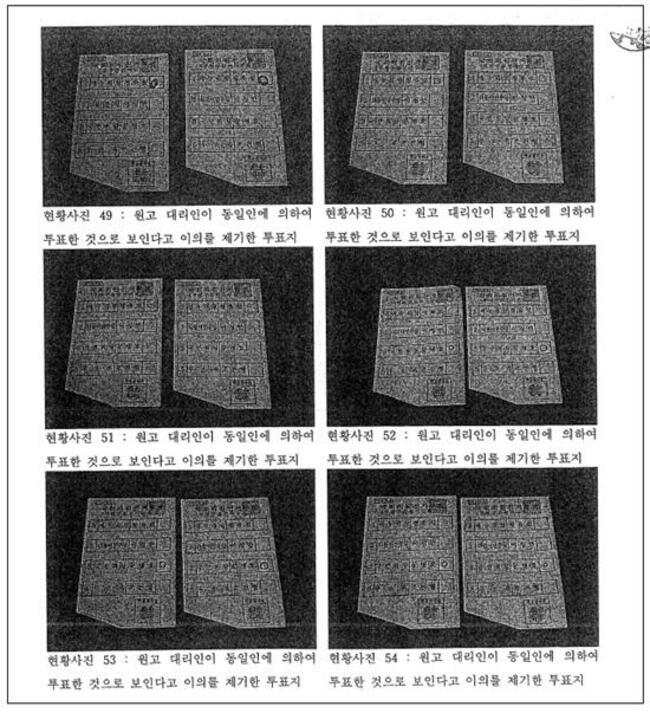 Ballots that the plaintiff's legal representative argued appeared to have been cast by the same person. The Supreme Court recorded them in grayscale photographs in the verification record.
The wife of candidate Moon, who abandoned the second recount in 2016, is former Supreme Court Justice Min Yu-sook. Min passed the Supreme Court justice confirmation hearing the year after her husband's election defeat. While there is no evidence of any connection between Moon's challenge and Min's appointment as a Supreme Court justice, Justice Min faced strong criticism for dismissing numerous evidence requests in the April 15 election lawsuit and concluding the proceedings, thereby disregarding suspicions of electoral fraud.
Concerns that the current system, where sitting judges serve as election committee chairpersons, leads to the judiciary's lukewarm rulings on election committee misconduct have been steadily growing since the December 3 emergency martial law declaration.
The judiciary's consistent dismissal of evidence requests related to electoral fraud suspicions, its disregard for the Special Prosecutor's Office's controversial "warrant shopping," and its allegedly unfair handling of presidential impeachment trials are also being cited as potential consequences of structural limitations, leading to renewed calls for judicial reform.
In particular, the fact that six out of the eight Constitutional Court justices who ruled to dismiss President Yoon Suk-yeol, who had emphasized investigations into electoral fraud, were former election committee chairpersons at various levels, has only intensified public distrust in a judiciary perceived as lenient towards election committee misconduct.
A lawyer who is a former district court judge stated, "Judges serve as non-standing election committee chairpersons during elections, creating a structure where it's difficult to audit the election committee's wrongdoings. In such an environment, judges can easily face disadvantages in their careers even for minor errors in a few votes, making it difficult for them to acknowledge suspicions of electoral fraud."
Another lawyer commented, "The structure raises suspicions that judges, from their time as senior judges serving as non-standing regional election committee chairpersons, have tolerated or overlooked (fraud). It is difficult for courts to acknowledge election committee misconduct, leading to a buildup of precedents. Claims that electoral fraud does not exist gain credibility based on these precedents. Structural changes are inevitable to halt the Supreme Court's practice of creating precedents through election litigation."

 Trump pressures for rate cut again ahead of FOMC... "Should be the lowest in the world"
U.S. President Donald Trump. [Photo = The White House] U.S. President Donald Trump once again pressured the Federal Reserve, the U.S. central bank, to lower interest rates on the 27th (local time
Trump pressures for rate cut again ahead of FOMC... "Should be the lowest in the world"
U.S. President Donald Trump. [Photo = The White House] U.S. President Donald Trump once again pressured the Federal Reserve, the U.S. central bank, to lower interest rates on the 27th (local time
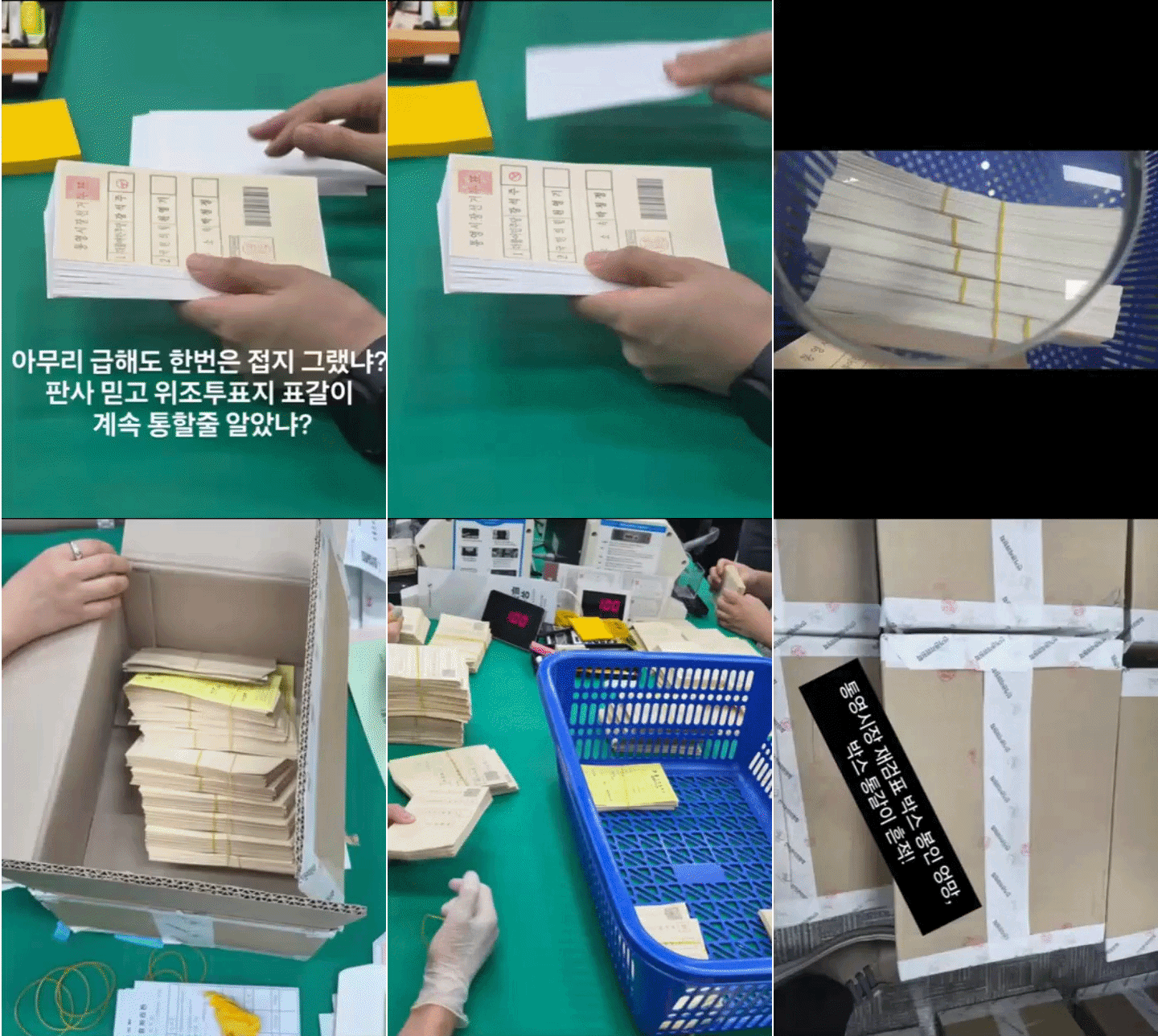 “Ignoring crisp ballots and damaged seals”… Tongyeong mayoral recount concludes with ‘no change in outcome,’ leaving suspicions and public outrage behind
Suspected counterfeit ballots discovered in Tongyeong [GIF from social media of Representative Hwang Kyo-ahn / Attorney Park Joo-hyun]During a recount of the Tongyeong mayoral election in South Gyeong
“Ignoring crisp ballots and damaged seals”… Tongyeong mayoral recount concludes with ‘no change in outcome,’ leaving suspicions and public outrage behind
Suspected counterfeit ballots discovered in Tongyeong [GIF from social media of Representative Hwang Kyo-ahn / Attorney Park Joo-hyun]During a recount of the Tongyeong mayoral election in South Gyeong
 President Yoon, regarding the first-instance ruling on the Public Official Election Act: “An excessive political verdict that distorts the facts… We will appeal immediately.”
The first-instance sentencing hearing for President Yoon Suk Yeol regarding violations of the Public Official Election Act is being broadcast live at Seoul Station on the 27th. [Photo=Yonhap News]Pres
President Yoon, regarding the first-instance ruling on the Public Official Election Act: “An excessive political verdict that distorts the facts… We will appeal immediately.”
The first-instance sentencing hearing for President Yoon Suk Yeol regarding violations of the Public Official Election Act is being broadcast live at Seoul Station on the 27th. [Photo=Yonhap News]Pres
 WSJ: "SK Hynix ADR Premium Is a Sign of AI Trading Overheat"
Advertisement for SK Hynix ADR listing in New York's Times Square [Reuters=Yonhap News file photo]The Wall Street Journal (WSJ) has pointed out that the price of SK Hynix’s American Depositary Recei
WSJ: "SK Hynix ADR Premium Is a Sign of AI Trading Overheat"
Advertisement for SK Hynix ADR listing in New York's Times Square [Reuters=Yonhap News file photo]The Wall Street Journal (WSJ) has pointed out that the price of SK Hynix’s American Depositary Recei
 'Godfather of Japanese Mystery Novels' Keigo Higashino Passes Away After Battle with Cancer at 68
Famous Japanese mystery novelist Keigo Higashino [AFP=Yonhap News]It has been belatedly reported that Keigo Higashino, the "godfather of Japanese mystery novels" and author of bestsellers such as "The
'Godfather of Japanese Mystery Novels' Keigo Higashino Passes Away After Battle with Cancer at 68
Famous Japanese mystery novelist Keigo Higashino [AFP=Yonhap News]It has been belatedly reported that Keigo Higashino, the "godfather of Japanese mystery novels" and author of bestsellers such as "The
 [Park Pil-kyu Security Column] To the Ignorant Trying to Clothe a Beast in Sheep's Clothing
Rep. Kim Byung-joo of the Democratic Party of Korea [Photo=Yonhap News]“The Air Force Academy doesn't teach you how to fly a plane!” “The Army, Navy, and Air Force academies are exactly the
[Park Pil-kyu Security Column] To the Ignorant Trying to Clothe a Beast in Sheep's Clothing
Rep. Kim Byung-joo of the Democratic Party of Korea [Photo=Yonhap News]“The Air Force Academy doesn't teach you how to fly a plane!” “The Army, Navy, and Air Force academies are exactly the
 [Issue Diagnosis] Two Effects of the Election Petition Review
 [Photo] Evidence of Election Fraud Flooding U.S. Media… Trump Had 2.7 Million Votes Stolen
 [Video] U.S. Semiquincentennial Air Show... 'Art in the Sky' streaks across New York
 [Editorial Cartoon] A Draconian Law That Undermines Freedom of Expression

 List
List










