 Iranian oil storage facility hit by Israeli bombing [Photo: Yonhap News]
Recent reports suggest that "Korean-made Cheongung II missiles intercepted Iranian missiles" in connection with the recent Middle East conflict. Some media outlets have used this to emphasize the performance of South Korea's air defense systems.
However, the official announcement released by the UAE Ministry of Defence indicates that the figures are closer to the engagement results of the UAE's integrated air defense network as a whole, rather than the performance of a specific weapon system.
In modern aerial warfare, interpreting air defense performance as the capability of a single weapon system is distant from the reality of the battlefield. The UAE's announcement materials showcase the structural characteristics of modern missile warfare rather than the success of a specific weapon.
Issue 1: 'Cheongung II Interception' Reports... Whose Achievement Is It?
The UAE Ministry of Defence, in its announcement on March 5, disclosed the scale of aerial threats detected following the recent conflict.
According to the announcement, Iran launched the following towards the UAE:
• 196 ballistic missiles
• 1,072 drones
• 8 cruise missiles
The UAE's air defense network intercepted 181 of these ballistic missiles and shot down 1,001 drones, the Ministry stated. Some missiles and drones fell into the sea or landed within UAE territory.
A simple calculation of these figures yields an interception rate of approximately 92% for ballistic missiles.
While some media outlets interpreted these figures as the performance of a specific air defense system, the UAE's announcement exclusively describes the engagement results of its integrated air defense network.
Modern air defense systems operate not as single weapons but as multi-layered defense structures.
Early warning radar and command and control systems detect targets, mid-range air defense systems like Patriot or Cheongung II are responsible for interception, and short-range air defense systems and electronic warfare equipment work in conjunction.
Therefore, the disclosed interception rate should be accurately viewed as the result of the cooperative operation of the entire air defense network, not the performance of a single weapon.
Issue 2: A 90% Interception Rate... Success or Limitation?
The figure of a 90% interception rate might appear to indicate very high performance at first glance.
Militarily, an interception rate above 90% is evaluated as a considerably high level. However, this number simultaneously reveals another reality of modern missile warfare.
Even with a high interception rate, some attacks eventually penetrate the defense network.
This fact becomes even clearer when considering the scale of the recent attack.
In a situation where 196 ballistic missiles and 1,072 drones were simultaneously deployed, even with a 90% interception rate, there remains a possibility that dozens of targets could bypass the defense network.
For this reason, in modern aerial warfare, the scale of the attack and the ability to sustain defense are considered more critical variables than a simple interception rate.
This is why military experts often describe missile warfare as a 'game of numbers'.
The defending side attempts to maintain the highest possible interception rate, while the attacking side pressures the air defense network by deploying more missiles and drones simultaneously.
In this structure, regardless of how high the interception rate is, if the scale of the attack increases, some attacks will inevitably breach the defense network.
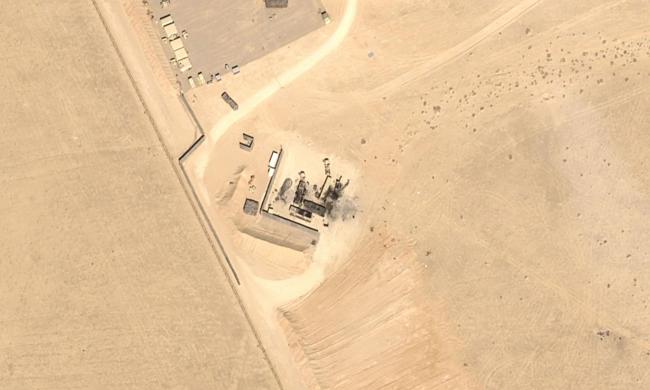 Satellite image taken on March 2, 2026. The THAAD radar at Muwaffaq Salti Air Base in Jordan is seen scorched with debris scattered around it. / Photo provided by Airbus. [Photo: CNN screen capture]
Issue 3: The Real Change This War Has Shown
The most notable aspect of the recent Middle East conflict is the number of drones.
There were 196 ballistic missiles, but 1,072 drones. In terms of attack scale, drones outnumbered missiles by more than five times.
This figure illustrates the altered structure of modern aerial warfare.
In the past, the core of aerial attacks consisted of ballistic missiles and fighter jets. However, in recent conflicts, drones, which are inexpensive and can be deployed in large numbers, have emerged as a central element of attack.
Because drones are low-cost and can be produced quickly, they can be utilized by the attacking side as a means to continuously pressure the air defense network.
Consequently, in recent wars, saturation attack strategies, which involve the simultaneous deployment of missiles and drones, are becoming increasingly important.
Interpretation: What is More Important Than the Interception Rate
What the UAE's announcement reveals is not a simple competition of weapon performance.
The figures of 196 ballistic missiles and 1,072 drones demonstrate that modern aerial warfare is a conflict operating on the balance between massed attacks and defense.
A 90% interception rate is undoubtedly a high level. However, it is also a figure that illustrates how a missile war unfolds amidst a competition of large-scale attack capabilities and defensive capabilities.
The recent Middle East conflict has reaffirmed one fact.
In modern missile warfare, the outcome is determined not by the performance of a single weapon, but by the structure and sustainability of the entire air defense network.

 Iranian Foreign Ministry: "Continuing Message Exchanges with the U.S. and Activities of Mediating Countries"
Esmaeil Baghaei, Spokesperson for the Iranian Ministry of Foreign Affairs [Xinhua, Yonhap News file photo]Esmaeil Baghaei, spokesperson for the Iranian Ministry of Foreign Affairs, stated on the 26th
Iranian Foreign Ministry: "Continuing Message Exchanges with the U.S. and Activities of Mediating Countries"
Esmaeil Baghaei, Spokesperson for the Iranian Ministry of Foreign Affairs [Xinhua, Yonhap News file photo]Esmaeil Baghaei, spokesperson for the Iranian Ministry of Foreign Affairs, stated on the 26th
 President Yoon: "Do You Think You Are Safe from the Special Counsel?"... Final Statement Video Released
President Yoon Suk Yeol rebuking the special prosecutor on the 24th. [Court video / @birds_justice X account subtitle GIF] A video of President Yoon Suk Yeol's closing statement at his trial rega
President Yoon: "Do You Think You Are Safe from the Special Counsel?"... Final Statement Video Released
President Yoon Suk Yeol rebuking the special prosecutor on the 24th. [Court video / @birds_justice X account subtitle GIF] A video of President Yoon Suk Yeol's closing statement at his trial rega
 President Yoon, regarding the first-instance ruling on the Public Official Election Act: “An excessive political verdict that distorts the facts… We will appeal immediately.”
The first-instance sentencing hearing for President Yoon Suk Yeol regarding violations of the Public Official Election Act is being broadcast live at Seoul Station on the 27th. [Photo=Yonhap News]Pres
President Yoon, regarding the first-instance ruling on the Public Official Election Act: “An excessive political verdict that distorts the facts… We will appeal immediately.”
The first-instance sentencing hearing for President Yoon Suk Yeol regarding violations of the Public Official Election Act is being broadcast live at Seoul Station on the 27th. [Photo=Yonhap News]Pres
 WSJ: "SK Hynix ADR Premium Is a Sign of AI Trading Overheat"
Advertisement for SK Hynix ADR listing in New York's Times Square [Reuters=Yonhap News file photo]The Wall Street Journal (WSJ) has pointed out that the price of SK Hynix’s American Depositary Recei
WSJ: "SK Hynix ADR Premium Is a Sign of AI Trading Overheat"
Advertisement for SK Hynix ADR listing in New York's Times Square [Reuters=Yonhap News file photo]The Wall Street Journal (WSJ) has pointed out that the price of SK Hynix’s American Depositary Recei
 'Godfather of Japanese Mystery Novels' Keigo Higashino Passes Away After Battle with Cancer at 68
Famous Japanese mystery novelist Keigo Higashino [AFP=Yonhap News]It has been belatedly reported that Keigo Higashino, the "godfather of Japanese mystery novels" and author of bestsellers such as "The
'Godfather of Japanese Mystery Novels' Keigo Higashino Passes Away After Battle with Cancer at 68
Famous Japanese mystery novelist Keigo Higashino [AFP=Yonhap News]It has been belatedly reported that Keigo Higashino, the "godfather of Japanese mystery novels" and author of bestsellers such as "The
 [Park Pil-kyu Security Column] To the Ignorant Trying to Clothe a Beast in Sheep's Clothing
Rep. Kim Byung-joo of the Democratic Party of Korea [Photo=Yonhap News]“The Air Force Academy doesn't teach you how to fly a plane!” “The Army, Navy, and Air Force academies are exactly the
[Park Pil-kyu Security Column] To the Ignorant Trying to Clothe a Beast in Sheep's Clothing
Rep. Kim Byung-joo of the Democratic Party of Korea [Photo=Yonhap News]“The Air Force Academy doesn't teach you how to fly a plane!” “The Army, Navy, and Air Force academies are exactly the
 [Issue Diagnosis] Two Effects of the Election Petition Review
 [Photo] Evidence of Election Fraud Flooding U.S. Media… Trump Had 2.7 Million Votes Stolen
 [Video] U.S. Semiquincentennial Air Show... 'Art in the Sky' streaks across New York
 [Editorial Cartoon] A Draconian Law That Undermines Freedom of Expression

 List
List









