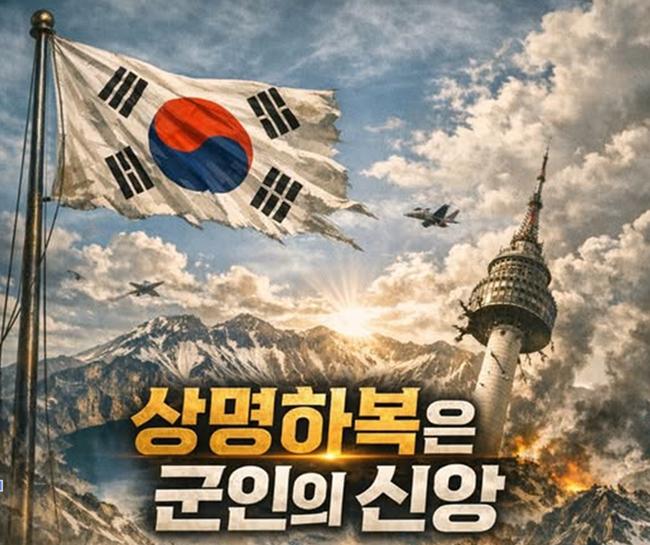
 The military defends the nation when orders are upheld; the nation collapses when orders are shaken.
A worrying phenomenon is currently occurring within the Republic of Korea's military. Overt legal and institutional attempts are being made to weaken the fundamental principle of the military: chain of command (subordination to superiors).
The Ministry of National Defense has expressed its agreement to amend the "Act on the Performance of Duties by Military Personnel" by adding a provision that states, "Clearly unlawful orders may be refused." This follows the events of the December 12th military coup, and legislation related to military justice and human rights is moving in a direction that reduces the authority of commanders.
This is a dangerous notion that risks shaking the military's fundamental principles of immediate obedience and the unity of the command structure, the chain of command, by allowing political controversy to interfere with internal military judgment.
The chain of command is an unwritten rule and a shared creed for protecting the people and the nation. The idea of allowing subordinates to judge the legality of orders is equivalent to denying the very reason for the military's existence.
The military operates on orders, and orders are premised on immediate execution, not choice. The moment this simple truth is shaken, the military ceases to be a military.
In combat situations, the moment the legitimacy of an order is questioned, the speed of response slows, and the direction of the gun might even change.
War is not a legal debate. In moments where life and death are at stake, if a subordinate is contemplating, "Is this order lawful or unlawful?", that unit has already lost its combat effectiveness.
The military defends the nation when orders are upheld; the nation collapses when orders are shaken.
Some criticize the chain of command as an outdated ill that leads to the disregard of individual opinions, concentration of power, and blind obedience. However, military orders are an essential element for commanding involuntary members to maintain liberal democracy and state functions.
If superiors must worry about legal responsibility with every order they issue, and subordinates are structured to find grounds for refusal, this destroys the military's strict order and professionalism, and weakens its combat readiness. If this atmosphere is not curbed, the military will degenerate into an armed club.
History has proven that the chain of command has determined the success or failure of armies.
During the Russian Revolution in 1917, "Order No. 1" was issued, making officers' orders subject to debate by soldiers' councils, which rapidly weakened the authority of command.
As the speed and consistency of orders vanished, desertions and refusals of orders surged, and ultimately, the Russian army lost its organizational combat power and effectively collapsed.
Later, the South Vietnamese army saw its command structure shaken by politically appointed loyalists. Commanders were appointed based on political criteria rather than professionalism, leading to a breakdown in command consistency. In combat situations, this resulted in a chain reaction of commanders fleeing and orders being disobeyed, becoming one of the reasons for the fall of South Vietnam.
These two examples demonstrate how military forces rapidly collapse when the chain of command is shaken.
Conversely, militaries that maintained the chain of command demonstrated organizational strength even in crises. In the 1815 Battle of Waterloo, Wellington integrated allied forces from multiple nations, including Britain, Prussia, and the Netherlands, under a single command structure, effectively thwarting Napoleon's attacks in a complex battlefield.
The 1944 Normandy landings involved a massive operation with hundreds of thousands of troops and thousands of ships and aircraft moving simultaneously. This was possible due to the strict, unified command of the Allied Supreme Headquarters, adhering to the chain of command.
On the 1950 Korean War's Nakdong River defense line, General Walker's "No Retreat" order played a decisive role in preventing chaos and maintaining the front, laying the crucial foundation for the subsequent counteroffensive.
In the 1967 Six-Day War, despite being numerically inferior, the Israeli army overwhelmed the Arab联合 forces with clear command and a swift order system, once again proving the effectiveness of the chain of command.
These cases from different eras and wars consistently show that armies that undermine the chain of command invariably collapse, while those that maintain it demonstrate organizational cooperation and combat power even in crises.
Ultimately, history has repeatedly proven that clear command, rapid orders, and organizational unity are the essence of a strong military.
Nevertheless, if attempts to weaken the military's chain of command are being pushed forward under the guise of political justification, this is not a measure for national security but a dangerous experiment for political purposes.
It is impossible not to know who benefits most when the military's command structure is shaken. These efforts can only be perceived as an attempt to turn the military into a club incapable of fighting wars, for the sake of maintaining the popularity of a regime, not for the nation's survival.
The military is the last bastion of the nation. If this bastion is shaken, the lives and property of the people cannot be protected. What is needed now is to firmly maintain the military's chain of command and allow the military to focus on its inherent mission of national defense.
The act of placing the military on the experimental table of politics must cease immediately. The military is not a lab rat.
The moment the chain of command is shaken, the military and the nation collapse. If the military's function collapses, who will benefit? The military, the security apparatus, and the politicians must not turn a blind eye to this simple truth.

◆ Commissioner Park Phil-kyu
Editor, The Hankook Ilbo
40th graduating class, Korea Military Academy

 Iranian Foreign Ministry: "Continuing Message Exchanges with the U.S. and Activities of Mediating Countries"
Esmaeil Baghaei, Spokesperson for the Iranian Ministry of Foreign Affairs [Xinhua, Yonhap News file photo]Esmaeil Baghaei, spokesperson for the Iranian Ministry of Foreign Affairs, stated on the 26th
Iranian Foreign Ministry: "Continuing Message Exchanges with the U.S. and Activities of Mediating Countries"
Esmaeil Baghaei, Spokesperson for the Iranian Ministry of Foreign Affairs [Xinhua, Yonhap News file photo]Esmaeil Baghaei, spokesperson for the Iranian Ministry of Foreign Affairs, stated on the 26th
 President Yoon: "Do You Think You Are Safe from the Special Counsel?"... Final Statement Video Released
President Yoon Suk Yeol rebuking the special prosecutor on the 24th. [Court video / @birds_justice X account subtitle GIF] A video of President Yoon Suk Yeol's closing statement at his trial rega
President Yoon: "Do You Think You Are Safe from the Special Counsel?"... Final Statement Video Released
President Yoon Suk Yeol rebuking the special prosecutor on the 24th. [Court video / @birds_justice X account subtitle GIF] A video of President Yoon Suk Yeol's closing statement at his trial rega
 President Yoon, regarding the first-instance ruling on the Public Official Election Act: “An excessive political verdict that distorts the facts… We will appeal immediately.”
The first-instance sentencing hearing for President Yoon Suk Yeol regarding violations of the Public Official Election Act is being broadcast live at Seoul Station on the 27th. [Photo=Yonhap News]Pres
President Yoon, regarding the first-instance ruling on the Public Official Election Act: “An excessive political verdict that distorts the facts… We will appeal immediately.”
The first-instance sentencing hearing for President Yoon Suk Yeol regarding violations of the Public Official Election Act is being broadcast live at Seoul Station on the 27th. [Photo=Yonhap News]Pres
 WSJ: "SK Hynix ADR Premium Is a Sign of AI Trading Overheat"
Advertisement for SK Hynix ADR listing in New York's Times Square [Reuters=Yonhap News file photo]The Wall Street Journal (WSJ) has pointed out that the price of SK Hynix’s American Depositary Recei
WSJ: "SK Hynix ADR Premium Is a Sign of AI Trading Overheat"
Advertisement for SK Hynix ADR listing in New York's Times Square [Reuters=Yonhap News file photo]The Wall Street Journal (WSJ) has pointed out that the price of SK Hynix’s American Depositary Recei
 'Godfather of Japanese Mystery Novels' Keigo Higashino Passes Away After Battle with Cancer at 68
Famous Japanese mystery novelist Keigo Higashino [AFP=Yonhap News]It has been belatedly reported that Keigo Higashino, the "godfather of Japanese mystery novels" and author of bestsellers such as "The
'Godfather of Japanese Mystery Novels' Keigo Higashino Passes Away After Battle with Cancer at 68
Famous Japanese mystery novelist Keigo Higashino [AFP=Yonhap News]It has been belatedly reported that Keigo Higashino, the "godfather of Japanese mystery novels" and author of bestsellers such as "The
 [Park Pil-kyu Security Column] To the Ignorant Trying to Clothe a Beast in Sheep's Clothing
Rep. Kim Byung-joo of the Democratic Party of Korea [Photo=Yonhap News]“The Air Force Academy doesn't teach you how to fly a plane!” “The Army, Navy, and Air Force academies are exactly the
[Park Pil-kyu Security Column] To the Ignorant Trying to Clothe a Beast in Sheep's Clothing
Rep. Kim Byung-joo of the Democratic Party of Korea [Photo=Yonhap News]“The Air Force Academy doesn't teach you how to fly a plane!” “The Army, Navy, and Air Force academies are exactly the
 [Issue Diagnosis] Two Effects of the Election Petition Review
 [Photo] Evidence of Election Fraud Flooding U.S. Media… Trump Had 2.7 Million Votes Stolen
 [Video] U.S. Semiquincentennial Air Show... 'Art in the Sky' streaks across New York
 [Editorial Cartoon] A Draconian Law That Undermines Freedom of Expression

 List
List










