Ulsan Port Authority shares navigation information through Portwise. [Photo=Ulsan Port Authority]
Looking at the controversy surrounding the ‘missing 900,000 barrels of crude oil,’ one question immediately comes to mind: Why, and what were they afraid of, to the point of trying to hide such a simple fact? If this question cannot be answered, no matter how much the government shouts, "There is no problem," the public will no longer believe those words.
The essence of this controversy does not lie in the number 900,000 barrels itself. The more fundamental issue lies in the government's attitude of withholding even the minimum facts that the public can verify.
One of the direct triggers that escalated the controversy was the claim made by a YouTube channel that there was a "possibility of it flowing to North Korea via China." Of course, this is currently an assumption, not a confirmed fact.
However, what is important here is not the sensational nature of the assumption, but why an environment was created where such an assumption could be consumed as fact in an instant.
It is because the government did not disclose the facts in a timely manner. The space left by the absence of facts is always filled by speculation. The longer the silence, the bolder the imagination becomes. Doubts multiply on the information vacuum created by the government, and the public tries to fill that vacuum themselves.
Let's think logically. What the public is asking for is not a state secret.
It is the ship's name and date. Simply revealing the name of the vessel that carried the crude oil, the arrival date, and the name of the vessel that carried out the problematic 900,000 barrels would allow for basic verification.
The ship's route can be confirmed to a significant extent through commercial tracking networks and port records. At the very least, it would establish a starting point to determine whether the government's explanation is correct or incorrect, what route it took, and how far it can be confirmed.
Despite this, the Korea National Oil Corporation and the Ministry of Trade, Industry and Energy did not provide even this most basic information to the public. At this point, the question the public is asking is not "Where did the oil go?" but "Why are you hiding it?"
The government is always like this. When a problem arises, they shut down the core facts and only announce the conclusion. "There's nothing to worry about." "There's no problem." "Everything is fine."
However, in a democracy, what the government can demand from the public is not blind trust. Trust is established only on verifiable information. Reassurance without explanation is not reassurance, but a notification. Clarification without verification is not clarification, but self-assertion.
The more the government presents its attitude instead of evidence, the more deeply the public becomes suspicious.
The bigger problem is that this incident occurred at a time when anxiety about crude oil supply was increasing. If the numbers are not explained, the circumstances are unclear, and verifiable information is blocked, it is almost a natural progression for various interpretations and speculations to intervene.
The subsequent YouTube videos, hushed rumors, and exaggerated interpretations are the results, not the causes. The cause is always the same.
It is because the government views the public not as subjects of information, but as objects of management. They tell us only what they deem necessary to tell, and expect us to believe only as much as they expect. This arrogant governance habit ultimately breeds greater distrust.
Some say regarding this controversy, "Aren't unconfirmed claims being amplified too much?"
However, that criticism is only half true. It is true that unconfirmed claims are problematic. But the government, which failed to disclose even the minimum verifiable facts, should be criticized even before that.
A society where assumptions are consumed as facts is not usually created because citizens are overly suspicious. It is created because the government has blocked verifiable information.
The more the government closes its mouth, the more the public answers with suspicion. This is not a disease of the public, but a self-inflicted wound of the government.
The responsibility of the Korea National Oil Corporation and the Ministry of Trade, Industry and Energy for the 900,000 barrels already sold will be revealed through future audits by the Board of Audit and Inspection or additional inspections. Whether it was an administrative error, management negligence, confusion in the reporting system, or some other issue may be revealed later.
However, separate from the process of determining responsibility, the trust that has already collapsed is an ongoing loss.
Inventory can be replenished. Numbers can be corrected. But once trust hits rock bottom, it takes much longer to climb back up. What the government is losing now is not crude oil, but its trust asset.
The lesson learned from this incident is clear.
The public no longer lives in an era where they simply accept, "The government says so, so it must be true." This is especially true in areas where basic data tracking is possible, such as shipping, ports, logistics, and energy.
The more you try to hide, the more you are exposed. The more you close off, the more suspicion you invite. If the government still fails to understand this simple truth, similar controversies will repeat in the future.
And each time, the government will blame conspiracies, but what truly brings them down is not conspiracy, but opacity.
What should be feared is not the expression '900,000 barrels of missing crude oil'.
What is frightening is the reality that the public no longer accepts the government's explanations as the starting point of truth.
A controversy that could have been resolved by simply releasing the ship's name and date has escalated into a matter of the entire administration's credibility due to the government's silence and information blockade. This is the true cost of this incident.
There is something more expensive than crude oil. It is trust. If the government is kicking away that trust itself, who can it possibly hold accountable?

 Trump pressures for rate cut again ahead of FOMC... "Should be the lowest in the world"
U.S. President Donald Trump. [Photo = The White House] U.S. President Donald Trump once again pressured the Federal Reserve, the U.S. central bank, to lower interest rates on the 27th (local time
Trump pressures for rate cut again ahead of FOMC... "Should be the lowest in the world"
U.S. President Donald Trump. [Photo = The White House] U.S. President Donald Trump once again pressured the Federal Reserve, the U.S. central bank, to lower interest rates on the 27th (local time
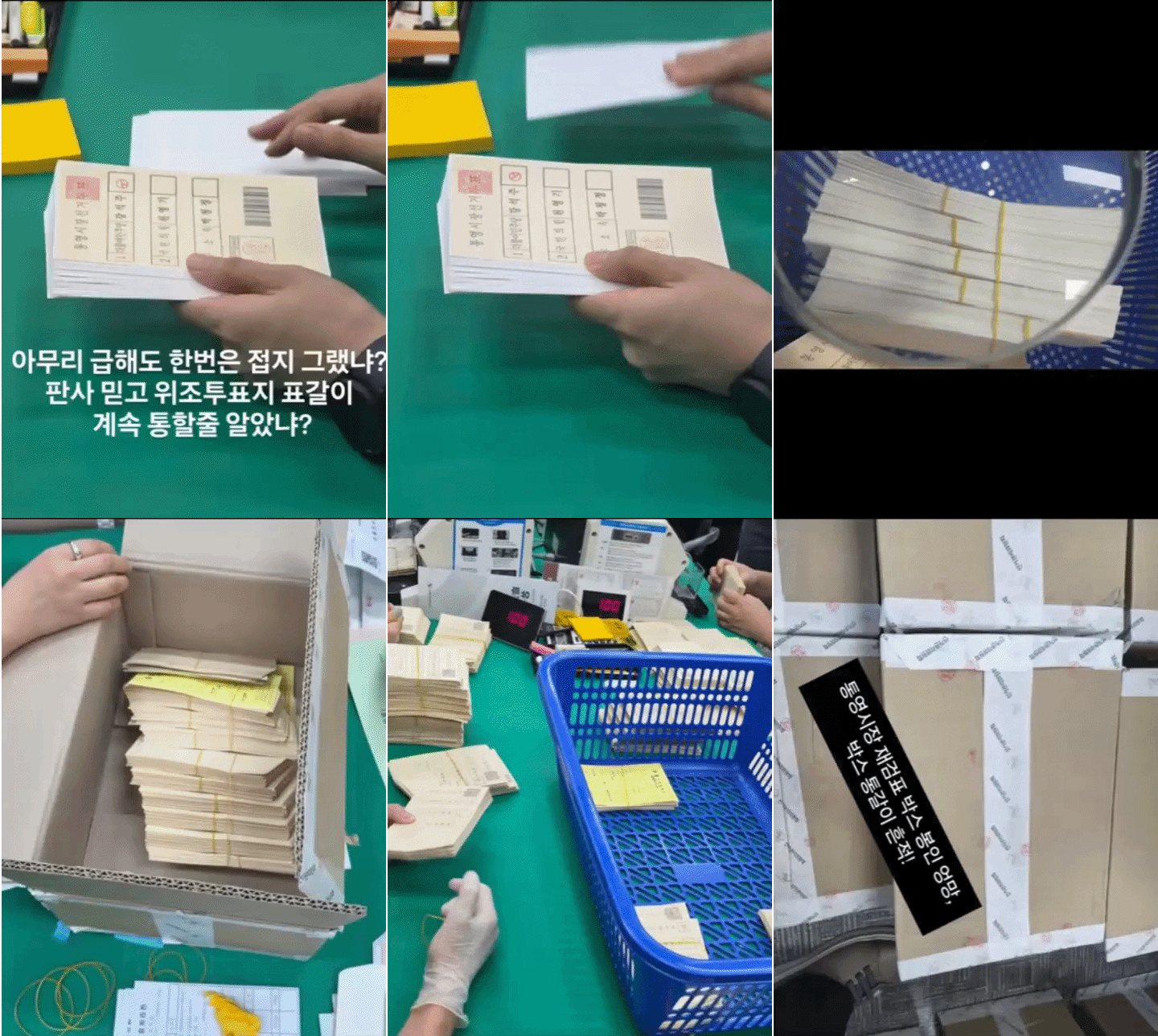 “Ignoring crisp ballots and damaged seals”… Tongyeong mayoral recount concludes with ‘no change in outcome,’ leaving suspicions and public outrage behind
Suspected counterfeit ballots discovered in Tongyeong [GIF from social media of Representative Hwang Kyo-ahn / Attorney Park Joo-hyun]During a recount of the Tongyeong mayoral election in South Gyeong
“Ignoring crisp ballots and damaged seals”… Tongyeong mayoral recount concludes with ‘no change in outcome,’ leaving suspicions and public outrage behind
Suspected counterfeit ballots discovered in Tongyeong [GIF from social media of Representative Hwang Kyo-ahn / Attorney Park Joo-hyun]During a recount of the Tongyeong mayoral election in South Gyeong
 President Yoon, regarding the first-instance ruling on the Public Official Election Act: “An excessive political verdict that distorts the facts… We will appeal immediately.”
The first-instance sentencing hearing for President Yoon Suk Yeol regarding violations of the Public Official Election Act is being broadcast live at Seoul Station on the 27th. [Photo=Yonhap News]Pres
President Yoon, regarding the first-instance ruling on the Public Official Election Act: “An excessive political verdict that distorts the facts… We will appeal immediately.”
The first-instance sentencing hearing for President Yoon Suk Yeol regarding violations of the Public Official Election Act is being broadcast live at Seoul Station on the 27th. [Photo=Yonhap News]Pres
 WSJ: "SK Hynix ADR Premium Is a Sign of AI Trading Overheat"
Advertisement for SK Hynix ADR listing in New York's Times Square [Reuters=Yonhap News file photo]The Wall Street Journal (WSJ) has pointed out that the price of SK Hynix’s American Depositary Recei
WSJ: "SK Hynix ADR Premium Is a Sign of AI Trading Overheat"
Advertisement for SK Hynix ADR listing in New York's Times Square [Reuters=Yonhap News file photo]The Wall Street Journal (WSJ) has pointed out that the price of SK Hynix’s American Depositary Recei
 'Godfather of Japanese Mystery Novels' Keigo Higashino Passes Away After Battle with Cancer at 68
Famous Japanese mystery novelist Keigo Higashino [AFP=Yonhap News]It has been belatedly reported that Keigo Higashino, the "godfather of Japanese mystery novels" and author of bestsellers such as "The
'Godfather of Japanese Mystery Novels' Keigo Higashino Passes Away After Battle with Cancer at 68
Famous Japanese mystery novelist Keigo Higashino [AFP=Yonhap News]It has been belatedly reported that Keigo Higashino, the "godfather of Japanese mystery novels" and author of bestsellers such as "The
 [Park Pil-kyu Security Column] To the Ignorant Trying to Clothe a Beast in Sheep's Clothing
Rep. Kim Byung-joo of the Democratic Party of Korea [Photo=Yonhap News]“The Air Force Academy doesn't teach you how to fly a plane!” “The Army, Navy, and Air Force academies are exactly the
[Park Pil-kyu Security Column] To the Ignorant Trying to Clothe a Beast in Sheep's Clothing
Rep. Kim Byung-joo of the Democratic Party of Korea [Photo=Yonhap News]“The Air Force Academy doesn't teach you how to fly a plane!” “The Army, Navy, and Air Force academies are exactly the
 [Issue Diagnosis] Two Effects of the Election Petition Review
 [Photo] Evidence of Election Fraud Flooding U.S. Media… Trump Had 2.7 Million Votes Stolen
 [Video] U.S. Semiquincentennial Air Show... 'Art in the Sky' streaks across New York
 [Editorial Cartoon] A Draconian Law That Undermines Freedom of Expression

 List
List