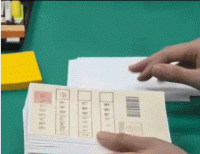
A symbolic image combining former US President Ronald Reagan with the silhouettes of barbed wire, watchtowers, and three dogs. The 'three dogs' satire, frequently cited by Reagan during the Cold War, concisely illustrates that the fundamental tragedy lies not in the lack of food, but in the loss of freedom of expression. [Composite by Hani Daily]
The May 18th Gwangju Uprising is a tragedy in modern Korean history. This is undeniable. The period leading up to the spring of 1980, following the assassination of President Park Chung-hee on October 26th and the December 12th military coup, was a turbulent time when national power, social order, and public sentiment were all shaken.
Student movements were strong, citizen participation expanded, and the shadow of martial law deepened. While industrialization accelerated in the 1970s, political divisions widened even faster. What happened in Gwangju was one of the most tragic scenes born out of that chaotic era.
The issue is not the tragedy itself, but how the nation handles that tragedy.
Remembering a tragedy and monopolizing its interpretation are two different things.
A prime example is the theory of North Korean involvement. In this regard, the nation's role should be to 'manage the debate,' not to prevent it through law.
There are also arguments to define the May 18th Uprising through special legislation, grant it an official national narrative, and even include it in the preamble of the constitution.
However, the debate surrounding the full details of that day has not yet ended.
Declassified US Central Intelligence Agency documents, analyses from overseas conservative research institutions, and some testimonies suggesting the possibility of North Korean involvement are posing questions that differ from the established national narrative.
Of course, not all claims can be true. Some claims may be absurd. However, in a free and democratic society, such judgments should be determined through verification and counter-arguments, not by suppressing the questions themselves with special laws.
It is at this juncture that the 'three dogs' satire by former US President Ronald Reagan, who led to the collapse of the Soviet Union during the Cold War, comes to mind.
The most chilling part is the scene where the Russian dog asks, "What is barking?" A society without food is a tragedy, but a society that doesn't even know what freedom of speech is is a more terrifying society.
Freedom of expression is an inherent human right. If that inherent human right begins to be restricted in the name of law, that society can no longer be considered a normal liberal democratic society.
If asking different questions about history, re-examining the framework of memory established by the state, and raising doubts that cannot be resolved by existing explanations are all considered sins, then that country is not a 'nation that protects freedom,' but a 'nation that manages freedom.'
The controversy over fraudulent elections that intensified after 2020 is similar.
The suspicions, which began with the April 15th general election, have gone beyond mere election law violations. After each election, winning candidates and nominees are tried for violations of the Public Official Election Act, and some are convicted.
However, the recent controversy over fraudulent elections is not an issue of post-conviction punishment. It has escalated into a matter of systemic trust, with multiple claims piling up, including distrust surrounding the introduction of electronic vote counting machines, the National Election Commission's closed-door operations, theories of Chinese intervention, theories of cartel backgrounds, and suspicions of collusion between the National Election Commission and judicial bodies.
The truthfulness of each claim must be examined individually. However, the mere fact that the suspicions have persisted for so long already shows that the foundation of trust in Korean society has been deeply eroded.
Despite this, the attitude of the establishment has been astonishingly arrogant.
When suspicions arise, the issue should have been to verify them transparently and resolve distrust with the verification results. There were methods, such as expanding manual vote counting, strengthening procedural transparency, or broadening the scope of monitoring. However, the National Election Commission fueled the controversy instead of reducing it.
It failed to absorb the demands for verification, failed to persuade the opposition, and was instead accustomed to portraying those who doubted as abnormal. The result is simple. The suspicions did not disappear, and distrust grew. This is why the National Election Commission, which escalated the issue to this point, should be criticized.
The May 18th Uprising and fraudulent elections are entirely different matters. One is a tragedy of modern history, and the other is a present-day systemic distrust.
However, there is a common thread that runs through both issues.
It is the issue of how the state handles truth. The state should be a tribunal for verification, not a judge of truth.
But Korean society is moving in the opposite direction. Some memories become sacred, and some doubts become taboos. Some questions are protected in the name of democracy, and some questions are punished in the name of democracy. This is the self-contradiction of liberal democracy.
Liberal democracy is not a system without doubts. It is a system where doubts can be voiced. It is a system where counter-arguments can be raised, where verification can be demanded, and where incorrect claims can be corrected through open facts and procedures.
It should be the same for questions surrounding history and for verification surrounding elections. The idea of establishing order by eliminating questions is not a democratic idea. It is simply the easiest option available to the arrogance of power.
The truth declared by the state is not always the truth.
Truth is not completed within the wording of laws; it only gains authority after enduring questions, counter-arguments, and verification. This is true for the memories surrounding the May 18th Uprising and for the suspicions surrounding fraudulent elections.
A nation that blocks questions is not a nation that protects truth. It is a nation that seeks to monopolize truth. It is a signal of dictatorship and the manifestation of totalitarianism.
The true standard of liberal democracy is not what the state proclaims as right. It is how far citizens can question.
If a nation begins to block questions about history, block verification of elections, and tame freedom of expression in the name of law, that nation may speak of democracy, but it has no right to speak of liberal democracy.

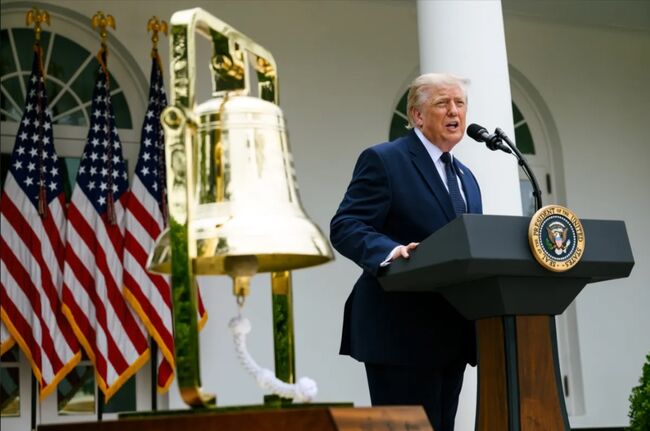 Trump pressures for rate cut again ahead of FOMC... "Should be the lowest in the world"
U.S. President Donald Trump. [Photo = The White House] U.S. President Donald Trump once again pressured the Federal Reserve, the U.S. central bank, to lower interest rates on the 27th (local time
Trump pressures for rate cut again ahead of FOMC... "Should be the lowest in the world"
U.S. President Donald Trump. [Photo = The White House] U.S. President Donald Trump once again pressured the Federal Reserve, the U.S. central bank, to lower interest rates on the 27th (local time
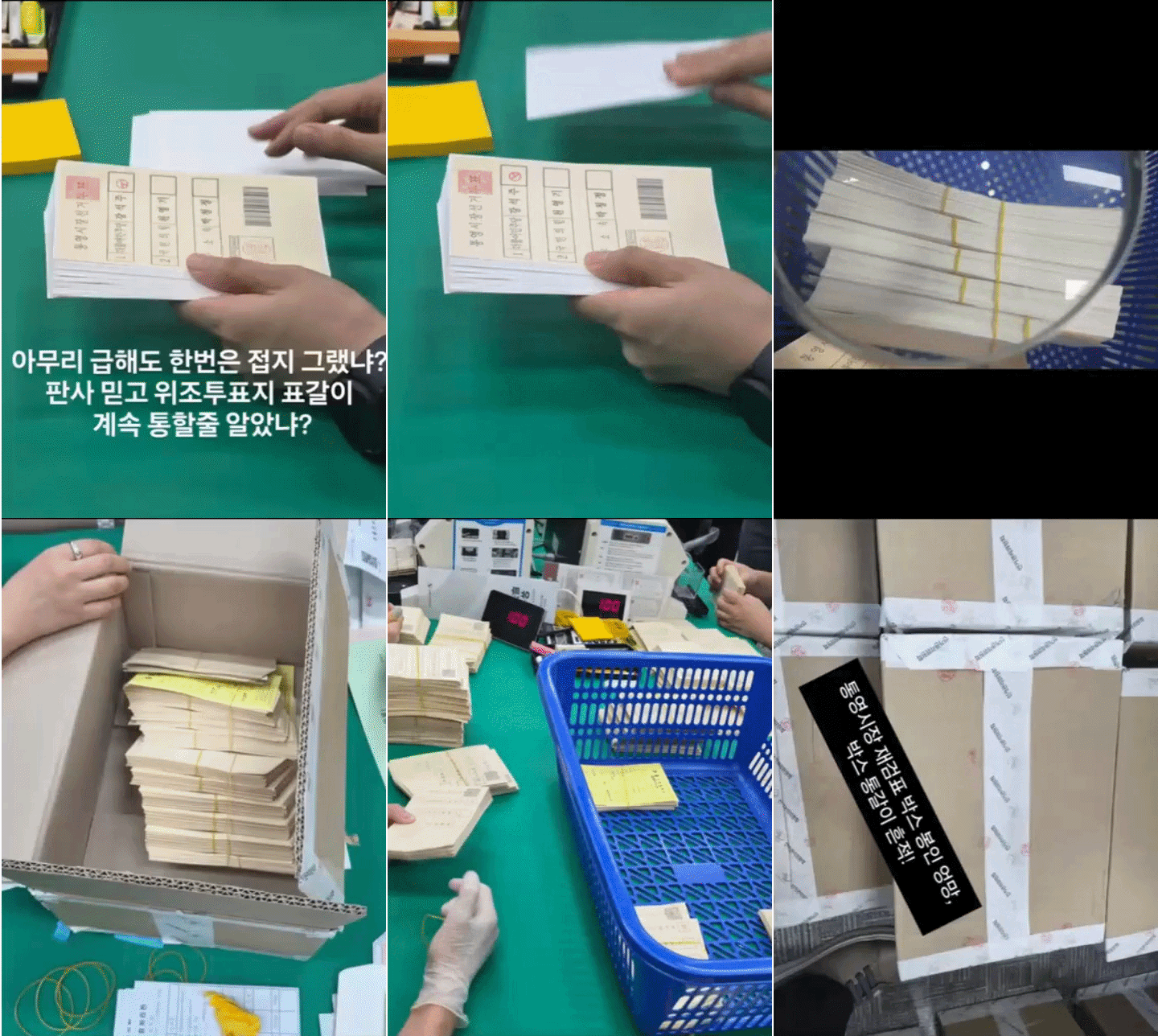 “Ignoring crisp ballots and damaged seals”… Tongyeong mayoral recount concludes with ‘no change in outcome,’ leaving suspicions and public outrage behind
Suspected counterfeit ballots discovered in Tongyeong [GIF from social media of Representative Hwang Kyo-ahn / Attorney Park Joo-hyun]During a recount of the Tongyeong mayoral election in South Gyeong
“Ignoring crisp ballots and damaged seals”… Tongyeong mayoral recount concludes with ‘no change in outcome,’ leaving suspicions and public outrage behind
Suspected counterfeit ballots discovered in Tongyeong [GIF from social media of Representative Hwang Kyo-ahn / Attorney Park Joo-hyun]During a recount of the Tongyeong mayoral election in South Gyeong
 President Yoon, regarding the first-instance ruling on the Public Official Election Act: “An excessive political verdict that distorts the facts… We will appeal immediately.”
The first-instance sentencing hearing for President Yoon Suk Yeol regarding violations of the Public Official Election Act is being broadcast live at Seoul Station on the 27th. [Photo=Yonhap News]Pres
President Yoon, regarding the first-instance ruling on the Public Official Election Act: “An excessive political verdict that distorts the facts… We will appeal immediately.”
The first-instance sentencing hearing for President Yoon Suk Yeol regarding violations of the Public Official Election Act is being broadcast live at Seoul Station on the 27th. [Photo=Yonhap News]Pres
 WSJ: "SK Hynix ADR Premium Is a Sign of AI Trading Overheat"
Advertisement for SK Hynix ADR listing in New York's Times Square [Reuters=Yonhap News file photo]The Wall Street Journal (WSJ) has pointed out that the price of SK Hynix’s American Depositary Recei
WSJ: "SK Hynix ADR Premium Is a Sign of AI Trading Overheat"
Advertisement for SK Hynix ADR listing in New York's Times Square [Reuters=Yonhap News file photo]The Wall Street Journal (WSJ) has pointed out that the price of SK Hynix’s American Depositary Recei
 'Godfather of Japanese Mystery Novels' Keigo Higashino Passes Away After Battle with Cancer at 68
Famous Japanese mystery novelist Keigo Higashino [AFP=Yonhap News]It has been belatedly reported that Keigo Higashino, the "godfather of Japanese mystery novels" and author of bestsellers such as "The
'Godfather of Japanese Mystery Novels' Keigo Higashino Passes Away After Battle with Cancer at 68
Famous Japanese mystery novelist Keigo Higashino [AFP=Yonhap News]It has been belatedly reported that Keigo Higashino, the "godfather of Japanese mystery novels" and author of bestsellers such as "The
 [Park Pil-kyu Security Column] To the Ignorant Trying to Clothe a Beast in Sheep's Clothing
Rep. Kim Byung-joo of the Democratic Party of Korea [Photo=Yonhap News]“The Air Force Academy doesn't teach you how to fly a plane!” “The Army, Navy, and Air Force academies are exactly the
[Park Pil-kyu Security Column] To the Ignorant Trying to Clothe a Beast in Sheep's Clothing
Rep. Kim Byung-joo of the Democratic Party of Korea [Photo=Yonhap News]“The Air Force Academy doesn't teach you how to fly a plane!” “The Army, Navy, and Air Force academies are exactly the
 [Issue Diagnosis] Two Effects of the Election Petition Review
 [Photo] Evidence of Election Fraud Flooding U.S. Media… Trump Had 2.7 Million Votes Stolen
 [Video] U.S. Semiquincentennial Air Show... 'Art in the Sky' streaks across New York
 [Editorial Cartoon] A Draconian Law That Undermines Freedom of Expression

 List
List