<목차>
① Simultaneous Local Elections: Expansion of Participation or Voter Turnout Calculation?
② Buma and May 18 in the Preamble: Commemoration or Re-narration of Legitimacy?
③ Constitutional Amendment for Martial Law Approval: Prevention of Recurrence or Parliamentary Supremacy?
④ One Line in the Addendum: Transitional Provision or Justification Effect for First Instance Logic?
⑤ The Trap of 'Equal Quality of Life': Regional Development or Constitutionalization of Statism?
⑥ Summary - What is the Problem?
 Leaders of political parties pushing for constitutional amendment meet with the Speaker of the National Assembly. The People Power Party opposed the constitutional amendment and did not sign the agreement. [Photo=Yonhap News]
④ One Line in the Addendum: Transitional Provision or Justification Effect for First Instance Logic?
Amending martial law provisions in light of December 3rd, The addendum states, "Dispositions and acts valid under the previous constitution shall be deemed as dispositions and acts under the new constitution." The issue is not the intention, but the justification effect that the appellate court can rely on. |
Surprisingly, the most sensitive part of this proposed constitutional amendment is the addendum, rather than the main text.
Article 2, Paragraph 2 of the addendum to the amendment bill states: "Dispositions and acts, etc., validly carried out under the former constitution shall be deemed as dispositions and acts, etc., under this constitution." Taken in isolation, the sentence might appear to be a common transitional provision.
However, the proposed amendment bill directly mentions the state of emergency martial law of December 3rd in its statement of purpose, stating that the current constitution lacks adequate countermeasures against unconstitutional and illegal attempts at martial law, and therefore the right to demand the lifting of martial law should be strengthened to a right to lift it, and an approval right should be introduced.
In other words, within the same document that declares an amendment to martial law provisions following December 3rd, the continuity of national acts valid under the former constitution is included.
The reason why this provision is difficult to dismiss as mere legislative technique is that this issue is not a matter of the past but is intertwined with ongoing court proceedings.
Former President Yoon Suk-yeol was sentenced to life imprisonment in the first trial for charges of leading a rebellion. The appellate trial has been assigned to the Seoul High Court's Criminal Division 12. It is anticipated that issues such as the timing and degree of preparation for the martial law conspiracy, and the evaluation of evidence not accepted in the first trial, will be re-examined in the appellate trial.
Ultimately, the core issue debated in court is not simply whether December 3rd was politically appropriate, but what legal character the national acts of that time possessed.
What needs to be clarified on this point is that this addendum is not a provision that immediately changes the outcome of the trial. Criminal trials are judged based on the constitution and criminal law in effect at the time of the act.
Article 13 of the Constitution stipulates the principle of applying the law at the time of the act and prohibits the restriction of political rights and the deprivation of property rights through retroactive legislation. The Constitutional Court has also consistently held that true retroactive legislation, which applies a new law in reverse to factual relationships that have already concluded, is generally not permitted.
Therefore, it is not accurate to say that this single line in the addendum immediately overturns the illegality of the acts during December 3rd, or automatically upholds or invalidates the guilty verdict of the first trial.
Then why is it problematic?
The key lies in the justification effect rather than the legal effect.
The first trial judged the December 3rd martial law as a rebellion, but there have been criticisms that its legal reasoning was forced and lacked logical leaps. If the concurrently proposed constitutional amendment then states in its addendum that acts valid under the former constitution are considered acts under the new constitution, the appellate court could interpret this to lend constitutional authority to the flawed logic of the first trial.
In other words, the danger of this provision lies not in predetermining the outcome, but in making it easier to interpret the judgment structure established in the first trial as being within the continuity of the subsequent constitutional order.
The moment the same document declares that the current constitution's control structure for martial law was inadequate and, on the other hand, includes the continuity of national acts valid under the former constitution, the court is provided with additional interpretive material, such as: "There is no need to view the national actions at the time as being solely disconnected from the new constitutional order."
This is precisely why this addendum is read differently from ordinary transitional provisions. In peacetime, it could be understood as "continuing existing legitimate national actions as valid during the transition of the legal order."
However, this is a constitutional amendment that revises martial law provisions specifically in light of December 3rd. In such a document, the phrase "dispositions and acts validly carried out" goes beyond mere administrative continuity and naturally connects with the determination of the legality and validity of national acts currently being debated in court.
This increases the weight of the provision. While a single article may not directly change a court ruling, it is entirely possible to alter the interpretive environment surrounding the ruling.
Furthermore, the statement of purpose for the proposed amendment states that the current constitution's martial law control structure was insufficient and that the introduction of an approval right and a strengthened lifting right is intended to supplement this. This, in itself, is an acknowledgment by the legislator of the insufficiency of the current system.
However, if the same amendment bill includes in its addendum the continuity of national acts valid under the former constitution, it paradoxically allows for the counter-argument in the appellate court that "the current constitutional order at the time of the act was not as strict as it is now, and the power to amend the constitution is also taking over the validity of former national acts into the new order on that premise."
This is precisely why this addendum is not just a subordinate clause.
The question is sufficient.
Why, of all times, amend martial law provisions in light of December 3rd, and simultaneously include an addendum declaring the continuity of national acts valid under the former constitution?
If a truly ordinary transitional provision was necessary, it would have been possible to include a proviso at least stating that this provision does not affect the ongoing determination of validity and illegality.
Without such safeguards, this sentence is no longer neutral. This is not an interpretation that forcibly imposes political meaning, but an interpretive burden that the provision itself incurs.
Ultimately, the issue of the addendum to this proposed constitutional amendment can be summarized in one sentence.
The problem is the justification effect. Regardless of the validity of the logic established by the first trial, this single line can be mobilized in the appellate court as a basis for interpretation that lends the weight of the subsequent constitutional order to that judgment.
Even if it is not a provision that directly changes the judgment of illegality of a rebellion, it is by no means insignificant in that it can provide an additional layer of constitutional veneer to the weak logic of the first trial.
This is why the shortest sentence in the proposed amendment can have the longest ripple effect.
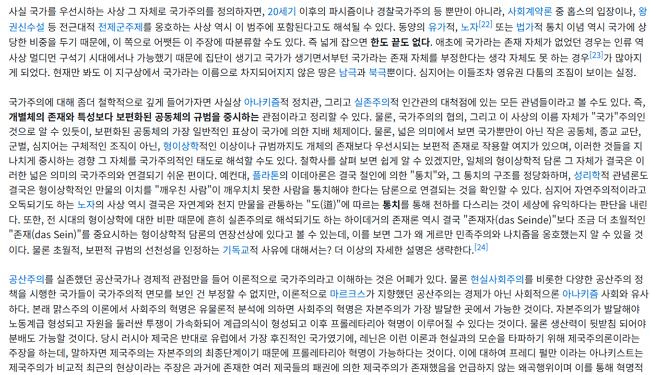 Screenshot of the explanation of statism written on Namu Wiki
⑤ The Trap of 'Equal Quality of Life': Regional Development or Constitutionalization of Statism?
The current constitution only stipulates the obligation to 'foster regional economies.'
The amendment expands state responsibility to include 'equal quality of life and opportunities.'
Although it sounds like a good phrase, the state now becomes a designer of life, not just a supporter.
If one were to pick the most innocuous provision in this proposed constitutional amendment, many would point to the regional balanced development clause.
The concentration in the Seoul metropolitan area is severe, the demise of rural areas is a reality, and the disparities in education, healthcare, culture, jobs, housing, and transportation are leading to disparities in life. It is difficult to disagree with this.
The statement of purpose for the proposed bill also highlights this point. It states that the shadow of low birth rates and an aging population is deepening, more than half of all local governments are classified as areas facing extinction, and more than half of the total population is concentrated in certain regions.
It further explains that regional imbalance manifests as disparities in education, healthcare, culture, jobs, and differences in life opportunities based on residential area. On the surface, this provision appears to be a common-sense statement reflecting the challenges of the times.
The problem lies in the next part.
Article 123, Paragraph 2 of the current Constitution states: "The State shall have the duty to foster the regional economy for balanced development among regions." This is a sentence that confines the state's responsibility within the relatively narrow framework of 'fostering regional economies.'
However, the proposed amendment changes this to: "The State shall foster regional economies and establish living foundations to resolve regional disparities and promote balanced development, so that all citizens can enjoy an equal quality of life and opportunities, regardless of their residential region."
In its statement of purpose, the proposed bill explains that the scope of these living foundations encompasses education, healthcare, culture, jobs, housing, and transportation.
This is not mere supplementation. It is a declaration that the state will undertake constitutional responsibility not only for regional economic support but also for the living conditions of individual citizens.
The key word here is not 'balance' but 'equality' (or 'equity').
'Balance' means reducing disparities. It is a concept that aims to mitigate imbalance while acknowledging the reality that regions have different conditions, industrial structures, and population and geographical characteristics.
However, 'equality' is different. Equality goes beyond simply compensating for lagging areas; it requires someone to define what constitutes an equal standard of life and what level of opportunity should be the same.
In particular, the amendment includes not only opportunities but also quality of life.
While "equality of opportunity" can be read as a liberal statement, "equality of quality of life" provides a stronger basis for state intervention. This is because "quality of life" is a concept that encompasses overall state policies, such as educational attainment, access to healthcare, cultural infrastructure, transportation networks, housing conditions, and job structures.
Therefore, this provision, while ostensibly about regional development, is in reality a sentence that qualitatively expands the role of the state.
Nice words are not always good constitutions.
The phrase "equal quality of life and opportunities" sounds smooth and is difficult to oppose. However, once it enters the constitution, its meaning changes.
The state is no longer a supporter merely laying roads and attracting industrial complexes. It becomes the entity that determines what level of education is equal, what level of healthcare access is equal, what housing conditions are equal, and what level of cultural enjoyment is equal, and redistributes resources, budgets, and systems accordingly.
In other words, the state moves beyond being a helper to regions and becomes a designer of life standards.
The problem is not regional development. The issue is that the focus of the provision shifts from regions to life, from the economy to living conditions, and from support to intervention. The state is essentially writing its own constitutional justification for intervening in individuals' lives.
It is at this very point that the door to statism opens.
Statism does not always appear with the face of overt oppression. Rather, more realistic statism always borrows the language of good intentions. Words like balance, equality, public interest, opportunity, quality of life, responsibility, and solidarity are all good words in themselves.
However, when the state decides to what extent citizens' lives must conform for the sake of good purposes, and determines to what extent regional differences are permissible, and how much fiscal transfer and living foundation compensation should be provided, freedom and autonomy are increasingly pushed aside.
The state ceases to be merely an entity that provides conditions and becomes an entity that defines what constitutes a desirable life.
Dictatorship and totalitarianism do not always come with tanks and guns. When the state begins to determine the standards of life on behalf of individuals, the foundation is already being laid.
Of course, this does not mean that this provision immediately leads to a dictatorial constitution. Such a conclusion would weaken the argument.
A more accurate statement is this: this provision, under the pretext of resolving regional disparities, expands the role of the state from economic support to designing living conditions. Today, it may be interpreted with good intentions. However, the constitution is not a document written solely for today's good intentions.
Any power that comes into office will interpret and wield that text. Therefore, constitutional texts must always be safe even when read by the worst possible powers.
By that standard, "equal quality of life and opportunities" is too broad, too sweet, and leaves too much room for interpretation.
In particular, this provision can also obscure the structure of responsibility for policy failures.
Fostering regional economies is relatively concrete. One can question which industries to revitalize, what tax incentives to provide, and what infrastructure to build.
However, equality of quality of life is abstract. It is difficult to evaluate the results, and it easily leads to the justification of "it is still insufficient, so more intervention is needed."
Ultimately, the constitution assigns endless tasks to the state, and politics uses these tasks to justify greater fiscal spending, broader regulation, and deeper intervention in daily life.
It begins in the name of regional balanced development, but in reality, it is likely to become a mechanism for the constant expansion of state intervention.
This provision is even more interesting given that the proposed amendment refers to itself as a "minimal amendment."
The martial law provisions and addendum, at least, put forward the justification of institutional improvement after December 3rd.
However, the amendment to Article 123 is closer to a revision of state philosophy than institutional improvement.
While the current constitution imposes a relatively restrained duty to foster regional economies, the amendment goes further, positing that the state must ensure equal quality of life and opportunities for its citizens.
This is not a simple reinforcement but a shift in perspective on the role of the state. And that shift is far more weighty than one might think.
Ultimately, the real issue with the proposed amendment to Article 123 is not whether one supports or opposes regional development.
The question is more fundamental. Should the state, beyond helping regions, be able to determine, in the name of the constitution, the extent to which citizens' lives should be equal?
The moment we readily answer "yes" to this, we lower the threshold for statism in the name of regional balanced development.
The word 'balance' is used with caution. However, the word 'equality' is much more dangerous.
Support can complement freedom, but design begins to replace freedom. This is the problem with this provision.
It is the point where a sentence that sounds like a good phrase can become the starting point for transforming the state from a supporter to a designer.
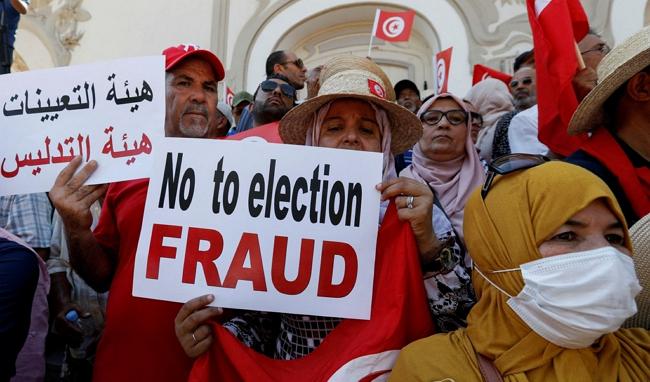 The draft amendment prepared by Tunisian President Kais Saied (64) grants immense power to the president, raising concerns of a slide into dictatorship, with a referendum to be held on the 25th. July 25, 2022 [Photo=Yonhap News]
⑥ Summary - What is the Problem?
It touches upon procedures, history, power, trials, and state philosophy simultaneously. This is not a minor amendment, but a bill that rewrites the entire constitutional order. |
The proposed constitutional amendment describes itself as "an amendment that proceeds step-by-step within the scope of consensus."
The statement of purpose also states that holding a national referendum on constitutional amendment along with the local elections on June 3rd would increase public participation and reduce costs.
It presents the amendment of the preamble, the introduction of parliamentary approval for martial law, the stipulation of the obligation to resolve regional disparities and promote balanced development, and transitional provisions in the addendum as key contents.
On the surface, it appears to be a "minimal amendment," but as one follows the articles, this amendment bill simultaneously addresses procedures, history, power structure, interpretation of trials, and the role of the state.
The first issue is procedure.
As evident from the remarks of National Assembly Speaker Woo Won-shik and the statement of purpose for the amendment bill, this plan was conceived from the outset with the simultaneous holding of local elections in mind. The issue is not the pretext of increased participation, but the calculation of voter turnout hidden within it.
The current National Referendum Act requires both the participation of a majority of eligible voters and the approval of a majority of those who voted for a constitutional amendment to be confirmed. This means that a constitutional amendment must first overcome the hurdle of establishment before it can be voted on.
Therefore, linking it with local elections can only be interpreted as a calculation that relies on the basic turnout of local elections rather than the independent mobilizing power of the amendment bill itself.
The moment one attempts to clear the deliberately high threshold set by the constitution through the participation rate of another election, the legitimacy issue of the constitutional amendment begins with the procedure, not the content.
The second issue is the amendment of the constitutional preamble.
The proposed amendment states that the "democratic spirit of the April 19 Revolution" in the current preamble will be changed to "the democratic spirit of the April 19 Revolution, the Buma Democratization Movement, and the May 18 Democratization Movement." This is not a matter of simply adding a commemorative phrase.
The preamble of the constitution is a statement that declares the historical foundations upon which the state bases its legitimacy. The moment a particular event is included in the preamble, it ceases to be a mere historical evaluation and becomes a constitutional historical narrative chosen by the state.
Ultimately, this amendment of the preamble is not about commemoration but about re-narration of legitimacy.
Moreover, the "investigation" surrounding May 18 today cannot be separated from the process by which the state has institutionalized official conclusions through special laws, investigative bodies, and criminal penalty provisions, rather than being solely the result of free questioning and verification.
In this context, including specific events in the preamble is less about writing a sentence of integration and more about choosing to seal the state's chosen historical interpretation into the constitution.
The third issue is the martial law provisions.
The proposed amendment changes the current constitution's structure of "notification to the National Assembly" and "demand for lifting" to a structure of "parliamentary approval" and "immediate loss of effect."
If martial law is declared, the president must immediately notify and obtain approval from the National Assembly, and if approval is not granted or is rejected within 48 hours, it immediately loses effect. On the surface, it appears to be a measure to prevent recurrence of December 3rd.
However, the issue is not solely the pretext of preventing recurrence.
The 1987 constitutional system was not designed to unleash presidential power from the outset. Three former presidents became subject to judicial judgment, and two incumbent presidents had their duties suspended by impeachment resolutions.
In a system where the president does not have the right to dissolve the National Assembly, but the National Assembly has the right to impeach, subordinating emergency powers to parliamentary approval can only be interpreted as a constitutional amendment that pushes the emergency powers of the presidential system one step further towards a parliamentary-dominant order, regardless of its constitutionality.
Furthermore, emergencies inherently require a swift response. If their duration is also tied to parliamentary approval, there is an increased risk that the mechanism for preventing abuse could, in certain circumstances, become a mechanism that delays or neutralizes the emergency response structure itself.
The fourth issue is the addendum.
The addendum to the amendment bill states: "Dispositions and acts, etc., validly carried out under the former constitution shall be deemed as dispositions and acts, etc., under this constitution." In peacetime, this might read like a common transitional provision.
However, this proposed amendment is a document that explicitly states it will revise martial law provisions in light of December 3rd. When such a document simultaneously declares the continuity of national acts valid under the former constitution, the addendum is no longer a bland technical provision.
The issue is the justification effect, rather than the legal effect. Criticisms have been raised that the legal reasoning of the first trial contained forced elements and logical leaps, and this addendum can be mobilized in the appellate court as a basis for interpretation that makes it easier to view that judgment and the national acts of the time within the continuity of the subsequent constitutional order. This is why it is significant, despite being brief.
The fifth issue is Article 123.
The current constitution states that the state has an obligation to foster regional economies. However, the proposed amendment changes this to stipulate that the state has an obligation to establish living foundations and resolve disparities so that all citizens can enjoy "equal quality of life and opportunities" regardless of their residential region.
At this moment, the focus of the provision shifts from regions to life, from the economy to living conditions, and from support to intervention. The state is essentially writing its own constitutional justification for intervening in individuals' lives.
'Balance' means reducing disparities, but 'equality' requires someone to define what level of life and opportunity should be the same. Ultimately, the state moves from being a helper to regions to becoming a designer of life standards.
Although it sounds like a good phrase, it is at this very point that the door to statism opens.
To summarize, this proposed constitutional amendment is by no means a "minimal amendment."
As seen in Part 1, it has procedural issues; in Part 2, it constitutionalizes historical interpretation in the preamble; in Part 3, it alters the balance of power and the structure of emergency response; in Part 4, it sends signals to the interpretive environment of current trials; and in Part 5, it expands the state's role to the domain of life design.
Although it purports to be a minor amendment, it is in fact an amendment that simultaneously moves five pillars of the constitutional order.
Therefore, instead of viewing each article in isolation, we must ask why all these issues are included in a single document.
The answer is clear. This proposed amendment is not a procedural amendment, but an amendment that seeks to rewrite the very direction of the constitutional order.

 Trump pressures for rate cut again ahead of FOMC... "Should be the lowest in the world"
U.S. President Donald Trump. [Photo = The White House] U.S. President Donald Trump once again pressured the Federal Reserve, the U.S. central bank, to lower interest rates on the 27th (local time
Trump pressures for rate cut again ahead of FOMC... "Should be the lowest in the world"
U.S. President Donald Trump. [Photo = The White House] U.S. President Donald Trump once again pressured the Federal Reserve, the U.S. central bank, to lower interest rates on the 27th (local time
 “Ignoring crisp ballots and damaged seals”… Tongyeong mayoral recount concludes with ‘no change in outcome,’ leaving suspicions and public outrage behind
Suspected counterfeit ballots discovered in Tongyeong [GIF from social media of Representative Hwang Kyo-ahn / Attorney Park Joo-hyun]During a recount of the Tongyeong mayoral election in South Gyeong
“Ignoring crisp ballots and damaged seals”… Tongyeong mayoral recount concludes with ‘no change in outcome,’ leaving suspicions and public outrage behind
Suspected counterfeit ballots discovered in Tongyeong [GIF from social media of Representative Hwang Kyo-ahn / Attorney Park Joo-hyun]During a recount of the Tongyeong mayoral election in South Gyeong
 President Yoon, regarding the first-instance ruling on the Public Official Election Act: “An excessive political verdict that distorts the facts… We will appeal immediately.”
The first-instance sentencing hearing for President Yoon Suk Yeol regarding violations of the Public Official Election Act is being broadcast live at Seoul Station on the 27th. [Photo=Yonhap News]Pres
President Yoon, regarding the first-instance ruling on the Public Official Election Act: “An excessive political verdict that distorts the facts… We will appeal immediately.”
The first-instance sentencing hearing for President Yoon Suk Yeol regarding violations of the Public Official Election Act is being broadcast live at Seoul Station on the 27th. [Photo=Yonhap News]Pres
 WSJ: "SK Hynix ADR Premium Is a Sign of AI Trading Overheat"
Advertisement for SK Hynix ADR listing in New York's Times Square [Reuters=Yonhap News file photo]The Wall Street Journal (WSJ) has pointed out that the price of SK Hynix’s American Depositary Recei
WSJ: "SK Hynix ADR Premium Is a Sign of AI Trading Overheat"
Advertisement for SK Hynix ADR listing in New York's Times Square [Reuters=Yonhap News file photo]The Wall Street Journal (WSJ) has pointed out that the price of SK Hynix’s American Depositary Recei
 'Godfather of Japanese Mystery Novels' Keigo Higashino Passes Away After Battle with Cancer at 68
Famous Japanese mystery novelist Keigo Higashino [AFP=Yonhap News]It has been belatedly reported that Keigo Higashino, the "godfather of Japanese mystery novels" and author of bestsellers such as "The
'Godfather of Japanese Mystery Novels' Keigo Higashino Passes Away After Battle with Cancer at 68
Famous Japanese mystery novelist Keigo Higashino [AFP=Yonhap News]It has been belatedly reported that Keigo Higashino, the "godfather of Japanese mystery novels" and author of bestsellers such as "The
 [Park Pil-kyu Security Column] To the Ignorant Trying to Clothe a Beast in Sheep's Clothing
Rep. Kim Byung-joo of the Democratic Party of Korea [Photo=Yonhap News]“The Air Force Academy doesn't teach you how to fly a plane!” “The Army, Navy, and Air Force academies are exactly the
[Park Pil-kyu Security Column] To the Ignorant Trying to Clothe a Beast in Sheep's Clothing
Rep. Kim Byung-joo of the Democratic Party of Korea [Photo=Yonhap News]“The Air Force Academy doesn't teach you how to fly a plane!” “The Army, Navy, and Air Force academies are exactly the
 [Issue Diagnosis] Two Effects of the Election Petition Review
 [Photo] Evidence of Election Fraud Flooding U.S. Media… Trump Had 2.7 Million Votes Stolen
 [Video] U.S. Semiquincentennial Air Show... 'Art in the Sky' streaks across New York
 [Editorial Cartoon] A Draconian Law That Undermines Freedom of Expression

 List
List









