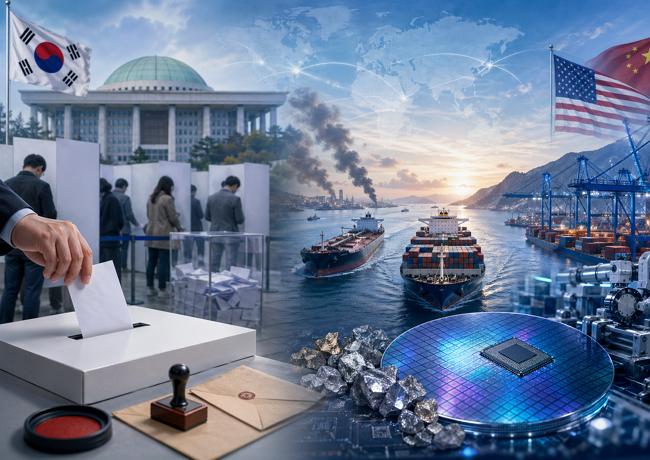
The simultaneous holding of a constitutional amendment referendum and the local elections will be a turning point in domestic politics in early to mid-May.
Controversies surrounding early voting, absentee voting, and vulnerable voters all converge on the issue of trust in election management.
The end of the US-Iran war and Trump's visit to China will mark a new beginning for supply chain reorganization.
May is a month where both domestic politics and international affairs will simultaneously plunge into turbulent times.
Domestically, the main contests for the June 3 local elections will intensify, and the decision on whether to hold a constitutional amendment referendum concurrently will reach a vote in the National Assembly. Internationally, a summit between the US and China is scheduled, and the end of the Iran war remains a key issue.
There is one overarching theme that runs through the month's news flow. Domestically, it is "election trust," and internationally, it is the "supply chain war."
Domestic Front: Local Elections, Constitutional Amendment Referendum, Early Voting Controversies, and Samsung Electronics Strike
While the June 3 local elections are officially in June, the actual political schedule is concentrated in May.
Candidate registration for the 9th National Simultaneous Local Elections will take place on May 14-15, and the election campaign period will begin on May 21. Early voting is scheduled for May 29-30. This structure means that candidate confirmation, election campaigning, and early voting will all occur throughout May, preceding the main vote on June 3.
What makes these local elections different from typical regional elections is the overlapping issue of a constitutional amendment referendum.
The Democratic Party of Korea has stated that if the constitutional amendment referendum is to be held simultaneously with the June 3 local elections, the National Assembly must pass the necessary resolution by May 11. They explain that this deadline is necessary to accommodate the practical preparations, such as the compilation of voter lists and ballots.
The proposed constitutional amendment itself has also entered the stage of a parliamentary vote.
According to reports, 187 lawmakers from six parties, excluding the People Power Party, have co-sponsored the constitutional amendment bill. A total of 191 votes are required for its passage, based on the total number of seats (286). The proposed amendments include provisions for refining the Preamble of the Constitution, strengthening control over martial law, and guaranteeing the right to an equal quality of life.
Therefore, the essence of domestic politics in May is not simply about which party will gain more local power. The larger issues are whether the method of holding a constitutional amendment referendum alongside the political schedule of local elections has been sufficiently explained, and whether the election management system is operating transparently enough to handle the added burden. (See related articles below)
It is highly likely that the early voting controversy will resurface within this context.
As early voting on May 29-30 approaches, issues such as the printing and stamping of early voting ballots, direct stamping by poll managers, management of roll paper quantities, absentee voting management, and statistics on voting paths for vulnerable voters could become contentious again.
The core of this issue is not about preempting election results. It is about whether the election process is being explained to the public in a verifiable manner.
On a secondary domestic front, there is the issue of the Samsung Electronics strike.
The Samsung Electronics branch of the Samsung Group's super-union has announced it will go on strike for 18 days starting May 21.
The union is raising issues related to the calculation of performance-based bonuses and compensation. It has been reported that a large number of union members participated in a rally at the Pyeongtaek plant. This matter could extend beyond a simple labor-management dispute to encompass risks related to the AI semiconductor supply chain, national core industries, and the possibility of early government intervention. (See related articles below)
International Front: End of the US-Iran War, US-China Summit
The international front is even more complex. The first gateway for international affairs in May is whether the US-Iran war will end.
U.S. President Trump is scheduled to visit China on May 14-15 to hold a summit with Chinese President Xi Jinping. However, this schedule was postponed once due to the Iran war before being rescheduled.
Therefore, President Trump's visit to China should be viewed not merely as a diplomatic event between the US and China, but as an opportunity to negotiate terms regarding the supply chain, trade, and security order with China after having somewhat resolved the Middle East conflict.
The problem is that the situation leading to the end of the war has not yet been fully resolved.
Reuters reported that President Trump was not satisfied with Iran's latest peace proposal, and that the US position of prioritizing the nuclear issue clashes with Iran's stance of prioritizing the end of the war and the issue of the Strait of Hormuz.
If Iran uses the issue of blockading the Strait of Hormuz and its ports as a bargaining chip, and the US maintains maritime pressure in response, the negotiations for ending the war will essentially become negotiations over the energy supply chain.
China's role also becomes significant at this point.
While strengthening diplomatic contacts with Iran, China is also making efforts to ensure a smooth preparation for the summit with President Trump. China is one of the world's largest energy importers and has maintained a strategic relationship with Iran.
For the United States to end the Iran war, China's cooperation is needed, and China can use that cooperation as leverage in its negotiations with the US.
Therefore, viewing the May US-China summit as a mere tariff negotiation is insufficient.
The official agenda for the summit may be trade and diplomacy, but underlying these are the end of the US-Iran war, stability in the Strait of Hormuz, international oil prices, rare earth elements, semiconductors, AI chips, electric vehicles, aircraft parts, and the Taiwan issue.
Even if the war ends, the issues will not. Rather, the next battlefield will be about who manages the energy routes, who controls key minerals and manufacturing networks, and who leads the semiconductor technology order after the war ends.
From South Korea's perspective, the situation is even more complex.
If the US-Iran war is prolonged, oil prices and maritime logistics will be disrupted, and Korean industries will bear the burden of increased energy costs and export logistics.
Even if the war ends, Korean companies may face renewed pressure during the process of reorganizing the post-war supply chain order by the US and China.
Semiconductors are caught between US technology controls and the Chinese market, while batteries are situated between China's control over materials and raw ingredients and the US's manufacturing protection policies. Shipbuilding, defense, and automobiles are also not immune to the reorganization of the US-China order after the Middle East conflict.
Ultimately, there is not just one international front in May.
First, will the US-Iran war end? Second, will President Trump carry the post-war resolution scenario to China? Third, how will the supply chain order be reconfigured after the US-China summit?
The end of a war is not the end of peace, but the starting point for further negotiations. This is the essence of international affairs in May.

 Iranian Foreign Ministry: "Continuing Message Exchanges with the U.S. and Activities of Mediating Countries"
Esmaeil Baghaei, Spokesperson for the Iranian Ministry of Foreign Affairs [Xinhua, Yonhap News file photo]Esmaeil Baghaei, spokesperson for the Iranian Ministry of Foreign Affairs, stated on the 26th
Iranian Foreign Ministry: "Continuing Message Exchanges with the U.S. and Activities of Mediating Countries"
Esmaeil Baghaei, Spokesperson for the Iranian Ministry of Foreign Affairs [Xinhua, Yonhap News file photo]Esmaeil Baghaei, spokesperson for the Iranian Ministry of Foreign Affairs, stated on the 26th
 President Yoon: "Do You Think You Are Safe from the Special Counsel?"... Final Statement Video Released
President Yoon Suk Yeol rebuking the special prosecutor on the 24th. [Court video / @birds_justice X account subtitle GIF] A video of President Yoon Suk Yeol's closing statement at his trial rega
President Yoon: "Do You Think You Are Safe from the Special Counsel?"... Final Statement Video Released
President Yoon Suk Yeol rebuking the special prosecutor on the 24th. [Court video / @birds_justice X account subtitle GIF] A video of President Yoon Suk Yeol's closing statement at his trial rega
 President Yoon, regarding the first-instance ruling on the Public Official Election Act: “An excessive political verdict that distorts the facts… We will appeal immediately.”
The first-instance sentencing hearing for President Yoon Suk Yeol regarding violations of the Public Official Election Act is being broadcast live at Seoul Station on the 27th. [Photo=Yonhap News]Pres
President Yoon, regarding the first-instance ruling on the Public Official Election Act: “An excessive political verdict that distorts the facts… We will appeal immediately.”
The first-instance sentencing hearing for President Yoon Suk Yeol regarding violations of the Public Official Election Act is being broadcast live at Seoul Station on the 27th. [Photo=Yonhap News]Pres
 WSJ: "SK Hynix ADR Premium Is a Sign of AI Trading Overheat"
Advertisement for SK Hynix ADR listing in New York's Times Square [Reuters=Yonhap News file photo]The Wall Street Journal (WSJ) has pointed out that the price of SK Hynix’s American Depositary Recei
WSJ: "SK Hynix ADR Premium Is a Sign of AI Trading Overheat"
Advertisement for SK Hynix ADR listing in New York's Times Square [Reuters=Yonhap News file photo]The Wall Street Journal (WSJ) has pointed out that the price of SK Hynix’s American Depositary Recei
 'Godfather of Japanese Mystery Novels' Keigo Higashino Passes Away After Battle with Cancer at 68
Famous Japanese mystery novelist Keigo Higashino [AFP=Yonhap News]It has been belatedly reported that Keigo Higashino, the "godfather of Japanese mystery novels" and author of bestsellers such as "The
'Godfather of Japanese Mystery Novels' Keigo Higashino Passes Away After Battle with Cancer at 68
Famous Japanese mystery novelist Keigo Higashino [AFP=Yonhap News]It has been belatedly reported that Keigo Higashino, the "godfather of Japanese mystery novels" and author of bestsellers such as "The
 [Park Pil-kyu Security Column] To the Ignorant Trying to Clothe a Beast in Sheep's Clothing
Rep. Kim Byung-joo of the Democratic Party of Korea [Photo=Yonhap News]“The Air Force Academy doesn't teach you how to fly a plane!” “The Army, Navy, and Air Force academies are exactly the
[Park Pil-kyu Security Column] To the Ignorant Trying to Clothe a Beast in Sheep's Clothing
Rep. Kim Byung-joo of the Democratic Party of Korea [Photo=Yonhap News]“The Air Force Academy doesn't teach you how to fly a plane!” “The Army, Navy, and Air Force academies are exactly the
 [Issue Diagnosis] Two Effects of the Election Petition Review
 [Photo] Evidence of Election Fraud Flooding U.S. Media… Trump Had 2.7 Million Votes Stolen
 [Video] U.S. Semiquincentennial Air Show... 'Art in the Sky' streaks across New York
 [Editorial Cartoon] A Draconian Law That Undermines Freedom of Expression

 List
List










