A U.S.-based Human Rights Activists News Agency (HRANA) reported on January 24th that 5,137 people had died in connection with the Iranian protests, with 12,904 more cases under investigation, and at least 7,402 additional severe injuries. [Photo=Yonhap News]
Among the terms used in Buddhism is "Yandanbeopseok." Originally, it referred to a grand Dharma assembly where many monks gathered to expound Buddhist teachings, but today it is more commonly understood to describe a scene where many people are talking and causing a commotion at the same time.
When news of the rescue of U.S. fighter jet crew members broke on April 5th, Western media and their South Korean counterparts erupted in a frenzy.
The problem lies in the South Korean media's adoption and reporting of the frame set by left-leaning foreign media.
When the disappearance was reported, they highlighted America's failures and divisions. However, with the news of the rescue, "but" and "however" invariably followed. They stirred up a fuss as if this single shootdown and rescue was the decisive moment determining the success or failure of the entire Iran war.
The word that comes to mind at this point is precisely "Yandanbeopseok."
War is not an exception in human affairs. War has been a significant axis of human history, and history has recorded the changes and outcomes brought about by wars rather than delivering moral judgments on them.
We look at who changed the order, what was destroyed, and what was newly built, rather than who was more virtuous.
However, the reporting on the Iran conflict was the opposite. The causes of the war and the reality of the threats, the broad flow of the war situation, and the direction of its outcomes were sidelined, while the emotional consumption of a single rescue operation was prioritized.
To be more precise, the problem is not exaggeration but a habit of downplaying significance.
Reuters described the rescue as a "big success" for U.S. President Trump, but immediately followed with details about U.S. casualties, the helicopter being hit, and Iran's counterattack capabilities. The Guardian, while acknowledging the propaganda effect of the rescue, shifted the focus in both its headline and body to "Iran can still fight."
Since they couldn't outright deny the success of the rescue, they acknowledged it but immediately appended counterbalancing statements to prevent its political and military significance from growing.
The problem isn't just the direction of the judgment; the bigger issue is the flimsy basis for that judgment.
To claim that the entire U.S. air superiority was fractured by a single shootdown and a single rescue operation, or that the strategic success was diminished because the rescue involved costs, is an overly thin argument.
In war, damage and costs are inherent. The mere fact that costs were incurred is not a refutation but an attribute of war.
Yet, prominent Western left-leaning media outlets frame this obvious reality as if it were a new discovery proving America's strategic vulnerability. It resembles an attitude of deciding on a conclusion first and then selectively attaching impressions that fit it, rather than a cool analysis.
Balance is needed here. Even if this rescue operation is significant, it does not immediately become the sole criterion for determining the success or failure of the entire Iran conflict. That is why the attitude of Western media is even more perplexing. Overstating the significance of the rescue is problematic, but conversely, deliberately downplaying its significance is also a problem.
Rescuing surviving crew members deep within enemy territory without any prisoners of war is, in itself, an expression of America's military strength, command structure, and national will.
The United States has already sustained casualties and injuries. On the contrary, because of that, the ability to ultimately extract surviving soldiers while accepting losses carries a meaning beyond tactical prowess. While there is no need to exaggerate victory, an attitude that refuses to acknowledge success as success is also abnormal.
This commotion is not just a problem for some media outlets; the attitudes of Western leaders are not much different.
Immediately after the conflict began, the European Union issued a joint statement calling for restraint and respect for international law, and tensions and distancing from U.S. military actions regarding the Iran conflict emerged within NATO. Spain and Austria imposing restrictions on U.S. military aircraft operations related to the Iran conflict are one example.
This is an attitude of relying on America's military power and maritime control for the existing order, while at the same time being unwilling to share the political responsibility for the exercise of that power.
Of course, politicians have a broader scope of understanding than the media. They must consider public opinion, elections, energy prices, alliance ruptures, and domestic politics. However, this makes them even more hypocritical.
If media hypocrisy is "hypocrisy of ideas," then political hypocrisy is perceived as "calculated hypocrisy," where risks are left to others while cowardice is hidden behind diplomatic language.
However, the more painful problem is some of South Korea's old media.
This commotion can also be read as a structure where Western media creates it, and South Korean media simply adopts it. Looking at Yonhap News alone, the dramatic narrative of the rescue scene and the immediately following frame of "a more dangerous war" were repeated on the same day.
Between articles like "U.S. Special Forces Deployed in the Heart of Iran... Missing U.S. Soldier Dramatically Rescued After Clash" and articles reporting foreign media interpretations that the war became more dangerous immediately after the rescue, there is almost no independent judgment from South Korean media.
It's not that South Korean media independently interpreted the military significance of the rescue; rather, they relayed the drama and warning grammar crafted by foreign media alternately. This is not prudence but an "outsourcing of thought."
What is more serious is the lack of a sense of reality in South Korean media.
Media in a country facing the substantial threat of North Korea's nuclear weapons should be more sensitive to Iran's nuclear issue and the violence of its new regime.
North Korea continues to expand its nuclear and missile capabilities and poses a direct threat to the security of South Korea and the surrounding region. Iran is also a subject that the International Atomic Energy Agency's February 2026 report pointed out again for undeclared nuclear material, nuclear-related activities, and unresolved issues regarding safeguards, and the U.S. State Department still designates Iran as a state sponsor of terrorism.
Despite this, some South Korean media focus more on the method of U.S. intervention and the political gains and losses of U.S. President Trump than on the essence of the Iranian regime.
While living under the fear of North Korea's nuclear program, they obscure the substantial threat that nuclear weapons and dictatorial regimes pose to the international order and instead highlight only Trump as the messenger.
This is cowardice, attacking the messenger because it's difficult to directly refute the message. In this regard, South Korean media is surprisingly similar to some Western media.
International politics is not a domestic criminal court. Good and evil are not determined solely by who struck first.
There are more important questions. What threats existed? How long could they have been tolerated? Who could control those threats, and at what cost? The West has long passed the actual burden of these questions to the United States. And when the United States took action, they belatedly invoked the language of morality to manage their own image.
The media disparages America's successes, and leaders, while standing on America's burden, cover their cowardice with words of restraint and balance. South Korean media, in turn, rewrites that frame, delegating the responsibility for judgment to foreign news. This was no different in the Iran conflict.
The essence of war lies in its outcome, not its scenes.
It is more important who shapes the flow of the war and who determines the direction of the order, rather than who was shot down once.
While the rescue operation can be given meaning as a scene, the attitude of deliberately downplaying the scene's significance and refusing to acknowledge success as success, and the attitude of pushing aside the truly essential threats of Iran's nuclear program and the violence of its new regime, are the true faces of Western and South Korean media coverage of the Iran conflict.
This is not cool-headedness. It is merely a "Yandanbeopseok" to conceal cowardice.

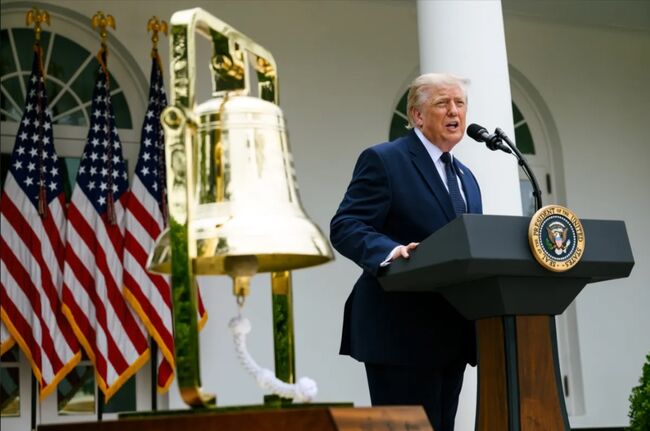 Trump pressures for rate cut again ahead of FOMC... "Should be the lowest in the world"
U.S. President Donald Trump. [Photo = The White House] U.S. President Donald Trump once again pressured the Federal Reserve, the U.S. central bank, to lower interest rates on the 27th (local time
Trump pressures for rate cut again ahead of FOMC... "Should be the lowest in the world"
U.S. President Donald Trump. [Photo = The White House] U.S. President Donald Trump once again pressured the Federal Reserve, the U.S. central bank, to lower interest rates on the 27th (local time
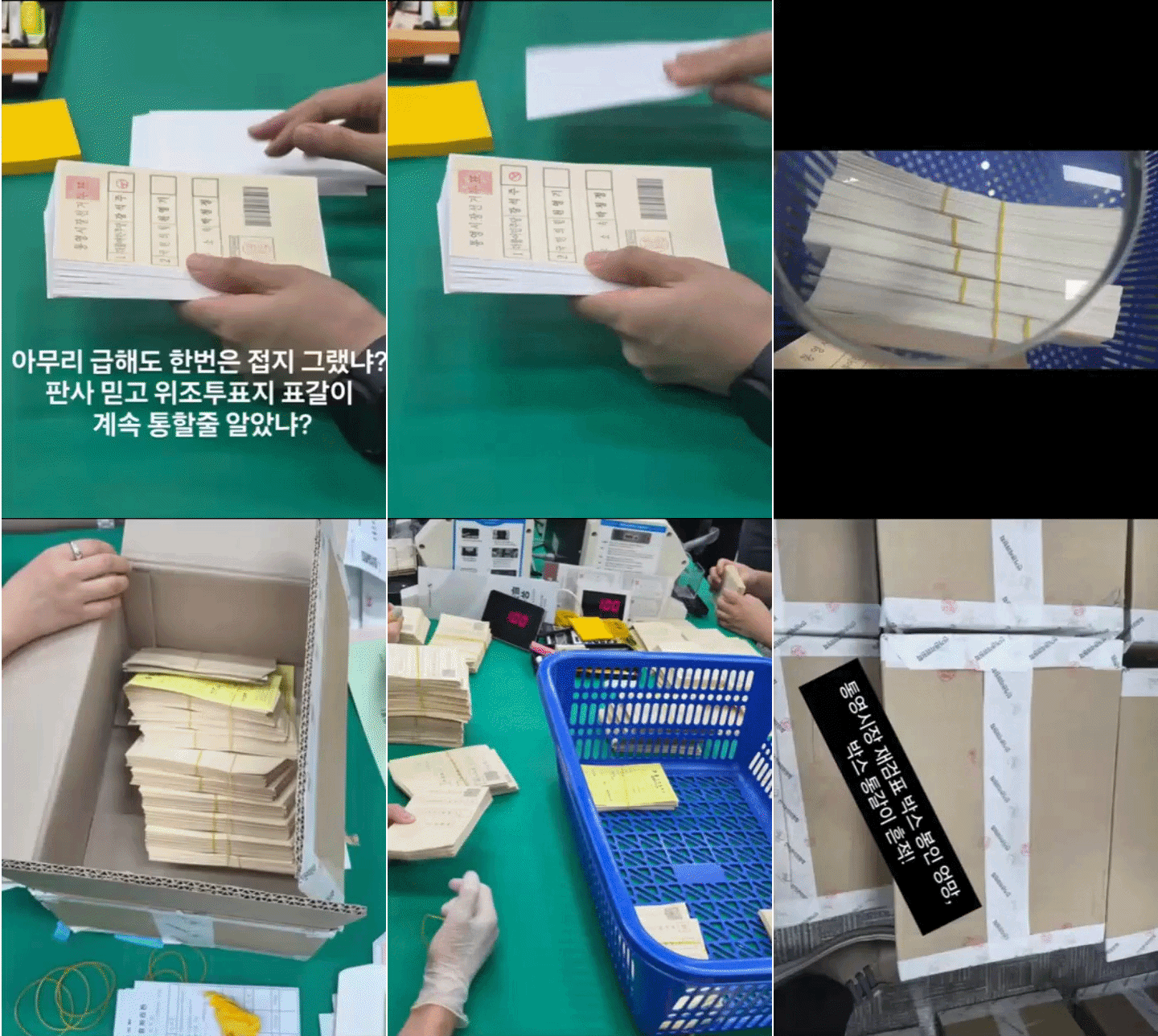 “Ignoring crisp ballots and damaged seals”… Tongyeong mayoral recount concludes with ‘no change in outcome,’ leaving suspicions and public outrage behind
Suspected counterfeit ballots discovered in Tongyeong [GIF from social media of Representative Hwang Kyo-ahn / Attorney Park Joo-hyun]During a recount of the Tongyeong mayoral election in South Gyeong
“Ignoring crisp ballots and damaged seals”… Tongyeong mayoral recount concludes with ‘no change in outcome,’ leaving suspicions and public outrage behind
Suspected counterfeit ballots discovered in Tongyeong [GIF from social media of Representative Hwang Kyo-ahn / Attorney Park Joo-hyun]During a recount of the Tongyeong mayoral election in South Gyeong
 President Yoon, regarding the first-instance ruling on the Public Official Election Act: “An excessive political verdict that distorts the facts… We will appeal immediately.”
The first-instance sentencing hearing for President Yoon Suk Yeol regarding violations of the Public Official Election Act is being broadcast live at Seoul Station on the 27th. [Photo=Yonhap News]Pres
President Yoon, regarding the first-instance ruling on the Public Official Election Act: “An excessive political verdict that distorts the facts… We will appeal immediately.”
The first-instance sentencing hearing for President Yoon Suk Yeol regarding violations of the Public Official Election Act is being broadcast live at Seoul Station on the 27th. [Photo=Yonhap News]Pres
 WSJ: "SK Hynix ADR Premium Is a Sign of AI Trading Overheat"
Advertisement for SK Hynix ADR listing in New York's Times Square [Reuters=Yonhap News file photo]The Wall Street Journal (WSJ) has pointed out that the price of SK Hynix’s American Depositary Recei
WSJ: "SK Hynix ADR Premium Is a Sign of AI Trading Overheat"
Advertisement for SK Hynix ADR listing in New York's Times Square [Reuters=Yonhap News file photo]The Wall Street Journal (WSJ) has pointed out that the price of SK Hynix’s American Depositary Recei
 'Godfather of Japanese Mystery Novels' Keigo Higashino Passes Away After Battle with Cancer at 68
Famous Japanese mystery novelist Keigo Higashino [AFP=Yonhap News]It has been belatedly reported that Keigo Higashino, the "godfather of Japanese mystery novels" and author of bestsellers such as "The
'Godfather of Japanese Mystery Novels' Keigo Higashino Passes Away After Battle with Cancer at 68
Famous Japanese mystery novelist Keigo Higashino [AFP=Yonhap News]It has been belatedly reported that Keigo Higashino, the "godfather of Japanese mystery novels" and author of bestsellers such as "The
 [Park Pil-kyu Security Column] To the Ignorant Trying to Clothe a Beast in Sheep's Clothing
Rep. Kim Byung-joo of the Democratic Party of Korea [Photo=Yonhap News]“The Air Force Academy doesn't teach you how to fly a plane!” “The Army, Navy, and Air Force academies are exactly the
[Park Pil-kyu Security Column] To the Ignorant Trying to Clothe a Beast in Sheep's Clothing
Rep. Kim Byung-joo of the Democratic Party of Korea [Photo=Yonhap News]“The Air Force Academy doesn't teach you how to fly a plane!” “The Army, Navy, and Air Force academies are exactly the
 [Issue Diagnosis] Two Effects of the Election Petition Review
 [Photo] Evidence of Election Fraud Flooding U.S. Media… Trump Had 2.7 Million Votes Stolen
 [Video] U.S. Semiquincentennial Air Show... 'Art in the Sky' streaks across New York
 [Editorial Cartoon] A Draconian Law That Undermines Freedom of Expression

 List
List