Amid North Korea's continuous missile provocations, Defense Minister An Kyu-baek announced plans to reduce front-line general outpost (GOP) troops from the current 22,000 to 6,000. [Photo=Ministry of National Defense]
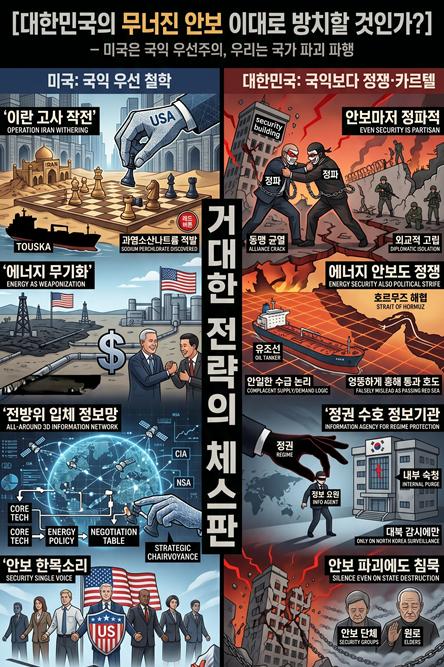
The United States' Iran containment operation and our own national security demolition acts are being compared on the grand chessboard of strategy.
While the U.S. is sustained and driven by a national interest-first approach, our nation's security is being destroyed by partisan politics and cartels, rather than national interest. If the U.S. is an architect of civilization, planting freedom in barren lands, we are dismantling a robust security structure.
Today, the decisive measure differentiating U.S. security-related decision-making from our current security destruction is "national interest." The philosophical difference in our understanding of "national interest" dictates national survival and stature.
When comparing the U.S. and South Korea through the prism of four aspects of national interest – security strategy, energy security, intelligence agency development, and national crisis response – our existential crisis becomes starkly clear.
1. The U.S. Manages a Security-Centric Nation; We Operate a Security Manipulation Administration
Trump's extension of the ceasefire with Iran hides a sophisticated strategy designed to dismantle the adversary's psychology. While Trump outwardly presents himself as a mediator, he simultaneously employs a containment strategy by cutting off the enemy's supply lines through a naval blockade.
Notably, the 'perchlorate sodium,' a missile propellant detected on the Chinese vessel 'TuscaHO' attempting to enter Iran near the Strait of Hormuz, has become a "red button" that could even dismantle China. This appears to be a sophisticated tactic designed for the enemy's self-destruction, by offering a lifeline to Iran's moderates to purge the hardliners. Everything is a sequence of security judgments.
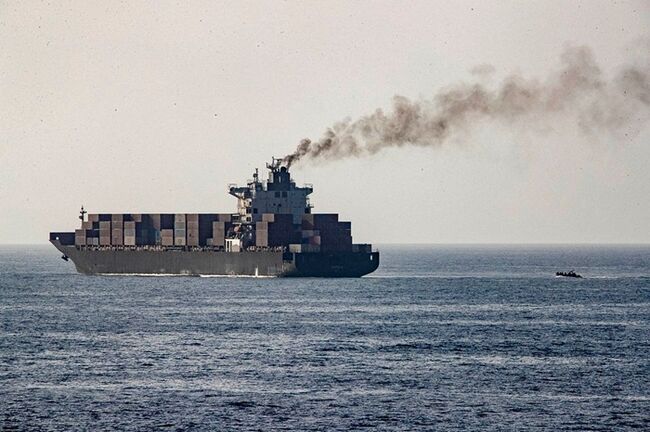 The cargo ship TuscaHO, intercepted by the U.S. military in the Gulf of Oman in the Arabian Sea on the 19th (local time). Missile propellant 'perchlorate sodium' was discovered here. [Reuters=Yonhap News]
In contrast, South Korea, amidst the volatile Middle Eastern situation, is not only failing to secure strategic leverage due to its conflict with Israel but is also causing rifts in alliances and diplomatic isolation by being swayed by partisan interests and emotional responses.
While the U.S. orchestrates attacks using the strategy of "using barbarians to control barbarians" (以夷制夷) to dismantle the enemy's cohesion, we are losing trust even from our allies, being led by forces that hold the reins of our energy supply chain, demonstrating not just negligence but active destruction of our security.
2. The U.S. 'Weaponizes' Energy; Korea 'Politicizes' Energy Security
The U.S. equates energy security with business-driven national interest. It leverages shale gas and overwhelming military power as tradable assets, demanding economic benefits from allies in exchange for security commitments and urging capitulation from adversaries by holding their survival hostage. A brief observation reveals a solid foundation where the U.S. converts military power into tangible national interest.
However, despite relying on maritime transport routes for over 95% of its energy, South Korea continues to address the crisis in the Strait of Hormuz with a complacent supply and demand logic. Even with 26 oil tankers detained for 55 days, it fails to find a solution, instead attempting to mislead by suggesting they passed through the Red Sea. This is a result of forgetting that energy is not a commodity to be bought on the market but a domain of national survival that protects sovereignty.
3. U.S. Intelligence Agencies Design National Interest; Our Intelligence Agencies Protect the Regime
Intelligence agencies are the eyes and ears of a nation and the last bastion for designing national interests in the unseen realms. However, there is a stark contrast in the purpose and operation of intelligence agencies in South Korea and the U.S.
The U.S. intelligence community, including the CIA and NSA, is dedicated to maximizing federal interests through a "comprehensive, three-dimensional intelligence network," operating under the absolute value of "American prosperity and survival," irrespective of the administration's political leaning.
Beyond simple military espionage, they convert elements such as the adversary's energy policies, key technology supply chains, and even the internal vulnerabilities of allied nations into "intelligence assets" to gain leverage at the negotiating table.
Collected data becomes a precision strike tool targeting the adversary's Achilles' heel. Through intelligence, they predict and even manipulate enemy divisions. They act as a "strategic foresight" that connects intelligence with business transactions, creating a structure that wins without fighting.
Despite having a skilled workforce, our intelligence agencies have become "political consumables" for safeguarding the regime's security. With major purges and personnel changes repeated during every transfer of power, they have focused on "regime security" rather than their fundamental mission of protecting national interests.
While the core personnel of the intelligence agencies may continue, decades of accumulated overseas intelligence networks and expertise have likely been destroyed and evaporated due to political logic, thus compromising the organization's perpetuity.
With intelligence capabilities heavily skewed towards North Korea surveillance, their ability to understand macro trends such as global energy crises or supply chain realignments is significantly diminished. The fact that we relied solely on foreign intelligence to ascertain the fate of our oil tankers during the Strait of Hormuz crisis indicates that the intelligence agencies have devolved from being the "brain of national strategy" to "short-sighted observers" preoccupied with appeasing political sentiment.
4. The U.S. Speaks with One Voice on Security; We Remain Silent Even as Security is Destroyed
Although the Democratic Party opposes President Trump's sophisticated security strategies and policies, the U.S. has demonstrated consistent execution led by experts within the overarching framework of "America First national interest." The overwhelming and multi-faceted military power displayed by the U.S. military in the Middle East conflict is a result of security-centric national management. In the process of rescuing a stranded weapons system officer in the Iranian mountains, Americans applauded the rescue itself, celebrating American pride, even with hundreds of billions invested, including $200 million in aircraft losses.
Conversely, South Korea, despite being in an armistice, is reportedly reducing forward border security forces by a quarter. Security is compromised by replacing key positions and officials with civilians and relying on batons for security. Even as the Ministry of National Defense and the Ministry of Unification are actively destroying national security identity and dismantling the national security system, numerous security organizations are unable to condemn the Minister of National Defense.
Despite concerns that incorporating constitutional amendments into the June 3rd local elections could lead to the collapse of the 78-year constitutional history and the negation of past conservative governments, even former high-ranking generals and security elders, who once held the power of life and death over their subordinates and enjoyed honor, remain silent.
Is their maintenance of pensions and appearances prioritized over sounding the alarm about national crisis? Have they abandoned their conscience for the sake of their dignity and comfort in old age? They are neglecting their lifelong duty of national defense for the pension they receive. We urge them to speak out against the constitutional amendment now.
To prevent national ruin, we must condemn and eradicate anti-national forces that are destroying our country. Externally, we must elevate the ROK-U.S. alliance to a comprehensive energy and technology alliance, institutionalizing priority energy supply rights in emergencies. Internally, we must restore military morale, prevent war through strong mental armament and realistic training, and gather wisdom and resolve to restore the military's original mission of annihilating the enemy if war breaks out. We expect and urge security organizations to unite and awaken to build and defend a holy war to protect our national defense and our people.

◆ Park Pil-kyu
Editorial Board Member, Hankook Ilbo
40th graduating class, Korea Military Academy
Standing Director, Korea Wireless Fire Protection Industry Cooperative

 Iranian Foreign Ministry: "Continuing Message Exchanges with the U.S. and Activities of Mediating Countries"
Esmaeil Baghaei, Spokesperson for the Iranian Ministry of Foreign Affairs [Xinhua, Yonhap News file photo]Esmaeil Baghaei, spokesperson for the Iranian Ministry of Foreign Affairs, stated on the 26th
Iranian Foreign Ministry: "Continuing Message Exchanges with the U.S. and Activities of Mediating Countries"
Esmaeil Baghaei, Spokesperson for the Iranian Ministry of Foreign Affairs [Xinhua, Yonhap News file photo]Esmaeil Baghaei, spokesperson for the Iranian Ministry of Foreign Affairs, stated on the 26th
 President Yoon: "Do You Think You Are Safe from the Special Counsel?"... Final Statement Video Released
President Yoon Suk Yeol rebuking the special prosecutor on the 24th. [Court video / @birds_justice X account subtitle GIF] A video of President Yoon Suk Yeol's closing statement at his trial rega
President Yoon: "Do You Think You Are Safe from the Special Counsel?"... Final Statement Video Released
President Yoon Suk Yeol rebuking the special prosecutor on the 24th. [Court video / @birds_justice X account subtitle GIF] A video of President Yoon Suk Yeol's closing statement at his trial rega
 President Yoon, regarding the first-instance ruling on the Public Official Election Act: “An excessive political verdict that distorts the facts… We will appeal immediately.”
The first-instance sentencing hearing for President Yoon Suk Yeol regarding violations of the Public Official Election Act is being broadcast live at Seoul Station on the 27th. [Photo=Yonhap News]Pres
President Yoon, regarding the first-instance ruling on the Public Official Election Act: “An excessive political verdict that distorts the facts… We will appeal immediately.”
The first-instance sentencing hearing for President Yoon Suk Yeol regarding violations of the Public Official Election Act is being broadcast live at Seoul Station on the 27th. [Photo=Yonhap News]Pres
 WSJ: "SK Hynix ADR Premium Is a Sign of AI Trading Overheat"
Advertisement for SK Hynix ADR listing in New York's Times Square [Reuters=Yonhap News file photo]The Wall Street Journal (WSJ) has pointed out that the price of SK Hynix’s American Depositary Recei
WSJ: "SK Hynix ADR Premium Is a Sign of AI Trading Overheat"
Advertisement for SK Hynix ADR listing in New York's Times Square [Reuters=Yonhap News file photo]The Wall Street Journal (WSJ) has pointed out that the price of SK Hynix’s American Depositary Recei
 'Godfather of Japanese Mystery Novels' Keigo Higashino Passes Away After Battle with Cancer at 68
Famous Japanese mystery novelist Keigo Higashino [AFP=Yonhap News]It has been belatedly reported that Keigo Higashino, the "godfather of Japanese mystery novels" and author of bestsellers such as "The
'Godfather of Japanese Mystery Novels' Keigo Higashino Passes Away After Battle with Cancer at 68
Famous Japanese mystery novelist Keigo Higashino [AFP=Yonhap News]It has been belatedly reported that Keigo Higashino, the "godfather of Japanese mystery novels" and author of bestsellers such as "The
 [Park Pil-kyu Security Column] To the Ignorant Trying to Clothe a Beast in Sheep's Clothing
Rep. Kim Byung-joo of the Democratic Party of Korea [Photo=Yonhap News]“The Air Force Academy doesn't teach you how to fly a plane!” “The Army, Navy, and Air Force academies are exactly the
[Park Pil-kyu Security Column] To the Ignorant Trying to Clothe a Beast in Sheep's Clothing
Rep. Kim Byung-joo of the Democratic Party of Korea [Photo=Yonhap News]“The Air Force Academy doesn't teach you how to fly a plane!” “The Army, Navy, and Air Force academies are exactly the
 [Issue Diagnosis] Two Effects of the Election Petition Review
 [Photo] Evidence of Election Fraud Flooding U.S. Media… Trump Had 2.7 Million Votes Stolen
 [Video] U.S. Semiquincentennial Air Show... 'Art in the Sky' streaks across New York
 [Editorial Cartoon] A Draconian Law That Undermines Freedom of Expression

 List
List